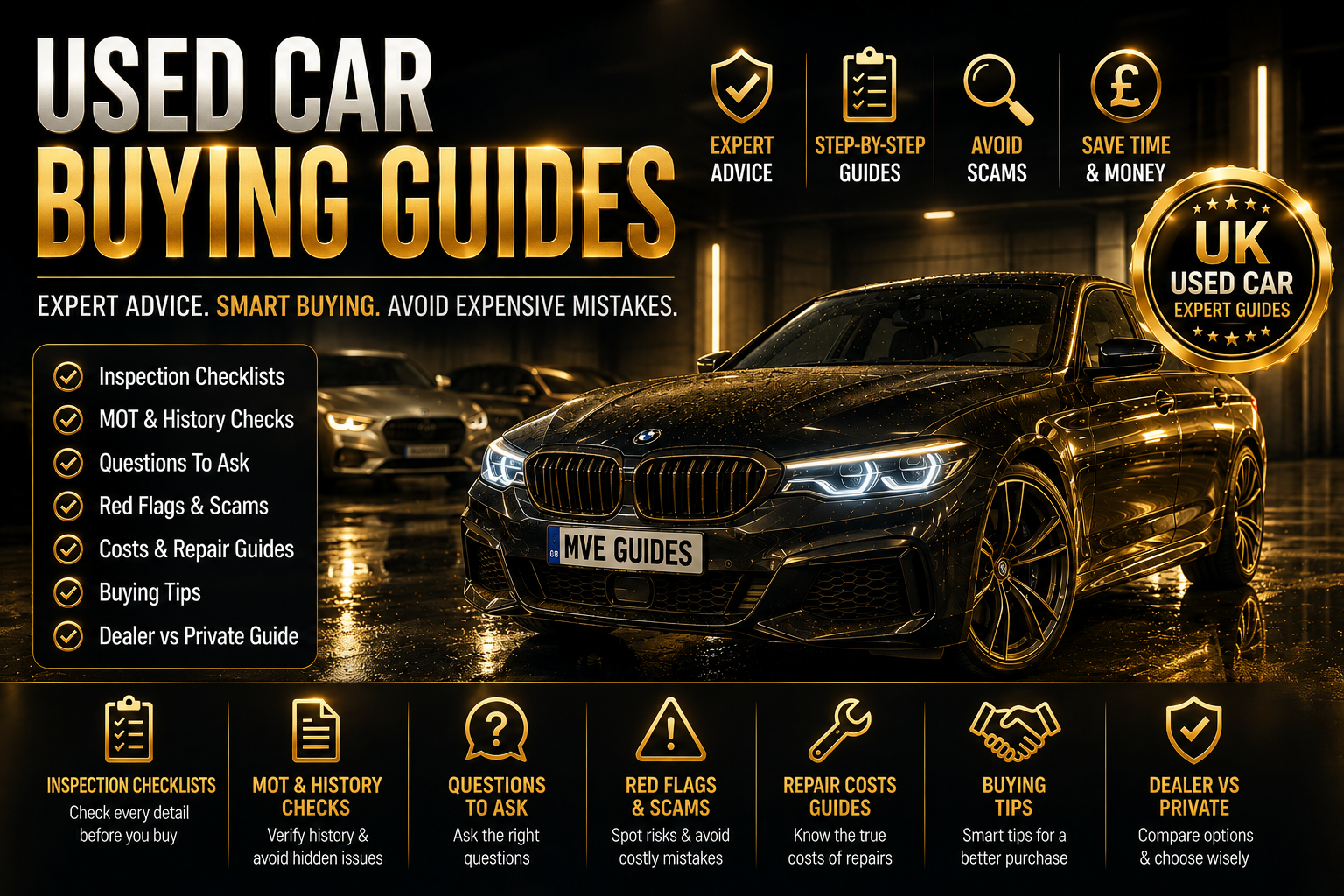
What Should You Check Before Buying A Used Car?
Before buying a used car in the UK, check the MOT history, service history, V5C document, VIN number, mileage records, dashboard warning lights, tyre condition, brakes, suspension, accident damage, fluid leaks and how the vehicle behaves during a proper test drive.
A good used car should make sense across the advert, seller answers, paperwork, MOT history, service history, mileage, cold start, test drive and final asking price. If one part of the story does not match, slow down before paying a deposit.
A fresh MOT is useful, but it is not a full mechanical inspection. It does not prove the clutch, timing chain, turbocharger, battery, gearbox, service history or accident repair quality is good.
Used Car Buying Risk Dashboard
This dashboard is built as mobile-friendly cards, not a wide table. Use each box to judge whether the vehicle is low risk, worth negotiating on or too risky to buy.
MOT History
Low risk
Clean record with sensible mileage.
Medium risk
Occasional advisories or one repaired failure.
High risk
Repeated failures, corrosion, brake or suspension defects.
Service History
Low risk
Full history with invoices.
Medium risk
Partial records with explainable gaps.
High risk
No proof of servicing or vague seller answers.
Mileage Pattern
Low risk
Consistent year-on-year increase.
Medium risk
Small gaps that can be explained.
High risk
Suspicious drops, missing years or heavy interior wear.
Warning Lights
Low risk
No warning lights after start-up.
Medium risk
Historic warning with invoice proof.
High risk
Engine, oil, airbag, ABS, brake or temperature warning active.
Seller Behaviour
Low risk
Transparent and allows checks.
Medium risk
Limited knowledge but cooperative.
High risk
Rushes you, avoids paperwork or refuses inspection.
Test Drive
Low risk
Smooth, quiet and stable.
Medium risk
Minor age-related concerns.
High risk
Smoke, overheating, slipping clutch, knocking or power loss.
One medium-risk area can be manageable. Three or more medium-risk areas should trigger a deeper inspection. Any high-risk issue should be investigated properly before you agree a price.
Typical Used Car Repair Costs UK
The purchase price is not the full cost of buying a used car. These repair-cost boxes are designed for mobile users and help you judge whether the asking price still makes sense once likely first-year repairs are considered.
Battery Replacement
£80–£250
Low buying risk
Common age-related cost, but repeated flat battery issues may indicate alternator or parasitic drain problems.
Tyres
£70–£180 each
Medium buying risk
Several worn tyres can quickly change the real price of the car.
Brake Pads
£100–£300
Medium buying risk
Normal wear item, but grinding, vibration or warning lights need proper checks.
Brake Discs & Pads
£250–£600+
Medium buying risk
Use brake wear and MOT advisories as negotiation evidence.
Suspension Repairs
£150–£1,000+
Medium buying risk
Knocking, uneven tyre wear or repeated MOT advisories need pricing carefully.
Clutch Replacement
£500–£1,500+
High buying risk
A slipping clutch, high biting point or burning smell can be expensive.
Timing Belt Replacement
£300–£800
High buying risk
Missing timing belt history should affect the price.
Timing Chain Repair
£700–£2,500+
High buying risk
Startup rattle, poor oil service history or cam/crank fault codes can be serious.
Turbocharger Repair
£700–£2,000+
High buying risk
Smoke, low power, whistling or boost fault codes need caution.
DPF Repair Or Replacement
£250–£2,000+
High buying risk
Short-trip diesel history, warning lights or regeneration issues should be checked carefully.
Head Gasket Repair
£800–£2,500+
Critical buying risk
Coolant loss, white smoke, overheating or pressure in the coolant system can make the car too risky.
Automatic Gearbox Repair
£1,000–£4,000+
Critical buying risk
Harsh shifts, slipping, warning messages or delayed engagement need specialist checking.
If a vehicle already shows symptoms linked to a high-cost repair, assume the repair may eventually be required and adjust your offer accordingly. Do not accept “it only needs resetting” without evidence.
Common Reasons Buyers Regret A Used Car Purchase
Ignored MOT Advisories
Repeated advisories for tyres, brakes, suspension, corrosion or leaks often reveal future repair bills before they become MOT failures.
Poor Service History
Missing oil changes and weak maintenance records can increase the risk of timing chain, turbocharger, DPF, cooling system and engine wear problems.
Rushed Buying Decisions
Pressure selling, evening viewings and “another buyer is coming” tactics can stop buyers from checking the car properly.
Start here before buying a used car
A good used car should make sense in every area: the advert, the seller’s answers, the MOT history, the service history, the mileage, the paperwork, the cold start, the test drive and the final price. If one part of the story does not add up, slow down before paying a deposit.
Many poor used car purchases happen because the buyer focuses on the wrong things. Clean paint, low mileage, a fresh valet and a recent MOT can make a car look safe, but they do not always show whether the car has been maintained properly.
Use this hub as your starting point. Begin with the inspection checklist, then check MOT history, service records, mileage, accident repair signs, warning lights and test-drive behaviour. If you are buying your first car, also check insurance, running costs and likely repair costs before deciding.
You can also browse our complete Guides section for more UK car advice covering maintenance, MOT tests, diagnostics, warning lights and repair costs.
Do not inspect a used car looking for reasons to buy it. Inspect it looking for reasons not to buy it. A genuinely good car should still look good after proper checks.
How to judge if a used car is risky
A professional used car check is not about one perfect score or one table. It is about whether the whole story makes sense. The advert, seller answers, MOT history, service records, mileage, paperwork, cold start and test drive should all point in the same direction.
A car does not need to be perfect to be worth buying. Older cars often have wear, advisories or cosmetic marks. The question is whether those issues are honest, understood and reflected in the price.
Low risk
Clear MOT history, believable service records, matching paperwork, smooth test drive, no warning lights, sensible tyre wear and a seller who answers questions properly.
Medium risk
Some MOT advisories, partial service history, light cosmetic repairs, tyres or brakes due soon, or small faults that can be checked and priced before buying.
High risk
Repeated MOT failures, structural corrosion, missing paperwork, warning lights, smoke, overheating, suspicious mileage or a seller who avoids inspection.
Do not buy because one thing looks good. Buy only when the car makes sense across history, condition, paperwork, test drive and price.
Should you buy, negotiate or walk away?
A used car buying decision should be based on evidence, not excitement. Use the checks below to decide whether the car is worth buying, worth negotiating on or worth walking away from.
Buy
The MOT history is sensible, service records are believable, paperwork matches, the test drive is smooth and the price reflects the condition.
Negotiate
The car is fundamentally sound but needs tyres, brakes, servicing, battery work or minor repairs that should fairly affect the price.
Walk away
Paperwork is missing, VIN does not match, the seller avoids checks, warning lights stay on, smoke appears or serious faults are being hidden.
If two or more major areas raise concerns, slow down and investigate properly before committing to the purchase.
Used car buying checklist summary
Essential before viewing
- ✓Check the MOT history before arranging a viewing.
- ✓Check the mileage pattern and look for gaps.
- ✓Ask about service history, invoices and timing belt or chain work.
- ✓Ask if the engine will be cold when you arrive.
- ✓Check insurance cost before travelling.
Essential when viewing
- ✓Check V5C, VIN, registration and seller details.
- ✓Look for warning lights before and after starting.
- ✓Check tyres, leaks, bodywork and accident repair signs.
- ✓Cold start the engine and listen carefully.
- ✓Take a proper test drive on different roads.
Walk away if the seller avoids paperwork, refuses inspection, rushes you, hides faults, blocks a proper test drive, or says warning lights “only need resetting” without proof.
10 used car red flags that should make you walk away
Some problems are not worth negotiating over. If the seller cannot explain the issue clearly or the car shows several red flags together, it is usually safer to walk away.
- !VIN or registration details do not match: this is a serious paperwork warning.
- !Seller refuses proper inspection: a genuine seller should allow reasonable checks.
- !Multiple warning lights stay on: this may indicate expensive diagnostic faults.
- !Heavy smoke from cold start: smoke can point to engine, turbo, injector or coolant issues.
- !Coolant level keeps dropping: possible leak, overheating or head gasket risk.
- !Evidence of clocked mileage: worn interior, odd MOT mileage or missing history.
- !Repeated corrosion advisories: rust can become expensive very quickly.
- !Fresh paint hiding poor repairs: check panel gaps, overspray and colour mismatch.
- !No service records at all: price must reflect the higher risk.
- !Pressure selling: rushing, deposit pressure or “another buyer is coming” tactics are warning signs.
For scam-specific checks, read common used car scams and how to check if a car is stolen or written off.
Which checks matter most?
MOT history
Shows mileage records, repeated advisories, failures, rust, tyres, brakes and suspension clues.
Check MOT history guide →Service history
Shows whether the car has been maintained, ignored, serviced late or missing important work.
No service history guide →Test drive
Reveals clutch, gearbox, steering, brakes, overheating, power loss, smoke and warning light issues.
Test drive checklist →