
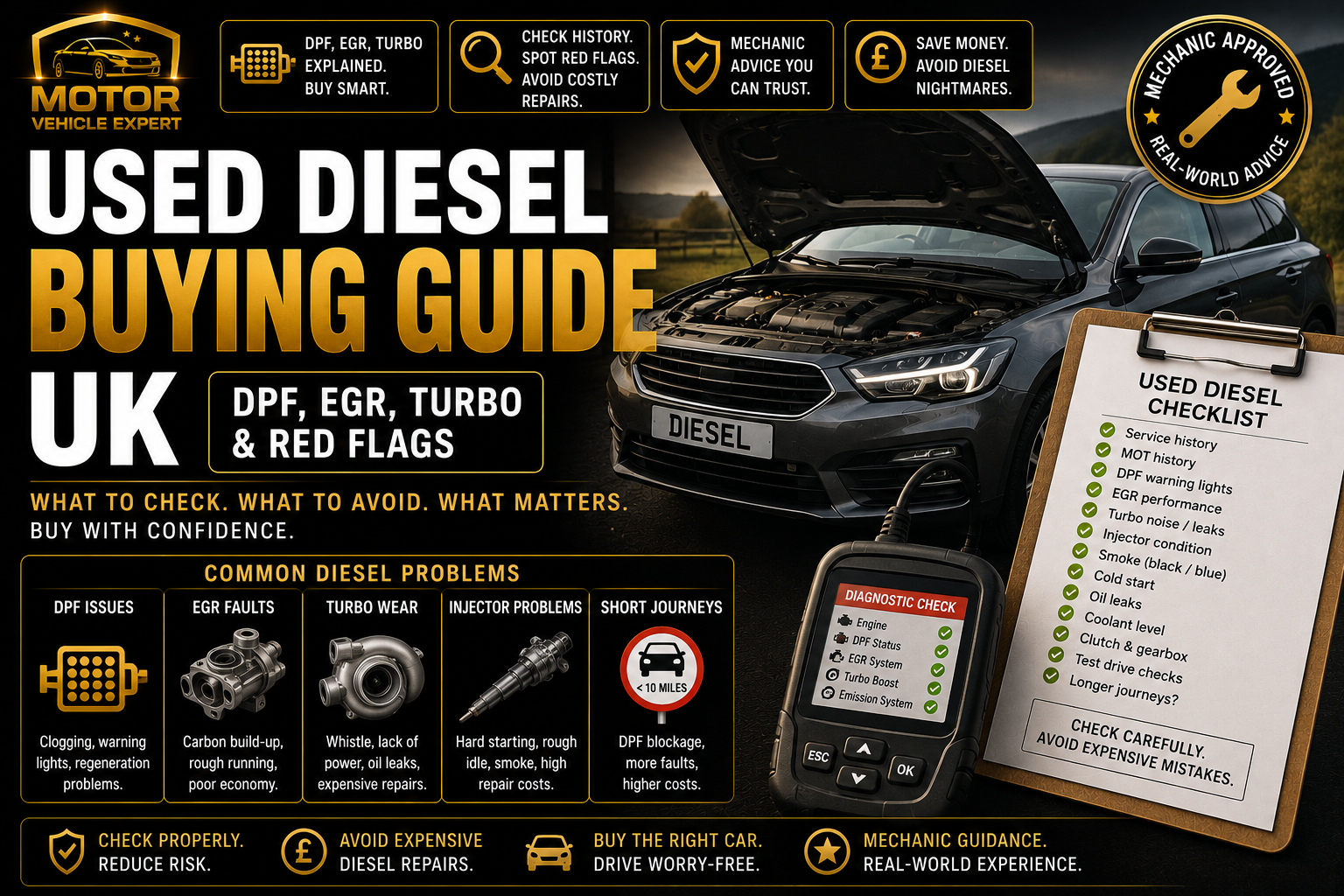
Quick answer
A used diesel is usually best for drivers doing regular longer journeys. Before buying, check DPF history, EGR symptoms, turbo noise, injector behaviour, smoke, cold starting, service history, MOT advisories, clutch condition and whether the car has been used mainly for short trips.
The biggest diesel buying red flags are DPF warning lights, limp mode, heavy smoke, poor service history, repeated emissions issues, turbo whine, injector knock, rough idle, coolant loss and a seller who says “it just needs a good run” without diagnosis.
What used diesel problems look like in real life
DPF light keeps returning
A blocked or struggling DPF can come back even after being cleared.
DPF warning guide →Car feels flat under load
Weak boost, EGR faults, DPF restriction or fuel issues can make a diesel feel slow.
Loses power uphill →Smoke when accelerating
Black, blue or white smoke can point to different diesel faults.
Smoke colour guide →Fan runs after switch-off
Can happen during DPF regeneration, but frequent behaviour needs checking.
Fan running after engine off →Rough idle from cold
Could be glow plugs, injectors, EGR trouble, air leaks or poor maintenance.
Rough idle when cold →High mileage but clean history
A well-serviced high-mileage diesel can be better than a low-mileage short-trip diesel.
High mileage diesel guide →Who a used diesel suits
Better suited to longer journeys
Diesels are often happier with regular motorway, A-road and longer-distance driving where the engine fully warms up.
Less suited to short town trips
Repeated short journeys can stop the DPF from regenerating properly and can encourage carbon build-up.
Good for high annual mileage
If you cover lots of miles, a well-maintained diesel may still make sense.
Risky if history is weak
Modern diesel repairs can be expensive, so poor history should make you cautious.
DPF checks before buying a used diesel
The DPF traps soot from the exhaust and needs the right conditions to regenerate. If the car has mainly done short trips, the DPF may be partly blocked or close to causing problems.
- !Check for a DPF warning light or engine management light.
- !Ask if the DPF has ever been cleaned, replaced or removed.
- !Watch for limp mode, reduced power or poor acceleration.
- !Check MOT history for emissions-related failures or advisories.
- !Ask what type of driving the previous owner mostly did.
- !Be cautious if the seller says the light only needs clearing.
A DPF issue is not always cheap. Read DPF warning light explained before buying a diesel with warning lights.
EGR valve and carbon build-up checks
The EGR system can become clogged with carbon, especially on diesels used for lots of short trips. EGR faults can cause rough idle, hesitation, smoke, poor economy and engine warning lights.
Rough idle
A diesel that shakes or hunts at idle may have EGR, injector or air intake problems.
Hesitation
Flat spots or hesitation when accelerating can be caused by EGR or boost issues.
Hesitation guide →Black smoke
Excess soot can point to fuel, boost, EGR or DPF-related faults.
Warning lights
Do not ignore engine management lights on a diesel, even if the car drives normally.
Engine management light →Turbo checks on a used diesel
Most modern diesels rely heavily on the turbo. A tired turbo can make the car slow, smoky, noisy or expensive to repair.
- !Listen for loud whining, siren noise or grinding under acceleration.
- !Watch for blue smoke, especially after idling or accelerating.
- !Check for oil leaks around boost pipes and intercooler areas.
- !Make sure power delivery is smooth, not flat or surging.
- !Check service history for regular oil changes.
- !Be cautious if the car loses power uphill or under load.
Useful related guides: whining noise when accelerating and car losing power when accelerating.
Injector and fuel system checks
Diesel injector problems can cause rough running, knocking sounds, smoke, poor starting and poor fuel economy. Repairs can become expensive, especially on modern common-rail systems.
Hard starting
Long cranking or poor cold starts can point to glow plug, injector or fuel pressure issues.
Cranks but won’t start →Diesel knock
A harsh knocking sound can be injector-related, but diagnosis is needed.
Rough idle
Uneven idle can be injector, EGR, air leak or engine mount related.
Vibrates at idle →Excess smoke
Smoke under acceleration can point to fuel, boost, injector or DPF faults.
Fuel smell
Diesel smell can suggest leaks around injectors, pipes or fuel system parts.
Fuel smell guide →Poor economy
Bad economy may point to DPF regeneration, injector issues or sensor faults.
Diesel smoke checks
Some smoke on an older diesel under hard acceleration may not always mean disaster, but heavy, constant or coloured smoke is a warning sign.
Black smoke
Often linked to excess fuel, boost leaks, EGR issues, DPF trouble or poor combustion.
Blue smoke
Can suggest oil burning, turbo seal wear or engine wear.
White smoke
Can be unburnt fuel, coolant, cold-start issues or more serious engine trouble.
White smoke coolant guide →For a full breakdown, read exhaust smoke colour guide.
Clutch and dual-mass flywheel checks
Many diesels have strong torque, which can put extra strain on the clutch and dual-mass flywheel. These repairs can be expensive, so do not ignore clutch feel during the test drive.
- !High clutch bite point or slipping under acceleration.
- !Judder when pulling away.
- !Rattling noise at idle that changes when the clutch pedal is pressed.
- !Difficulty selecting gears.
- !Vibration through the pedal or drivetrain.
For budgeting, read clutch replacement cost UK.
Service history and MOT checks
Diesel history matters. Regular oil changes are important for turbo health, timing chain wear and general engine life. MOT history can also reveal emissions problems, smoke, advisories and mileage patterns.
- ✓Check oil service intervals and invoices.
- ✓Check cambelt or timing chain evidence if relevant.
- ✓Look for DPF, EGR, turbo or injector repairs.
- ✓Check MOT history for emissions failures or smoke notes.
- ✓Compare mileage against service records and interior wear.
- ✓Ask whether the car mainly did motorway or town driving.
Useful guides: how to check service history, how to check MOT history and signs of clocked mileage.
Used diesel test drive checklist
- 1Start the engine from cold if possible.
- 2Listen for rattles, injector knock, belt noise or turbo whine.
- 3Check idle quality once cold and once warm.
- 4Accelerate under load and check for flat spots, smoke or limp mode.
- 5Make sure the temperature gauge rises normally and stays stable.
- 6Check clutch bite, gear changes and any vibration.
- 7Look for warning lights during and after the drive.
- 8After the drive, smell for hot oil, fuel, coolant or burning smells.
Use the full used car test drive checklist alongside these diesel checks.
Used diesel red flags
- !DPF warning light or engine management light stays on.
- !Seller says “it just needs a long run” without diagnosis.
- !Heavy black, blue or white smoke.
- !Turbo whine, siren noise or poor acceleration.
- !Injector knock, rough idle or hard starting.
- !Poor service history or long oil change gaps.
- !Repeated MOT emissions issues.
- !Coolant loss, overheating or pressure problems.
- !Suspiciously low mileage with heavy wear.
- !Clutch slip, flywheel rattle or gearbox concerns.
Best mechanic-style advice
Do not buy a diesel only because it is cheap to tax or good on fuel. A modern diesel with DPF, EGR, turbo or injector trouble can wipe out the saving quickly.
A good used diesel should have strong service history, clean MOT mileage, stable temperature, smooth power, no serious smoke and no warning lights. If the seller cannot explain DPF or service history clearly, slow down and check properly.
Related used car and diesel guides
Frequently asked questions
Is a used diesel worth buying?
Yes, if you do regular longer journeys and the car has good service history. It is riskier if you mainly do short town trips.
Are short journeys bad for diesel cars?
They can be. Short trips may stop the DPF from regenerating properly and can contribute to EGR carbon build-up.
What should I check before buying a used diesel?
Check DPF lights, EGR symptoms, turbo noise, injector behaviour, smoke, service history, MOT history, clutch condition and test drive behaviour.
Is high mileage bad on a diesel?
Not always. A well-maintained high-mileage diesel used for long journeys can be better than a low-mileage diesel used only for short trips.
What smoke is bad on a diesel?
Heavy black, blue or white smoke should be taken seriously. It can point to fuel, turbo, oil burning, DPF, EGR or coolant-related problems.
Should I buy a diesel with a DPF warning light?
Usually no, unless it has been properly diagnosed and priced accordingly. A DPF warning can become expensive.
What does limp mode mean on a diesel?
Limp mode means the car has limited power to protect itself. Causes can include DPF, turbo, EGR, sensor or fuel system faults.
When should I walk away from a used diesel?
Walk away if there are warning lights, heavy smoke, limp mode, poor history, coolant loss, overheating, turbo noise or vague seller answers.