
Quick answer
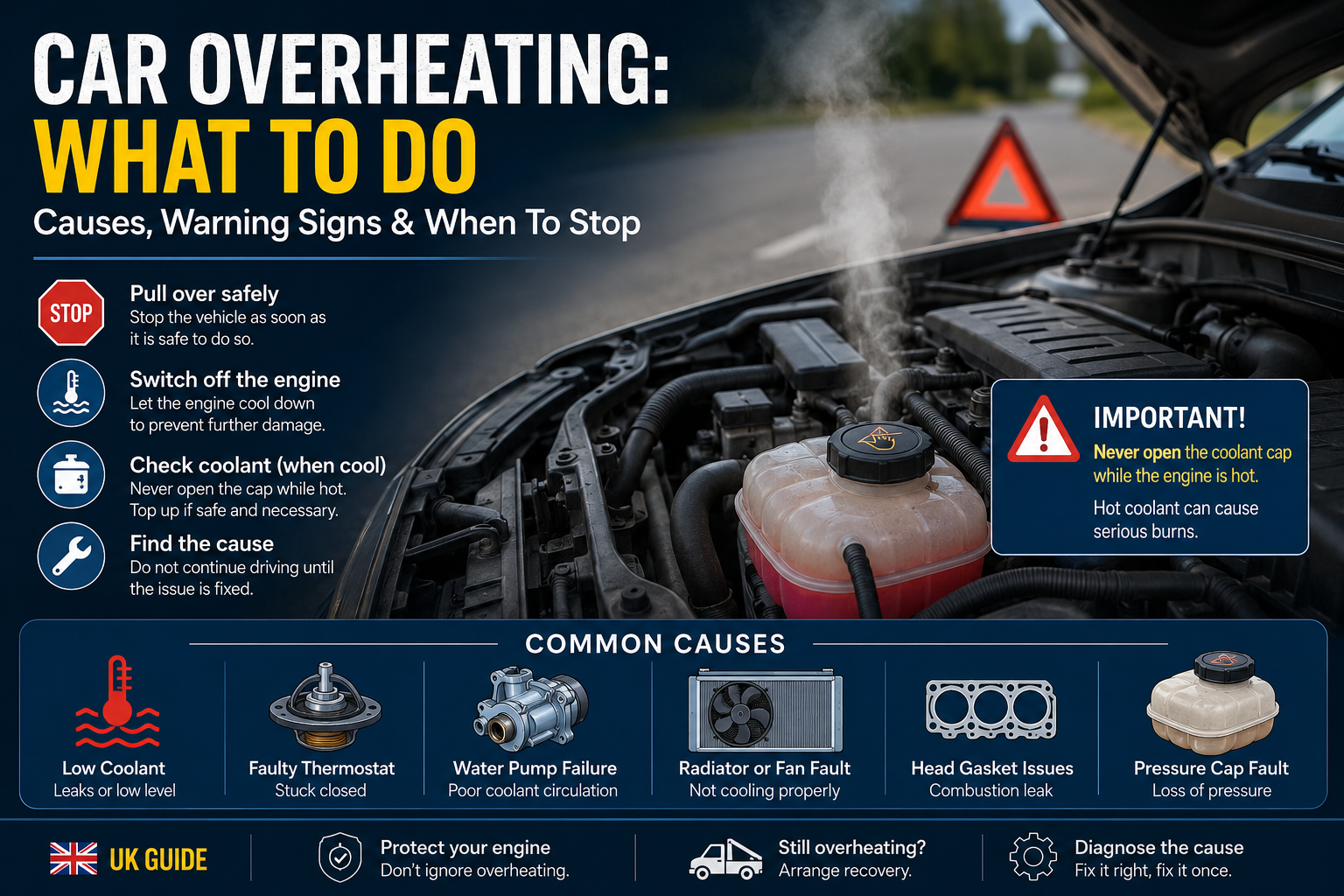
If the temperature gauge rises high, steam appears, or an overheating warning light comes on, pull over safely and switch the engine off. Let the engine cool before checking coolant. Do not open the coolant cap while the engine is hot.
Do not continue driving if the temperature stays high, coolant is leaking, steam appears, the heater blows cold while the engine is hot, or the warning returns after topping up. A cooling fault can damage the engine very quickly.
- !Stop safely if the gauge rises high, steam appears or the warning light comes on.
- !Never open the coolant cap hot. Wait until the engine has cooled properly.
- ✓Find the cause before driving normally again.
Explore overheating causes, coolant leaks, radiator fan faults, thermostats, water pumps, white smoke, coolant warning lights and repair costs in our Cooling System Guides UK.
Emergency overheating checklist
If your car starts overheating, work through these steps before trying to diagnose the fault.
- ✓Pull over safely away from traffic.
- ✓Switch the engine off.
- ✓Let the engine cool properly.
- !Do not open the coolant cap while hot.
- ✓Check the coolant level only when cold.
- ✓Look for obvious leaks, steam, wet hoses or coolant smell.
- !Arrange recovery if overheating returns, coolant is empty or steam appears.
Quick overheating symptom path
Overheats in traffic
Usually points towards radiator fan, airflow, coolant level or radiator restriction.
Traffic overheating guide →Overheats while driving
Often points towards coolant flow, radiator blockage, thermostat, water pump or pressure issues.
Overheating while driving →Coolant keeps dropping
Look for leaks, pressure loss, water pump seepage, radiator damage or internal coolant loss.
Coolant loss guide →Steam or heavy leak
Stop driving. Let the engine cool and arrange recovery or garage inspection.
Coolant leak cost →The first time I had to deal with an overheating car
One of the most stressful cooling-system situations I experienced was seeing the temperature gauge climb while still needing to find somewhere safe to stop.
At first, it was tempting to keep driving and hope the temperature would settle, but the gauge kept rising and the engine bay started to smell hot.
That experience taught me that the first job is not to diagnose the fault at the roadside. The first job is to stop heat damage before a manageable cooling problem becomes major engine damage.
Only after the engine had cooled did it make sense to check coolant level, look for leaks and think about possible causes such as a fan fault, thermostat issue, water pump problem or radiator restriction.
If the temperature gauge keeps rising, steam appears or coolant is leaking badly, recovery is safer than trying to drive home.
Can you drive after the engine cools down?
Only move the car if the temperature returns to normal, coolant level is safe and there is no steam, heavy leak or warning light. Even then, drive only as far as needed to reach safety or a garage.
| Situation | Best action |
|---|---|
| Temperature briefly rose but returned to normal | Drive carefully and monitor closely |
| Coolant slightly low but no leak visible | Top up only when cold and arrange diagnosis |
| Temperature keeps rising | Stop driving |
| Steam from bonnet | Recovery recommended |
| Coolant leaking badly | Do not drive |
| Overheating returns after topping up | Garage diagnosis required |
What to do if your car overheats
1. Pull over safely
Move away from traffic where possible. Do not sit in traffic while the gauge keeps climbing.
2. Switch the engine off
Stopping the engine helps prevent more heat build-up and reduces the chance of serious damage.
3. Let it cool properly
Wait before checking anything. A hot cooling system can be pressurised and dangerous.
4. Do not open the coolant cap hot
Hot coolant can spray out and cause burns. Only check the expansion tank when the engine is cool.
5. Check coolant level cold
Compare the level with the minimum and maximum marks. If it is empty or very low, do not keep driving normally.
6. Look for obvious leaks
Check for puddles, wet hoses, steam, staining, dried coolant residue or a sweet coolant smell.
7. Restart only if safe
If the coolant level is correct and the temperature returns to normal, move carefully only if necessary.
8. Arrange diagnosis
If overheating returns, recovery is safer than risking engine damage.
What not to do
- !Do not keep driving with the temperature gauge in the red.
- !Do not open the coolant cap while the engine is hot.
- !Do not pour cold water onto a very hot engine block.
- !Do not assume topping up coolant fixes the cause.
- !Do not ignore overheating that happens again after a short journey.
- !Do not drive far if the heater blows cold while the engine is hot.
- !Do not put your hands near the fan area while the engine bay is hot.
- !Do not fit random parts before the fault is properly checked.
Common causes of car overheating
Overheating can be caused by low coolant, leaks, poor airflow, poor coolant circulation, pressure faults or internal engine problems. The pattern of overheating often gives the best clue.
Low coolant level
Low coolant cannot carry heat away properly and is one of the first things to check.
Coolant warning guide →Coolant leak
Leaks can come from hoses, radiator, expansion tank, thermostat housing or water pump.
Coolant leak cost →Radiator problem
A leaking, blocked or damaged radiator may not remove enough heat from the coolant.
Radiator symptoms →Thermostat fault
A stuck thermostat can stop coolant flowing through the radiator at the right time.
Thermostat guide →Water pump issue
If the pump cannot move coolant properly, engine temperature can rise quickly.
Water pump symptoms →Cooling fan failure
Often most noticeable in traffic, at idle, after stopping or with air conditioning on.
Radiator fan guide →Airlock in the system
Trapped air can stop proper coolant circulation, especially after leaks or repairs.
Bubbling coolant guide →Head gasket issue
Internal coolant loss, pressure problems or white smoke can point to serious faults.
Head gasket symptoms →Signs your car is overheating
- !Temperature gauge rising higher than normal.
- !Dashboard coolant warning light or overheating message.
- !Steam from the bonnet area.
- !Sweet coolant smell after driving.
- !Loss of power, rough running or engine knocking.
- !Heater stops blowing warm air while the engine is hot.
- !Coolant puddle, wet hoses or dried coolant residue.
- !Fan running constantly or not running at all.
- !Coolant bubbling or being pushed out of the expansion tank.
A sweet smell can be an early clue of coolant escaping. Read car smells like coolant.
Car overheats in traffic
If the car overheats mainly in traffic, at idle or in slow queues, cooling fan faults are a common suspect. The radiator needs airflow. When the car is not moving, the fan has to pull air through the radiator.
Typical clue
Temperature rises in traffic but drops once the car starts moving again.
Common checks
Fan operation, relay, fuse, fan control, radiator blockage, coolant level and airlocks.
Read more: car overheats in traffic, engine overheating when idle and radiator fan not working.
Car overheats while driving or at motorway speed
If overheating happens at higher speeds, uphill or under load, do not blame the fan first. At road speed, air is already passing through the radiator.
Typical clue
Temperature rises during sustained load, motorway driving, towing or long climbs.
Common checks
Coolant flow, leaks, radiator condition, thermostat, water pump and pressure issues.
This pattern often points towards coolant loss, poor coolant flow, thermostat restriction, blocked radiator, water pump weakness or pressure trouble. Read more: engine overheating while driving.
Coolant checks after overheating
Check level cold only
Use the minimum and maximum marks on the expansion tank when the engine has cooled.
Look for stains
Dried pink, blue, orange, green or white crust around joints can show where coolant has escaped.
Smell for coolant
A sweet smell after stopping can mean coolant is leaking onto hot parts.
Watch if level drops again
Repeated top-ups mean the coolant is going somewhere and the fault still exists.
Useful next reads: coolant warning light on, car losing coolant but no leak and coolant leak repair cost UK.
When overheating may point to head gasket trouble
Not every overheating car has a head gasket fault. Many are simple leaks, fans, thermostats or water pumps. But repeated overheating should be taken seriously because overheating can cause head gasket damage, and a failing head gasket can also cause overheating.
- !Coolant keeps disappearing with no obvious external leak.
- !White smoke or sweet-smelling steam from the exhaust.
- !Coolant bubbles constantly in the expansion tank.
- !Cooling system becomes over-pressurised quickly from cold.
- !Engine overheats again soon after topping up coolant.
- !Oil looks milky or coolant looks oily.
Useful guides: blown head gasket symptoms, white smoke from exhaust and coolant bubbling in expansion tank.
How a garage usually diagnoses overheating
Cooling system pressure test
Helps find leaks that only appear when the system is under pressure.
Thermostat and flow checks
Checks whether coolant reaches the radiator at the correct time.
Radiator temperature check
Cold spots can suggest internal blockage or poor flow through the radiator.
Fan operation test
Confirms whether the radiator fan, relay, fuse, wiring or sensor control is working.
Combustion gas test
Checks whether exhaust gases are entering the cooling system.
Water pump inspection
Checks for leaks, bearing play, belt issues or weak coolant circulation.
Typical overheating repair costs UK
Costs vary by vehicle, labour time, parts quality and how much damage has already been caused. These are practical UK guide ranges only.
| Repair | Typical UK cost |
|---|---|
| Coolant top-up and pressure test | £40–£120 |
| Coolant hose replacement | £80–£250 |
| Thermostat replacement | £120–£400 |
| Radiator replacement | £180–£800+ |
| Cooling fan repair | £150–£700+ |
| Water pump replacement | £250–£900+ |
| Head gasket repair | £700–£3,000+ |
For wider repair budgeting, see car repair costs guide UK.
Most common overheating mistakes
Opening the coolant cap hot
This can cause serious burns from pressurised coolant.
Continuing to drive
Many serious overheating repairs happen because drivers keep going after the warning appears.
Ignoring coolant loss
Coolant does not normally disappear. If the level keeps dropping, find the cause.
Replacing parts without diagnosis
Thermostats, pumps and fans are often replaced unnecessarily when the fault has not been checked properly.
Do not treat overheating like a normal warning light that can wait for weeks. The first job is to stop heat damage. The second job is to find out why the car got hot.
Use the diagnostic app for overheating symptoms
You can use the free Motor Vehicle Expert diagnostic app to check overheating symptoms, warning lights, coolant loss clues and safe-to-drive guidance before deciding what to do next.
The app gives general guidance only. If the car is actively overheating, losing coolant or producing steam, stop safely and arrange proper inspection.
Related cooling and diagnostics guides
Overheating and coolant guides
Cooling system fault guides
Serious engine warning guides
More help
Frequently asked questions
What should I do if my car is overheating?
Pull over safely, switch the engine off and let it cool. Do not open the coolant cap while hot.
Can I drive a car that is overheating?
Only long enough to stop safely. Continued driving can cause severe engine damage.
Can low coolant cause overheating?
Yes. Low coolant is one of the most common causes and often means there is a leak, airlock or cooling-system fault.
Why does my car overheat only in traffic?
Cooling fan or radiator airflow issues are common suspects when overheating happens in traffic or at idle.
Why does my car overheat while driving?
Overheating while driving can point to low coolant, poor circulation, thermostat restriction, blocked radiator, water pump weakness or pressure problems.
Can I add water if my car overheats?
Only when the engine is cool. Proper coolant mix is better, but water may help in an emergency to reach safety.
Should I call recovery?
Yes, if the gauge stays high, steam appears, coolant leaks badly, the expansion tank is empty or overheating returns after topping up.
Can overheating damage the engine?
Yes. Severe or repeated overheating can damage the head gasket, cylinder head, seals, hoses and other engine parts.
Why does the heater blow cold when the car overheats?
This can happen when coolant is low, air is trapped or coolant is not circulating through the heater matrix properly.
Is overheating expensive to fix?
Sometimes no, sometimes yes. A simple hose leak is very different from head gasket damage, which is why stopping early matters.