Quick answer
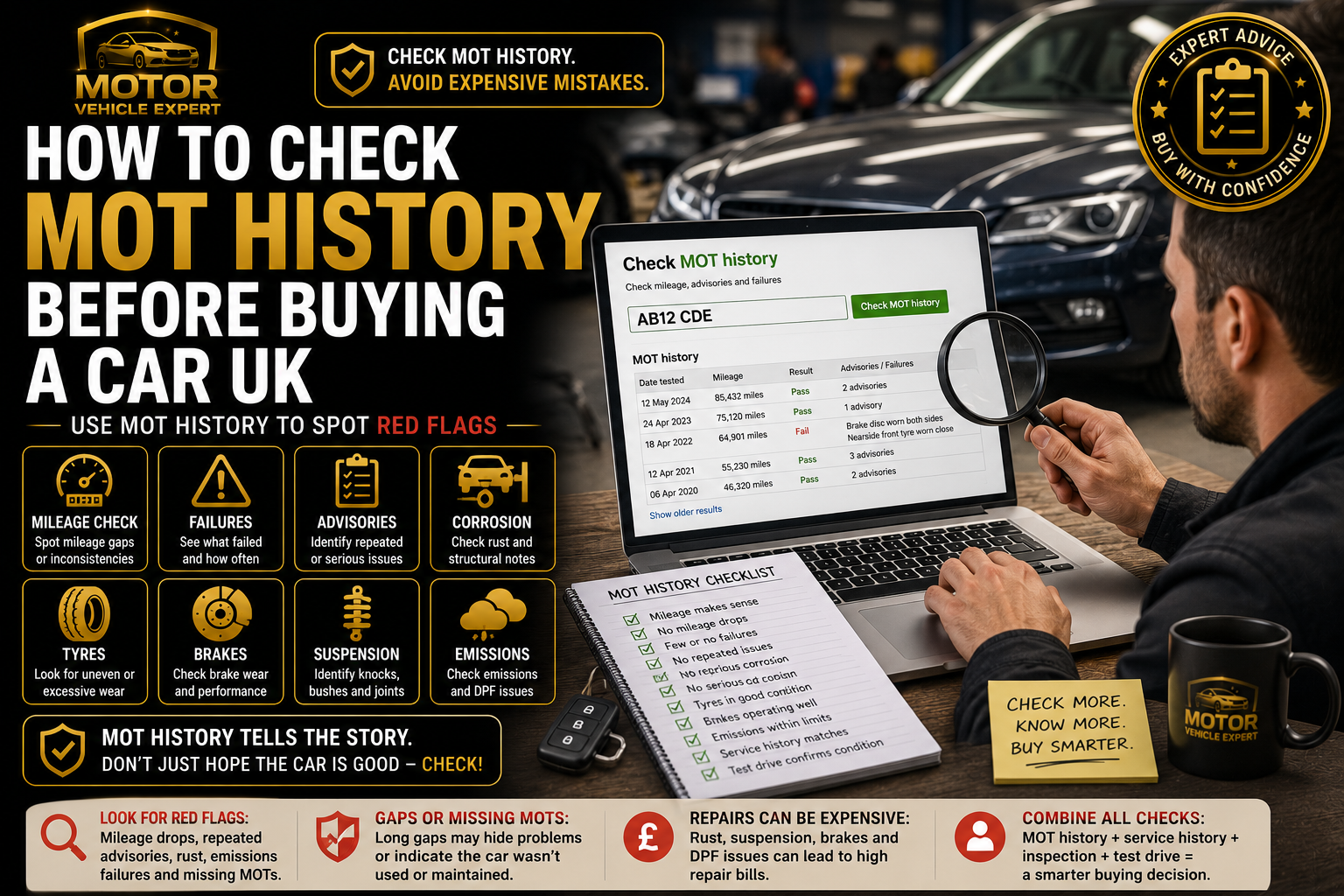
Before buying a used car, check the MOT history for mileage consistency, repeated advisories, previous failures, rust, tyre wear, brake faults, suspension issues, emissions problems and warning-light related defects.
One previous MOT failure is not always a problem if it was repaired properly. The real concern is a pattern: the same advisories coming back every year, mileage that does not make sense, corrosion getting worse, or serious defects appearing close to the sale date.
Do not just ask, “Has it got MOT?” Ask, “What has the MOT history been telling us for the last few years?”
Why MOT history matters when buying a used car
MOT history gives you a rough story of how the car has been treated. It will not tell you everything, but it can show patterns that a seller may not mention in the advert.
Mileage pattern
MOT records can show whether mileage rises naturally or has strange gaps, drops or jumps.
Clocked mileage signs →Repeated advisories
The same advisory appearing year after year can show repairs were delayed or ignored.
MOT advisory meaning →Rust clues
Corrosion advisories can become expensive if they affect structure, suspension or seatbelt areas.
Rust MOT guide →Brake and tyre condition
Frequent tyre and brake failures can suggest poor maintenance or hard use.
Common MOT failures →Suspension wear
Repeated bushes, springs, ball joints or shock absorber notes can point to future repair costs.
Suspension MOT guide →Emissions problems
Repeated emissions failures can point towards engine, exhaust, DPF or catalytic converter problems.
Emissions failure guide →MOT history checklist before buying
- 1Check the registration: make sure the car shown matches the registration you are checking.
- 2Check MOT expiry: see how long is left and whether the seller is using a fresh MOT as a selling point.
- 3Check mileage: mileage should rise naturally year by year.
- 4Read failures: look at what the car failed on, not just whether it later passed.
- 5Read advisories: repeated advisories matter because they often become future repair bills.
- 6Check rust notes: corrosion can be one of the most expensive used car problems.
- 7Check tyres: repeated tyre wear can suggest alignment, suspension or neglect.
- 8Check brakes: brake pipes, discs, pads and imbalance issues need attention.
- 9Check emissions: repeated emissions issues can be expensive on petrol and diesel cars.
- 10Compare with the car: MOT history should match what you see during inspection and test drive.
Check the mileage history carefully
Mileage is one of the first things buyers look at, but the pattern matters more than one number. MOT history lets you compare mileage year by year.
Normal pattern
Mileage rises steadily each year and matches the advert, service invoices and general condition.
Warning pattern
Mileage drops, jumps strangely, stays the same for years or does not match the service records.
Condition mismatch
A low-mileage car should not usually have heavy wear on seats, pedals, steering wheel and gear knob.
Missing history
Long gaps or missing records are not proof of a problem, but they should make you ask more questions.
For more detail, read signs of clocked mileage, is 100k miles too much? and best mileage to buy a used car UK.
Do not ignore MOT advisories
An advisory means the item was not bad enough to fail at the time, but it was worth noting. When buying a used car, advisories matter because they can show future costs.
One-off advisory
Less worrying if it was repaired and did not appear again.
Repeated advisory
More worrying because it suggests the issue may have been ignored.
Advisory close to sale
Ask whether it has been repaired before buying.
- !Repeated tyre advisories can suggest poor maintenance or alignment problems.
- !Repeated brake advisories can mean repairs are being delayed.
- !Repeated suspension advisories can become noisy and expensive.
- !Repeated corrosion advisories can become serious structural issues.
- !Oil leak advisories may become worse and affect future MOT results.
Read more: MOT advisory meaning explained and should you buy a car with advisories?
Previous MOT failures: should you worry?
A previous MOT failure does not automatically mean the car is bad. Many cars fail for simple things like bulbs, tyres or wipers. What matters is what it failed on, how serious it was, whether it was repaired properly and whether the same fault keeps returning.
Less worrying
Bulbs, wipers, number plate lights or simple tyre issues that were repaired properly.
Needs checking
Brakes, suspension, steering, emissions, warning lights or repeated failures.
More worrying
Severe corrosion, structural issues, dangerous defects or repeated emissions failures.
If the car failed recently, ask for proof of repair. Do not rely only on the seller saying “it is sorted now”.
Helpful guide: buying a car with failed MOT history.
Rust and corrosion in MOT history
Rust is one of the biggest things to check in UK used cars, especially older vehicles. A small surface rust note is different from corrosion near suspension, seatbelt, sill, subframe or structural mounting points.
- !Repeated corrosion advisories should be taken seriously.
- !Rust near suspension mounting points can become expensive.
- !Rust near seatbelt areas can affect safety and MOT results.
- !Fresh underseal can sometimes hide corrosion rather than fix it.
- !Structural rust can make an otherwise cheap car a bad buy.
When viewing the car, check sills, arches, subframes, suspension mounts, brake pipes and underneath if possible. Also read can rust fail an MOT?.
Tyres, brakes and suspension history
MOT history often shows whether a car has been maintained properly. Tyres, brakes and suspension are normal wear items, but repeated failures or advisories can show neglect.
Tyres
Low tread, cords exposed, bulges or uneven wear can show poor maintenance or alignment problems.
Tyre tread MOT →Brakes
Brake imbalance, worn discs, weak handbrake or corroded pipes can become expensive.
Brake pad MOT →Suspension
Broken springs, worn bushes, leaking shocks or ball joints can affect safety and ride quality.
Suspension MOT →On the test drive, listen for knocking, humming, pulling, brake grinding, vibration and steering shake.
Emissions, DPF and warning-light clues
Repeated emissions failures can be expensive, especially on diesel cars with DPF, EGR, turbo, injector or sensor issues. On petrol cars, emissions problems can involve oxygen sensors, catalytic converters, misfires or fuel mixture faults.
- !Repeated emissions failures need careful investigation.
- !Engine management light history can suggest unresolved faults.
- !DPF-related issues can be costly on diesel vehicles.
- !Smoke during test drive should not be ignored.
- !A fresh MOT does not mean the emissions system is perfect long term.
Useful guides: car fails MOT on emissions, DPF warning light explained and engine management light guide.
MOT history red flags before buying
- !Mileage drops between MOT tests.
- !Same advisories appear year after year.
- !Corrosion advisories become worse over time.
- !Recent dangerous defects before sale.
- !Repeated emissions failures.
- !Frequent tyre failures or uneven tyre wear.
- !Brake, suspension or steering defects appearing repeatedly.
- !Seller says “ignore the advisories” without proof of repair.
- !Fresh MOT but no service history or repair invoices.
- !MOT history does not match the condition of the car.
Is a fresh MOT enough?
No. A fresh MOT is useful, but it is not the same as a full service, warranty or full mechanical inspection. It means the vehicle met MOT standards at the time of the test. It does not prove the clutch, gearbox, turbo, timing chain, DPF, battery, air conditioning or service condition is good.
Fresh MOT helps
It gives some confidence that the car recently met minimum test standards.
Fresh MOT does not prove everything
It does not replace checking service history, cold start, test drive, fluids and warning lights.
Use the MOT history as one part of the full buying check. Read used car inspection checklist UK.
What to do after checking MOT history
1. Ask the seller about advisories
Ask whether they have been repaired and request invoices or proof.
2. Compare MOT history with the car
If MOT history mentions rust, tyres or brakes, inspect those areas carefully.
3. Check service history
MOT history does not prove servicing. Ask for oil changes, cambelt proof and major repair records.
4. Test drive properly
A car can pass MOT and still have clutch, gearbox, overheating or engine faults.
5. Use faults to negotiate
Price repairs properly before accepting a discount.
6. Walk away if needed
A risky MOT pattern is often a good reason to keep looking.
Best mechanic-style advice
Do not read MOT history like a pass-or-fail certificate. Read it like a pattern. A car that keeps getting advisories for the same tyres, brakes, rust or suspension faults is telling you something about its maintenance.
The best used cars usually have MOT history, service history and physical condition that all tell the same story. If the MOT history says one thing, the advert says another, and the seller has no proof, be careful.
Related used car buying guides
Frequently asked questions
How do I check MOT history before buying a used car?
Use the registration number, then check mileage, advisories, failures, rust notes, tyres, brakes, suspension, emissions and whether the same problems appear repeatedly.
Why is MOT history important?
It can show mileage inconsistencies, repeated advisories, corrosion, poor maintenance, recurring faults and repair risks before you buy the car.
Is a car bad if it failed an MOT before?
Not always. Many cars fail for simple items. The important thing is what it failed on, whether it was repaired properly and whether the issue returned.
Should I worry about advisories?
Yes, especially if the same advisories appear more than once or involve rust, tyres, brakes, suspension, oil leaks or emissions.
Can MOT history show clocked mileage?
It can show mileage drops, strange jumps or gaps that may suggest clocking, recording mistakes or missing history.
Is a fresh MOT enough when buying?
No. A fresh MOT is useful, but it does not replace service history, a proper inspection and a test drive.
What is the biggest MOT red flag?
Repeated corrosion, mileage inconsistency, dangerous defects, recurring emissions failures or repeated advisories that were never repaired are major warning signs.
Can a car pass MOT and still have problems?
Yes. A car can pass MOT and still have clutch, gearbox, turbo, battery, air conditioning, service or hidden engine problems.
Should I ask for repair invoices?
Yes. If MOT history shows failures or advisories, ask for proof that the work was repaired properly.
What should I do if MOT history looks bad?
Ask questions, inspect the car carefully, price the repairs and walk away if the risk is too high.