Quick answer
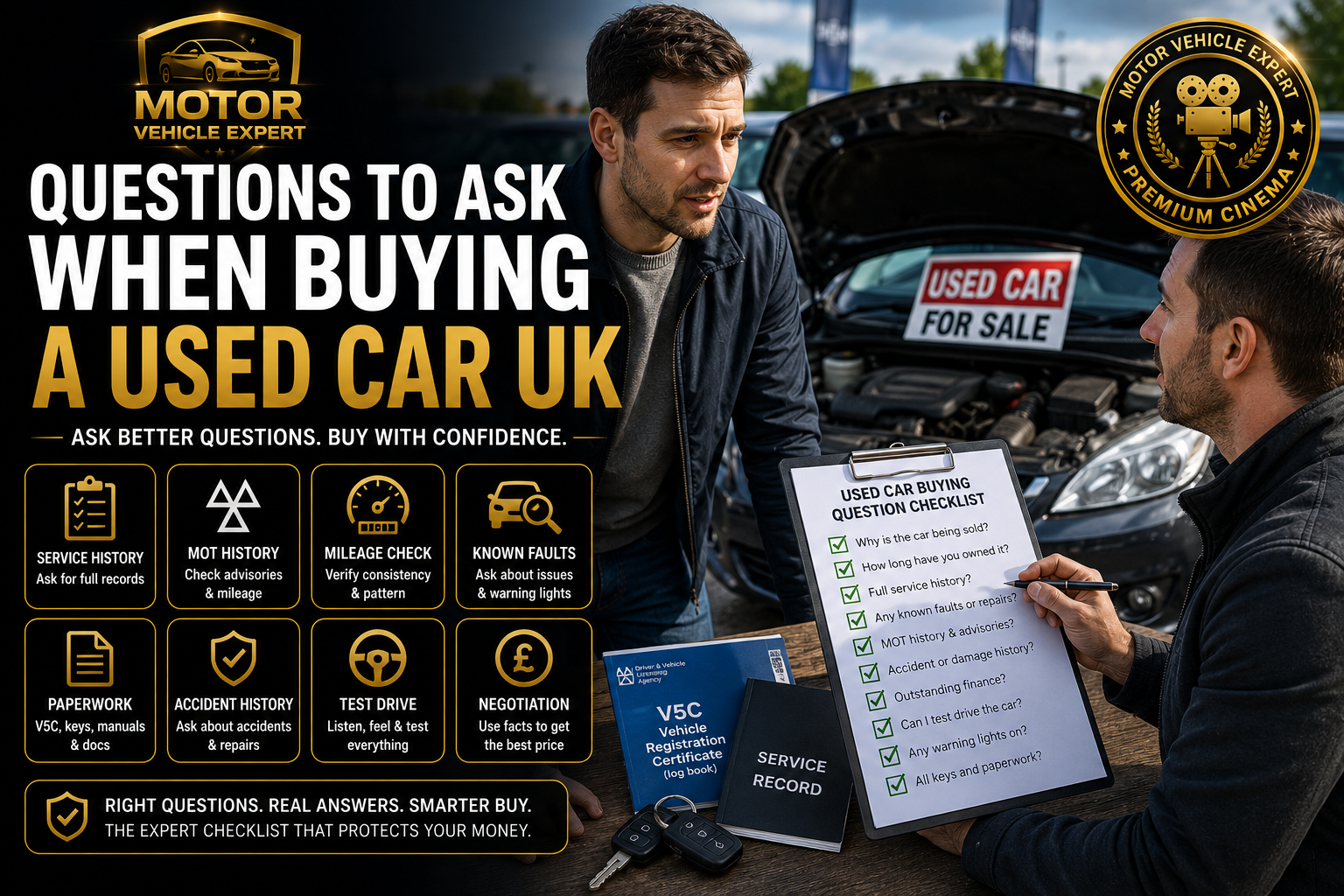
Before buying a used car, ask about ownership, reason for sale, service history, MOT history, mileage, known faults, warning lights, accident damage, outstanding finance, keys, paperwork and whether you can inspect and test drive the car properly.
Good answers should match the advert, V5C, invoices, MOT history and the car’s actual condition. If the seller avoids basic questions, rushes you, refuses a proper viewing or says a warning light “just needs resetting”, be very careful.
The question is not only what the seller says. The question is whether the car, paperwork, MOT history and test drive all tell the same story.
What I normally notice when buyers ask the wrong questions
In real workshop situations, buyers often ask simple questions like “does it drive well?” or “is it reliable?” and then accept a vague answer. That is not enough. A seller who has looked after a car should be able to talk clearly about service history, MOT advisories, repairs, faults and how long they have owned it.
Some problem cars look excellent in photos but the seller cannot explain missing service records, repeated MOT advisories, coolant top-ups, warning lights or why the car is being sold quickly. That is where better questions protect your money.
The best used cars usually have a story that lines up. The seller’s answers, the V5C, MOT history, invoices, condition and test drive should all make sense together.
If the seller gives unclear answers before you even arrive, be extra careful. Bad answers before viewing often become worse problems after buying.
Questions to ask before viewing the car
Ask these before travelling. They can save you a wasted journey and help you spot hidden faults, poor history or a dishonest seller early.
- 1How long have you owned the car?
- 2Why are you selling it?
- 3Does it have full, partial or no service history?
- 4Are there any warning lights, faults, leaks, noises or starting problems?
- 5Has it ever been damaged, repaired after an accident or written off?
- 6Is there any outstanding finance on the car?
- 7Does the mileage match the MOT and service history?
- 8Can I view it at the address on the V5C?
- 9Can I inspect it properly and take it for a test drive?
- 10Will the engine be cold when I arrive?
Before viewing, also read how to check MOT history before buying and used car inspection checklist UK.
Questions to ask the seller
Are you the registered keeper?
In a private sale, the V5C should usually match the seller’s name and address.
How long have you owned it?
Very short ownership is not always bad, but it needs a clear explanation.
Why are you selling?
A normal answer is fine. A vague, rushed or defensive answer is worth noting.
Where can I view it?
Viewing at the V5C address is safer than a random car park or petrol station.
Can I bring someone?
A genuine seller should usually be comfortable with a proper inspection.
Is the price negotiable?
Useful if tyres, brakes, servicing or MOT advisories need money spending.
Paperwork questions and checks
Paperwork does not make a car perfect, but missing or inconsistent paperwork can make a car risky. The V5C, VIN, MOT history, service invoices and seller details should all line up.
- ✓Can I see the V5C logbook?
- ✓Does the V5C name and address match the seller and viewing location?
- ✓Does the VIN on the car match the V5C and service records?
- ✓Are there service invoices, digital service records or stamped history?
- ✓Are there receipts for major repairs such as clutch, cambelt, brakes, tyres or suspension?
- ✓Are there two keys, manuals and the locking wheel nut?
- ✓Has a proper history check been done for finance, stolen status and write-off category?
- ✓Will I get a written receipt if I buy the car?
If the car has little paperwork, read used car with no service history — is it worth it?.
Questions about MOT history
MOT history is one of the best tools a UK buyer has. Do not only check whether the car has passed. Read the failures and advisories properly.
- ✓Does the MOT history show mileage increasing naturally?
- ✓Are there repeated advisories for the same item?
- ✓Has the car failed on rust, brakes, tyres, suspension or emissions?
- ✓Were previous failures repaired properly?
- ✓Are there corrosion advisories getting worse over time?
- ✓Are there recent advisories the seller has not mentioned?
Helpful guides: how to check MOT history before buying, MOT advisory meaning, buying a car with failed MOT history and should you buy a car with advisories?.
Questions about service history
Service history tells you how the car has been looked after between MOT tests. A car can pass an MOT but still be overdue for oil changes, cambelt work, gearbox service, brake fluid or major maintenance.
When was it last serviced?
Ask for the date, mileage and invoice, not just “recently serviced”.
What oil has been used?
Wrong oil or poor servicing can cause engine, DPF, timing chain or turbo problems.
Is the cambelt due?
Cambelt replacement can be expensive and should be supported by proof.
Has major work been done?
Ask for proof of clutch, brakes, tyres, battery, alternator, DPF or cooling-system repairs.
Related guides: how to check service history, car servicing guide UK and when should cambelt be changed?.
Questions about condition and maintenance
- 1Does the car use oil or coolant between services?
- 2Are there any oil leaks, coolant leaks or overheating problems?
- 3Do any warning lights appear before or after startup?
- 4Are there any knocks, rattles, vibrations or unusual smells?
- 5When were the tyres and brakes last replaced?
- 6Does the clutch bite high, slip or judder?
- 7Has any bodywork, paint or accident repair been done?
- 8Are all electrics, windows, locks, air conditioning and infotainment working?
- 9Has the battery, alternator or starter motor caused problems?
- 10Does the car drive straight without pulling, shaking or knocking?
If the seller mentions repair work, compare likely costs using car repair costs guide UK.
Questions about faults and warning lights
This is where sellers often become vague. Do not accept “it just needs a reset” without proof. A warning light usually comes on for a reason.
Engine light
Ask what code was stored, what repair was done and whether the light returned.
Engine light guide →ABS or airbag light
These can affect MOT and safety. Do not ignore them.
ABS warning guide →Coolant or overheating
Coolant loss and overheating can become expensive quickly.
Overheating causes →Oil warning
Oil pressure warnings should be treated seriously because engine damage can happen fast.
Oil warning guide →Battery warning
Charging faults can mean alternator, battery, wiring or belt issues.
Battery warning guide →Smoke or smells
Smoke, coolant smell, burning oil or fuel smell should always be investigated.
Smoke colour guide →Questions to ask before and during the test drive
A test drive should start from cold where possible. Some faults only appear on startup, while others show when the engine is warm, under braking, on bumps or at higher speed.
- ✓Can I start the car from cold?
- ✓Can I drive on town roads, faster roads and over bumps?
- ✓Do all warning lights go out after startup?
- ✓Does the engine idle smoothly and accelerate cleanly?
- ✓Does the clutch slip, judder, smell burnt or bite very high?
- ✓Do the brakes grind, vibrate, squeal or pull to one side?
- ✓Does the steering shake, pull left or right, or feel loose?
- ✓Does the temperature stay normal during the drive?
- ✓Does the gearbox change smoothly with no crunching, delay or banging?
- ✓Are there any knocks from the suspension over bumps?
Use our used car test drive checklist alongside this guide.
Dealer vs private seller: what to ask
Buying from a dealer
Ask what warranty is included, what checks have been done, whether MOT advisories were repaired, whether the car has finance history and what happens if a fault appears shortly after purchase.
Buying privately
Ask whether the seller is the registered keeper, view at the V5C address, check paperwork carefully and do not rely on verbal promises after payment.
For more detail, read buying from dealer vs private seller.
Questions to help negotiate the price
Do not negotiate only because you want money off. Negotiate because you have found real costs, missing history or risk that should be reflected in the price.
- £When is the next service due?
- £Are tyres, brakes, battery, cambelt or clutch work due soon?
- £Have MOT advisories been repaired, and is there proof?
- £Are both keys included?
- £Is the price lower because of known faults?
- £Would the seller be happy for an independent inspection?
- £Has the car recently had tyres, brakes, clutch, battery or alternator work?
- £Are there invoices for the work being claimed?
If a car needs work, compare it with is it worth repairing an old car? before deciding.
Red flag answers to watch for
- !“I’m selling it for a friend” with no clear explanation.
- !“No paperwork, but it has been well looked after.”
- !“The warning light just needs resetting.”
- !“It only overheats sometimes.”
- !“It has no MOT but should pass easily.”
- !“No test drives until you pay.”
- !“The price is low because I need it gone today.”
- !“The clutch slips a little but it is normal.”
- !“Coolant just needs topping up now and again.”
- !V5C name, address, seller story or viewing location do not match.
If the car has failed MOT history, read buying a car with failed MOT history.
Good signs from a used car seller
- ✓Clear answers that match the advert, paperwork and car condition.
- ✓Service records, MOT history and repair invoices are available.
- ✓The seller allows a proper inspection and test drive.
- ✓Known faults are explained honestly before viewing.
- ✓The vehicle can be viewed at a sensible address.
- ✓The seller is not rushing or pressuring you to decide immediately.
- ✓The car starts from cold without smoke, rattles or warning lights staying on.
- ✓The test drive matches what the seller said before viewing.
Best order to ask the questions
1. Ask before travel
Ownership, reason for sale, service history, faults, MOT and viewing location.
2. Check paperwork
V5C, VIN, invoices, MOT history, keys, manuals and repair records.
3. Inspect and test drive
Look for warning lights, noises, leaks, smoke, clutch issues, brake problems and overheating.
If anything does not line up, pause. A good used car should make sense on paper, in person and on the road.
Best mechanic-style advice
Do not ask questions just to make conversation. Ask questions to see whether the seller’s story matches the car. If they say it has been well maintained, there should be service records. If they say the MOT advisories were fixed, there should be proof. If they say the warning light is nothing, ask what code was stored and what repair was done.
The best used cars usually have a clear history, honest seller, sensible MOT pattern, clean cold start and good test drive. If the answers feel slippery before you even inspect the car, that is usually a sign to slow down or walk away.
The seller’s answers should match three things: the paperwork, the MOT history and the way the car behaves on the test drive. If those three do not line up, do not rush into paying.
Related used car buying guides
Frequently asked questions
What is the most important question to ask when buying a used car?
Ask whether the car has service history, current faults, warning lights or recent repairs. Then check whether the answer matches the paperwork, MOT history and condition.
Should I ask why the car is being sold?
Yes. It is a simple question that can reveal whether the sale sounds normal, rushed or suspicious.
Should I ask for service history before viewing?
Yes. Service history can save wasted journeys and help you judge whether the car has been maintained properly.
Is mileage the most important thing?
No. Mileage matters, but condition, service history, MOT history and how the car has been used are often more important.
Can I negotiate after viewing?
Yes. Worn tyres, brakes, overdue servicing, MOT advisories, missing keys and obvious faults can all be fair reasons to negotiate.
Should I buy a used car without a test drive?
Usually no. A test drive helps reveal clutch, gearbox, brake, steering, suspension, engine and overheating problems.
What should I ask a private seller?
Ask if they are the registered keeper, why they are selling, how long they have owned the car, whether the V5C matches their address and whether you can inspect and test drive the car.
What should I ask a dealer?
Ask what warranty is included, what checks have been done, whether advisories were repaired and what happens if a fault appears shortly after purchase.
Is no service history a red flag?
It can be. No service history makes it harder to prove maintenance, mileage and major repair work.
What answer should make me walk away?
Walk away if the seller refuses inspection, refuses a test drive, cannot explain paperwork, hides faults, dismisses warning lights or pressures you to pay quickly.