What does an MOT advisory mean?
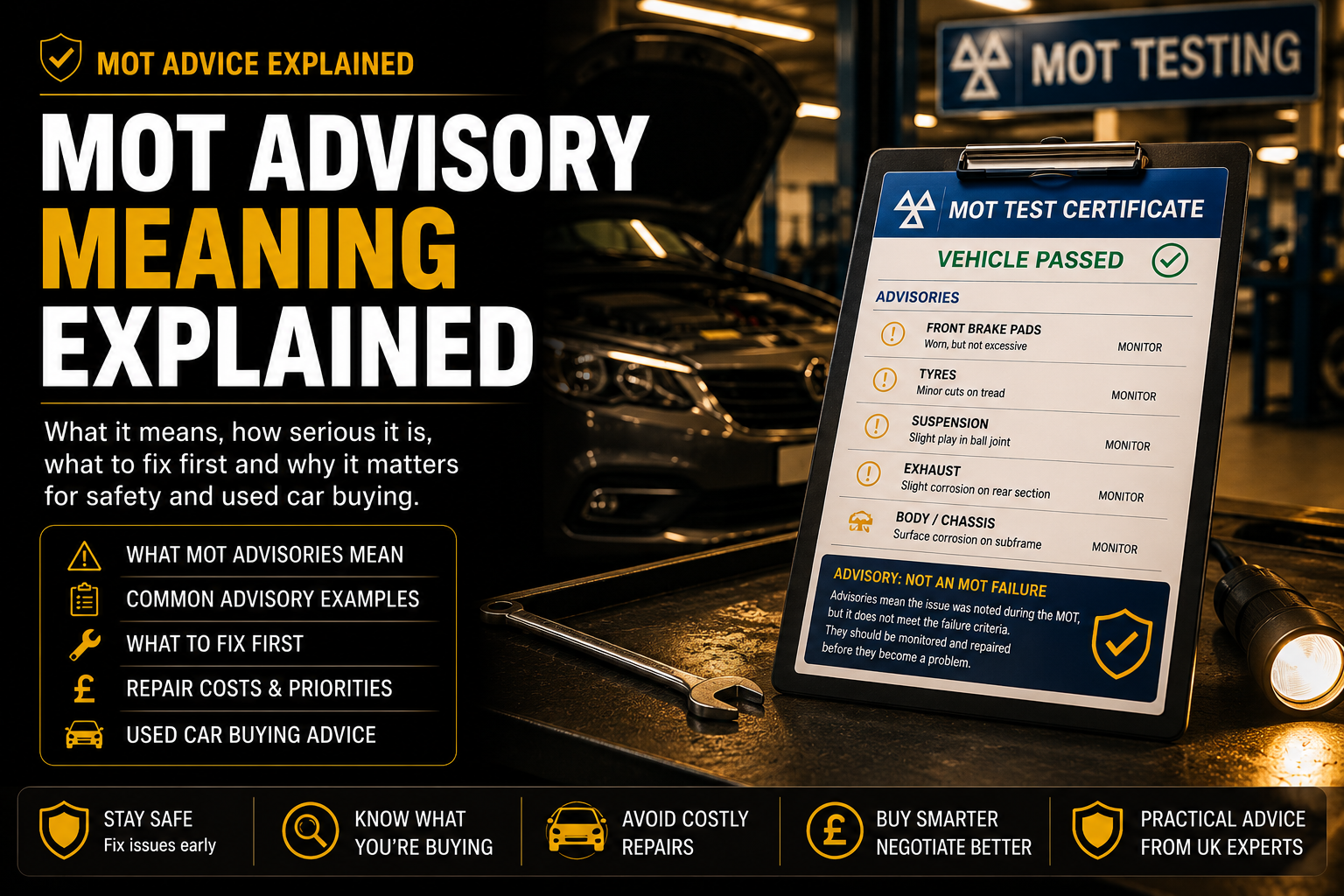
An MOT advisory means the vehicle has passed the MOT test, but the tester has recorded an issue that should be monitored, maintained or repaired. It is not a failure, but it is still important because it can show wear, deterioration, corrosion, leakage or a developing safety concern.
The safest way to read an advisory is this: the car was good enough to pass at the time of the test, but it may not remain that way if the issue is ignored. For a driver, it is a repair-planning warning. For a used car buyer, it is a clue about future spending and past maintenance.
It passed today
An advisory is not the same as a major or dangerous MOT failure.
It needs attention
The tester has noticed something worth monitoring, checking or repairing.
It can get worse
Tyres, brakes, suspension, corrosion and leaks can become future failures.
Do not judge a car by “MOT passed” alone. Always read the advisory wording and check whether the same issue appears in previous years.
Workshop experience: common MOT advisory patterns
In real workshop situations, many drivers see a pass and forget about the advisory section. That is where problems begin. Advisories are often early warnings that a component is wearing, corroding, leaking or getting close to a limit.
A single advisory on an older car is not always serious. What matters more is the type of advisory and whether it repeats. A repeated advisory for tyres, brakes, steering, suspension, corrosion or leaks can show delayed maintenance.
When buying a used car, advisories are extremely useful. They can show where money may need to be spent next, whether the seller has maintained the vehicle properly and whether the asking price reflects the real condition of the car.
A pass with advisories is still a pass, but it is not a clean bill of health. A car can pass an MOT and still need repairs, servicing or preventative maintenance.
What an MOT advisory actually means
An MOT advisory is a note from the MOT tester. It tells you that something was noticed during the inspection, but it was not bad enough to fail the vehicle at that moment.
The advisory may relate to wear, age, corrosion, play, deterioration, minor leakage, tyre condition, brake condition, suspension movement, steering components, exhaust condition or other visible issues.
Advisory does not mean failed
The car can still receive a valid MOT certificate if it only has advisories.
Advisory does not mean ignore
The advisory is recorded because the issue may need checking, maintenance or repair.
Advisory can show future cost
Brake pads, tyres, brake pipes, suspension arms and corrosion can become expensive later.
Advisory history matters
Repeated advisories can reveal whether a vehicle has been neglected or properly maintained.
MOT advisory vs minor defect vs major defect
An advisory is not the same as a defect category, but drivers often confuse them. The easiest way to understand it is that an advisory is a warning note, while a major or dangerous defect is a failure issue.
Advisory
The vehicle passes, but the tester has recorded something that should be monitored or repaired before it worsens.
Minor defect
A defect exists but is not serious enough to fail the MOT. It should still be repaired because it can worsen.
Major or dangerous defect
The vehicle fails the MOT. A dangerous defect should not be driven until repaired.
For deeper MOT failure guidance, read common MOT failure reasons UK and MOT retest rules UK.
Which MOT advisories should you worry about most?
The most professional way to judge MOT advisories is not by counting them. You should group them by safety risk, repair urgency and whether they are likely to become more expensive if ignored.
Fix urgently
Brake pipe corrosion, structural corrosion, steering play, tyre damage, tyres close to the legal limit, brake fluid leaks, serious suspension wear and any advisory that affects control or braking.
Book in soon
Brake pads wearing thin, brake discs worn or corroded, suspension bushes deteriorating, shock absorber misting, exhaust corrosion and oil leaks that need tracing.
Monitor carefully
Light component wear, early deterioration, minor surface corrosion, small exhaust deterioration or advisory wording that clearly suggests early-stage wear.
Tyres, brakes, steering, suspension, corrosion and leaks should always be treated as the highest-priority advisory groups because they affect safety, repair cost and future MOT risk.
Are MOT advisories serious?
Some MOT advisories are minor, but others are early warnings of safety-related wear or expensive future repairs. The seriousness depends on the part affected, the wording used by the tester, the age of the vehicle and whether the same advisory has appeared before.
Lower risk
Light wear, early deterioration or minor non-safety notes that simply need monitoring.
Medium risk
Tyres wearing low, brake wear, suspension bushes, light leaks, exhaust corrosion or early rust.
High risk
Brake pipe corrosion, structural corrosion, steering play, serious suspension wear, tyre damage or fluid leaks.
The wording matters. “Slightly worn” is usually less urgent than “worn close to limit”, “corroded”, “deteriorated”, “leaking”, “insecure” or “excessive”.
The most serious MOT advisories
The most serious MOT advisories are the ones that affect stopping, steering, structure, tyres, suspension control or fluid loss. These advisories should not be treated as casual notes because they can become safety issues or expensive failures.
1. Structural corrosion
Rust near sills, subframes, suspension mounting points or load-bearing areas can become one of the most expensive MOT problems to repair.
Structural corrosion advisory guide →2. Brake pipe corrosion
Brake pipe corrosion is serious because it can worsen and affect the braking system. It should be inspected properly, not ignored.
Corroded brake pipe advisory guide →3. Tyres close to legal limit
A tyre may pass today but become illegal or unsafe before the next MOT, especially if mileage is high or wear is uneven.
Tyre wear advisory guide →4. Steering or suspension play
Play in steering or suspension components can affect vehicle control, tyre wear and road safety.
Suspension advisory guide →5. Fluid leaks
Oil, coolant, brake fluid or power steering leaks can worsen and may point to larger mechanical problems.
Oil leak advisory guide →6. Brake wear advisories
Pads or discs that are wearing thin can become poor braking, grinding noise or future MOT failure if left too long.
Brake pad advisory guide →Most common MOT advisories explained
The same advisory types appear again and again on UK vehicles. These are the ones that matter most for safety, repair costs and used car buying decisions.
Tyre wear advisory
The tyre is still legal at the test, but it may be getting close to replacement.
Risk: Medium–High
Full tyre advisory guide →Brake pad advisory
The pads are wearing thin but still passed at the time of inspection.
Risk: Medium–High
Full brake pad advisory guide →Brake disc advisory
The discs may be corroded, pitted, lipped or worn but not bad enough to fail.
Risk: Medium
Full brake disc advisory guide →Corroded brake pipe advisory
Brake pipe corrosion should always be taken seriously because it can affect braking safety.
Risk: High
Full brake pipe advisory guide →Suspension advisory
Worn bushes, ball joints, arms or mounts can affect handling and tyre wear.
Risk: Medium–High
Full suspension advisory guide →Shock absorber advisory
Misting or early leakage can become poor ride control and future MOT failure.
Risk: Medium
Full shock absorber advisory guide →Structural corrosion advisory
Rust near structural areas can become serious, expensive and difficult to repair.
Risk: High
Full corrosion advisory guide →Oil leak advisory
A minor oil leak may pass, but it can worsen or hide a larger engine issue.
Risk: Medium–High
Full oil leak advisory guide →Exhaust corrosion advisory
Surface rust can become a blowing exhaust, noise issue or future MOT failure.
Risk: Medium
Full exhaust corrosion guide →MOT advisory wording clues
Do not only count advisories. Read the wording. Two cars can both have three advisories, but one may be much more risky depending on the words used.
“Slightly worn”
Usually early wear. Monitor it and ask when replacement may be needed.
“Worn close to limit”
More urgent. The part may soon become a failure or safety issue.
“Corroded”
Needs careful checking, especially on brake pipes, sills, subframes and suspension mountings.
“Deteriorated”
Often means rubber, metal, mounting or component condition is declining.
“Leaking”
Leaks can worsen quickly. Identify the fluid and source before the repair becomes expensive.
Same wording every year
Repeated wording suggests the issue has not been properly repaired.
Common MOT advisory wording examples
MOT advisory wording can look confusing when you first read it. The examples below show how to translate common advisory language into plain English.
“Tyre worn close to legal limit”
The tyre passed at the time of test, but it is nearing the legal minimum tread depth. Plan replacement soon, especially if you drive regularly.
“Brake pad(s) wearing thin”
The pads still had enough material to pass, but they may not last until the next MOT. Listen for grinding and plan inspection.
“Brake pipe corroded, covered in grease or other material”
The tester could see corrosion or could not fully assess the pipe condition. This should be checked carefully because brake pipes are safety critical.
“Suspension arm bush deteriorated”
The rubber bush is ageing, cracked or weakening. It may later cause knocking, poor handling or uneven tyre wear.
“Shock absorber has light misting of oil”
A small amount of oil is visible. It may not yet be a failure, but it should be monitored before it becomes a proper leak.
“Oil leak, but not excessive”
The leak was not severe enough to fail the MOT, but the source should be found because small leaks can become expensive.
“Exhaust has minor corrosion”
The exhaust is rusting but has not yet become insecure or started blowing. It may need replacement later.
“Vehicle structure corroded but structural rigidity not significantly reduced”
This is an important rust warning. It may still pass today, but it should be inspected properly before it becomes a structural failure.
How an MOT advisory can become a future failure
An advisory is often the first stage of a problem. The vehicle may pass today, but wear, corrosion and leaks usually move in one direction if nothing is done.
1. Advisory issued
The tester records early wear, corrosion, leakage or deterioration.
2. Issue worsens
The part continues to wear, rust spreads, or a small leak becomes more noticeable.
3. Symptoms appear
You may notice noise, vibration, poor handling, warning lights, fluid loss or uneven tyre wear.
4. Repair delayed
The fault becomes harder to repair, affects nearby parts or becomes more expensive.
5. MOT failure
The issue becomes bad enough to fail the MOT as a major or dangerous defect.
6. Higher repair cost
Leaving the advisory can turn a planned repair into an urgent repair bill.
What happens if you ignore MOT advisories?
Ignoring an advisory does not automatically mean the vehicle is illegal if it passed the MOT, but it can still lead to bigger repair costs, worse safety risk and a future MOT failure.
- !Tyre advisories can become illegal tread, exposed cords, sidewall damage or poor wet-weather grip.
- !Brake advisories can become grinding brakes, poor braking performance, imbalance or MOT failure.
- !Suspension advisories can become knocking, poor handling, uneven tyre wear or failed components.
- !Corrosion advisories can become structural failures, brake pipe failures or expensive welding repairs.
- !Leaks can worsen and lead to low oil, coolant loss, brake fluid loss or power steering problems.
- !Repeated advisories can reduce buyer confidence when you sell the vehicle.
Repeated MOT advisories: why they matter
One MOT advisory is not always a big problem. The bigger warning sign is when the same advisory appears year after year. Repeated advisories usually mean the issue has been ignored, delayed or only partly repaired.
Repeated tyre advisories
Can suggest poor tracking, worn suspension, bad alignment or poor maintenance.
Repeated brake advisories
Can mean pads, discs, pipes or hoses are being left until they eventually fail.
Repeated rust advisories
Rust usually gets worse unless repaired properly, so repeated corrosion is a strong warning.
A single advisory is rarely a reason to walk away. Repeated safety-related advisories are much more important because they show maintenance behaviour over time.
How long can you drive with an MOT advisory?
There is no fixed time limit for driving with an MOT advisory because the seriousness depends on the issue. A light advisory may be monitored, but safety-related advisories should be inspected and repaired as soon as practical.
Monitor only
Light wear or early deterioration may be checked during routine servicing if there are no symptoms.
Book soon
Tyres, brakes, suspension, steering or small leaks should be checked before they worsen.
Do not delay
Brake pipe corrosion, structural corrosion, tyre damage, steering play or worsening leaks need urgent attention.
For a dedicated guide, read how long can you drive with an MOT advisory?.
Why MOT advisories matter when buying a used car
MOT advisories are one of the best ways to understand a used car before you buy it. They can show upcoming repair costs, repeated faults, poor maintenance and whether the seller has been honest about the vehicle.
A clean MOT pass is reassuring, but a pass with advisories needs closer reading. You should look at the latest MOT and previous MOT history together. If advisories disappear, ask whether the work was repaired. If advisories repeat, ask why they were not fixed.
One minor advisory
Usually not a major problem on an older car if the price, history and condition are fair.
Several safety advisories
Tyres, brakes, steering, suspension and corrosion advisories should affect your buying decision.
Repeated advisories
The same issue appearing every year can suggest neglect or delayed repairs.
Advisories disappear suddenly
Ask for repair evidence. Sometimes repairs were done; sometimes the wording changed.
Before buying, use our MOT history check guide, used car inspection checklist and used car test drive checklist.
MOT advisory red flags when buying a used car
- !Repeated structural corrosion: rust normally gets worse unless properly repaired.
- !Repeated brake pipe corrosion: this can become a serious braking safety issue.
- !Multiple suspension advisories: this may mean several worn parts, not one small repair.
- !Tyre wear every year: this may suggest poor tracking, worn suspension or neglect.
- !Oil leak plus coolant issues: this combination can suggest bigger engine-related risk.
- !No receipts after advisories disappear: ask for proof that repairs were completed.
A few minor advisories may be acceptable. A pattern of repeated safety-related advisories should make you slow down, inspect carefully and price the repair risk.
Typical MOT Advisory Repair Costs UK
MOT advisories often provide an early warning of future repair costs. While an advisory is not an MOT failure, many advisory items become failures at the next test if they are ignored. These guide prices are broad UK estimates only and should be used for planning rather than as fixed quotations.
Tyre Wear Advisory
One tyre replacement
£70–£180 per tyreBrake Pad Advisory
Front or rear brake pads
£100–£250Brake Disc Advisory
Discs and pads on one axle
£250–£500Suspension Advisory
Bush, arm or joint replacement
£150–£600Shock Absorber Advisory
Pair of shock absorbers
£150–£400Brake Pipe Corrosion
Brake pipe repair or replacement
£100–£600Oil Leak Advisory
Diagnosis and repair of leak source
£80–£800+Exhaust Corrosion
Exhaust repair or replacement
£100–£800+Structural Corrosion
Inspection, welding or structural repair
£200–£2,000+Repeated advisories for corrosion, brake pipes, oil leaks or suspension wear are often more important than the repair cost itself. Multiple years of the same advisory usually indicate maintenance has been delayed and future costs may be significantly higher than the figures shown above.
Why MOT advisory repair costs vary
Repair costs vary because two advisories with similar wording can require very different levels of work. A simple brake pad advisory may be straightforward, while corrosion or oil leaks can require diagnosis before a realistic price is known.
- £Vehicle make and model: parts prices and labour access vary widely.
- £Labour rate: independent garages and main dealers may charge different hourly rates.
- £Parts quality: budget, aftermarket and OE-quality parts affect the final price.
- £Severity: light corrosion is very different from structural welding work.
- £Hidden damage: leaks, rust and suspension wear can reveal extra repairs once inspected.
When buying a used car, do not only ask whether it passed the MOT. Add up the likely advisory repair costs and use them when judging the price.
Do MOT advisories affect insurance?
MOT advisories do not automatically mean your insurance is invalid because an advisory is not the same as an MOT failure. However, the vehicle still needs to be roadworthy.
If the advisory relates to tyres, brakes, steering, suspension, corrosion or leaks, the safest approach is to repair it quickly and keep receipts. If an accident happens and the vehicle is found to be poorly maintained, ignored safety-related advisories may make the situation harder to explain.
- ✓Keep receipts after repairing advisory items.
- ✓Prioritise safety advisories over cosmetic or minor items.
- ✓Do not drive a vehicle that has become unsafe.
- ✓Check your insurance policy wording if unsure about roadworthiness duties.
For more detail, read do MOT advisories affect insurance? and do you need an MOT to insure a car?.
Selling a car with MOT advisories
You can sell a car with MOT advisories, but honesty matters. Advisories are normally visible in the MOT history, so buyers can check them before viewing the car.
If you have repaired the advisory, keep the invoice or receipt. This helps show the buyer that the issue was dealt with properly and can make the vehicle easier to sell.
If advisories are repaired
Show receipts, explain what was fixed and mention the repair clearly in the advert.
If advisories are not repaired
Be realistic on price because buyers may use advisory repair costs during negotiation.
If advisories repeat
Expect more questions. Repeated advisories often make buyers think maintenance has been delayed.
If the car is older
Some minor advisories are normal, but safety-related advisories still need proper explanation.
Useful guides: how to sell a car privately UK, can you sell a car without MOT? and sell a failed MOT car.
How to read MOT advisory history properly
The most useful part of an MOT advisory is often the pattern over time. One advisory may not tell the full story, but several years of MOT history can show whether a car has been maintained properly or whether problems have been ignored.
- !Repeated advisories: the same issue appearing every year can suggest delayed maintenance.
- !Worsening advisories: wording changing from slight wear to corrosion, deterioration or excessive wear is a warning sign.
- !Disappearing advisories: ask for receipts to confirm the fault was repaired.
- !Low mileage but many advisories: this may suggest age-related corrosion, poor storage or lack of maintenance.
- !Tyre advisories every year: this may point to tracking, suspension or alignment problems.
Do not judge one MOT in isolation. Read the car's MOT history year by year and look for repeated problems, worsening wording and missing repair evidence.
Example MOT advisory patterns and what they suggest
Tyre advisory every year
This may be normal if the car does high mileage, but it can also point to poor wheel alignment, worn suspension or cheap tyres being fitted late.
Brake pipe corrosion repeats
This is a serious warning because brake pipe corrosion can progress. Ask whether the pipe has been cleaned, treated or replaced.
Structural rust appears then disappears
Ask for photos or invoices. Rust may have been repaired properly, but you should not assume it was fixed without evidence.
Oil leak advisory appears for several years
A small leak may stay minor, but repeated oil leaks can hide larger engine, gearbox, turbo or gasket issues.
Complete MOT advisory guide directory
Use this directory to understand the most common MOT advisories, what they mean, how serious they are, what they may cost and what to check next.
Tyre Wear Advisory
Tyre tread, sidewall wear, uneven wear and replacement timing explained.
Read guide →Brake Pad Advisory
Brake pad wear, symptoms, repair timing and MOT risk explained.
Read guide →Brake Disc Advisory
Brake disc corrosion, pitting, wear and future MOT risk explained.
Read guide →Corroded Brake Pipe Advisory
Brake pipe corrosion, safety risk and repair priority explained.
Read guide →Suspension Advisory
Bushes, arms, ball joints, suspension wear and handling risk explained.
Read guide →Shock Absorber Advisory
Misting, leakage, worn dampers and ride-control issues explained.
Read guide →Structural Corrosion Advisory
Rust near structural areas, MOT risk and buying advice explained.
Read guide →Oil Leak Advisory
Oil leaks, MOT risk, repair urgency and warning signs explained.
Read guide →Exhaust Corrosion Advisory
Exhaust rust, blowing exhausts and replacement timing explained.
Read guide →What should you do after an MOT advisory?
- ✓Read the advisory wording carefully instead of only counting how many advisories there are.
- ✓Prioritise anything related to tyres, brakes, steering, suspension, corrosion or leaks.
- ✓Ask a garage how urgent the issue is if you are unsure.
- ✓Plan repairs before the advisory becomes a failure.
- ✓Keep receipts if you fix the issue, especially when selling the car later.
- ✓Check old MOT history to see whether the same advisory appears repeatedly.
If your MOT is due soon, read how to prepare for MOT test UK.
Key takeaways
- ✓An MOT advisory is not a fail, but it should not be ignored.
- ✓Tyres, brakes, steering, suspension, corrosion and leaks are usually the highest-priority advisories.
- ✓Repeated advisories often reveal delayed maintenance.
- ✓Advisories can affect repair costs, negotiation and used car buying decisions.
- ✓Always review MOT history, not just the latest MOT result.
Related MOT and used car guides
Frequently asked questions
What does an MOT advisory mean?
An MOT advisory means the car passed, but the tester noticed an issue that should be monitored, maintained or repaired before it becomes worse.
Does an MOT advisory mean the car failed?
No. An advisory means the car passed. It is not a failure, but it is still worth taking seriously.
Can I ignore an MOT advisory?
You should not ignore an MOT advisory. The vehicle may have passed, but advisories can lead to future failures, repair bills or safety issues.
Are MOT advisories serious?
Some are minor, but advisories involving tyres, brakes, steering, suspension, corrosion or leaks should be treated seriously.
Should I fix MOT advisories straight away?
Safety-related advisories such as tyres, brakes, steering, suspension, corrosion and leaks should be prioritised. Less urgent items may be monitored, but should not be forgotten.
Can an advisory become a failure next year?
Yes. Wear, corrosion, leaks, tyre condition and brake issues can get worse and become MOT failures later.
Do MOT advisories show online?
Yes. MOT history normally shows previous advisories, failures and mileage records, which can help you judge how well a car has been maintained.
How long can you drive with an MOT advisory?
There is no fixed time limit. A light advisory may be monitored, but safety-related advisories should be inspected and repaired as soon as practical.
Do MOT advisories affect insurance?
They do not normally affect insurance directly, but the vehicle must remain roadworthy. Ignoring a safety-related advisory can create problems if the defect contributes to an accident.
Can MOT advisories reduce car value?
Yes. Advisories can reduce value because buyers may need to pay for repairs shortly after purchase.
How many advisories are too many?
There is no fixed number. The type, severity and repeat pattern of advisories are more important than the quantity.
Should I buy a car with repeated advisories?
Only with caution. Repeated advisories can suggest delayed maintenance, especially if they involve tyres, brakes, suspension, corrosion or leaks.
What is the most serious MOT advisory?
Brake pipe corrosion, structural corrosion, tyres close to the legal limit, brake defects and steering or suspension play are among the advisories that should be treated most seriously.