
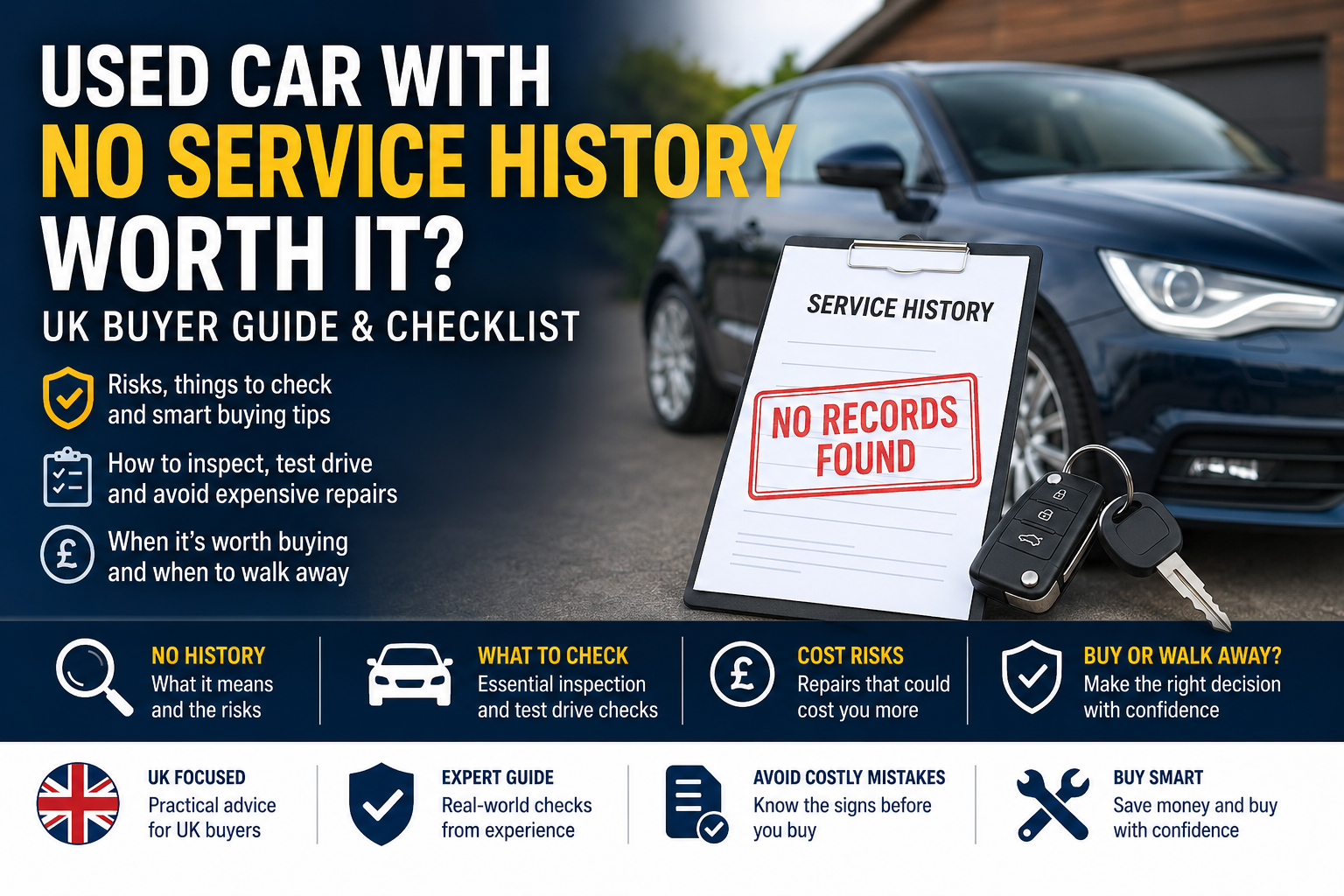
Should you buy a car with no service history?
Only if the price reflects the risk and the car checks out well. No service history does not automatically mean the car is bad, but it removes proof of maintenance and usually lowers value.
The safest approach is to judge the car on current condition, MOT history, mileage consistency, test drive behaviour, seller honesty and whether any invoices, digital records or garage printouts can still be found.
Looking for more buying advice? Browse our Used Car Buying Guides UK hub for inspection checklists, MOT history checks, service history advice, used car scams and first-time buyer tips.
Do not pay full-history money for a no-history car. Missing evidence should mean a stronger inspection, a lower price and a bigger maintenance budget.
What no service history means in real life
In real used car buying, missing service history can mean two very different things. Sometimes the car has been looked after but the paperwork has been lost. Other times, the missing history hides skipped oil changes, overdue cambelt work, neglected fluids or previous ownership problems.
The danger is paying strong money for a car where the maintenance story cannot be proved. This is especially important on diesel, turbocharged, high-mileage, performance, timing chain and cambelt engines.
MOT history helps you understand mileage and roadworthiness, but it does not prove oil changes, filter changes, brake fluid, coolant changes, cambelt replacement or proper servicing.
How risky is a car with no service history?
Lower risk
Low price, clean MOT history, low ownership doubts, smooth test drive, no warning lights and inspection looks strong.
Medium risk
Some invoices missing, advisories present, mileage is higher, service proof is patchy or major maintenance cannot be confirmed.
High risk
No records, poor MOT history, warning lights, smoke, coolant loss, timing belt uncertainty, seller pressure or refusal of inspection.
Best used car checklist flow before buying
Use this order before paying a deposit. It helps you decide whether the missing service history is a manageable risk or a reason to walk away.
1. Check MOT history
Look for mileage consistency, repeated advisories, corrosion, brake issues, tyre issues and old failures.
Check MOT history →2. Search for service proof
Ask for invoices, digital records, dealer printouts, previous garage details or receipts from the last owner.
Service history guide →3. Inspect the car properly
Check oil condition, coolant level, leaks, tyres, brakes, suspension, warning lights and interior wear.
Inspection checklist →4. Test drive it properly
Check clutch, gearbox, brakes, steering, temperature, smoke, noises, hesitation and warning lights.
Test drive checklist →5. Compare price against risk
The price should be lower than similar cars with strong history, especially if major work cannot be proved.
Car value guide →6. Budget immediate servicing
Assume the car needs a full service unless you can prove recent maintenance.
Full service cost →Main risks of buying with no service history
Unknown oil changes
Missed oil changes can increase engine, turbo and timing chain wear.
No cambelt proof
If the timing belt is due and there is no evidence, budget for replacement.
Cambelt guide →Poor resale value
Future buyers may be cautious, so the car can be harder to sell later.
No major repair evidence
You cannot easily prove clutch, brakes, tyres, battery or suspension work.
Warranty concerns
Some warranty or goodwill claims may be affected by missing maintenance records.
Neglect risk
Missing records can sometimes suggest skipped maintenance or careless ownership.
When it may still be worth buying
- ✓The asking price is clearly lower than similar cars with full history.
- ✓The MOT history is clean, consistent and shows few repeated advisories.
- ✓The car drives well with no warning lights, smoke, overheating or strange noises.
- ✓There are some recent invoices, even if full history is missing.
- ✓The seller has a believable ownership story and allows proper inspection.
- ✓An independent inspection finds no serious concerns.
Use our used car test drive checklist and questions to ask when buying a used car before deciding.
What to check first
- 1MOT history: check mileage consistency, failed tests and repeated advisories.
- 2Engine condition: look for smoke, oil leaks, coolant loss, rough idle or warning lights.
- 3Test drive behaviour: check clutch, gearbox, brakes, steering and suspension.
- 4Tyres and brakes: worn consumables can quickly add to the real purchase cost.
- 5Paperwork search: ask for invoices, digital records, dealer printouts or previous owner receipts.
- 6Timing belt or chain: check whether cambelt replacement is due or whether chain noise is present.
- 7Immediate service budget: assume it needs servicing unless proven otherwise.
Helpful pages: how to check MOT history before buying, MOT advisory meaning and used car inspection checklist.
What missing history matters most?
Some missing records are more serious than others. A missing receipt for a wiper blade is not a big concern. Missing proof of oil changes, cambelt replacement or major repairs can be much more important.
Oil and filter services
Especially important for turbocharged, diesel, performance and timing chain engines.
Cambelt replacement
If there is no proof and it is due, budget for replacement immediately.
Cambelt guide →Brake and tyre work
These affect safety and can add immediate cost after purchase.
Clutch replacement
Useful proof on higher-mileage manual cars.
Clutch cost guide →Cooling system repairs
Overheating history or coolant loss needs careful checking.
Coolant leak guide →Timing chain concerns
Poor oil history can matter if the engine is known for chain wear.
Timing chain rattle guide →Use missing service history to negotiate
A car with no service history should usually be cheaper than a similar car with full history. Missing records increase uncertainty, so the asking price should reflect that risk.
- £Budget for a full service soon after purchase.
- £Budget for cambelt replacement if there is no proof it has been done.
- £Allow for brake, tyre, battery, coolant and fluid work.
- £Use MOT advisories and inspection results to support your offer.
- £Compare likely repair costs using our car repair costs guide UK.
Do not pay full-history money for a no-history car unless the condition, inspection and price genuinely justify it.
What to do after buying a car with no service history
If you decide to buy, start building a maintenance record immediately. Keep invoices and record mileage for every job.
Book a full service
Change oil, oil filter, air filter, cabin filter and inspect fluids, brakes, tyres and suspension.
Full service cost guide →Check safety items
Brakes, tyres, steering, suspension, lights and wipers should be checked early.
Maintenance checklist →Confirm cambelt status
If there is no proof and the engine uses a cambelt, treat it as due unless you can verify otherwise.
Cambelt guide →Keep every invoice
Good records from your ownership will help resale value later.
When to walk away
- !No service history and poor MOT history.
- !Seller cannot explain ownership or maintenance.
- !Warning lights stay on after startup.
- !Smoke, overheating, coolant loss or serious oil leaks.
- !Clutch slip, gearbox problems, brake grinding or suspension knocks.
- !Timing belt is overdue with no proof of replacement.
- !The seller refuses inspection or test drive.
- !The price is similar to cars with proper history.
If the car is expensive, high mileage, diesel, turbocharged, performance-focused or has a cambelt with no evidence, missing history becomes a much bigger risk.
Best mechanic-style advice
Do not buy the seller’s reassurance — buy the evidence. A car with no service history needs a better price, a stronger inspection and a bigger maintenance budget.
If the car drives well, has clean MOT mileage, no warning lights and a fair price, it may still be worth considering. If the story is vague and the price is not reduced, walk away.
Missing history is not always a deal breaker, but paying too much for missing evidence is where buyers get caught.
Related used car buying guides
Frequently asked questions
Is no service history a deal breaker?
Not always, but it increases risk. The car should be cheaper and should pass careful inspection.
Does no service history affect value?
Yes. Cars with missing service history are usually worth less and may be harder to sell later.
Should I service the car straight after buying?
Yes. If you buy a car with no history, a full service soon after purchase is sensible.
Should I buy a high-mileage car with no service history?
Be very cautious. High mileage can be fine with strong history, but missing history makes it much harder to judge condition and maintenance.
Can MOT history replace service history?
No. MOT history helps with mileage and roadworthiness records, but it does not prove oil changes, servicing or major maintenance.
Can digital service history be recovered?
Sometimes. A dealer, specialist or previous garage may be able to confirm digital records if the car was serviced within their network.
Should I buy a diesel with no service history?
Only with caution. Diesel repairs such as DPF, turbo, injector and EGR faults can be costly, so strong service history is especially useful.
What should I service first after buying?
Start with oil, oil filter, air filter, cabin filter, fluid checks, brakes, tyres and cambelt status if the engine uses a timing belt.