
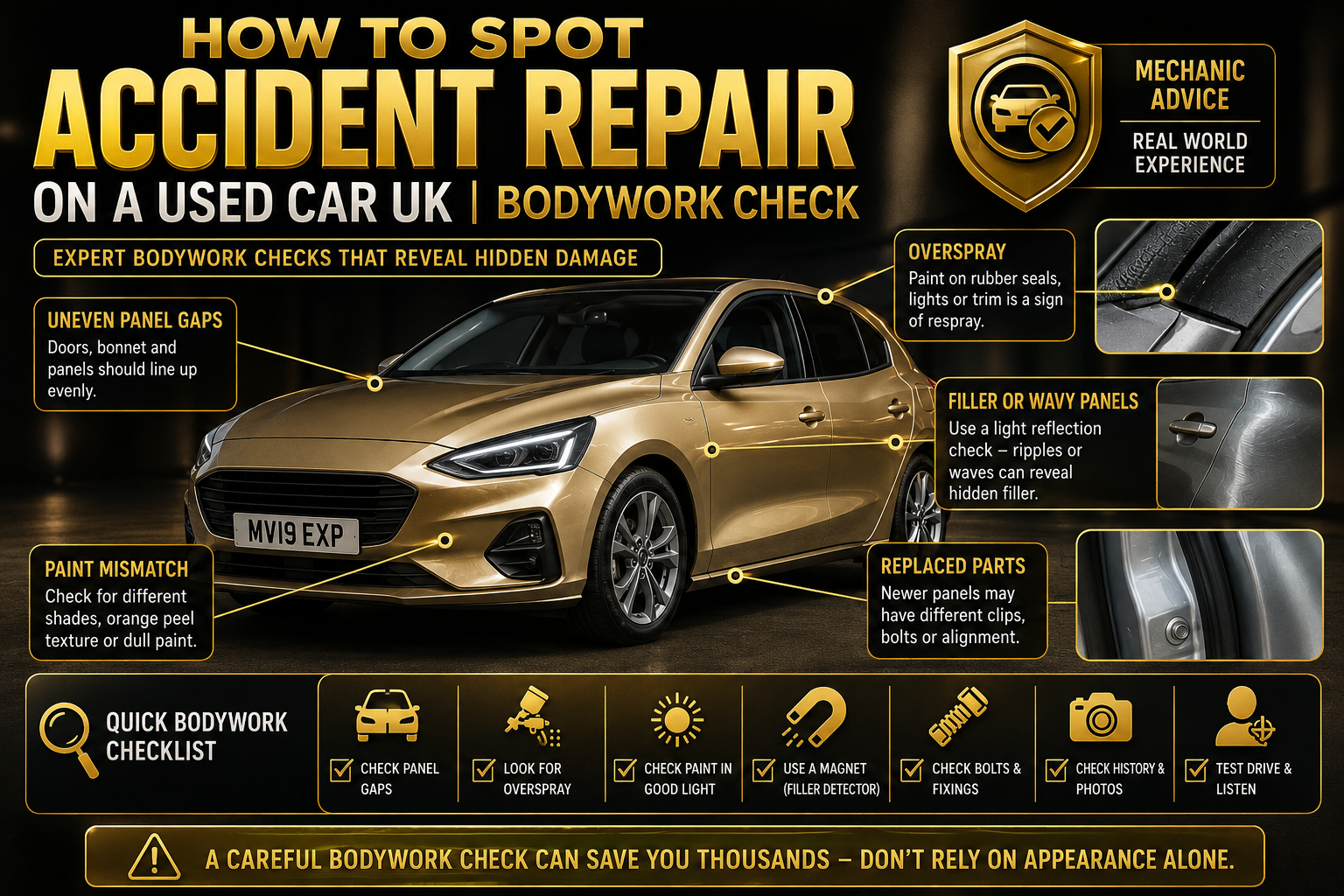
Quick answer
To spot accident repair on a used car, check for mismatched paint, uneven panel gaps, overspray, poor bumper fit, misaligned lights, fresh underseal, replaced bolts, uneven tyre wear, steering pull, damp carpets, warning lights and paperwork that does not explain the repair history.
A repaired car is not always bad. The real problem is poor repair quality, hidden structural damage, missing evidence and a seller who avoids direct questions. If the bodywork, history and test drive do not match, be careful.
Do not judge a used car only by how shiny it looks. Look at the edges, gaps, bolts, tyre wear, warning lights, paperwork and how it drives.
What accident repair looks like in real life
In real used car checks, poor accident repair often shows around the edges rather than in the centre of the panel. A door may be a slightly different colour, a bumper may not sit evenly, a headlight may be slightly lower, or one side of the car may have newer bolts, clips or trims.
Some sellers describe damage as “only a small bump”, but the car may show deeper signs such as steering pull, uneven tyre wear, water leaks, airbag warning lights or poor panel alignment. The story, paperwork and condition should all match.
A repaired car can still be a sensible buy if the repair is safe, documented and priced correctly. What you want to avoid is hidden damage, poor repair work and a seller who cannot explain what happened.
Paint and panel clues
Walk around the car slowly in daylight. Look at each side from a few metres away, then inspect close up. Poor accident repair often shows at the edges, shut lines and trim areas.
- !Different paint shade between nearby panels.
- !One panel looks newer, glossier or duller than the rest.
- !Uneven gap around bonnet, boot, bumper or doors.
- !Doors do not close with the same feel from side to side.
- !Headlights or rear lights do not sit level.
- !Bumper corners do not line up cleanly with wings or quarter panels.
- !Paint texture looks rough, heavy, flat or badly blended.
- !Paint edge can be felt around trims, fuel flap, door shuts or bumper edges.
Avoid inspecting bodywork in rain, darkness or under strong showroom lighting only. Those conditions can hide colour mismatch, small ripples and poor blending.
Overspray and repair marks
Good body repair should be difficult to spot. Rushed repair often leaves small clues around trims, rubber seals, bolts and hidden edges.
Check rubber seals
Look around windows, door seals, boot seals and windscreen edges for paint mist.
Check bolts and hinges
Fresh paint, tool marks, missing paint or mismatched bolts can show panels have been removed.
Check wheel arches
Overspray on arch liners, suspension parts or mud guards can suggest repair work.
Check inside door shuts
Poor blending, rough edges or colour changes inside shuts can reveal previous paintwork.
Check behind bumpers if visible
Broken clips, cable ties, cracked brackets or poor bumper fit can suggest previous impact.
Check the fuel flap
Colour mismatch around the fuel flap can show whether paint has been blended badly.
Structural and underside clues
Structural damage is more serious than a painted bumper. Look for signs that the car has been hit hard or repaired underneath.
- !Creased metal in the boot floor, inner wings, chassis legs or engine bay.
- !Fresh seam sealer or uneven welds compared with the other side.
- !Fresh underseal only on one side or one section.
- !Suspension components look newer on one side only.
- !Uneven tyre wear after recent alignment.
- !Bonnet, boot or doors need force to close properly.
- !Water leaks into boot, footwells or spare wheel well.
- !Subframe, mounting points or inner arches look bent, repaired or heavily coated.
If you cannot inspect the underside safely, do not guess. A pre-purchase inspection is sensible on high-value cars, Cat S cars, Cat N cars or anything with unclear repair history.
VIN, paperwork and history checks
Accident repair is not only a bodywork issue. The paperwork should make sense too. The car’s identity, MOT history, service records and seller’s story should all line up.
Check the VIN
The VIN on the car should match the V5C, history report and visible vehicle identity points.
Check MOT history
Look for repeated advisories for tyres, suspension, corrosion, lights, brakes or accident-related clues.
MOT history guide →Check category markers
A history check can reveal Cat S, Cat N or previous write-off markers.
Cat S vs Cat N →Ask for repair evidence
Invoices, photos and inspection reports are much better than “it was only a small bump”.
Also check service history carefully. Missing records do not prove accident damage, but weak paperwork makes any used car harder to trust. See how to check service history.
Interior and safety clues
Airbag warning light
An airbag light can point to crash-related or restraint-system faults.
Airbag light MOT guide →Different trim fit
Loose trims, rattles or poor dashboard fit can follow repair, water ingress or previous dismantling.
Seatbelt marks
Check seatbelts retract properly and show no fraying, stiffness, cuts or damage.
Seatbelt MOT guide →Damp carpets
Poor body repair or bad seals can let water into the cabin or boot.
Warning lights
ABS, airbag, steering and traction lights should go out after startup.
Warning lights hub →Odd smells
Damp, mouldy or chemical smells may suggest hidden leaks or recent repair work.
Car smells guide →Test drive clues that may point to poor repair
A car can look fine while parked but feel wrong on the road. Accident repair issues often show through steering, braking, tyre wear and road noise.
- !The car pulls left or right on a straight road.
- !The steering wheel sits off-centre.
- !The car shakes at speed or under braking.
- !There are knocks from one corner over bumps.
- !Tyres wear unevenly across one axle.
- !The car feels unstable or nervous on uneven roads.
- !Braking pulls the car to one side.
- !There is wind noise from one door, window or roof area.
Use the full used car test drive checklist before buying.
Car pulls left or right
Could be tyres, alignment, suspension wear or repair-related geometry issues.
Read guide →Car shakes at high speed
Vibration can come from wheels, tyres, suspension, alignment or damaged parts.
Read guide →Car shakes when braking
Brake vibration, warped discs, suspension play or accident-related issues should be checked.
Read guide →Cat S and Cat N accident history
Cat S and Cat N cars are insurance write-off categories. They can be repaired and sold, but you need to understand what damage was recorded and whether the repair was done properly.
Cat S
Usually means structural damage was recorded. Repair quality and inspection matter a lot.
Cat N
Usually means non-structural damage was recorded, but that does not automatically mean the repair was cheap or simple.
Ask for evidence
Photos, invoices and inspection reports help show what was damaged and how it was repaired.
Price should reflect history
A categorised car should normally be priced lower than a clean-history equivalent.
Read Cat S vs Cat N explained UK before buying a written-off repaired car.
Good repair vs poor repair
Signs of a better repair
- ✓Repair history is clear.
- ✓Invoices or photos are available.
- ✓Paint match is good in daylight.
- ✓Panel gaps are even.
- ✓The car drives straight.
Signs of a poor repair
- !Seller avoids the repair story.
- !Overspray and rough edges are visible.
- !Warning lights stay on.
- !Tyres wear unevenly.
- !Car pulls, knocks or feels unstable.
What to check first
1. View in daylight
Daylight makes paint mismatch, dents, overspray and poor blending easier to see.
2. Stand back and compare sides
Look at the car from the front, rear and both sides to compare panel gaps and alignment.
3. Check door shuts and hidden edges
Poor repairs often show around inner edges, hinges, seals and bolts.
4. Inspect tyres and steering
Uneven tyre wear and steering pull can point to alignment or suspension damage.
5. Check VIN and history
A vehicle history check can reveal recorded insurance categories and previous damage markers.
6. Test drive properly
The road test can reveal pulling, vibration, suspension knocks and poor alignment.
When to walk away
- !The seller hides or denies obvious accident repair signs.
- !VIN, paperwork or history report details do not match.
- !Airbag, ABS, steering or traction warning lights stay on.
- !The car pulls badly even after claimed alignment work.
- !Panel gaps are very poor or doors do not shut properly.
- !Fresh underseal appears to hide serious rust or repairs.
- !Cat S or Cat N repair history has no supporting evidence.
- !The seller rushes you, refuses inspection or changes the story.
If accident repair signs are clear but the seller cannot explain them properly, it is usually safer to walk away or pay for an independent inspection.
Best mechanic-style advice
- ✓View the car in daylight, not rain or darkness.
- ✓Compare both sides of the car from a distance.
- ✓Check door shuts, bonnet edges, boot floor and hidden paint edges.
- ✓Do not ignore warning lights after a claimed accident repair.
- ✓Ask for repair invoices, photos or inspection reports.
- ✓Use a history check for Cat S, Cat N, stolen or written-off markers.
- ✓Walk away if the seller's story does not match the car.
Related used car buying guides
Frequently asked questions
How can I spot accident repair on a used car?
Look for mismatched paint, uneven panel gaps, overspray, poor bumper fit, misaligned lights, fresh underseal, different bolts, tyre wear and steering pull.
Is a repaired accident car always bad?
No. A properly repaired car can be fine if the repair is clear, safe and reflected in the price. Poor repairs and hidden damage are the bigger concern.
What does paint mismatch mean?
Paint mismatch usually means a panel has been resprayed. It could be cosmetic, rust-related or accident-related, so check the surrounding area carefully.
Can a test drive reveal accident damage?
Yes. Pulling, vibration, off-centre steering, braking pull and uneven tyre wear can point to alignment, suspension or repair issues.
Should I buy a Cat S or Cat N car?
Only with caution. Check the repair quality, ask for evidence and consider an independent inspection before buying.
Is fresh underseal a warning sign?
It can be. Fresh underseal may be protective, but it can also hide rust, welding or poor underside repairs.
Can accident damage affect insurance?
Yes. Category history, poor repair quality or undisclosed damage can affect value, insurance questions and future resale confidence.
When should I walk away?
Walk away if the seller hides damage, warning lights stay on, the car pulls badly, paperwork does not match or repair quality looks unsafe.