Quick answer
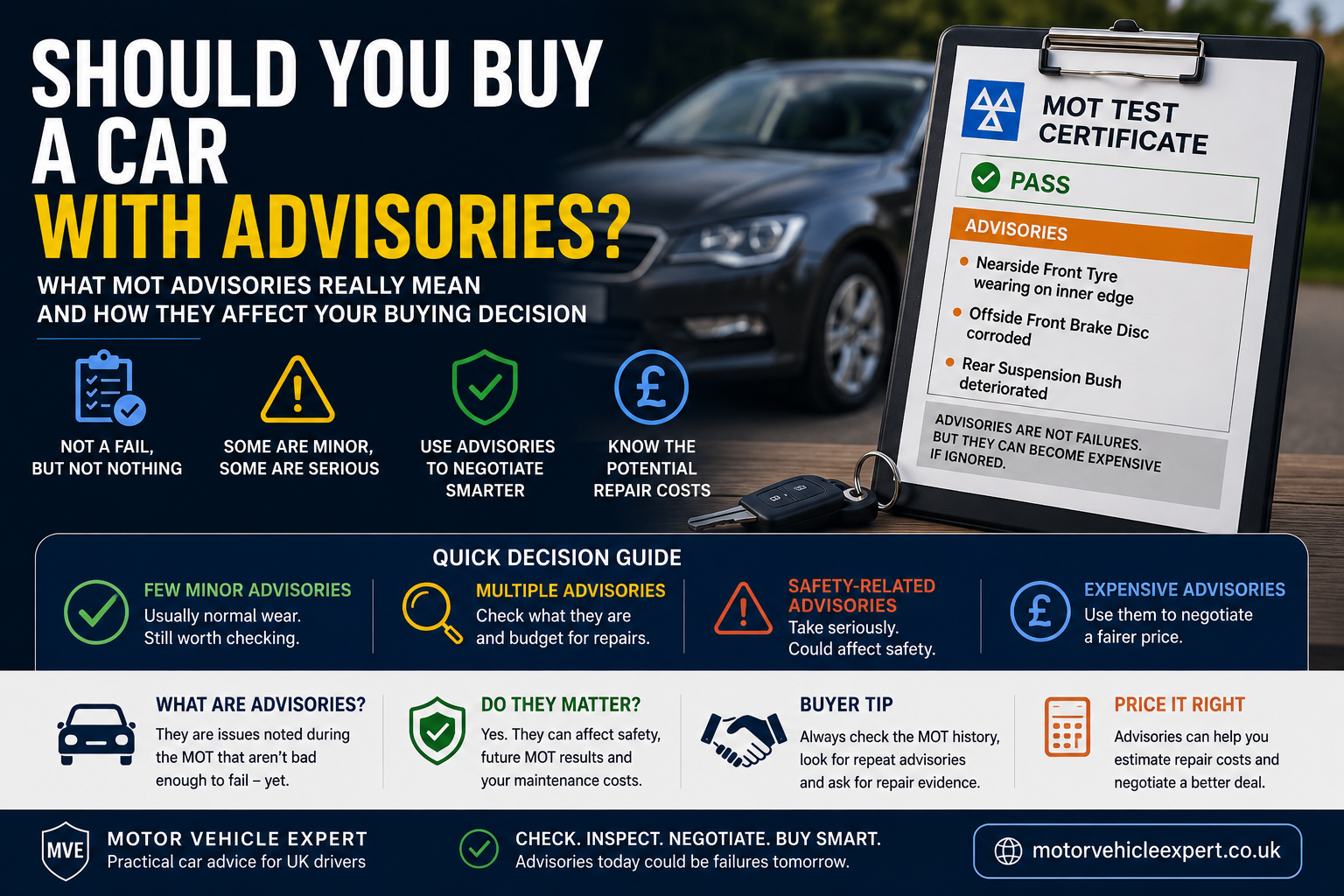
It is OK to buy a car with MOT advisories if the advisories are minor, the price is fair, repair costs are understood and the car passes a proper inspection and test drive. An advisory is not a failure, but it is still useful buying information.
Be more cautious if the same advisory appears year after year, or if the notes mention corrosion, brakes, tyres, steering, suspension, emissions, oil leaks, coolant leaks, structural areas or anything safety-related.
Do not decide from the word “advisory” alone. Decide from the type of advisory, how often it appears, repair cost, service history, seller honesty and how the car drives.
What I normally look for before buying a car with advisories
In real workshop situations, advisories are not automatically bad. A used car may have a tyre close to the limit, brake pads wearing thin or a small wiper issue and still be a sensible buy if the price is right.
What worries me is a pattern. If the same corrosion, suspension, brake pipe, tyre wear or oil leak advisory appears again and again, it normally means the issue has been ignored, delayed or only partly dealt with.
When I look at a car with advisories, I want the MOT history, seller story, inspection, service records and test drive to agree with each other. If they do not, I slow down or walk away.
A car with advisories can still be a good buy, but only if you understand the repair risk before paying.
What MOT advisories mean in real life
“Only an advisory” can still cost money
A tyre, brake or suspension advisory may not fail today, but it can need repair soon.
Repair costs guide →Repeated notes show habits
If the same advisory returns every year, the car may be maintained only at MOT time.
Check MOT history →Clean latest MOT is not enough
Older MOT history can show repeated rust, tyre or suspension problems even if the latest test looks clean.
Advisory meaning →Tyres can be a quick bill
Low tread or uneven wear may mean replacement and alignment are needed soon.
Low tyre tread MOT →Rust needs proper inspection
Corrosion advisories can go from “monitor” to expensive welding later.
Rust MOT guide →Seller attitude matters
If the seller dismisses serious advisories or refuses inspection, that is a buying red flag.
Used car scams →What does an MOT advisory mean when buying a car?
An MOT advisory means the car passed the MOT, but the tester noticed something that may need monitoring or repair. It is not the same as a failure, but it should not be ignored when deciding whether to buy.
Some advisories are cheap and simple, such as worn wiper blades. Others can point to expensive repairs, such as suspension wear, brake corrosion, structural rust, wheel bearing play, emissions issues or fluid leaks.
For a full explanation, read MOT advisory meaning explained.
Common MOT advisories on used cars
Tyres wearing low
Budget for replacement soon, especially if tread is close to the legal limit or worn unevenly.
Low tyre tread guide →Brake wear
Pads, discs, pipes or fluid condition may need attention soon.
Brake pad cost guide →Light corrosion
Minor rust can be normal on older cars, but repeated corrosion needs caution.
Rust MOT guide →Suspension wear
Worn bushes, ball joints, links or dampers can lead to future repair bills.
Suspension MOT guide →Oil misting or leaks
Small leaks may worsen, so check underneath and around the engine bay.
Oil leak MOT guide →Wipers or washers
Usually simple fixes, but still worth checking before purchase.
Wipers MOT guide →Wheel bearing play or noise
Can become noisy, unsafe or expensive depending on access and vehicle type.
Wheel bearing cost →Exhaust or emissions notes
Can be more serious on diesels, especially with smoke, DPF or EGR symptoms.
Used diesel guide →Lights or number plates
Usually lower cost, but repeated failures may show poor basic maintenance.
Common MOT failures →Good advisories vs bad advisories
- ✓One-off minor advisories can be normal on older used cars.
- ✓Consumables such as tyres, wipers or brake pads may simply need budgeting for.
- ✓Repaired advisories are less concerning if the seller has invoices or proof.
- ✓Advisories priced into the car can still make a sensible purchase.
- !Repeated corrosion advisories need careful underside inspection.
- !Multiple suspension or steering advisories can become expensive.
- !Fluid leaks should be checked properly before buying.
- !Patterns matter more than one isolated advisory.
Look at the full MOT history, not only the latest MOT
A car can have a clean latest MOT but a messy history behind it. Look for repeat advisories, mileage patterns, rust notes, tyre wear and whether the owner fixes problems properly or lets them return.
Same advisory every year
This suggests the issue may be ignored, recurring or only temporarily repaired.
Advisory disappears suddenly
Ask for proof it was repaired, especially if it involved rust, brakes or suspension.
Mileage does not match
Mileage gaps or drops should be checked against service history and condition.
Clocked mileage signs →Recent advisories before sale
The seller may be moving the car on before spending money on repairs.
Advisory red flags before buying
- !The same advisory appears several years in a row.
- !Corrosion advisories are getting worse over time.
- !There are several advisories for brakes, suspension, tyres or steering together.
- !The seller says “it is only an advisory” but has no repair evidence.
- !The car drives poorly, despite having a valid MOT.
- !The price does not reflect likely repair costs.
- !The latest MOT is clean but older MOT history shows repeated serious issues.
- !Advisories mention structural corrosion, leaks, brake pipes, steering or suspension mounting points.
If the car has a poor MOT record, read buying a car with failed MOT history.
Use MOT advisories to negotiate
Upcoming tyres, brakes, suspension work, corrosion repairs or leak repairs can justify a lower offer. Ask whether the advisory items have already been fixed and request invoices where possible.
- £Brake advisories: compare likely costs with brake pad replacement cost UK.
- £Wheel bearing concerns: see wheel bearing replacement cost UK.
- £Suspension issues: budget for arms, bushes, joints, springs or shocks if several notes appear.
- £Rust concerns: welding and corrosion repair can be expensive, so inspect underneath carefully.
- £General repair budgeting: use car repair costs guide UK.
Do not negotiate only on the existence of advisories. Negotiate based on likely repair cost, urgency, proof of repair and whether the asking price already reflects the condition.
Questions to ask the seller
- ?Have the advisory items been repaired?
- ?Do you have invoices for tyres, brakes, suspension, rust or leak repairs?
- ?Why does the same advisory appear more than once?
- ?Has the car had welding, underseal or corrosion treatment?
- ?Are there any faults not shown on the MOT history?
- ?Can I inspect the car from cold and test drive it properly?
- ?Is the price already reduced because of the advisories?
For more buyer questions, use questions to ask when buying a used car and questions to ask a dealership.
What to check before buying
MOT advisories should be checked alongside the car’s current condition, service history and test drive behaviour. Do not rely on the latest MOT alone.
- 1Check the full MOT history, not just the latest test.
- 2Ask whether advisory items have been repaired.
- 3Inspect tyres, brakes, steering, suspension and underside corrosion.
- 4Take a proper test drive and listen for knocks, grinding or vibration.
- 5Compare the advisories with the asking price.
- 6Ask for invoices, not just verbal reassurance.
- 7Check service history, mileage records and seller details.
- 8Walk away if the seller avoids questions or refuses inspection.
Use our MOT history check guide, used car inspection checklist, used car test drive checklist and how to check service history.
When a car with advisories can still be a good buy
A car with advisories can still be a strong buy if the advisories are minor, the vehicle has good service history, the seller is honest, the price is fair and a test drive shows no worrying symptoms.
Good example
One advisory for tyres wearing low, strong service history, fair price, clean test drive and clear repair budget.
Bad example
Repeated corrosion, suspension wear and brake advisories, no invoices, vague seller and a price that ignores the repair risk.
Acceptable risk
Minor wear items on an older car where the price leaves room for maintenance.
High risk
Structural rust, brake pipe corrosion, steering play, multiple suspension advisories or leaks.
Best mechanic-style advice
Do not panic just because a used car has advisories. Most older cars have some wear. The real question is whether the advisories are honest wear, ignored maintenance or signs of bigger problems.
Read the full MOT history, inspect the car, test drive it properly, check service records and price the repairs. If the seller’s story does not match the paperwork or the car, walk away.
A car with advisories is not automatically bad. A seller who ignores, hides or dismisses serious advisories is the bigger problem.
Related used car buying guides
Frequently asked questions
Is an MOT advisory bad?
Not always. An advisory means the car passed, but something was noted for monitoring or future repair.
Should I avoid a car with advisories?
Not automatically. Avoid it if the advisories are serious, repeated, expensive or not reflected in the price.
Can advisories become MOT failures?
Yes. Tyres, brakes, suspension, corrosion, steering, emissions problems and leaks can become failures if ignored.
Should advisories reduce the price?
Often yes, especially if repairs are likely soon or the seller cannot prove the work has been done.
Are repeated advisories a warning sign?
Yes. The same advisory appearing year after year can suggest delayed maintenance or a problem that is getting worse.
Should I ask the seller to fix advisories before buying?
You can. For safety-related advisories such as tyres, brakes, steering or suspension, it may be better to have them repaired before purchase or negotiate the price accordingly.
Is a car with a clean latest MOT always better?
Not always. Older MOT history, service records and the current condition still matter.
Which advisories are most serious?
Corrosion, brakes, steering, suspension, tyre damage, brake pipe corrosion, emissions problems and fluid leaks are usually more serious than simple wipers or bulbs.
Can I use advisories to negotiate?
Yes. Use realistic repair costs and inspection findings to negotiate, especially where repairs are due soon.
When should I walk away?
Walk away if advisories are serious, repeated, expensive, poorly explained or the seller refuses inspection or repair evidence.