
Quick answer
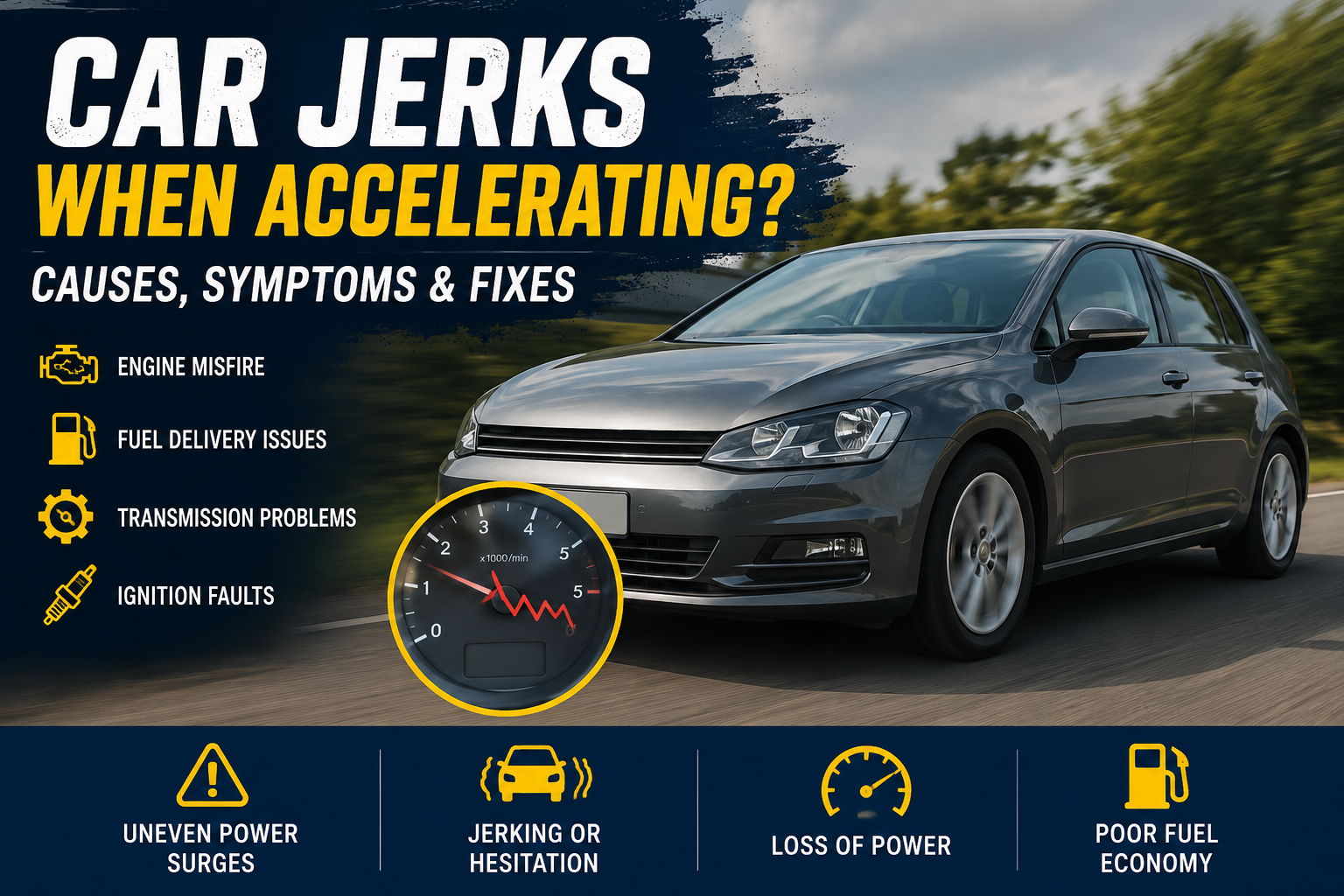
A car jerking when accelerating is commonly caused by an engine misfire, weak spark plugs, faulty ignition coils, fuel delivery problems, a blocked filter, dirty injectors, turbo boost faults, clutch slip, gearbox issues, engine mount movement or sensor faults.
The quickest way to narrow it down is to notice the pattern. Jerking with warning lights often points towards engine or sensor faults. Jerking during gear changes points towards clutch, gearbox or mounts. Jerking only under hard acceleration often points towards misfire, fuel pressure, boost or load-related faults.
Do not replace parts just because the car “jerks”. First work out whether the jerk follows throttle load, engine revs, road speed, gear change or warning lights.
What acceleration jerking often feels like in real life
Many drivers describe several different faults as “jerking”. One car may have a misfire under load, another may have poor fuel pressure, and another may have a gearbox or clutch issue. From the driver’s seat, they can all feel like the car is pulling, dropping, then pulling again.
The most useful clue is when it happens. A jerk at low speed, a jerk during gear changes, a jerk uphill and a jerk with the engine management light are not the same diagnosis.
If the car jerks harder when you press the accelerator more, think about load-related faults such as misfire, fuel delivery, boost leaks, clutch slip or engine movement.
Quick diagnosis map
Jerks with engine light
Start with fault codes, misfire data, ignition coils, spark plugs, sensors and fuel trim readings.
Engine management light guide →Jerks under hard acceleration
Think misfire under load, weak fuel pressure, turbo boost fault, dirty filter or ignition weakness.
Power loss guide →Jerks at low speed
Think throttle control, clutch control, gearbox behaviour, mounts or low-speed drivability issues.
Low-speed jerk guide →Jerks after fuel filter work
Think air in fuel system, wrong filter, poor priming, low pressure or disturbed connections.
Fuel filter change guide →Jerks when changing gear
Think clutch, gearbox, engine mounts, gearbox mounts or driver-assist calibration issues.
Gear-change jerk guide →Jerks and hesitates
If power pauses before arriving, hesitation diagnosis may be more accurate than vibration diagnosis.
Hesitation guide →Common causes of car jerking when accelerating
Engine misfire
A misfire can make the engine shake, hesitate and jerk when power is requested.
Engine misfire guide →Spark plugs or ignition coils
Weak ignition often shows under load, especially uphill or during hard acceleration.
Ignition fault clues →Fuel delivery issue
Low fuel pressure, injector issues or restricted filters can cause uneven power.
Fuel filter issue →Turbo boost problem
Boost leaks or unstable turbo control can cause surging, hesitation or jerking.
Acceleration power loss →Clutch fault
A worn or contaminated clutch can make acceleration feel uneven or jerky.
Clutch wear signs →Gearbox behaviour
Automatic, manual or dual-clutch gearboxes can jerk during gear selection or throttle changes.
Gearbox jerk guide →Engine mounts
Worn mounts let the engine move too much when torque is applied.
Mount movement clues →Dirty air or fuel filter
Restricted airflow or fuel flow can make the car feel flat, hesitant or jerky.
Sluggish after service →Sensor fault
MAF, MAP, throttle, oxygen or crank sensor faults can affect fuelling and throttle response.
Use diagnostic app →Misfire and ignition-related jerking
Misfire is one of the most common reasons a car jerks when accelerating. The engine may feel smooth at idle but struggle when load increases because weak plugs, coils or fuelling cannot keep combustion stable.
Typical misfire clues
Jerking under load, flashing engine light, rough idle, poor fuel economy, petrol smell or loss of power.
Common checks
Fault codes, misfire counters, spark plugs, coils, injectors, compression and air leaks.
Read more: engine misfire symptoms and causes and check engine light flashing then stops.
Fuel delivery problems
If the engine does not receive enough fuel when you accelerate, it may hesitate, jerk, surge or feel like it is cutting in and out. This can happen because of low fuel pressure, injector issues, contaminated fuel or a restricted filter.
Blocked filter
A restricted filter may allow idle but struggle when more fuel is needed.
Injector issue
Uneven injector delivery can make one cylinder behave differently from the others.
Poor fuel pressure
Weak pressure can show more during hard acceleration, hills or higher speeds.
If the issue started after filter work, read car jerks after fuel filter change.
Clutch, gearbox and drivetrain jerking
Not every acceleration jerk comes from the engine. If the jerk appears when changing gear, pulling away, reapplying throttle or driving uphill, the clutch, gearbox, engine mounts or drivetrain should be checked.
Manual clutch
Slip, judder, contamination or poor bite point can make acceleration feel uneven.
Clutch wear signs →Gear change jerk
A jerk during gear changes can involve clutch control, mounts, gearbox wear or transmission calibration.
Gear-change jerk guide →Pull-away judder
If the car shakes or judders when moving off, the diagnosis may be clutch or mount-related.
Pull-away judder guide →For budgeting, see clutch replacement cost UK.
When does the car jerk?
Only when accelerating hard
Misfire, fuel pressure, boost faults or ignition weakness are more likely.
Losing power under acceleration →Only at low speed
Throttle control, clutch, gearbox, mounts or low-speed fuelling may be involved.
Low-speed jerk guide →Only uphill
Uphill driving exposes weak ignition, fuel delivery, clutch slip and turbo problems.
Loses power uphill →Only after gear changes
Clutch, gearbox, mounts or drivetrain movement become more likely.
Gear change jerk →Only after service or repair
Start with the recently touched area, such as filters, plugs, coils or hoses.
Sluggish after service →With shaking or vibration
If it feels more like vibration than a lurch, compare with juddering and shaking guides.
Juddering when accelerating →Jerking with dashboard warning lights
If the car jerks and a warning light appears, diagnosis should start with a fault-code scan. Warning lights can point towards misfires, emissions, sensors, boost control, fuel faults or throttle issues.
Engine management light
Often linked to misfires, emissions, sensors, fuelling or boost faults.
Engine light guide →Flashing engine light
Treat seriously because it can indicate an active misfire that may damage the catalytic converter.
Flashing engine light →Traction or ESP lights
Sometimes traction control intervention can feel like jerking or power cutting.
Traction control light →What to check first
1. Check warning lights
Scan for fault codes if the engine light, traction light or other warning appears.
2. Notice when it happens
Hard acceleration, low speed, uphill, gear changes and cold starts all point in different directions.
3. Check recent service history
Old spark plugs, filters, missed servicing or recent filter work can matter.
4. Listen and feel carefully
A sharp lurch feels different from vibration, hesitation, misfire or gearbox thump.
5. Check for smells or smoke
Fuel smell, burning clutch, exhaust smoke or hot smells are useful clues.
6. Avoid guessing parts
Many faults feel similar, so road-test pattern and diagnostic data matter.
Useful guides: Diagnostic App, Diagnostics Hub and car repair costs guide UK.
When to stop driving or get it checked quickly
- !The engine management light flashes.
- !The car loses power suddenly or struggles to accelerate.
- !The jerking becomes violent or unsafe.
- !You smell fuel, burning clutch, burning oil or hot electrics.
- !The car shakes badly at idle or under load.
- !There are loud knocks, bangs, grinding or metallic noises.
- !The fault started immediately after hitting a pothole, kerb or deep water.
- !The car stalls, cuts out or will not restart normally.
Possible repair costs
Repair cost depends on the cause. Some jerking faults are simple service items, while others need proper diagnostics before expensive parts are replaced.
Spark plugs or coils
Often moderate if diagnosis confirms an ignition misfire.
Fuel filter or fuel issue
Can be simple or more involved depending on pressure, pump and injector condition.
Clutch or flywheel
Usually more expensive because gearbox removal may be needed.
Clutch cost guide →Turbo or boost fault
Costs vary widely, so boost testing is important before replacing parts.
Sensor fault
Costs depend on whether the issue is sensor, wiring, air leak or ECU data mismatch.
Gearbox issue
Can range from adjustment or mounts to more expensive transmission work.
Best mechanic-style advice
The biggest mistake with acceleration jerking is replacing parts based only on guesses. A weak ignition coil, blocked filter, clutch issue and gearbox mount can all feel like “jerking” to the driver.
Start by identifying the pattern, then scan for codes, check service items, confirm fuel and ignition performance, and road test the car under the same conditions that create the fault.
If the jerk happens under load, do not ignore it. Load-related faults often get worse and can turn into misfire damage, clutch wear, fuel system issues or unsafe drivability.
Related acceleration and diagnostics guides
Frequently asked questions
Why does my car jerk when accelerating?
Common causes include misfires, spark plugs, ignition coils, fuel delivery problems, turbo faults, clutch issues, gearbox problems, mounts or sensors.
Can spark plugs cause jerking?
Yes. Worn plugs can misfire under load, causing jerking, hesitation, poor fuel economy and rough running.
Can fuel problems cause jerking?
Yes. Low fuel pressure, blocked filters, injector problems or contaminated fuel can cause uneven acceleration.
Can a clutch cause jerking?
Yes. Clutch wear, contamination, slip or flywheel issues can cause jerking, especially pulling away or uphill.
Can an automatic gearbox jerk?
Yes. Automatic and dual-clutch gearboxes can jerk because of adaptation, fluid, mounts, clutch packs, sensors or internal wear.
Should I keep driving?
Avoid hard driving. Stop if the car jerks violently, loses power, flashes a warning light, smells hot or feels unsafe.
Why does it jerk only uphill?
Uphill driving increases load, which can expose weak ignition, fuel pressure, turbo, clutch or engine mount faults.
Will diagnostics help?
Yes, especially if the engine management light appears, misfires are stored or the fault happens under load.