Quick answer
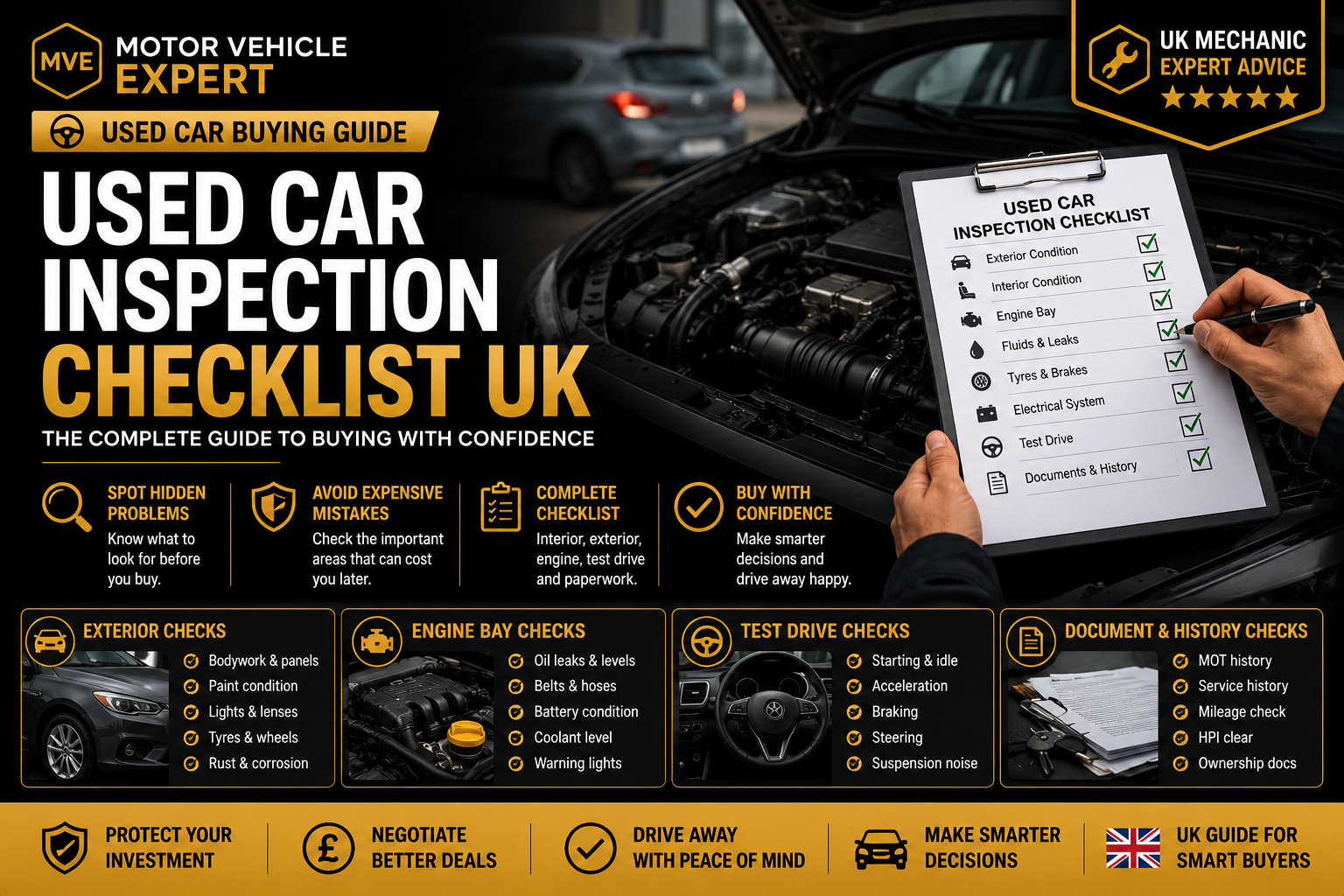
Before buying a used car in the UK, check the V5C logbook, VIN, MOT history, mileage pattern, service records, tyres, brakes, suspension, bodywork, rust, engine fluids, warning lights and test-drive behaviour.
The biggest warning signs are missing paperwork, mismatched vehicle details, mileage that does not add up, repeated MOT advisories, warning lights staying on, smoke, overheating, coolant loss, oil leaks, clutch slip, gearbox faults and a seller who rushes you.
Use this hub as your starting point. Begin with the inspection checklist, then check MOT history, service records, mileage, accident repair signs, warning lights and test-drive behaviour. If you are buying your first car, also check insurance, running costs and likely repair costs before deciding.
You can also browse our complete Guides section for more UK car advice covering maintenance, MOT tests, diagnostics, warning lights and repair costs.
Do not inspect the car looking for reasons to buy it. Inspect it looking for reasons not to buy it. A genuinely good used car should still look good after proper checks.
What I see when buyers choose the wrong used car
A lot of bad used car purchases happen because the buyer focuses on the wrong things. Clean paint, low mileage, nice photos and a fresh MOT can make a car look safe, but they do not always show how the car has been maintained.
In real workshop situations, the expensive faults are often hiding underneath: coolant leaks, worn clutches, weak batteries, engine misfires, hidden rust, accident repair, uneven tyre wear, warning lights that have been cleared and MOT advisories that keep coming back every year.
The best used car inspection starts before you arrive. Check the advert, MOT history and seller answers first. When you view the car, inspect it cold, check the fluids and warning lights, then drive it properly before making any decision.
A fresh MOT is useful, but it is not a full mechanical health check. A car can pass an MOT and still need a clutch, battery, tyres, brakes, suspension work, coolant repairs or engine diagnostics soon after purchase.
Used car inspection checklist
- 1Advert: check mileage, price, MOT length, number of owners, service history and whether the photos look honest.
- 2Seller: ask why the car is being sold, how long they have owned it and whether any faults are known.
- 3V5C: check the registration, VIN, colour, engine size and keeper details match the vehicle.
- 4MOT history: look for mileage gaps, repeated advisories, rust, brakes, tyres, suspension and emissions issues.
- 5Service records: check invoices, stamps, dates, mileage and proof of major jobs.
- 6VIN: make sure the VIN on the car matches the V5C and any vehicle history check.
- 7Bodywork: check rust, accident repair signs, uneven gaps, overspray and poor paint match.
- 8Tyres: check tread depth, sidewall damage, tyre age, matching brands and uneven wear.
- 9Engine cold start: listen for rattles, knocking, rough idle, weak starting and smoke.
- 10Fluids: check oil, coolant, leaks, contamination and overheating signs.
- 11Dashboard: warning lights should come on with ignition and go out after the engine starts.
- 12Test drive: check clutch, gearbox, brakes, steering, suspension, acceleration, temperature and warning lights.
Fast buyer inspection flow
1. Check the story
The advert, MOT history, mileage, service records and seller answers should all make sense before you travel.
2. Check the car cold
A cold engine can reveal smoke, rattles, rough idle, weak battery, timing chain noise and coolant problems.
3. Drive it properly
A proper test drive checks clutch, gearbox, brakes, steering, suspension, temperature and warning lights.
Before viewing the car
Do not wait until you are standing next to the car to start checking it. A poor advert, weak seller answers, missing history or strange MOT record can save you a wasted journey.
- ✓Check the registration number against the MOT history.
- ✓Compare the advert mileage with recorded MOT mileage.
- ✓Ask if the engine will be cold when you arrive.
- ✓Ask about service history, invoices and proof of major repairs.
- ✓Ask whether there are warning lights, leaks, smoke, overheating or known faults.
- ✓Check if the price is realistic compared with similar cars.
- ✓Arrange to view in daylight, not in darkness, rain or a rushed location.
- ✓Be cautious if the seller avoids simple questions before you arrive.
For more buying help, read how to check MOT history before buying, common used car scams and how to check if a car is stolen or written off.
Documents and history checks
Good paperwork does not guarantee a perfect car, but bad paperwork is one of the fastest ways to spot risk. The V5C, VIN, MOT history, service records and seller story should all line up.
- ✓The V5C logbook should match the registration, VIN and vehicle details.
- ✓The VIN on the car should match the V5C and any history report.
- ✓The MOT history should show consistent mileage and believable repair history.
- ✓Service records should include dates, mileage and work carried out.
- ✓Check for proof of cambelt, clutch, brakes, tyres, cooling system, battery or major repairs if claimed.
- ✓Check how many keys are included because replacement keys can be expensive.
- ✓If buying privately, check that the seller’s name and story make sense.
- ✓Get a written receipt if you buy the car.
If the V5C is missing, the VIN does not match, or the seller refuses basic checks, do not continue as if everything is normal.
How to use MOT history properly
MOT history is one of the strongest tools a UK used car buyer has. Do not only check whether the car passed. Read the failures and advisories year by year because the pattern often tells you how the car has been maintained.
Repeated advisories
Tyres, brakes, suspension or rust advisories that return every year can show poor maintenance.
MOT advisory buying guide →Mileage gaps
Mileage should rise naturally. Drops, missing years or odd jumps need questioning.
Corrosion notes
Rust near structural areas, sills, subframes or suspension mounting points can become expensive.
Rust MOT guide →Tyre history
Repeated tyre failures or advisories can suggest poor maintenance, alignment problems or suspension wear.
Low tyre tread MOT guide →Suspension history
Repeated suspension advisories can point to worn bushes, arms, springs, shocks or neglected repairs.
Suspension MOT guide →Fresh MOT
A fresh MOT helps, but it is not the same as a service, inspection or guarantee.
Common MOT failures →Mileage checks and clocking clues
Mileage should match the car’s condition. A low-mileage car with a shiny steering wheel, worn pedals, tired seat bolsters, missing history and odd MOT mileage records needs careful checking.
MOT mileage pattern
Look for sudden drops, strange jumps, missing years or mileage that does not match the advert.
Interior wear
Check the steering wheel, gear knob, pedals, driver seat and buttons against the claimed mileage.
Service invoice mileage
Invoices should show dates, mileage and work carried out. Missing records around key years need questioning.
Vehicle condition
Tyre wear, suspension wear, stone chips and interior wear should make sense for the mileage.
For more buying context, see used car with no service history and used diesel buying guide.
Exterior inspection checklist
- 1Check body panels for dents, rust, scratches and poor paint repairs.
- 2Look for uneven gaps around doors, bonnet, boot and bumpers.
- 3Look for paint mismatch between panels.
- 4Check for overspray around trims, door shuts, lights and rubber seals.
- 5Inspect tyres for low tread, cracks, bulges, exposed cords and uneven wear.
- 6Check headlights, brake lights, indicators, fog lights, number plate lights and side lights.
- 7Check windscreen chips, mirrors, wipers and washer operation.
- 8Look underneath for oil, coolant, fuel or brake fluid leaks.
- 9Check rust on sills, wheel arches, subframes and suspension mounting areas.
- 10Be careful with fresh underseal because it may be hiding corrosion.
Useful MOT-related checks: common MOT failure reasons UK, low tyre tread MOT failure and car fails MOT on rust.
Accident repair signs to check
A repaired car is not always a bad car, but poor accident repair can cause alignment problems, uneven tyre wear, water leaks, corrosion and resale issues.
Paint mismatch
Different shades between panels can suggest previous paintwork.
Overspray
Look around rubber seals, arch liners, trims, lights and inside door shuts.
Uneven panel gaps
Bonnet, boot, bumper and door gaps should look even from side to side.
Misaligned lights
Headlights and rear lights sitting unevenly can suggest previous impact.
Uneven tyre wear
Uneven wear can come from tracking, suspension wear or accident damage.
Does MOT check wheel alignment? →History category
If the car has been written off before, understand the risk before buying.
Stolen or written-off check →Interior and dashboard checks
- ✓Check seat, steering wheel, gear knob and pedal wear against the mileage.
- ✓Check windows, mirrors, central locking, radio, infotainment and key fobs.
- ✓Check heater, air conditioning, fan speeds and demisting.
- ✓Turn ignition on and make sure warning lights illuminate, then go out after starting.
- ✓Check for damp carpets, mould smell, water staining or condensation.
- ✓Look in the boot, spare wheel well and under mats for signs of water leaks.
- ✓Make sure seatbelts retract properly and are not frayed or damaged.
- ✓Check whether the spare wheel, inflation kit and locking wheel nut are present if supplied.
Warning lights matter when buying. See the warning lights hub and engine management light guide.
Engine bay and cold-start checks
Ask to see the car from cold if possible. A cold start can reveal timing chain noise, smoke, weak battery, rough idle and hidden coolant problems that may disappear once warm.
- 1Check oil level and look for thick sludge under the oil cap.
- 2Check coolant level, colour and signs of leaks or overheating.
- 3Look for oil, coolant, fuel or power steering fluid leaks.
- 4Listen for rattles, knocking, misfires or uneven idle after startup.
- 5Watch for white, blue, grey or black smoke from the exhaust.
- 6Smell for burning oil, coolant, petrol, exhaust fumes or hot plastic.
- 7Check whether the battery warning light, oil light or engine management light stays on.
- 8Make sure the engine temperature stays stable once warmed up.
Useful fault guides: car losing coolant but no leak, coolant warning light on, blown head gasket symptoms and car overheating causes explained.
Used car test drive checks
A proper test drive should include town driving, gentle acceleration, braking, steering, gear changes, bumps and a short faster section where legal and safe. Do not just drive around the block and decide.
- ✓The engine should pull smoothly without hesitation, smoke or warning lights.
- ✓The clutch should not slip, judder or smell burnt.
- ✓Gears should select smoothly without crunching, delay or banging.
- ✓Brakes should stop straight without grinding, vibration or pulling.
- ✓Steering should feel stable without shaking, drifting or heavy spots.
- ✓Suspension should not knock loudly over bumps.
- ✓The temperature gauge should stay stable once warm.
- ✓No warning lights should appear during the drive.
Good sign
The car starts cleanly, idles smoothly, drives straight, changes gear properly, brakes confidently and shows no warning lights.
Bad sign
The car hesitates, smokes, overheats, pulls to one side, knocks over bumps, slips the clutch, bangs into gear or shows warning lights.
Most commonly missed used car faults
Coolant loss
Many buyers never check coolant level, coolant smell or overheating signs before buying.
Coolant loss guide →Clutch slip
A weak clutch may only show under acceleration during a proper test drive.
Clutch replacement guide →Hidden warning lights
Some sellers clear codes temporarily before viewings, so stored faults and warning lights matter.
Engine management guide →Rust underneath
Clean paint does not mean the underside, sills or subframe areas are corrosion free.
Rust MOT guide →Suspension knocks
Knocks over bumps can point to worn bushes, drop links, ball joints, springs or shock absorbers.
Suspension MOT guide →Weak battery
Slow cranking, warning lights and poor starting can point to battery or charging problems.
Battery health guide →Used car buying red flags
- !The seller refuses a test drive or independent inspection.
- !The V5C is missing, incomplete or does not match the vehicle.
- !The VIN does not match the paperwork or looks tampered with.
- !The mileage does not match MOT or service records.
- !Warning lights stay on after the engine starts.
- !The engine smokes, overheats, misfires or loses coolant.
- !There are major oil, coolant, brake fluid or fuel leaks.
- !The seller rushes you, avoids questions or pushes for a quick deposit.
- !The car has repeated MOT advisories for the same problem.
- !The price is unusually low and the reason does not make sense.
Expensive faults to watch for
- £Clutch slip: rising revs without matching speed, burning smell or biting point very high.
- £Cooling system problems: coolant loss, overheating, white smoke or pressure in the expansion tank.
- £Brake problems: grinding, vibration, pulling or poor stopping performance.
- £Suspension wear: knocking, uneven tyre wear, poor handling or repeated MOT advisories.
- £Engine faults: misfire, smoke, rough idle, oil leaks or warning lights.
- £Electrical faults: weak starting, battery light, charging faults or multiple dashboard warnings.
- £Rust: corrosion around sills, subframes, suspension mounts or structural areas.
- £Diesel faults: DPF, injector, turbo or emissions problems.
For budget planning, read the car repair costs guide UK.
When to walk away from a used car
Sometimes the best inspection result is walking away. If the paperwork does not line up, the seller blocks proper checks, or the car shows serious mechanical symptoms, do not let pressure make the decision for you.
Walk away from overheating
Overheating can lead to head gasket, cylinder head and cooling system damage.
Overheating causes →Walk away from major warning lights
Engine, oil, battery, brake, ABS, airbag and coolant warnings can become expensive quickly.
Warning lights hub →Walk away from unclear mileage
If MOT mileage, service records and condition do not match, the risk is high.
Walk away from seller pressure
A good car should stand up to questions, checks and a proper test drive.
Used car scams →Quick buy-or-walk-away decision
More likely worth considering
The V5C matches, MOT mileage is consistent, service history is believable, the engine starts cleanly from cold, there are no warning lights, tyres are decent, temperature stays stable and the test drive feels normal.
Better to walk away
The seller avoids questions, paperwork does not match, warning lights stay on, the car overheats, coolant drops, smoke appears, gearbox feels rough, clutch slips or the MOT history shows repeated serious advisories.
Best mechanic-style advice before buying
Do not let clean paint, a fresh valet or seller pressure distract you from the mechanical checks. The car must make sense on paper, from cold, underneath, inside and on the road.
Start with documents and MOT history, then inspect the body, tyres, fluids, warning lights and cold start. Finish with a proper test drive. If the car fails on paperwork, seller honesty or serious mechanical symptoms, walk away.
Looking for more buying advice? Browse our Used Car Buying Guides UK hub for inspection checklists, MOT history checks, service history advice, used car scams and first-time buyer tips.
Never let a seller rush you. The more pressure there is to pay quickly, the more carefully you should check the V5C, VIN, MOT history, warning lights, coolant level, tyres and test-drive behaviour.
Related used car buying guides
Frequently asked questions
What should I check before buying a used car?
Check the V5C, MOT history, service records, mileage, VIN, tyres, brakes, bodywork, rust, engine fluids, warning lights and how the car drives.
Is a used car inspection checklist worth using?
Yes. A checklist stops you being distracted by clean paint, a nice interior or seller pressure. It keeps you focused on paperwork, safety, mechanical condition and expensive faults.
Should I buy a used car without a test drive?
Usually no. A test drive can reveal clutch, gearbox, brake, steering, suspension, overheating and engine faults that are not obvious while parked.
Can MOT history reveal problems?
Yes. Repeated advisories, mileage gaps, corrosion notes, tyre problems and recurring faults can suggest poor maintenance or future repair costs.
Is a fresh MOT enough when buying a used car?
No. A fresh MOT is useful, but it is not the same as a service, warranty or full mechanical inspection.
Should I check the car when the engine is cold?
Yes. A cold start can reveal smoke, rattles, rough idle, weak battery, timing chain noise and starting issues.
What warning lights are serious when buying a used car?
Engine management, oil pressure, battery charging, ABS, airbag, coolant and brake warning lights should be taken seriously if they stay on after startup.
When should I walk away from a used car?
Walk away if the paperwork does not match, the seller refuses inspection, the car overheats, warning lights stay on, mileage looks suspicious or the repair risk is higher than your budget.
Should I get a professional inspection?
For expensive cars, high-mileage cars, performance cars, diesels, Cat S or Cat N vehicles, or anything you are unsure about, an independent inspection can be worthwhile.
What is the biggest mistake when buying a used car?
The biggest mistake is rushing because the car looks clean or the seller says someone else is coming. Take your time, check the paperwork, inspect the car cold and test drive it properly.