Quick answer
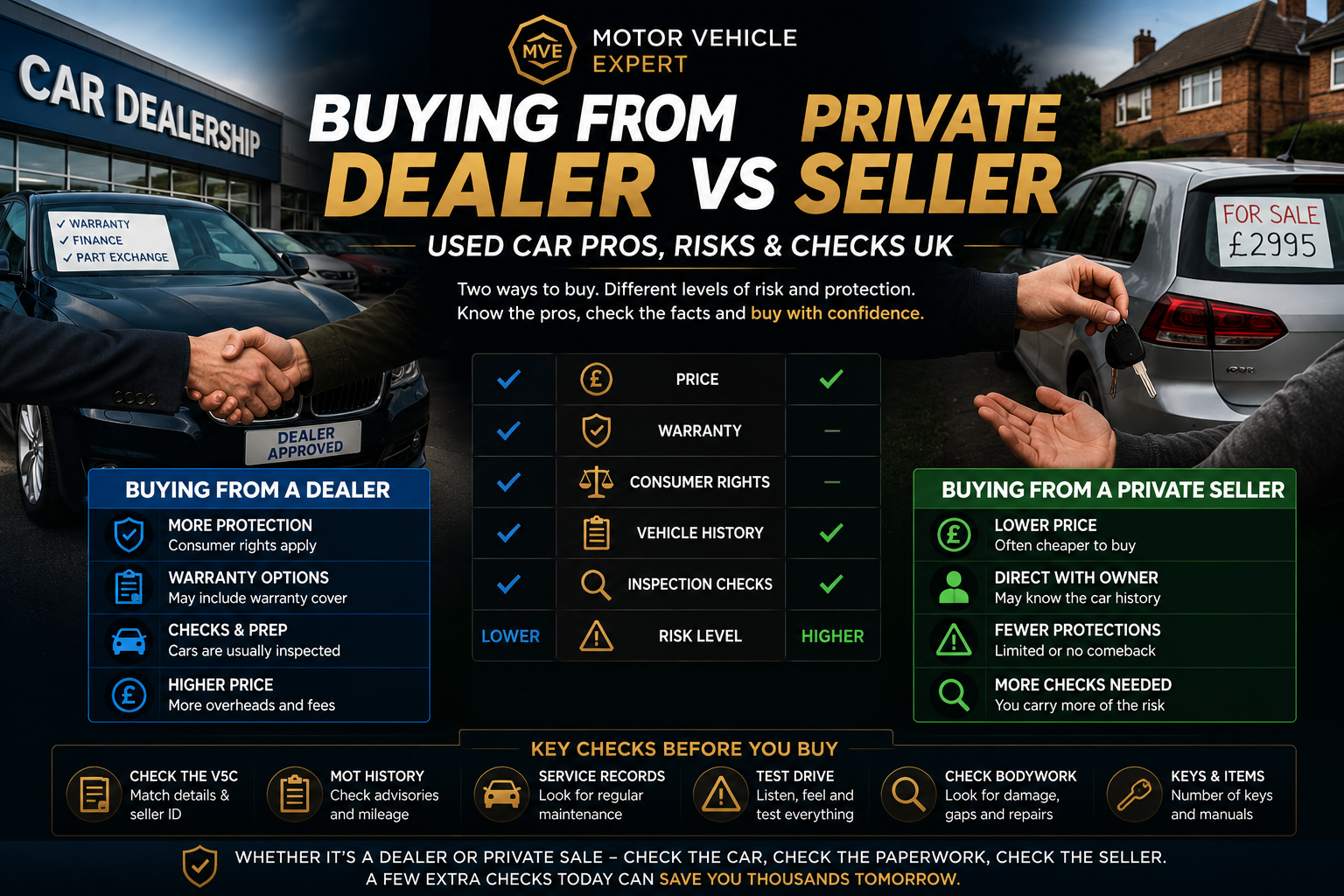
Buying from a dealer is usually safer for many UK used car buyers because there is more structure, a business address, clearer paperwork and possible warranty cover. Buying from a private seller is often cheaper, but you must check the car, seller, documents and payment route much more carefully.
The best option depends on your confidence. If you are not comfortable spotting faults, reading MOT history or checking paperwork, a dealer or independent inspection is usually safer. If buying privately, never skip the V5C, VIN, MOT history, service history, mileage checks and test drive.
A good car should make sense on paper and on the road. If the seller’s story, paperwork, mileage and condition do not match, walk away.
What really matters when choosing dealer or private
In real used car buying, the seller type matters, but the car itself matters more. Some dealer cars are poorly prepared, and some private cars are honestly owned with excellent history. The safest approach is to check every car properly, regardless of where it is being sold.
The danger with dealer cars is becoming too relaxed because the car is on a forecourt. The danger with private cars is focusing too much on the cheaper price and ignoring missing paperwork, seller pressure or faults during the test drive.
Do not buy because the advert looks clean. Buy because the MOT history, service records, condition, mileage and test drive all support the seller’s story.
Dealer vs private seller comparison
Price
Private sellers are often cheaper. Dealers usually charge more because of business costs, preparation and warranty options.
Protection
Dealers usually offer more formal structure. Private buying places more responsibility on the buyer.
Warranty
Dealers may offer warranty cover. Private cars are usually sold without warranty.
Paperwork
Both need proper paperwork. Dealer paperwork may be clearer, but you should still check everything.
Negotiation
Private sellers may be more flexible on price. Dealers may negotiate warranty, servicing or repairs.
Risk
Private buying usually carries more risk, especially if you skip history checks or buy under pressure.
Which option is best for you?
Choose a dealer if
You want more structure, possible warranty cover, finance options, clearer paperwork and a business address to return to if there is a problem.
Choose private if
You want a lower price, are confident checking cars, can verify the seller and are prepared to walk away if anything feels wrong.
Get an inspection if
The car is expensive, high mileage, diesel, performance-focused, Cat S, Cat N, has unclear history or you are not confident checking it yourself.
Walk away if
The paperwork is wrong, the seller pressures you, warning lights stay on, the car overheats, or the story does not match the evidence.
Buying from a dealer: pros and risks
A dealer can be the better route if you want a more organised buying process, a trading address, possible warranty and clearer documentation. But a dealer car still needs proper checking.
Main advantages
A dealership usually gives a business address, structured paperwork, warranty options, finance choices and more accountability than a private sale.
Main risks
The car may cost more, warranty wording may be limited, admin fees may appear and a fresh valet can hide warning signs.
What to check
Check MOT advisories, service records, tyres, brakes, warning lights, previous repairs and warranty exclusions.
What to ask
Ask whether advisories were repaired, whether independent inspection is allowed and what the warranty actually covers.
Buying from a private seller: pros and risks
Buying privately can save money and sometimes gives you direct access to the person who owned the car. But it also means you need to be sharper with identity checks, vehicle history, payment safety and paperwork.
Main advantages
Private cars are often cheaper, and the owner may know the car’s history better than a dealer.
Main risks
There is usually less protection, no dealer warranty and more responsibility on you to check the car properly.
What to check
Seller identity, V5C, VIN, registered address, MOT history, mileage, service records and test drive behaviour.
What to avoid
Avoid sellers who will not meet at the registered address, avoid questions, rush payment or give changing stories.
Best used car buying checklist flow
Use this order whether buying from a dealer or a private seller. It keeps emotion out of the decision and helps you spot expensive problems before paying.
1. Check the advert carefully
Look for vague wording, missing mileage, no service history mention, poor photos or pressure language.
2. Check MOT history
Look for repeated advisories, mileage drops, corrosion, brake issues, tyre problems and old failures.
Check MOT history →3. Check service history
Invoices should match the age, mileage and maintenance claims.
Service history checks →4. Inspect the car
Check tyres, brakes, lights, bodywork, engine bay, warning lights, interior wear and leaks.
Inspection checklist →5. Test drive properly
Listen for knocks, vibration, clutch slip, brake judder, overheating, smoke and loss of power.
Test drive checklist →6. Check history risk
Check for stolen, written-off, finance, mileage and identity issues before payment.
Vehicle history checks →Questions to ask before buying
- ?Can I see the V5C and does the VIN match the car?
- ?Can I check the MOT history before viewing?
- ?Does the mileage match MOT and service records?
- ?Does the car have service history and invoices?
- ?Has the car had accident damage or insurance category history?
- ?Are there any warning lights, leaks, smoke or known faults?
- ?Can I test drive the car properly?
- ?Can I arrange an independent inspection?
Paperwork checks for both dealer and private cars
- ✓V5C logbook details should match the car and registration.
- ✓VIN on the car should match the paperwork.
- ✓MOT history should show consistent mileage.
- ✓Service history should match mileage and age.
- ✓Major repairs should have invoices if claimed.
- ✓Number of keys should be confirmed before payment.
- ✓Payment receipt should show car details, price, date and seller information.
Poor paperwork does not always mean the car is bad, but it increases risk and should affect how much you trust the car and what you are willing to pay.
Test drive checks matter more than the seller type
A dealer car and private car can both hide faults while parked. The test drive is where expensive problems often reveal themselves.
Engine behaviour
Look for hesitation, smoke, rough idle, overheating, warning lights or loss of power.
Misfire symptoms →Clutch and gearbox
Check for clutch slip, judder, burning smell, gear crunching or delayed engagement.
Clutch cost guide →Brakes and steering
Check for grinding, vibration, pulling, shaking or knocking over bumps.
Brake warning signs →Temperature and cooling
The temperature gauge should stay stable once warm and the car should not smell hot or lose coolant.
Overheating causes →Red flags when buying from a dealer or private seller
- !Seller refuses a test drive or inspection.
- !V5C is missing or VIN does not match.
- !Mileage does not match MOT or service records.
- !Warning lights stay on after the engine starts.
- !Engine smokes, overheats, misfires or loses coolant.
- !Dealer gives vague warranty wording or adds surprise fees.
- !Private seller will not meet at the registered address.
- !Seller pressures you to pay a deposit before proper checks.
Before paying a deposit
A deposit can make buyers feel committed before they have finished checking the car. Do not leave money unless you understand whether it is refundable, what it reserves, what happens if faults are found and whether the car details are written clearly on the receipt.
Dealer deposit
Get the terms in writing. Confirm whether the deposit is refundable and whether promised repairs, MOT work or warranty terms are written down.
Private deposit
Be very cautious. Avoid sending money before seeing the car, checking the seller and confirming the paperwork.
Best mechanic-style advice
Do not judge the car by the seller type alone. Judge the evidence. A clean dealer forecourt does not guarantee a good car, and a private driveway does not automatically mean a bad car.
The best used car is the one where the advert, paperwork, MOT history, service records, mileage, condition and test drive all tell the same story.
If the car looks good but the story does not add up, keep your money in your pocket.
Related used car buying guides
Frequently asked questions
Is it better to buy from a dealer or private seller?
A dealer is usually safer for many buyers because there is more structure and possible warranty cover. A private seller may be cheaper, but you need to check everything more carefully.
Is buying privately cheaper?
Usually yes, but a cheaper private car can become expensive if it has hidden clutch, gearbox, cooling, brake or suspension faults.
What should I check when buying privately?
Check the V5C, VIN, seller identity, registered address, MOT history, mileage, service records, warning lights and test drive behaviour.
What should I ask a dealer?
Ask about service history, MOT advisories, warranty cover, previous repairs, admin fees, finance checks, number of keys and whether independent inspection is allowed.
Can a trader pretend to be private?
Yes. Be cautious if the seller has several cars for sale, avoids meeting at the registered address or says they are selling for someone else.
Is a dealer warranty always good?
Not always. Check what is covered, what is excluded, whether labour is included and whether there is a claim limit.
Should I still inspect a dealer car?
Yes. A dealer car can still have faults, poor service history, MOT advisories or hidden issues. Always inspect and test drive properly.
When should I walk away?
Walk away if the paperwork is wrong, the mileage does not add up, the seller pressures you, warning lights stay on or the test drive reveals serious faults.