UK no-MOT used car buying guide

Buying A Car With No MOT?

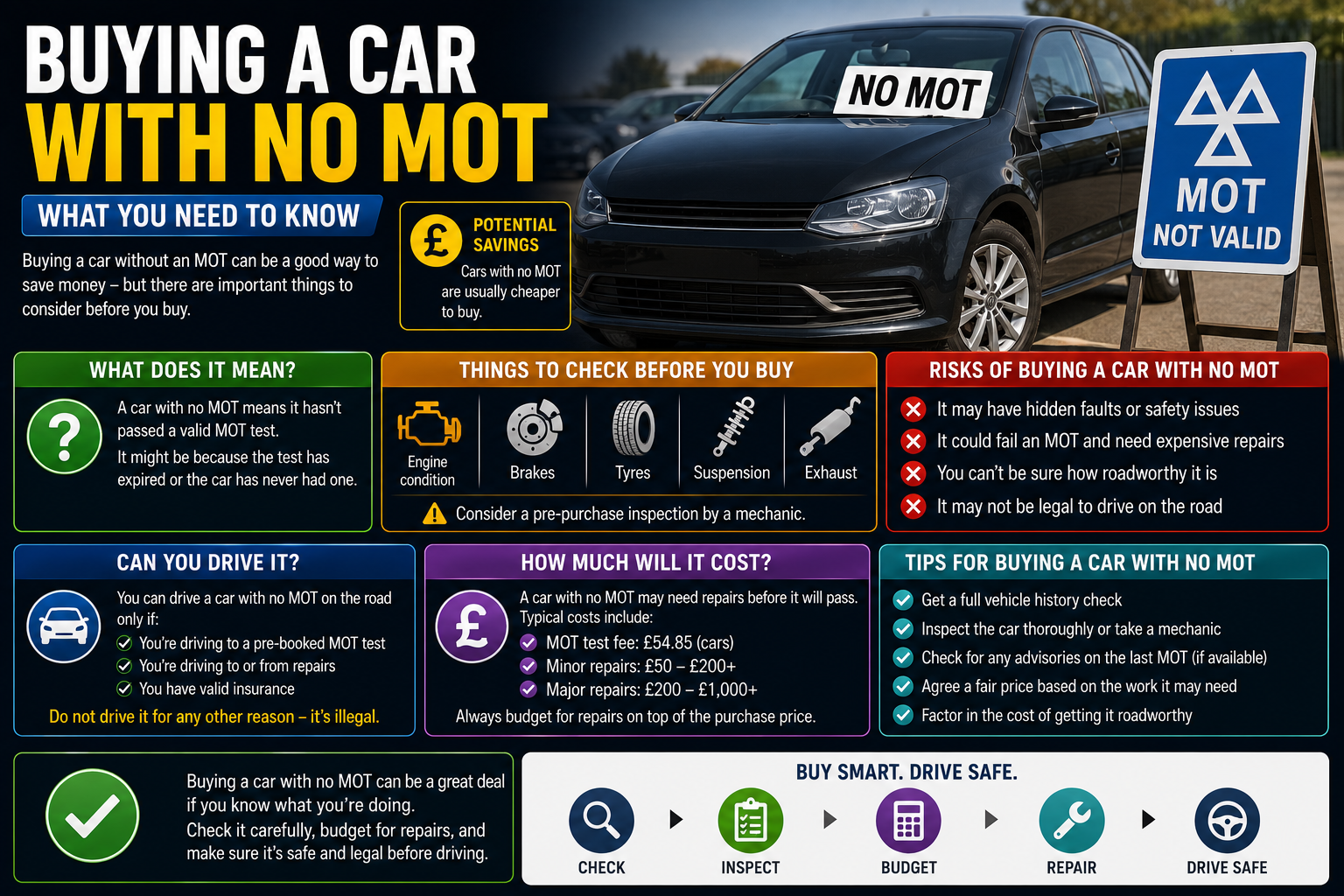
Buying a car with no MOT can be a bargain, but it can also be an expensive mistake. Before paying, check the MOT history, understand why it has no MOT, price the repairs properly and make sure collection is legal and safe.

Buying a car with no MOT UK guide
Quick answer

Should you buy a car with no MOT?

You can buy a car with no MOT, but only if the price reflects the risk. A no-MOT car should be treated as a repair-risk vehicle, not a normal used car ready to drive away.

The safest approach is to check the MOT history, inspect the tyres, brakes, suspension, lights, rust and warning lights, get a realistic repair estimate and arrange proper collection before handing over money.

Mechanic answer

No MOT means unknown repair risk

A no-MOT car might only need minor work, or it might fail on serious rust, brakes, emissions, suspension or tyre defects. The problem is that you do not know until it is tested or inspected properly.

That uncertainty is why a car with no MOT should be cheaper than the same car with a clean, fresh MOT.

Driving home

Can you drive a car home with no MOT after buying it?

Not for normal road use. A car with no MOT is not something you should simply buy and drive home like a normal used car.

The usual limited exceptions are journeys to or from repairs or to a pre-arranged MOT test, but the car still needs valid insurance and must be roadworthy enough for the journey.

Best option

Recovery is often the safest answer

If you do not know the condition of the tyres, brakes, steering, suspension, lights or rust, recovery or trailer collection is normally the safest way to move the car.

Do not let a cheap car become expensive because you risk fines, breakdown, accident damage or insurance problems on the way home.

Main risks

The biggest risks when buying a car with no MOT

These are the areas I would check before treating the car as a bargain.

Risk 1

Hidden repair costs

A seller may say it β€œonly needs an MOT”, but it may fail on tyres, brakes, suspension, emissions, rust or warning lights.

Risk 2

Unsafe collection

If the car has no MOT, do not assume you can drive it away. Transport costs can change the value of the deal.

Risk 3

Old advisories becoming failures

Previous advisories can turn into current MOT failures if they were ignored.

MOT advisory guide β†’
Risk 4

Rust underneath

Rust can be hard to judge from photos. Structural corrosion can make a cheap car uneconomical.

Rust MOT guide β†’
Risk 5

Emissions faults

Emissions faults can be cheap or very expensive depending on whether the issue is a leak, sensor, DPF, catalytic converter or engine problem.

Emissions failure guide β†’
Risk 6

Overpaying

A no-MOT car should be priced below normal market value because the buyer is taking the repair risk.

Car value guide β†’
MOT history

Check the MOT history before viewing

Before you travel, check the MOT history. Look for previous failures, repeated advisories, mileage gaps, corrosion notes, tyre wear, brake imbalance, emissions problems and suspension defects.

A clean-looking car can still have a worrying MOT pattern. Repeated advisories for rust, suspension wear or tyres can tell you what the next MOT may fail on.

How to check MOT history β†’
Pattern check

One failed MOT is not always the full story

If the car has no current MOT but failed badly last time, the repair bill may be bigger than the seller suggests.

If it has simply expired and the previous MOT history was clean, the risk may be lower, but you should still inspect it properly.

Buying with failed MOT history β†’
Value impact

How much cheaper should a no-MOT car be?

The discount should reflect more than just the visible repair cost.

Small discount

Minor expired MOT risk

If the previous MOT history is clean, the car drives well and only the MOT has expired recently, the discount may be smaller.

Medium discount

Known minor faults

If tyres, brakes, bulbs, wipers or simple suspension items need work, deduct repair cost, retest cost and inconvenience.

Large discount

Rust, emissions or warning lights

Rust, emissions faults, engine lights, ABS lights or airbag faults can become expensive and should reduce the offer heavily.

Walk away

Seller cannot explain the MOT gap

If the seller avoids questions, refuses inspection, hides history or says β€œeasy pass” without evidence, be careful.

Simple buyer value rule

Start with the normal value of the same car with a fresh MOT. Then deduct repair cost, MOT retest risk, recovery cost, your time and a safety margin for hidden faults.

Repair costs

Typical repair costs before a no-MOT car can pass

These are rough UK guide prices only. The actual cost depends on the car, labour rate, parts quality and fault severity.

Suspension arm or ball joint

Often around Β£120–£450+ depending on parts and alignment needs.

Lower arm MOT guide β†’

Emissions fault

Can range from simple diagnosis to expensive DPF or catalytic converter work.

Emissions guide β†’
Red flags

When not to buy a car with no MOT

These signs usually mean the risk is too high unless the price is extremely low.

Red flag 1

Seller says β€œwill pass easily” but has no proof

If it will pass easily, ask why the seller has not tested it. Sometimes there is a genuine reason, but do not accept vague claims.

Red flag 2

Severe corrosion history

Repeated corrosion advisories or failures can mean the car is becoming uneconomical.

Red flag 3

Multiple warning lights

Engine, ABS, airbag, brake or power steering lights can make repair costs unpredictable.

Red flag 4

No V5C or poor paperwork

Missing paperwork, unclear ownership or pressure to pay quickly should make you cautious.

Red flag 5

Seller refuses inspection

If you cannot inspect underneath, check the tyres or hear the engine properly, the risk increases.

Red flag 6

Price is not low enough

A no-MOT car should be priced as a risk. If it is close to fresh-MOT money, walk away or negotiate hard.

Collection

How should you collect a car with no MOT?

The safest collection method is normally a trailer, recovery truck or vehicle transport service. This avoids using an unknown-condition car on the road.

If the plan is to drive it to a pre-booked MOT or repair appointment, make sure the journey is genuine, direct, insured and the car is safe enough to drive.

Driving to MOT without tax guide β†’
Insurance

Do not assume insurance covers everything

A vehicle still needs insurance if it is driven. Some insurers may have conditions around MOT status, so check before driving a no-MOT car.

If you are not completely sure, transport is the cleaner and safer option.

MOT and insurance guide β†’
Real experience

What I see in real garage work

I have seen no-MOT cars that were genuinely good cars needing only tyres, bulbs or a simple brake repair. I have also seen cars that looked clean in photos but needed welding, suspension arms, tyres, brakes and emissions work before they could pass.

The difference is inspection. If you buy only from pictures and a seller’s promise, you are taking a gamble. If you check history, inspect the car properly and price the risk, a no-MOT car can still make sense.

Buyer mindset

Think like a mechanic, not a bargain hunter

The question is not β€œis it cheap?” The question is β€œwhat will it owe me once it has passed MOT?”

Add purchase price, recovery, repairs, MOT, tax, insurance, time and unexpected faults. If the total is still below market value, it may be worth considering.

Mechanic tips

Best mechanic-style advice before buying

These checks can save you from buying the wrong no-MOT car.

Check MOT history first

Do this before travelling. It can show repeated faults and mileage issues.

MOT history guide β†’

Price recovery before paying

Transport costs can wipe out the bargain if the car is far away.

Best advice

Only buy a no-MOT car if the discount is big enough to cover repairs, transport and risk. If the seller wants normal market price, ask them to put a fresh MOT on it first.

Buyer checklist

Buying a car with no MOT checklist

Use this before you hand over any money.

Step 1

Check MOT history

Look for failures, advisories, mileage gaps, rust notes and repeated defects.

MOT history guide β†’
Step 2

Ask why it has no MOT

A genuine reason is different from a seller avoiding the test because they expect failure.

Step 3

Inspect tyres, brakes and suspension

These are common MOT failure areas and can change the deal quickly.

Common MOT failures β†’
Step 4

Look for rust properly

Check sills, subframes, arches, jacking points and suspension mounting areas.

Step 5

Price repairs before agreeing

Do not guess. Add parts, labour, MOT, retest, transport and extra risk.

Step 6

Plan collection

Recovery, trailer or direct pre-booked MOT journey should be sorted before payment.

Ask first

Questions to ask before buying a no-MOT car

If the seller cannot answer clearly, be careful.

Question 1

Why does it have no MOT?

Expired by accident, parked up, failed previously, or seller knows it will fail?

Question 2

When was it last driven?

A long-parked car can develop brakes, battery, tyre and fuel issues.

Question 3

Are there any warning lights?

Ask for dashboard photos with the ignition on and engine running.

Question 4

Does it start and move?

Starting and driving on private land is not the same as being roadworthy.

Question 5

Is the V5C present?

Make sure the paperwork matches the vehicle and seller story.

Question 6

Can I inspect underneath?

If the seller refuses inspection, assume the risk is higher.

Useful related page: questions to ask when buying a used car.

FAQs

Buying a car with no MOT FAQs

Common questions about no-MOT cars, collection, value and repair risk.

Can you buy a car with no MOT?

Yes. You can buy a car with no MOT, but you should price it as a repair-risk vehicle and plan safe collection.

Can I drive it home after buying?

Not for normal road use. The usual limited exceptions are driving to or from repairs or to a pre-arranged MOT test, with insurance and only if the car is safe enough.

Is a no-MOT car always a bad buy?

No. Some are bargains, but only if the repair risk is properly priced and the vehicle is inspected before purchase.

Should I ask the seller to MOT it first?

Yes, if they want close to normal market price. If they refuse, the price should reflect the risk you are taking.

Can I insure a car without MOT?

You may be able to insure it, but driving it without MOT is restricted and insurer terms matter. Check before driving.

Can I tax a car with no MOT?

Usually no. You normally need a valid MOT to tax a vehicle, except in specific exempt situations.

How much should I offer?

Start with normal value, then deduct repair cost, recovery cost, MOT risk and a safety margin for hidden faults.

What if the car failed MOT before?

Check the failure sheet and whether repairs were done. Repeated failures or advisories should reduce your offer.

Should I buy a no-MOT car from a private seller?

Only if you inspect carefully, check history, confirm paperwork and price the risk properly.

What is the safest collection method?

Recovery truck, trailer or transport service is usually safest, especially if you do not know the car’s condition.
Motor Vehicle Expert publishes practical UK-focused MOT, diagnostics, warning light, used car and repair guidance written in clear mechanic-style language for everyday drivers.