
Quick answer
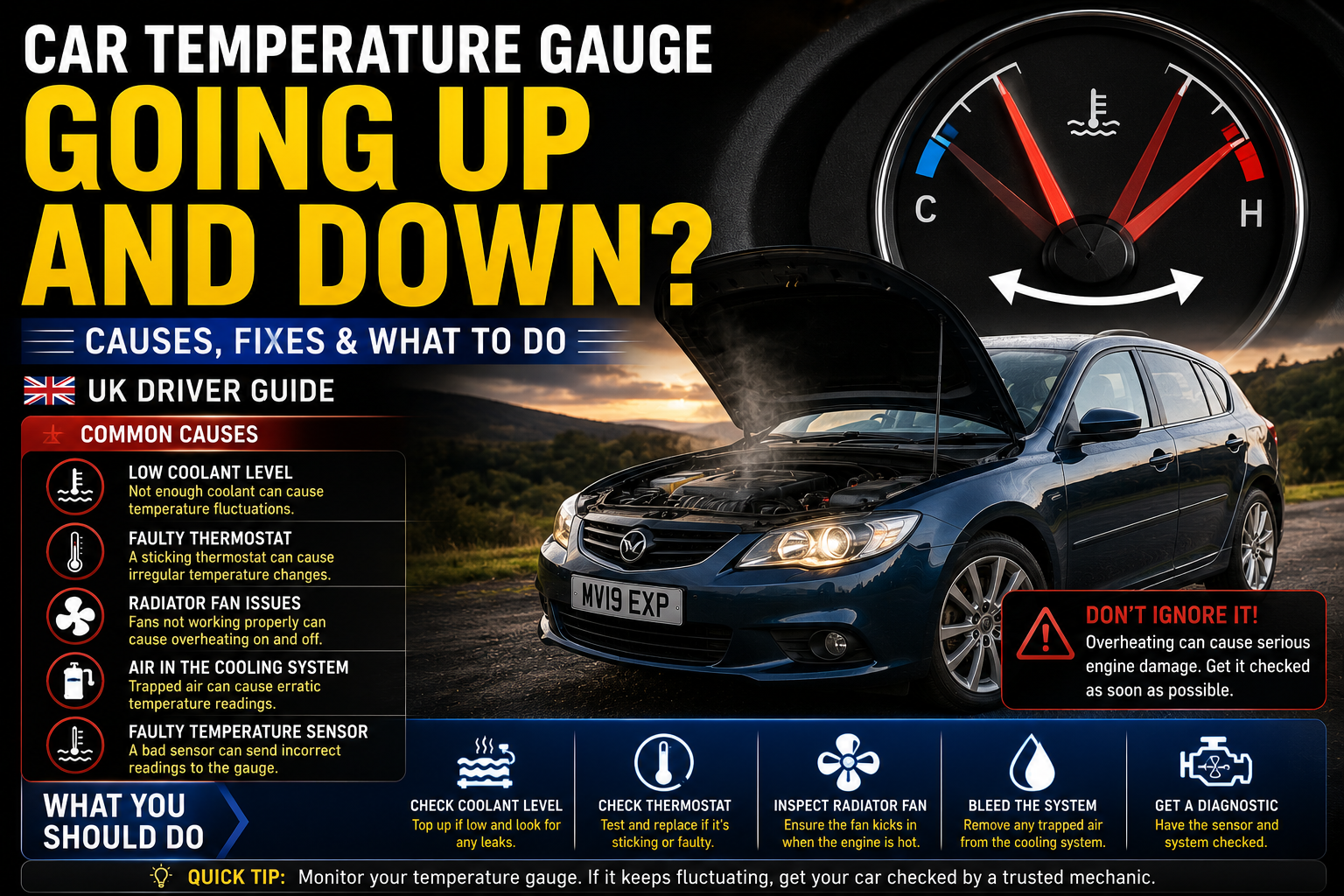
A temperature gauge that rises and falls usually means one of two things: the engine temperature is genuinely changing, or the temperature signal to the dashboard is unreliable.
Genuine temperature changes are often caused by low coolant, trapped air, a sticking thermostat, radiator fan problems, weak water pump circulation, a blocked radiator, a weak pressure cap or head gasket pressure. Unreliable readings can come from a coolant temperature sensor, wiring connector, damaged plug, ECU data issue or dashboard gauge fault.
- ✓Gauge rises in traffic: check radiator fan, coolant level, airflow and airlocks.
- ✓Gauge rises uphill or motorway: check coolant flow, thermostat, water pump and radiator restriction.
- ✓Gauge jumps randomly: check sensor, wiring, plug connection and live temperature data.
- !Gauge reaches red: stop driving and let the engine cool.
Do not assume it is “just the gauge” until coolant level, heater behaviour, fan operation, leaks and actual coolant temperature have been checked.
What I see in real cooling system checks
In real workshop diagnosis, a temperature gauge that goes up and down is often linked to simple faults first: low coolant, trapped air, radiator fan faults or a thermostat that is not opening properly. The mistake many drivers make is ignoring it because the gauge drops again.
The gauge dropping does not always mean the fault has fixed itself. It may only mean the radiator has received more airflow, the thermostat has opened suddenly, the fan has finally switched on, or the sensor signal has changed.
The most worrying cases are when the heater blows cold while the engine is hot, coolant keeps disappearing, the expansion tank bubbles, or the gauge rises quickly after a previous overheating incident. Those signs need proper diagnosis before serious engine damage happens.
Never open the coolant cap when the engine is hot. A pressurised cooling system can release boiling coolant and steam.
Find the closest symptom
Gauge goes up and down in traffic
Likely areas: fan operation, low coolant, airlock, radiator airflow or idle cooling weakness.
Overheating at idle →Gauge rises then drops when driving
Road speed may be helping the radiator cool, hiding a fan, airflow or coolant circulation fault.
Overheats in traffic →Gauge rises on motorway
Likely areas: radiator restriction, thermostat, water pump, coolant loss or pressure trouble.
Overheating while driving →Gauge drops to cold suddenly
Can suggest a sensor, wiring, dashboard gauge issue or thermostat behaviour.
Heater goes cold too
Low coolant, trapped air or poor coolant circulation becomes more likely.
Heater not hot →Coolant bubbles as gauge rises
Airlocks, boiling coolant, pressure cap faults or head gasket pressure may be involved.
Coolant bubbling →Common causes of a temperature gauge going up and down
Low coolant level
Low coolant can create air pockets and hot spots, making the gauge rise and fall.
Coolant warning guide →Air trapped in the system
Airlocks can interrupt coolant flow and cause sudden changes in heater and gauge behaviour.
Airlock and bubbling guide →Sticking thermostat
A thermostat that opens late, sticks or moves slowly can make temperature rise, then drop.
Thermostat symptoms →Radiator fan fault
A faulty fan often causes temperature rise at idle or in traffic, then improvement when moving.
Radiator fan not working →Weak water pump
Poor coolant circulation can cause hot spots, heater changes and unstable temperature control.
Water pump symptoms →Blocked radiator
A restricted radiator may not remove heat properly, especially on long drives or under load.
Blocked radiator symptoms →Faulty temperature sensor
A bad sensor, plug or wiring issue can make the dashboard reading inaccurate or jumpy.
Weak pressure cap
If the cooling system cannot hold pressure, coolant can boil sooner and readings may become unstable.
Pressure clues →Head gasket pressure
Combustion gases entering the coolant can cause pressure, bubbling, coolant loss and overheating.
Head gasket symptoms →When the gauge moves gives the best clue
Rises in traffic, falls when moving
This often points to radiator fan trouble, poor airflow, low coolant or weak low-speed cooling. The car may feel fine on open roads because airflow helps the radiator.
Traffic overheating guide →Rises while driving or uphill
This can point towards coolant flow restriction, thermostat trouble, water pump weakness, blocked radiator, low coolant or head gasket symptoms.
Overheating while driving →Drops suddenly to cold
A sudden drop to cold can suggest a sensor, wiring, gauge or thermostat issue rather than normal cooling behaviour.
Moves after topping up coolant
The system may have trapped air. If the coolant level drops again, there is likely still a leak or pressure problem.
Coolant loss with no leak →Moves with heater temperature
If the heater blows hot, then cold, then hot again, suspect airlocks, low coolant or poor circulation before blaming the dashboard gauge.
Heater blows cold then hot →Jumps randomly with no symptoms
If the engine feels normal, heater output stays stable, coolant level is steady and the gauge jumps sharply, electrical diagnosis is more likely.
Low coolant and airlocks are common causes
Coolant must flow smoothly around the engine, radiator and heater matrix. If the level is low, the system can pull in air. If air is trapped, the sensor may see changing temperatures and the engine can develop hot spots.
- ✓Low coolant can make the gauge rise in traffic, uphill or under load.
- ✓Airlocks can cause gurgling, bubbling or heater temperature changes.
- ✓A coolant warning light makes the problem more urgent.
- ✓Repeated coolant top-ups mean the coolant is going somewhere.
- ✓Dried coolant marks, sweet smells or damp undertrays can reveal hidden leaks.
Useful next reads: coolant warning light on, car losing coolant but no leak, coolant leak repair cost UK and car smells like coolant.
Thermostat clues when the gauge rises and falls
A thermostat controls when coolant flows through the radiator. If it sticks closed, the engine can get hot quickly. If it sticks open, the engine may run too cool. If it sticks halfway or opens late, the gauge may rise then suddenly drop.
More like thermostat stuck open
Slow warm-up, weak heater, gauge stays lower than normal or poor fuel economy in cold weather.
More like thermostat stuck closed
Gauge climbs quickly, radiator stays cooler than expected or overheating warning appears.
More like sticking thermostat
Gauge rises, drops, then rises again as coolant flow changes unevenly.
Not always thermostat
Low coolant, airlocks, fan faults, blocked radiator and water pump issues can feel similar.
Read the full guide: thermostat stuck open or closed.
Radiator fan clues
If the temperature gauge rises when the car is stationary or crawling in traffic, then drops once the car is moving, the radiator fan should be checked. At road speed, natural airflow can cool the radiator. At idle, the fan has to do that job.
Fan not coming on
Possible fan motor, relay, fuse, resistor, wiring or control module fault.
Fan not working →Fan runs constantly
Can suggest sensor, thermostat, coolant level, AC demand or ECU control issues.
Overheats with A/C on
Air conditioning adds heat load and can expose fan or radiator performance faults.
Overheats with A/C →Gauge fault or real overheating?
More likely gauge or sensor issue
The gauge jumps suddenly, the engine does not smell hot, the heater stays normal, there is no coolant loss, no steam and no warning message.
More likely real overheating
The gauge rises gradually, the fan runs hard, coolant drops, the heater changes temperature, steam appears or the engine bay smells hot.
A garage can compare the dashboard gauge with live coolant temperature data using diagnostics. That helps separate a real cooling fault from a sensor or wiring fault.
Heater clues that help diagnosis
The cabin heater uses hot coolant from the engine. That means heater behaviour can give useful clues when the temperature gauge is moving.
Heater cold while engine hot
Can suggest low coolant, airlocks or poor coolant circulation.
Heater not hot →Heater hot then cold
Often points towards trapped air or unstable coolant flow.
Heater cold then hot →Gauge drops with heater on
The heater matrix may be removing extra heat, but the cooling fault still needs checking.
When to suspect head gasket pressure
Most fluctuating temperature gauges are caused by simpler cooling faults, but repeated overheating, coolant loss and bubbling can sometimes point towards combustion pressure entering the cooling system.
- !Coolant bubbles continuously in the expansion tank.
- !Coolant is pushed out of the tank or overflow.
- !Hoses become very hard soon after a cold start.
- !The car loses coolant but no external leak is obvious.
- !White smoke appears from the exhaust with coolant loss.
- !The gauge rises quickly after previous overheating.
Useful next reads: blown head gasket symptoms, white smoke from exhaust and coolant loss and coolant bubbling in expansion tank.
When to stop driving
- !The temperature gauge reaches the red zone.
- !The coolant warning light appears.
- !Steam comes from the engine bay.
- !The heater blows cold while the engine is hot.
- !Coolant level is very low or dropping quickly.
- !Coolant is bubbling, boiling or being pushed out.
- !The engine loses power, runs rough, knocks or smells very hot.
Do not remove the coolant cap while the engine is hot. The system can be pressurised and dangerous. Let the engine cool before checking the level.
For urgent steps, read car overheating: what to do.
What to check first
1. Note the pattern
Does it happen in traffic, on the motorway, uphill, after coolant work, when the heater is on, or randomly?
2. Check coolant level cold
Check the expansion tank only when the engine is cold. Low coolant is one of the most important first checks.
3. Look for leaks and residue
Inspect hoses, radiator edges, thermostat housing, expansion tank, water pump area and underneath the car.
4. Check heater output
A heater that blows cold while the engine is hot can point to low coolant, airlocks or poor circulation.
5. Watch radiator fan behaviour
If the gauge rises at idle or in traffic, check whether the cooling fan comes on before the car gets too hot.
6. Arrange proper diagnosis
Repeated gauge movement, coolant loss or overheating should be checked before it damages the engine.
How garages diagnose temperature gauge fluctuation
Live temperature data
Compares the dashboard gauge with actual coolant temperature readings from the ECU.
Cooling system pressure test
Checks for leaks, weak caps and whether the system holds pressure correctly.
Thermostat operation check
Confirms whether coolant is flowing to the radiator at the correct temperature.
Radiator fan test
Checks fan motor, relay, fuse, control module, wiring and temperature command.
Bleed and airlock check
Confirms whether trapped air is causing heater changes, bubbling or unstable readings.
Combustion gas test
Used if bubbling, hard hoses, coolant loss or repeated overheating suggests head gasket pressure.
Possible UK repair costs
Cost depends on whether the problem is a simple coolant issue, an electrical reading fault or a genuine cooling-system fault. Diagnosis matters because several faults can create the same gauge behaviour.
Coolant top-up and bleed
Usually lower cost if trapped air is the only issue and no leak is found.
Temperature sensor
Often moderate, depending on access, wiring condition and diagnosis time.
Thermostat replacement
Can vary widely because some thermostats are built into housings or hidden behind pipework.
Thermostat guide →Radiator fan repair
Depends whether the fault is a fuse, relay, fan motor, resistor, module or wiring.
Fan guide →Water pump repair
Can be more expensive if access is difficult or the pump is linked to cambelt labour.
Water pump guide →Radiator or leak repair
Cost depends on whether there is a blocked radiator, coolant leak or pressure fault.
Coolant leak costs →For broader budgeting, read car repair costs guide UK.
Common mistakes drivers make
- !Opening the coolant cap while the engine is still hot.
- !Repeatedly topping up coolant without finding where it is going.
- !Assuming a jumpy gauge is only a sensor fault.
- !Ignoring a heater that blows cold while the engine is hot.
- !Driving with the gauge near the red because it later drops again.
- !Replacing the thermostat without checking coolant level, fan operation and airlocks.
Best mechanic-style advice
Do not ignore a temperature gauge that keeps moving around. It might be a simple sensor fault, but it might also be the first warning that coolant is low, the thermostat is sticking or the engine is starting to overheat.
Start simple: check coolant level cold, look for leaks, watch when the gauge rises, check heater behaviour and note whether the fan comes on. If the gauge rises again after topping up, do not keep topping up and hoping. Get the cooling system pressure-tested.
If the heater goes cold while the gauge is high, treat it seriously. That can mean coolant is not circulating properly, even if the engine looks normal from outside.
Related coolant and overheating guides
Frequently asked questions
Why is my car temperature gauge going up and down?
Common causes include low coolant, airlocks, a sticking thermostat, radiator fan faults, weak water pump circulation, blocked radiator, pressure cap issues, head gasket pressure or a faulty coolant temperature sensor.
Can low coolant make the temperature gauge fluctuate?
Yes. Low coolant can create air pockets and unstable coolant flow, causing the gauge to rise and fall.
Can a thermostat cause this?
Yes. A sticking thermostat can make the gauge rise then drop as coolant flow changes.
Is it safe to drive if the gauge moves up and down?
Only if it stays within normal range and there are no warning signs. Stop if it reaches the red, warning lights appear, steam is visible or coolant is low.
Why does the gauge rise in traffic but drop when moving?
This often points to radiator fan problems, poor airflow, low coolant, airlocks or weak cooling at idle.
Why does the gauge rise on the motorway?
Motorway or uphill overheating can point to coolant flow restriction, blocked radiator, weak water pump, thermostat trouble, low coolant or head gasket symptoms.
Can a bad sensor make the gauge jump?
Yes. A faulty coolant temperature sensor, damaged wiring, poor connector or gauge fault can cause erratic readings.
Why does my heater go cold when the gauge rises?
This can happen with low coolant, trapped air or poor coolant circulation. It is a warning sign because the engine may be hot while coolant is not flowing properly through the heater matrix.
Can air in the cooling system cause temperature changes?
Yes. Airlocks can cause gurgling, bubbling, unstable heater temperature and fluctuating gauge readings.
What should I check first?
Check the coolant level when cold, look for leaks or dried residue, note when the gauge moves, watch heater behaviour and check whether the radiator fan operates.