
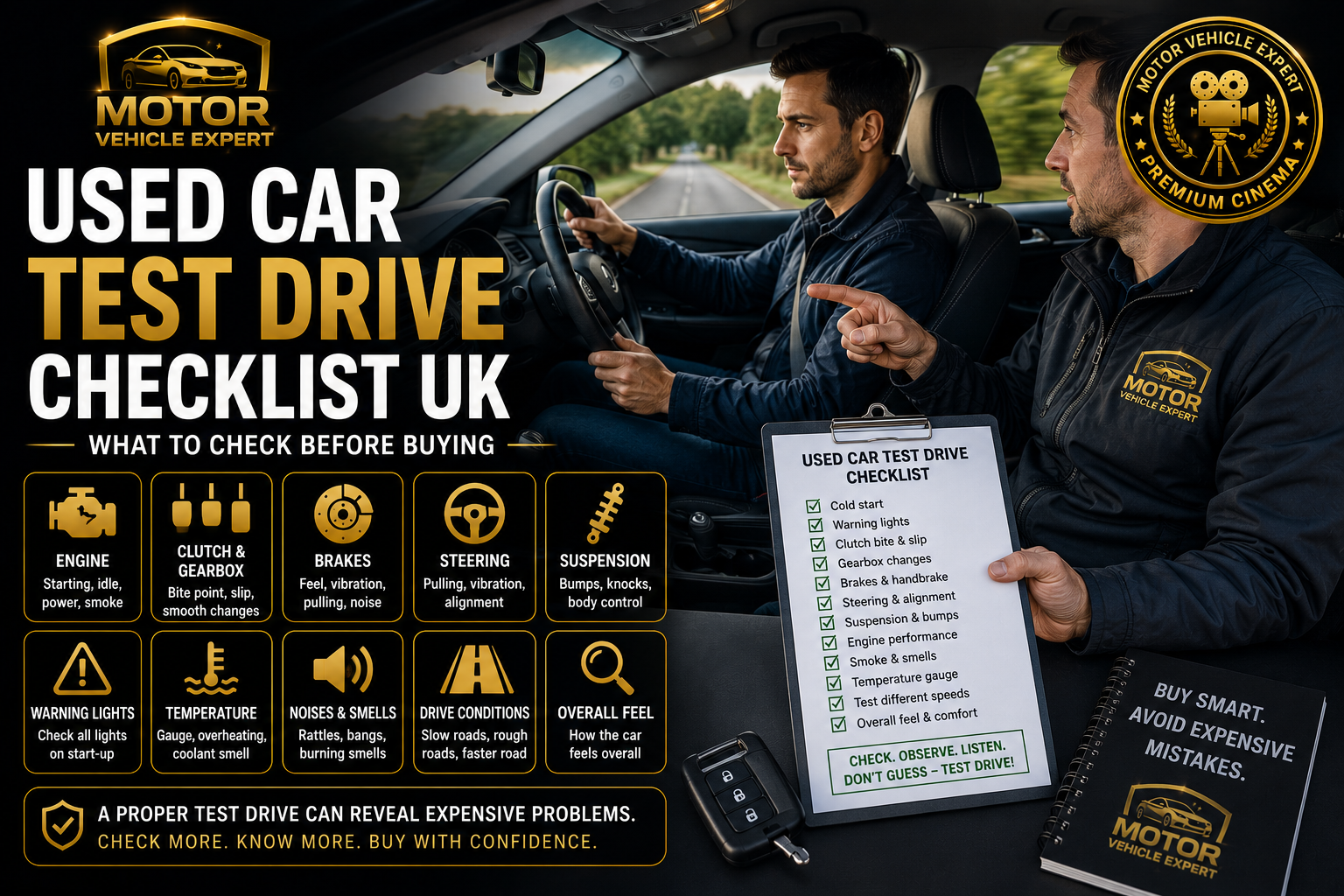
Quick answer
On a used car test drive, check how the car starts, idles, accelerates, brakes, steers, changes gear, handles bumps and behaves once warm. Watch for warning lights, smoke, overheating, clutch slip, gearbox faults, brake vibration, steering pull and suspension knocks.
Do not just drive around the block. A proper test drive should include slow manoeuvres, stop-start traffic, braking, turning, rough roads and a faster road where safe and legal.
- ✓Start from cold if possible so rattles, smoke and weak starting are easier to spot.
- ✓Drive long enough for the engine, gearbox and brakes to warm up properly.
- !Walk away if warning lights, overheating, heavy smoke or seller pressure appear.
Looking for more buying advice? Browse our Used Car Buying Guides UK hub for inspection checklists, MOT history checks, service history advice, used car scams and first-time buyer tips.
Test drive the car like you are trying to find the repair bill before you own it. A good car should still feel good after town driving, braking, turning, rough roads and a proper warm-up.
What I normally see when buyers skip a proper test drive
In real workshop situations, many expensive used car problems could have been spotted on the test drive. Buyers often drive gently for five minutes, like the car, then only notice clutch slip, brake vibration, overheating or gearbox hesitation after they have bought it.
A short test drive can miss faults that only show when the engine is warm, when braking from speed, when turning sharply, when driving over bumps or when accelerating in a higher gear.
As a mechanic, I have seen buyers discover clutch failures, overheating problems and gearbox faults only after purchase because the original test drive was too short or too gentle.
A proper test drive is not about being difficult with the seller. It is about protecting yourself from buying someone else’s repair problem.
If a seller refuses a sensible test drive, keeps the route too short or avoids faster roads, slow roads and bumps, treat that as a warning sign.
What happens when buyers rush the test drive
The clutch only slips under load
A clutch can feel fine at low speed but slip in a higher gear or uphill.
Clutch wear signs →The car warms up and overheats
Cooling problems may not show until the engine is fully warm or sitting in traffic.
Overheating causes →Warning lights return after driving
A cleared fault may come back once the car is driven properly.
Warning lights hub →Brake vibration appears at speed
Warped discs, worn brakes or suspension issues may only show under braking.
Car shakes when braking →Steering pull reveals issues
Pulling can be tyres, alignment, suspension wear or poor accident repair.
Spot accident repair →The seller keeps it short
A rushed test drive can hide faults. Pressure is a buying red flag.
Common used car scams →Before the test drive
Before driving, take a few minutes to check the car properly. Some faults are easier to spot before the seller has warmed the engine up or before the car has moved.
- 1Try to view the car from cold. A warm engine can hide smoke, rattles and starting problems.
- 2Look underneath for oil, coolant, fuel, brake fluid or power steering leaks.
- 3Check tyre tread, sidewall damage, bulges and uneven wear.
- 4Turn the ignition on and check warning lights illuminate, then go out after starting.
- 5Check the clutch, brake pedal and steering feel before moving off.
- 6Check MOT history, service records and mileage before you drive.
- 7Confirm you are insured and allowed to test drive the vehicle.
- 8Do not drive if the seller refuses basic paperwork checks first.
Before viewing, use how to check MOT history before buying, how to check service history and questions to ask when buying a used car.
Cold start checklist
A cold start can reveal faults that disappear once the engine warms up. If possible, ask the seller not to start the car before you arrive.
- ✓Engine starts immediately without excessive cranking.
- ✓No excessive smoke from the exhaust.
- ✓No loud timing chain rattle or harsh knocking noise.
- ✓Warning lights come on for the ignition check, then go out after starting.
- ✓Idle settles smoothly without hunting, misfiring or stalling.
- ✓No strong fuel, coolant, burning oil or burning plastic smell.
A seller who has already warmed the engine before you arrive may be hiding poor cold starting, smoke, timing chain noise or rough idle.
The ideal used car test drive route
The best test drive includes several different road types because different faults appear under different conditions.
Town driving
Check clutch control, stop-start behaviour, steering feel, gear changes and low-speed hesitation.
Rough roads
Listen for suspension knocks, rattles, worn bushes, loose trim and steering clunks.
Faster roads
Check stability, wheel bearing noise, engine performance, vibration and whether warning lights appear.
Parking manoeuvres
Check steering lock, clutch bite, reverse gear, parking sensors, camera function and unusual noises.
Many expensive faults only appear after 15–20 minutes of driving. If the seller only allows a short drive, you may never see the problem.
During the test drive
A good test drive should include slow roads, stop-start traffic, braking, turning, reversing and, where safe and legal, a faster road. The aim is not just to see if you like the car. The aim is to find faults before they become your repair bill.
Engine
The engine should pull smoothly without misfiring, hesitation, smoke or warning lights.
Misfire symptoms →Clutch
The clutch should engage smoothly without slipping, juddering or smelling burnt.
Clutch cost guide →Gearbox
Gear changes should feel clean, with no crunching, jumping out of gear or heavy resistance.
Brakes
The car should stop straight without grinding, vibration, pulling or a soft brake pedal.
Brake warning signs →Steering
The steering should feel stable, with no heavy vibration, wandering or pulling to one side.
Car pulls left or right →Suspension
Listen for knocking, clunking or rattling over bumps and uneven roads.
Suspension MOT faults →Temperature
Watch the temperature gauge. Overheating can point to serious cooling system problems.
Overheating while driving →Noise
Listen for whining, humming, knocking, scraping or wheel bearing noise as speed changes.
Car noises explained →Warning lights
No engine, ABS, airbag, oil, battery or brake warning lights should stay on.
Warning lights hub →Manual car test drive checks
- ✓Check the clutch bite point is not unusually high.
- ✓Accelerate gently in a higher gear to check for clutch slip.
- ✓Make sure reverse selects cleanly without grinding.
- ✓Check the car pulls away smoothly without judder.
- ✓Watch for a burning clutch smell after hill starts or traffic.
- ✓Listen for gearbox whine, crunching or knocking when changing gear.
If the clutch slips, judders or smells burnt, check clutch wear signs, clutch replacement cost UK and car smells like burnt clutch.
Automatic car test drive checks
- ✓Gear changes should be smooth, not harsh, delayed or jerky.
- ✓Reverse should engage quickly without a heavy thump.
- ✓The car should pull away cleanly without hesitation.
- ✓There should be no gearbox warning lights or limp mode symptoms.
- ✓Avoid cars with slipping, flaring revs or delayed drive engagement.
- ✓Check for harsh changes after the gearbox is warm, not only when cold.
If the revs rise but the car does not accelerate properly, read car revs but won’t accelerate.
Brakes, steering and suspension checks
Brake in a straight line
The car should stop straight without pulling, grinding, shaking or a soft pedal.
Shakes when braking →Check steering centre
The steering wheel should sit straight when the car drives straight on a level road.
Steering wheel shaking →Listen over bumps
Knocks, clunks and rattles can point to suspension arms, drop links, bushes, shocks or mounts.
Knocking noise guide →Watch tyre behaviour
Uneven tyre wear can point to alignment, suspension wear or accident repair.
Accident repair signs →Temperature, smoke and smells during the drive
A used car should not overheat, smell strongly or smoke heavily during a test drive. These are not “minor character” faults — they can become expensive quickly.
Temperature gauge rises
Overheating can point to coolant leaks, thermostat faults, radiator blockage or head gasket issues.
Overheating causes →Coolant smell
A sweet smell can suggest coolant leaking or evaporating on hot parts.
Coolant smell guide →Burning oil smell
Oil leaking onto hot parts can smell strong after a drive.
Burning oil smell →Blue smoke
Can suggest oil burning, turbo wear or engine wear.
Smoke colour guide →White smoke
Can point to coolant, cold-start issues or internal engine problems.
White smoke coolant →Diesel smoke
Heavy smoke on a diesel can point to DPF, EGR, turbo or injector problems.
Used diesel guide →Used car test drive red flags
- !The seller refuses a test drive or only allows a very short route.
- !The engine is already warm when you arrive and the seller cannot explain why.
- !Warning lights stay on after the engine starts.
- !There is smoke, overheating, coolant smell or burning oil smell.
- !The clutch slips, gearbox crunches or the car struggles to pull.
- !The brakes grind, vibrate or pull the car to one side.
- !The steering pulls, shakes or feels unstable.
- !The seller rushes you, avoids questions or discourages an inspection.
If the seller behaviour feels wrong, read common used car scams and buying from dealer vs private seller.
Walk away immediately if...
Some faults are not negotiation points. They are warning signs that the car may become expensive, unsafe or difficult to prove afterwards.
- !The seller refuses a proper test drive.
- !Warning lights remain on after starting.
- !The engine overheats or the coolant warning appears.
- !Heavy smoke appears from the exhaust.
- !The VIN, mileage, V5C or paperwork does not match.
- !The seller pressures you to buy immediately.
Expensive faults a test drive can reveal
A test drive is not just about whether the car feels nice. It can help you avoid buying a car with expensive repair bills waiting around the corner.
| Potential repair | Typical UK cost |
|---|---|
| Clutch replacement | £500–£1,500+ |
| Automatic gearbox repair | £1,500–£5,000+ |
| Turbocharger replacement | £800–£2,000+ |
| Timing chain repair | £700–£2,500+ |
| Head gasket repair | £800–£3,000+ |
| Wheel bearing replacement | £180–£450+ |
| Brake pads and discs | £180–£500+ |
For repair price research, see car repair costs guide UK, brake pad replacement cost UK, wheel bearing replacement cost UK and used diesel buying guide.
After the test drive
Check underneath again
Fresh oil, coolant or power steering leaks may appear after the engine is warm.
Use your nose
Burning clutch, burning oil, petrol, exhaust fumes or coolant smells should not be ignored.
Car smells guide →Review calmly
Do not let the seller pressure you into deciding before you have checked everything.
Questions to ask →Walk away if unsure
A bad used car can cost far more than paying slightly more for a better one.
Inspection checklist →Best mechanic-style advice
Do not test drive the car like you already want it. Test drive it like you are trying to find what the advert did not tell you.
Start from cold if possible, drive long enough to get the car warm, check brakes and steering properly, listen over bumps, watch the temperature gauge and never ignore warning lights or seller pressure.
If the seller will not allow a sensible route, cold start, proper braking check or time for the car to warm up, do not rush. A better car and a better seller will let the vehicle prove itself.
Printable used car test drive checklist
Use this as a final quick check before deciding whether the car is worth buying, negotiating or walking away from.
- ✓Cold start checked
- ✓Warning lights checked
- ✓Clutch tested
- ✓Gearbox tested
- ✓Brakes tested
- ✓Steering tested
- ✓Suspension checked
- ✓Engine performance checked
- ✓Smoke checked
- ✓Temperature gauge monitored
- ✓Service history checked
- ✓MOT history checked
Related used car guides
Frequently asked questions
How long should a used car test drive be?
A test drive should be long enough to check starting, braking, steering, gearbox behaviour, slow-speed driving, rough roads and a faster road if safe and legal.
Should I test drive a used car from cold?
Yes, if possible. Cold starts can reveal smoke, rattles, weak batteries, misfires, rough idle and other faults that may disappear when warm.
Can I buy a used car without a test drive?
It is usually not recommended unless there is strong buyer protection, a trusted inspection and a clear return policy.
Should warning lights stay on after starting?
No. Most warning lights should illuminate briefly during ignition checks and then go out after the engine starts.
What does clutch slip feel like on a test drive?
The engine revs rise but the car does not accelerate properly, especially in a higher gear or going uphill.
What does a bad automatic gearbox feel like?
Watch for delayed drive, harsh shifts, flaring revs, thumps into reverse, hesitation or gearbox warning lights.
What brake problems can a test drive reveal?
Grinding, vibration, pulling to one side, a soft pedal or weak braking can all suggest brake problems.
Should I pay for an inspection before buying?
For expensive cars, high-mileage cars, diesels, Cat S or Cat N vehicles, or anything you are unsure about, a professional inspection can be worthwhile.