
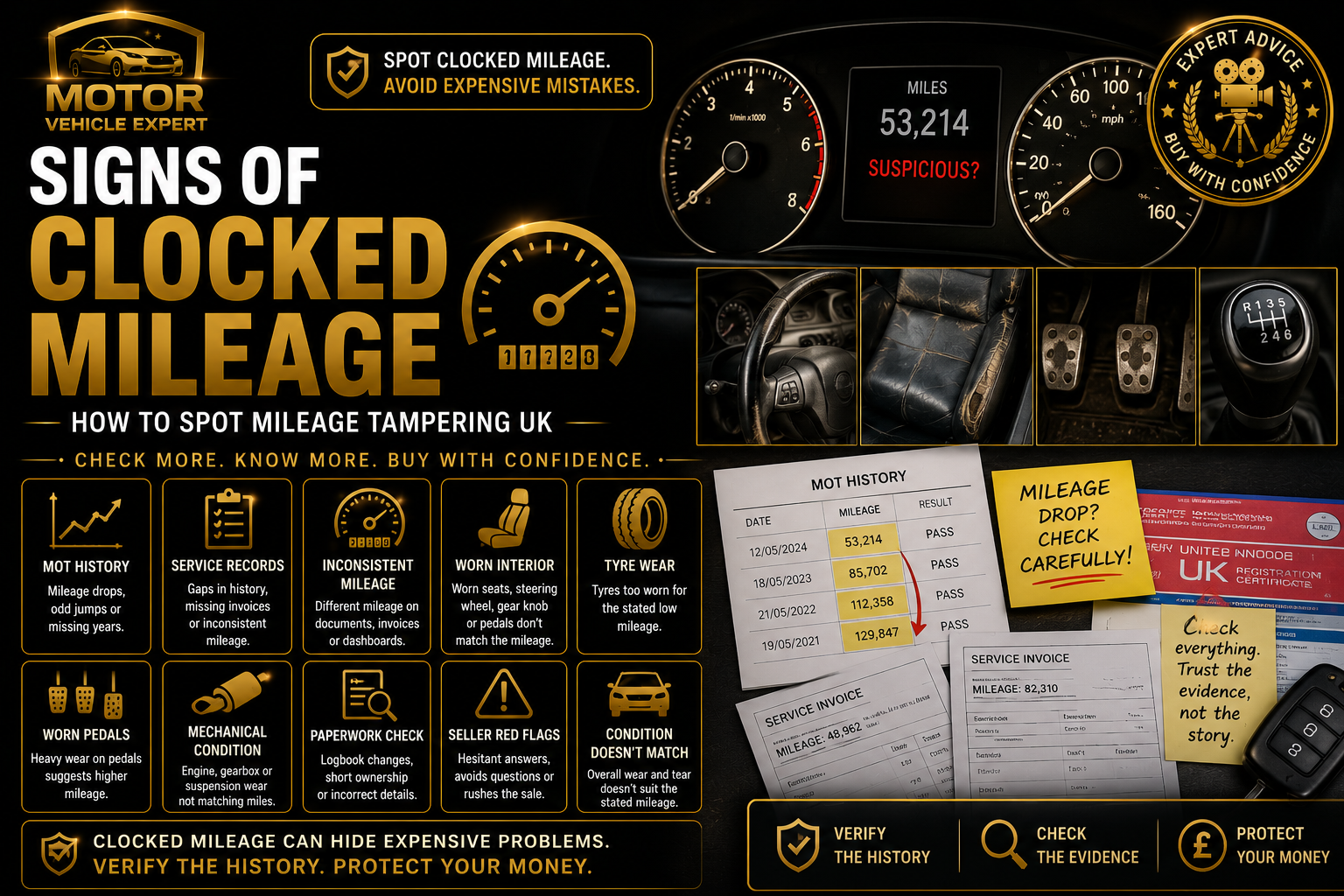
Quick answer
The biggest signs of clocked mileage are mileage drops in MOT history, missing service records, invoice mileage that does not match, worn interior parts on a “low mileage” car, strange gaps in paperwork and a seller who cannot explain the car’s history clearly.
Do not judge mileage by the dashboard alone. A proper used car mileage check compares MOT records, service history, invoices, vehicle wear, ownership story, test drive behaviour and whether the condition matches the mileage.
Buy the evidence, not the number on the dashboard. Mileage only means something when the paperwork and condition support it.
What suspicious mileage usually looks like
Mileage problems rarely show from one clue alone. It is usually a combination: MOT readings look odd, invoices are missing, the driver seat is tired, pedals are worn smooth and the seller gives vague answers.
Some cars have honest MOT mileage mistakes, but a genuine seller should be able to explain the mistake with invoices, service records or later mileage evidence. If they cannot explain it, do not ignore it.
A low-mileage car should still feel tight, well-kept and properly documented. If it drives like a hard-used car, looks heavily worn inside and has thin paperwork, the mileage deserves serious questioning.
Mileage affects value, maintenance planning, resale confidence and how much life may be left in major parts such as clutch, suspension, brakes, timing components and interior trim.
Instant mileage fraud red flags
Mileage dropped
The MOT history shows the mileage went backwards between tests.
No real invoices
The seller has a stamped book but no dated invoices showing mileage and work carried out.
Heavy interior wear
The steering wheel, pedals, gear knob and driver seat look too worn for the mileage.
Seller rushing you
Pressure tactics are being used to stop you checking history properly.
Very cheap price
The car is priced much lower than similar genuine examples.
History gaps
Several years of mileage, servicing or ownership history appear to be missing.
Best order to inspect a used car properly
Use this simple checklist flow before travelling far, paying a deposit or arranging insurance. It helps you spot mileage problems before emotion takes over.
1. Check MOT history first
Look for mileage drops, odd jumps, repeated advisories, corrosion warnings and unexplained gaps.
Check MOT history →2. Check service records
Compare invoice mileage against MOT records and confirm major maintenance history.
Service history checks →3. Inspect the car physically
Look for steering wheel wear, pedal wear, seat collapse, trim damage and condition mismatch.
Inspection checklist →4. Test drive it properly
A suspicious low-mileage car may still feel loose, noisy, tired or poorly maintained.
Test drive checklist →5. Ask direct questions
Ask about previous owners, servicing, mileage changes, repairs and why the car is being sold.
Buyer questions →6. Run a wider history check
Mileage concerns often sit alongside finance, write-off, theft or accident repair concerns.
Vehicle history checks →How MOT history can reveal clocked mileage
MOT history is one of the best places to start because it gives mileage readings recorded over time. You are looking for a mileage story that rises naturally year by year.
- !Mileage drops from one MOT to the next.
- !One year shows unusually low mileage compared with the rest.
- !Several years are missing or the car was off the road without explanation.
- !The advert mileage does not match the latest MOT mileage.
- !The mileage rises too little for the car’s age and likely usage.
- !The seller gives a vague answer when you ask about the mileage pattern.
Some mileage errors can happen by mistake at MOT time, but the seller should be able to explain them with paperwork. If they cannot, treat it as a serious warning.
Service history clues
Service invoices should show dates, mileage and work carried out. If the car has genuine maintenance history, the mileage on invoices should match the MOT record and the car’s condition.
Invoices with mileage
Good invoices usually include the registration, mileage, date, garage details and work completed.
Service book stamps only
Stamps are useful, but invoices are stronger evidence because they show more detail.
Digital service history
For newer cars, ask if the manufacturer or dealer network can confirm the digital record.
Missing proof of major work
No proof of cambelt, clutch, brake or major servicing on a “well-maintained” car deserves caution.
For a deeper check, read how to check service history before buying.
Interior wear that can expose false mileage
Interior wear is not proof by itself, but it helps build the picture. A car used for short town trips, taxis, deliveries or heavy commuting may wear faster than the mileage suggests.
Steering wheel
Heavy shine, peeling, smooth leather or worn trim can look suspicious on low-mileage cars.
Pedals
Badly worn rubber pedals can suggest lots of use, especially clutch and brake pedals.
Driver seat
Collapsed bolsters, torn fabric or heavy creasing can suggest repeated use.
Gear knob
Heavy wear on the gear knob can reveal more use than the odometer suggests.
Switches and buttons
Worn window switches, heater controls and start buttons can show regular use.
Door handles
Heavy wear on driver door handles and armrests can expose high-use vehicles.
When the car condition does not match the mileage
- !Low mileage but worn tyres, brakes and suspension.
- !Low mileage but clutch feels high, slips or judders.
- !Low mileage but steering wheel, seat and pedals look heavily used.
- !Low mileage but MOT history shows repeated maintenance neglect.
- !Low mileage but paint, stone chips and interior wear look high-use.
- !Low mileage but no service invoices support the story.
- !Low mileage but the car drives tired, noisy or loose on the road.
Mileage is only one part of value. A well-serviced higher-mileage car can be a better buy than a suspicious low-mileage car with poor records.
Useful related reads: is 100k miles too much for a used car? and best mileage to buy a used car UK.
Seller red flags around mileage
“I do not know the history”
Sometimes honest, but risky if the car is being priced as low-mileage or well-maintained.
“The MOT must be wrong”
MOT errors can happen, but the seller should have evidence to explain the difference.
“It belonged to a family member”
This can be true, but still check V5C, MOT mileage and service invoices properly.
“Someone else wants it”
Pressure tactics are used to stop buyers checking history carefully.
Before contacting a seller, use questions to ask when buying a used car.
What to check first
1. Check MOT mileage
Look for mileage drops, strange jumps, missing years or numbers that do not match the advert.
2. Compare service invoices
Dates and mileage on invoices should line up with MOT records.
3. Inspect interior wear
Check steering wheel, pedals, gear knob, driver seat, switches and door handles.
4. Check condition against mileage
Tyres, brakes, clutch, suspension and paintwork should make sense for the mileage.
5. Ask direct questions
Ask the seller to explain gaps, drops or missing history clearly.
6. Pay for a history check
A vehicle history check can help identify mileage concerns, write-off markers and finance issues.
Good vs suspicious mileage examples
Good example
The car shows 82,000 miles, MOT mileage rises steadily, service invoices match, wear looks normal and the seller has clear paperwork.
Suspicious example
The car shows 48,000 miles, but MOT history once showed 71,000 miles, the service book is missing and the interior looks heavily worn.
Possible innocent error
One MOT reading looks wrong, but the seller has invoices and later records proving it was likely an input mistake.
High-risk situation
Mileage drops, paperwork is missing, the seller is rushing you and the price is much cheaper than similar cars.
How clocked mileage affects value
Clocked mileage can make a car look more desirable than it really is. The problem is not only the number on the dashboard. The bigger issue is that the car may have more wear, more servicing needs and less resale value than the buyer expects.
Resale risk
Future buyers may walk away if the mileage story does not make sense.
Repair risk
Parts may be more worn than expected, even if the dashboard shows low mileage.
Trust risk
If the mileage is questionable, other parts of the car’s history may also be unreliable.
If you are comparing cars, also read how to value a car UK and buying from a dealer vs private seller.
When to walk away
- !Mileage drops in MOT history with no clear evidence-based explanation.
- !Service invoices do not match MOT mileage.
- !The seller avoids mileage questions.
- !The car looks far more worn than the mileage suggests.
- !Important service records are missing on an expensive car.
- !The price is low and the seller is rushing you.
- !The story changes when you ask direct questions.
If the mileage story does not make sense, do not talk yourself into the car because the price looks good. Clocked mileage can affect value, maintenance planning, future resale and your trust in the vehicle.
Best mechanic-style advice
Do not buy the mileage. Buy the condition, history and evidence. The dashboard number is only believable when the MOT record, service invoices and wear all support it.
If the car is advertised as low mileage but the paperwork is thin and the interior looks tired, treat it as a warning sign. A genuine car should not fall apart when you ask simple history questions.
If the history, condition, seller story and test drive do not all agree, pause the sale and keep looking.
Related used car buying guides
Frequently asked questions
What are the signs of clocked mileage?
Common signs include MOT mileage drops, missing service history, worn interior parts, invoice mileage mismatch and car condition that does not match the dashboard mileage.
Can MOT history show mileage tampering?
Yes. MOT history can show mileage drops, strange jumps, missing years and readings that do not match the advert.
Can a car have incorrect mileage by mistake?
Yes, mileage can sometimes be entered incorrectly, but the seller should be able to explain the issue with records and evidence.
Is a low-mileage used car always better?
No. A low-mileage car with poor history can be worse than a well-maintained higher-mileage car.
Can service history reveal clocked mileage?
Yes. Service invoices should show dates and mileage. If they do not match MOT history, be cautious.
What interior wear suggests mileage may be wrong?
Heavy wear on the steering wheel, pedals, gear knob, driver seat, switches and door handles can look suspicious on a low-mileage car.
Should I buy a car if the mileage does not add up?
Usually no, unless there is a clear evidence-based explanation. If the seller cannot explain it properly, walk away.
What is the best way to protect myself?
Check MOT history, service records, invoices, vehicle condition, seller details and consider a paid vehicle history check before buying.