
Quick answer
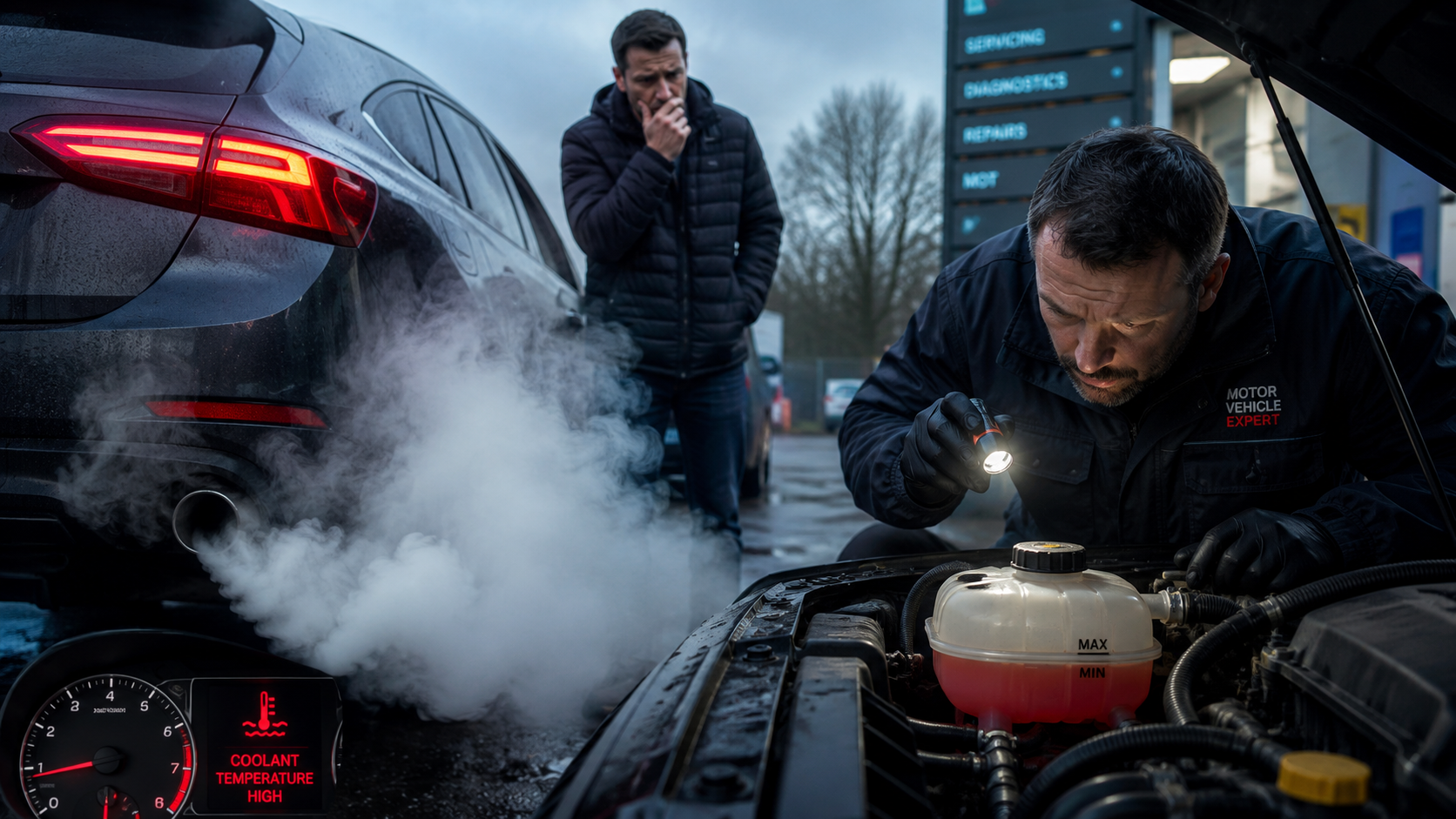
If white smoke is light, disappears quickly and only happens on cold starts, it is often condensation. If the smoke is thick, keeps coming after warm-up, smells sweet or comes with coolant loss, overheating or rough running, treat it as a serious cooling-system or engine fault.
White smoke with coolant loss can be caused by a blown head gasket, coolant entering the cylinders, an EGR cooler leak on some diesels, a cracked cylinder head, or coolant leaking onto hot exhaust parts. Do not keep driving if the coolant level is dropping or the engine is overheating.
What I look for first when a car comes in smoking white
In real workshop life, I do not condemn the head gasket just because a driver says “white smoke”. I first ask when it happens. A bit of vapour on a cold morning that clears after a few minutes is very different from thick white smoke still pouring out when the engine is warm.
The serious cases usually come with more than one clue. Coolant level keeps dropping, the exhaust has a sweet smell, the heater may go cold, the temperature gauge climbs or the expansion tank starts bubbling. That is when I stop treating it like normal condensation and start checking for pressure problems, combustion gases and internal coolant loss.
The combination matters. White smoke alone can be normal. White smoke with coolant loss and overheating needs proper testing before more damage is done.
Normal condensation or serious white smoke?
More likely normal condensation
Thin white vapour appears on a cold start, clears as the exhaust warms up, has no strong sweet smell and the coolant level stays stable.
More likely coolant-related smoke
Thick white smoke continues when warm, smells sweet, coolant level drops, temperature rises, coolant bubbles or the engine runs rough.
Cold weather makes exhaust vapour more visible, especially on short journeys. The important question is whether the vapour clears normally or keeps coming once the engine and exhaust are warm.
For a broader guide to smoke colours, read exhaust smoke colour guide.
Common causes of white smoke with coolant loss
Head gasket failure
Can allow coolant into the combustion chamber, creating white smoke or steam.
Head gasket symptoms →Cracked cylinder head
Less common, but serious. Coolant may enter cylinders or oil passages after overheating.
Damaged engine block
Rare, but possible after severe overheating, freezing damage or major engine stress.
EGR cooler leak
On some diesels, a leaking EGR cooler can send coolant into the intake or exhaust path.
Coolant leak near exhaust
Coolant dripping onto hot exhaust parts can create steam or a sweet smell outside the car.
Coolant smell guide →Recent coolant spill
Spilled coolant after repairs can briefly steam or smell sweet until it burns off.
White smoke and possible head gasket symptoms
A head gasket seals the engine block and cylinder head. If it fails between a coolant passage and a cylinder, coolant can enter the combustion chamber and leave as white smoke or steam from the exhaust.
- !Thick white exhaust smoke after the engine is warm.
- !Coolant level keeps dropping with no obvious external leak.
- !Sweet smell from the exhaust or engine bay.
- !Engine overheating while driving or idling.
- !Bubbles in the expansion tank or pressure building quickly.
- !Radiator hoses become very hard soon after starting.
- !Rough running, misfire or difficult cold starts.
- !Milky oil or oily residue in the coolant.
Useful related checks: coolant bubbling in expansion tank, car losing coolant but no leak and blown head gasket symptoms.
Can an EGR cooler cause white smoke and coolant loss?
On some diesel engines, the EGR cooler uses engine coolant to cool exhaust gases. If the cooler leaks internally, coolant can enter the intake or exhaust path instead of dripping onto the ground.
Possible EGR cooler clues
Coolant loss with no puddle, white smoke or steam, rough running and symptoms that do not clearly match an external leak.
Why diagnosis matters
EGR cooler symptoms can look similar to head gasket symptoms, so testing is better than guessing.
When to stop driving
- !White smoke is thick and does not clear after warm-up.
- !Coolant warning light appears.
- !Temperature gauge rises or the engine overheats.
- !Coolant level drops quickly after topping up.
- !The engine misfires, runs rough or loses power.
- !Steam, strong coolant smell or visible leaks appear.
- !The expansion tank is empty or coolant is being pushed out.
If these happen, stop safely and let the engine cool. Do not remove the coolant cap while hot because the system can be pressurised.
What to check first
1. Check whether the smoke clears
Cold-start vapour should fade as the exhaust warms. Persistent thick smoke is more serious.
2. Check coolant level cold
A falling coolant level is a key clue. Only check the expansion tank when the engine is cool.
3. Watch the temperature gauge
Overheating with white smoke and coolant loss needs urgent diagnosis.
4. Smell the exhaust carefully
A sweet smell can suggest coolant vapour rather than normal condensation.
5. Check oil and coolant condition
Milky oil or oily coolant can suggest internal contamination, although not every head gasket fault shows this.
6. Look for external leaks
Not all steam is from the exhaust. Coolant can also steam on hot exhaust or engine parts.
How garages usually diagnose coolant-related white smoke
Cooling system pressure test
Checks whether coolant pressure drops and helps find external leaks.
Combustion gas test
Checks for exhaust gases entering the coolant system, often used for suspected head gasket faults.
Diagnostic scan
Can reveal misfire codes, overheating history, sensor data or emissions faults.
Compression or leak-down test
Helps assess cylinder sealing and internal engine condition.
Cooling fan and thermostat checks
Confirms whether overheating is caused by airflow or coolant flow problems.
EGR cooler inspection
Useful on some diesels when coolant loss and white smoke do not clearly point to the head gasket.
Possible repair costs
Repair cost depends on the cause. Do not assume it is automatically a head gasket, but do not ignore the warning signs either.
Condensation only
No repair needed if coolant level is stable and vapour clears normally.
External coolant leak
Cost depends on whether it is a hose, radiator, tank, thermostat housing or pump.
Coolant leak cost →EGR cooler issue
Can be moderate to expensive depending on vehicle and access.
Head gasket repair
Often expensive because of labour, testing, machining and related parts.
Cylinder head damage
Can become more expensive if overheating has warped or cracked components.
Engine replacement
In severe cases, repair may not be economical on older vehicles.
If repair cost is high, compare it with is it worth repairing an old car?.
Use the diagnostic app for smoke and coolant symptoms
You can use the free Motor Vehicle Expert diagnostic app to check exhaust smoke, coolant loss, overheating, misfire and warning light symptoms before deciding what to do next.
The app gives general guidance only. White smoke with coolant loss should be confirmed with proper inspection and testing.
Best mechanic-style advice
Do not judge white smoke from one cold start. Watch what happens when the engine is warm, check whether coolant is actually disappearing and look for other clues like overheating, bubbling coolant, hard hoses or rough running.
If the coolant level is dropping and the smoke is still there when warm, get the car tested before driving it normally. A pressure test and combustion gas test can save a lot of guessing.
Do not keep topping the coolant up and hoping the smoke clears. If coolant is going into a cylinder, driving can damage the engine, catalytic converter, DPF, oxygen sensors and turbo system depending on the vehicle.
Related smoke, coolant and overheating guides
Frequently asked questions
Does white smoke mean coolant is burning?
Not always. Cold-start vapour can be normal. Thick white smoke with coolant loss or a sweet smell can mean coolant is entering the combustion chamber.
Can a head gasket cause white smoke?
Yes. A failed head gasket can allow coolant into the cylinders, creating white smoke or steam from the exhaust.
Is white smoke on a cold start normal?
A small amount of white vapour can be normal condensation if it clears quickly and coolant level stays stable.
Can I drive with white smoke and coolant loss?
You should avoid driving if coolant is dropping, the engine is overheating, warning lights appear, white smoke is heavy or the engine runs rough.