Does an MOT Check Wheel Alignment?
No. An MOT test does not include a computerised wheel alignment or tracking check. The tester does not measure toe, camber or caster angles using specialist alignment equipment. Those measurements require dedicated wheel alignment machinery and fall outside the scope of the MOT inspection.
However, poor wheel alignment can cause problems that are inspected during an MOT. Uneven tyre wear, damaged suspension components, steering defects and unsafe vehicle handling may all result in advisories or MOT failures depending on their severity.
✔ The MOT does not measure wheel alignment.
✔ The MOT does inspect tyres, steering and suspension.
✔ Poor alignment often causes defects that can lead to an MOT advisory or failure.
Wheel Alignment
Measured using specialist laser or camera alignment equipment at a garage.
Tyre Wear
Excessive or uneven tyre wear caused by poor alignment is checked during every MOT inspection.
Steering & Suspension
Loose steering joints, worn suspension parts and damaged components caused by poor alignment can all fail an MOT.
Why Wheel Alignment Still Matters Before an MOT
Many drivers believe an MOT includes a full tracking check, but this is one of the most common misconceptions. In reality, MOT testers inspect the results of poor wheel alignment rather than the alignment measurements themselves. If incorrect tracking has caused rapid tyre wear, damaged suspension components or steering problems, the vehicle may fail even though no alignment measurements have been taken.
For example, a tyre worn through to the cords on its inner edge because of incorrect toe settings is likely to fail the MOT due to its condition, not because the wheel alignment itself has been measured. Likewise, damaged steering or suspension components discovered during the inspection may lead to an MOT failure if they affect the vehicle's safety.
If your steering wheel sits off-centre, the vehicle pulls to one side, or you notice uneven tyre wear, have the wheel alignment checked before booking your MOT. Correcting the problem early is usually far cheaper than replacing tyres damaged by poor alignment.
Before Your MOT
Inspect all four tyres for uneven shoulder wear, exposed cords or flat spots.
During The MOT
The tester checks tyre condition, steering components, suspension wear and overall roadworthiness.
After Repairs
If steering or suspension parts have been replaced, a professional four-wheel alignment is recommended to prevent premature tyre wear.
For more detailed guidance, continue with our related UK guides covering Car Fails MOT on Tyres, Car Fails MOT on Suspension, Most Common MOT Advisories Explained, MOT Advisory Meaning Explained and Common MOT Failure Reasons UK.
Wheel Alignment vs MOT Inspection
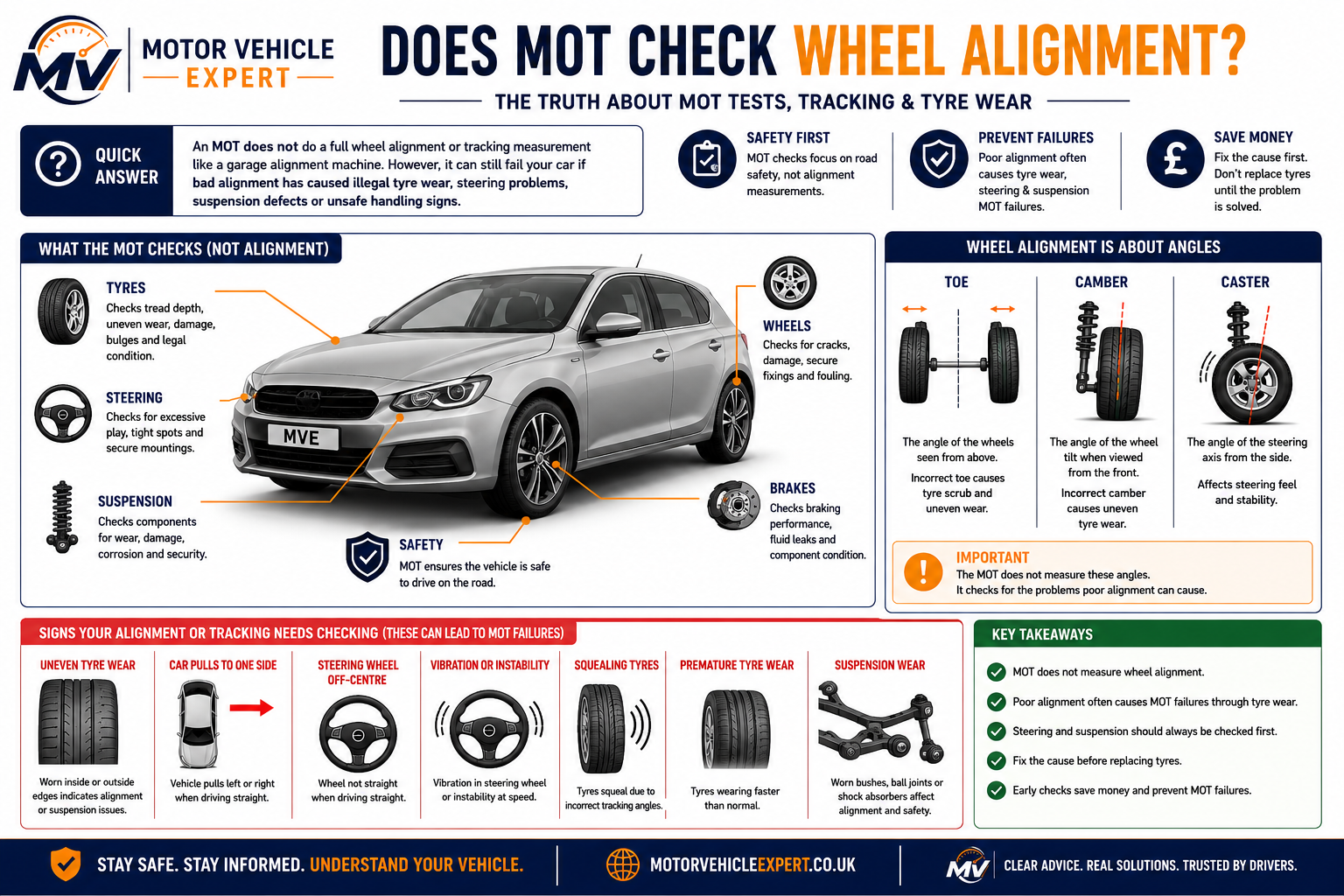
An MOT inspection and a wheel alignment service are not the same thing. The MOT checks roadworthiness, tyre condition, steering and suspension safety. A wheel alignment service measures and adjusts the vehicle's steering geometry using specialist equipment.
An MOT does not measure wheel alignment angles. It checks whether poor alignment has already caused unsafe tyre wear, steering play, suspension defects or other roadworthiness problems.
Toe Angle
Wheel alignment: measured and adjusted using alignment equipment.
Camber Angle
Wheel alignment: measured where applicable, depending on vehicle and equipment.
Caster Angle
Wheel alignment: measured on many four-wheel alignment systems.
Tyre Wear
Wheel alignment: checked because uneven tyre wear can point to tracking or suspension issues.
Steering Play
Wheel alignment: steering components should be inspected before adjustment.
Suspension Condition
Wheel alignment: worn parts must be repaired before accurate alignment.
Alignment Printout
Wheel alignment: often provides a before-and-after geometry report.
Adjustment Work
Wheel alignment: adjusts tracking or geometry settings where possible.
MOT Failure Risk
Bad alignment itself is not measured, but tyre, steering or suspension defects can fail.
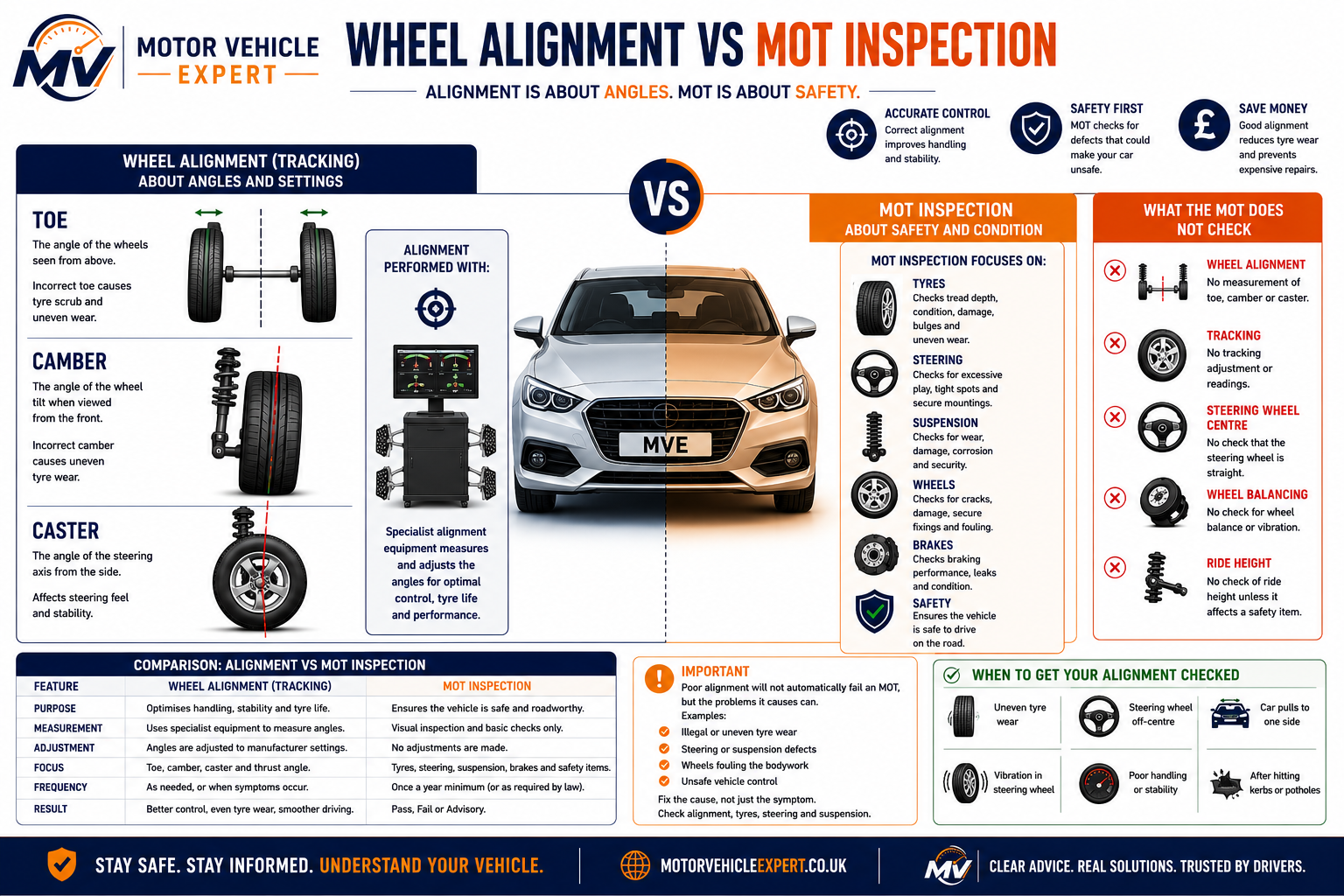
If your car pulls to one side, has uneven tyre wear or the steering wheel is off-centre, inspect tyres, steering and suspension before paying for alignment. Alignment only makes sense once the mechanical parts are sound.
What the MOT Actually Checks Around Alignment
The MOT is a safety inspection. It looks for visible defects, unsafe wear and roadworthiness problems.
Tyre condition and tread
The tester checks tyre tread depth, damage, bulges, cuts, exposed cords and whether the tyres are suitable and safe.
Tyre tread MOT guide →Steering condition
The tester checks steering components, steering play, security, operation and whether there are obvious defects.
Steering rack MOT guide →Suspension parts
Worn lower arms, ball joints, shock absorbers, springs and bushes can all affect alignment and can also cause MOT failures.
Suspension MOT guide →Wheels and bearings
Loose wheels, damaged wheels or worn wheel bearings can be picked up during the MOT safety checks.
Wheel bearing MOT guide →Track rod ends
A worn track rod end can affect steering and alignment, and it can fail the MOT if it has excessive play or damage.
Track rod end MOT guide →Lower arms and ball joints
These parts help hold the wheel in the correct position. Wear here can cause uneven tyre wear and poor handling.
Lower arm MOT guide →Wheel Alignment Is Not the Same as an MOT Check
A proper wheel alignment check uses specialist equipment to measure wheel angles. The garage looks at settings such as toe, camber and sometimes caster depending on the equipment and vehicle.
An MOT is different. It is not designed to fine-tune the way the car drives. It checks whether important parts are safe and roadworthy on the day of the test.
What alignment measures
Wheel alignment measures steering geometry and adjusts tracking where possible to reduce tyre wear and improve vehicle stability.
What drivers usually mean by tracking
When most UK drivers say “tracking”, they usually mean front wheel toe adjustment. Poor tracking can make the steering wheel sit off-centre, make the car pull, or scrub the tyre edges.
If tyres are already badly worn because of tracking, the MOT issue becomes the tyre condition rather than the tracking measurement itself.
How Alignment Problems Can Become MOT Failures
These are the common ways tracking and alignment issues turn into MOT problems.
Uneven tyre wear below the legal limit
If the inside or outside edge of a tyre has worn too low, the car can fail even if the centre tread still looks acceptable at a glance.
Tyre MOT failure guide →Tyre cords showing
Bad tracking can wear an inner edge right through to the cords. That is dangerous and should be dealt with before driving.
Bald tyres MOT guide →Worn steering parts
If tracking is out because of a worn track rod end, steering rack issue or excessive steering play, the MOT can fail on the worn component.
Track rod end guide →Suspension damage or play
A bent arm, worn bush, damaged spring or loose ball joint can throw alignment out and also be a direct MOT failure.
Ball joint MOT guide →Wheels or Tyres Fouling Bodywork
If a tyre or wheel rubs against bodywork or another component because of damage, incorrect fitment, suspension movement or excessive steering movement, the resulting defect can become an MOT concern.
This is different from wheel alignment itself being tested. The MOT is concerned with the condition and safety of the affected components rather than carrying out a tracking or alignment measurement.
Unsafe Handling Signs
A car that pulls strongly to one side, has excessive steering free play or shows other obvious steering or suspension defects should be inspected before the MOT.
Car Pulls Left or Right Guide →MOT Advisories Related to Wheel Alignment and Tyre Wear
Wheel alignment or tracking itself is not measured during an MOT, but alignment problems can contribute to uneven tyre wear and may be associated with worn steering or suspension components. Investigating related advisories early can help prevent further tyre wear, improve handling and reduce the risk of defects becoming more serious.
Tyre Wear Advisory
Uneven tyre wear can be associated with incorrect wheel alignment, unsuitable tyre pressures or worn steering and suspension components.
Read Tyre Wear Advisory Guide →Suspension Advisory
Worn suspension components can alter wheel geometry, reduce stability and accelerate tyre wear before they become serious enough to cause an MOT failure.
Read Suspension Advisory Guide →Brake Disc Advisory
Brake disc advisories highlight wear or corrosion that may develop into braking performance issues if ignored.
Read Guide →Brake Pad Advisory
Low brake pad material is frequently recorded as an advisory before becoming an MOT failure at the next inspection.
Read Guide →Corroded Brake Pipe Advisory
Brake pipe corrosion is one of the UK's most common MOT advisories and should always be repaired before it becomes a dangerous defect.
Read Guide →Most Common MOT Advisories
Explore the UK's most common advisory items, what they mean and how to prevent them becoming future MOT failures.
Read Guide →Many MOT failures begin as simple advisories. If your vehicle receives repeated tyre wear, suspension or brake advisories, arrange repairs before your next MOT to reduce repair costs and improve road safety.
Signs Your Alignment or Tracking Needs Checking Before MOT
These signs do not always mean the car will fail, but they are strong warnings that something needs checking.
Steering wheel off-centre
The car drives straight but the steering wheel sits slightly left or right.
Car pulls to one side
The vehicle drifts left or right on a level road without much steering input.
Pulling to one side causes →Inner tyre edge worn
The tyre looks fine from the outside but the inside shoulder is low, cracked or showing cords.
Outer tyre edge worn
The outside shoulder wears faster than the rest of the tyre.
Vibration at speed
This can be wheel balance, tyre damage, suspension wear or wheel issues rather than alignment alone.
Car shakes at high speed →Car pulls after tracking
If the car still pulls after tracking, there may be tyre, brake, suspension or steering faults.
Pulls after tracking guide →What I See in Real Garage Work
A lot of drivers only notice tracking problems when the MOT is due. They look at the tyre from the outside and think it is fine, but when the steering is turned or the car is lifted, the inside edge is badly worn.
In many cases, the tracking is only part of the story. A worn lower arm bush, loose track rod end, bent suspension arm or damaged tyre can be the real reason the car is wearing tyres unevenly.
That is why I would not just say “get tracking done” without checking the front suspension and steering first. If there is play in the parts, alignment may not hold properly.
Do not fit new tyres before checking the cause. Inspect steering and suspension first, repair worn parts, then align the wheels, then fit or protect the tyres depending on condition.
What to Check Before Your MOT
Use this quick pre-MOT check if you suspect alignment or tracking problems.
Inspect both tyre edges
Do not only look at the visible outer face. Turn the steering and check the inner edges of both front tyres.
Look for bulges, cuts and cords
If you see cords, cracks, a bulge or deep damage, do not wait for the MOT to tell you.
Tyre bulge MOT guide →Drive on a straight, safe road
If the car pulls, the steering wheel is off-centre or the vehicle wanders, book an inspection before MOT.
Listen for knocks or clunks
Knocking over bumps or when turning can point to worn suspension or steering parts.
Knocking when turning guide →Check tyre pressures
Wrong tyre pressure can also cause poor handling and uneven tyre wear, so check pressures before blaming alignment.
TPMS MOT guide →Do not ignore recent impacts
If you hit a kerb or pothole, alignment can move and suspension parts can bend. Get the car checked if it drives differently afterwards.
Buying a Used Car With Wheel Alignment Problems
Poor wheel alignment is often a symptom rather than the root cause of the problem. While a simple tracking adjustment may solve minor steering issues, persistent pulling, uneven tyre wear or an off-centre steering wheel can indicate worn suspension components, accident damage or steering faults that require more extensive repairs. A careful inspection before buying can save hundreds of pounds in unexpected repair costs.
Many buyers focus only on tyre condition, but tyres often tell the story of the suspension and steering underneath. A vehicle with rapid inner-edge tyre wear, repeated MOT advisories or evidence of recent kerb impacts deserves a much closer inspection before money changes hands.
Never assume uneven tyre wear simply means the tracking needs adjusting. Always inspect the tyres, steering and suspension together, check the vehicle's MOT history for repeated advisories and ask whether any suspension or steering repairs have recently been carried out.
Car Pulls Left or Right
A vehicle that consistently drifts to one side on a level road may have incorrect wheel alignment, uneven tyre pressures, worn suspension components or previous accident damage.
Read Guide →Uneven Tyre Wear
Heavy wear on the inner or outer tyre edges often indicates poor wheel alignment or worn suspension parts that should be investigated before purchase.
Read Guide →Steering Wheel Off-Centre
A steering wheel that is not straight while driving in a straight line usually suggests incorrect alignment or steering repairs that require further investigation.
Read Guide →Check the MOT History
Repeated advisories for tyres, suspension or brakes often reveal long-term maintenance problems that could become expensive after purchase.
Read Guide →Suspension History
Ask whether springs, dampers, control arms or suspension bushes have been replaced. Worn suspension frequently causes alignment problems and uneven tyre wear.
Read Guide →Complete Used Car Buying Guides
Follow our complete inspection guides to identify expensive steering, suspension and braking faults before buying a used vehicle.
Read Guide →If a seller says a vehicle "just needs tracking", always ask why the alignment changed. Kerb strikes, pothole damage, worn suspension joints or previous accident repairs are far more expensive than a simple alignment adjustment and should always be ruled out before buying.
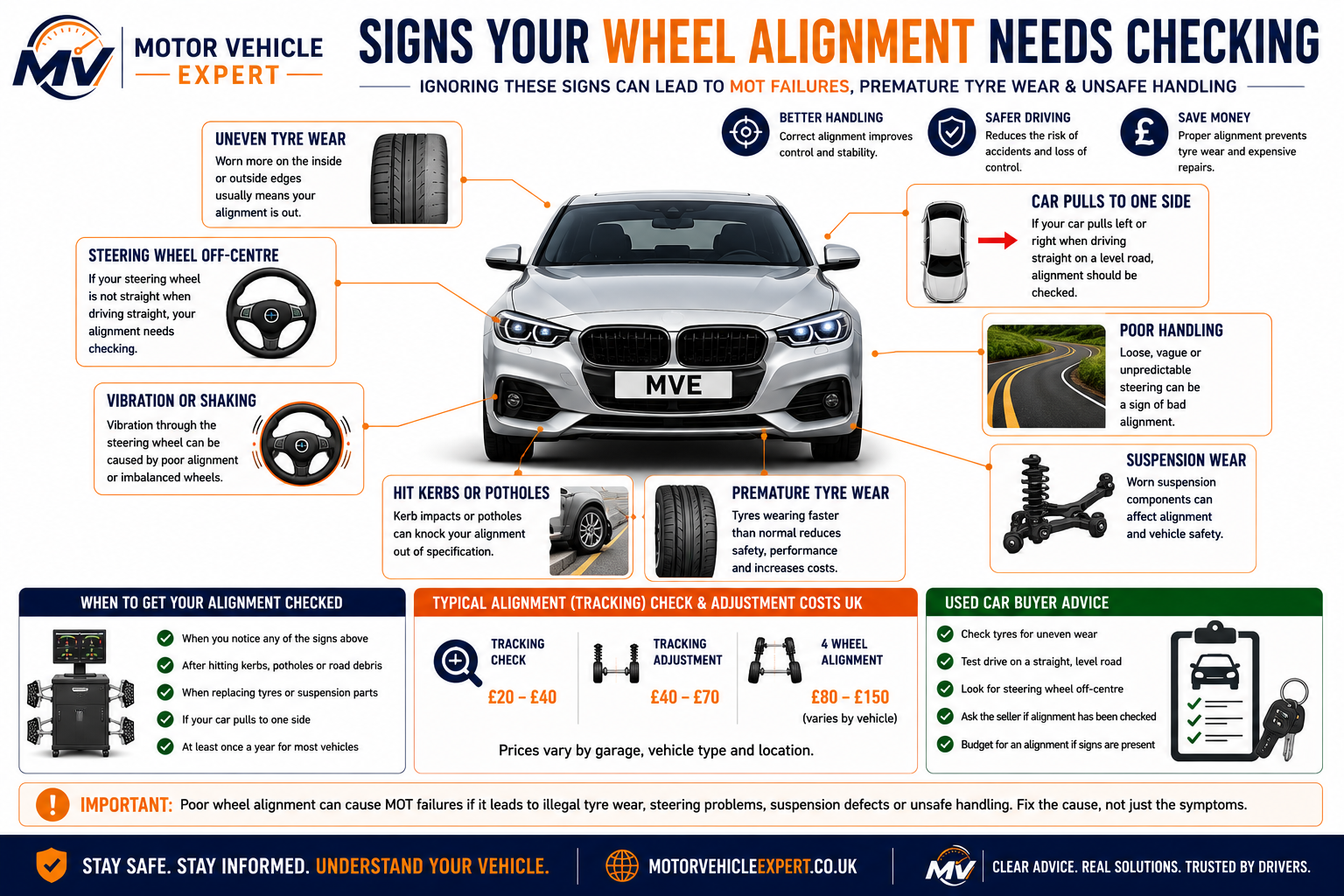
Typical Wheel Alignment & Related Repair Costs UK
Wheel alignment itself is usually inexpensive, but uneven tyre wear or damaged steering and suspension components can significantly increase the final repair bill. These are typical UK guide prices and should be used for planning only.
Front Wheel Tracking
Basic front axle tracking adjustment.
£40–£70Four-Wheel Alignment
Computerised full vehicle geometry check and adjustment.
£60–£120Track Rod End Replacement
Replacement followed by wheel alignment.
£90–£220Lower Suspension Arm
Common cause of alignment issues and uneven tyre wear.
£180–£450Replacement Tyre
If poor alignment has damaged the tyre edge.
£70–£220 per tyreMajor Steering or Suspension Repairs
Multiple worn components requiring repair before alignment.
£400–£1,000+Always repair worn steering or suspension components before paying for wheel alignment. Aligning a vehicle with worn parts rarely produces accurate results and may allow tyre wear to return quickly.
Best Mechanic-Style Advice
If your car pulls to one side, has uneven tyre wear or the steering wheel is not straight, do not treat it as “just tracking” straight away. Check tyres, tyre pressures, brakes, steering joints, suspension arms, ball joints and wheel bearings first. Once the mechanical parts are sound, then wheel alignment makes sense.
Explore More MOT, Steering & Wheel Alignment Guides
Wheel alignment is closely linked to tyre wear, suspension condition, steering performance and MOT inspections. Continue exploring the Motor Vehicle Expert knowledge centre with these related UK guides to build a better understanding of vehicle safety, MOT standards and common repair issues.
MOT & Inspection Guides
Tyres & Wheel Alignment
Suspension & Steering
Brake & Safety Checks
Used Car Buying
Continue Exploring
Wheel alignment itself is not directly measured during an MOT, but the tyre wear, steering faults and suspension defects it causes are inspected carefully. Exploring the guides above will help you understand DVSA inspection standards, recognise problems earlier and make better repair decisions before your next MOT.
Wheel Alignment and MOT: Key Takeaways
- ✓ An MOT does not measure wheel alignment using specialist tracking equipment.
- ✓ Poor wheel alignment commonly leads to MOT failures through excessive tyre wear rather than the alignment itself.
- ✓ Always inspect tyres, steering and suspension before paying for wheel alignment.
- ✓ Uneven tyre wear is one of the earliest indicators of alignment or suspension problems.
- ✓ If your car pulls to one side or the steering wheel sits off-centre, investigate the underlying cause before replacing tyres.
- ✓ Checking your MOT history for repeated tyre or suspension advisories can help identify long-term alignment issues when buying a used car.
Does MOT Check Wheel Alignment? Frequently Asked Questions
Clear answers to the questions UK drivers most commonly ask about MOT tests, wheel alignment, tracking, tyre wear and steering-related MOT failures.
Does an MOT check wheel alignment?
No. An MOT does not perform a computerised wheel alignment or tracking measurement. Instead, it checks the condition of tyres, steering, suspension and other safety-related components that may be affected by poor alignment.
Can bad tracking fail an MOT?
Not directly. However, poor tracking can cause excessive tyre wear, exposed cords, steering defects or suspension problems that may result in an MOT failure.
Can uneven tyre wear fail an MOT?
Yes. A tyre can fail if tread depth is below the legal limit, cords are exposed, or the tyre has dangerous damage such as cuts or bulges.
Can a car pass an MOT with the steering wheel off-centre?
Possibly, but the underlying cause should always be investigated. An off-centre steering wheel often indicates wheel alignment, steering or suspension problems that may require repair.
Should I get wheel alignment done before an MOT?
Yes, if the vehicle pulls to one side, the steering wheel is not centred or the tyres are wearing unevenly. Any worn steering or suspension components should be repaired before alignment is carried out.
Will an MOT tester tell me if my tracking is out?
The tester may identify uneven tyre wear or steering and suspension defects, but they do not perform a full wheel alignment report or provide alignment measurements.
Is wheel balancing checked during an MOT?
No. Wheel balancing is not part of the MOT inspection, although damaged wheels, unsafe tyres and related defects may still be identified during the test.
What is the best thing to check before an MOT?
Inspect tyre condition, tread depth, tyre pressures, steering feel, suspension noises and any signs of uneven tyre wear. Fixing problems early often prevents MOT advisories and expensive repairs later.
Think of poor wheel alignment as an early warning rather than the fault itself. The alignment may not be measured during an MOT, but the tyre wear, steering defects and suspension problems it creates are carefully inspected. Dealing with these issues early usually improves handling, extends tyre life and reduces the risk of MOT advisories or failures.