
Quick answer
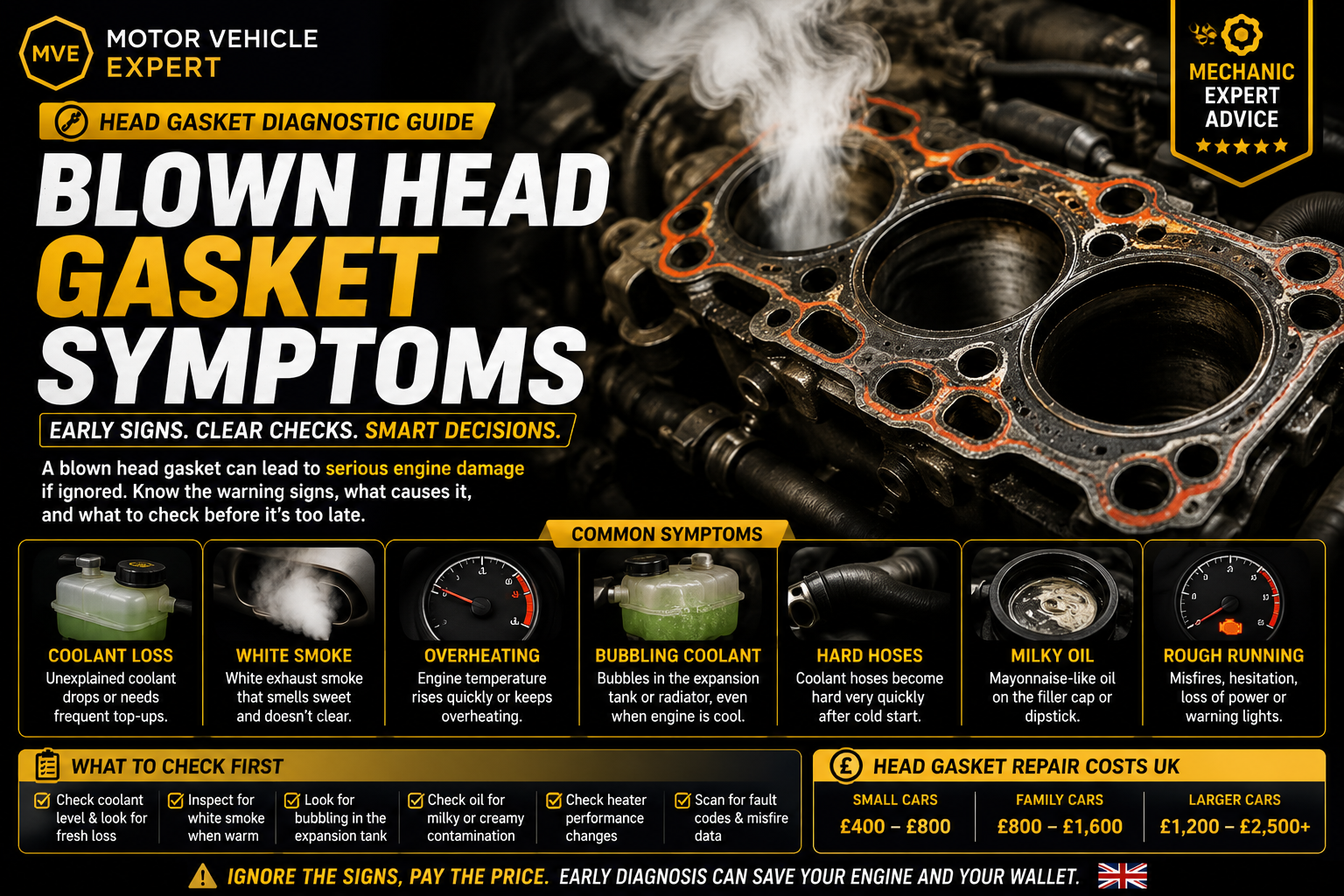
The main blown head gasket symptoms are coolant loss with no obvious external leak, repeated overheating, thick white exhaust smoke, bubbling in the expansion tank, coolant being pushed out, very hard coolant hoses, rough running, misfires, milky oil or oily coolant.
The strongest warning pattern is when several symptoms appear together. Coolant loss plus white smoke, overheating, bubbling coolant or hard hoses is more serious than one small clue on its own.
Do not keep topping up coolant without finding where it is going. Repeated coolant loss can quickly lead to overheating and expensive engine damage.
Use the diagnostic app for head gasket symptoms
You can use the Motor Vehicle Expert diagnostic app to compare coolant loss, overheating, white smoke, misfire, warning light and cooling-system symptoms before deciding what to check next.
Check coolant symptoms
Compare coolant loss, bubbling, pressure build-up, warning lights and heater changes.
Compare smoke signs
Separate normal cold-start vapour from thick white smoke linked with coolant loss.
Understand urgency
See when overheating, rough running or falling coolant level means you should stop driving.
Find next checks
Use symptom patterns before guessing expensive repairs.
What a blown head gasket looks like in real life
Coolant keeps dropping
The level falls again after topping up, even when there is no clear puddle under the car.
Coolant loss guide →Overheats after top-up
The car seems better after coolant is added, then overheats again because the cause is still there.
Overheating causes →White smoke continues when warm
Thick white smoke or steam after warm-up can suggest coolant entering a cylinder.
White smoke guide →Expansion tank bubbles
Combustion pressure can enter the cooling system and create constant bubbling.
Bubbling coolant guide →Heater goes cold
Low coolant or trapped gases can stop hot coolant reaching the heater matrix properly.
Heater cold then hot →Engine runs rough
Coolant entering a cylinder can cause misfire, shaking or rough running, especially from cold.
Misfire symptoms →Find the closest symptom pattern
Coolant loss + no puddle
Could be internal coolant loss, heater matrix leak, pressure leak or head gasket trouble.
Read coolant loss guide →White smoke + sweet smell
More concerning if the smoke continues after warm-up and coolant level drops.
Read white smoke guide →Bubbling coolant + hard hoses
Can suggest pressure entering the cooling system, especially from cold.
Read bubbling coolant guide →Overheats repeatedly
Repeated overheating after top-ups needs proper testing before more damage happens.
What to do if overheating →Milky oil or oily coolant
Can suggest internal contamination, but not every head gasket fault shows this.
Misfire after startup
Coolant entering one cylinder can cause rough running after the car has been parked.
Misfire guide →What does a head gasket do?
The head gasket seals the join between the engine block and the cylinder head. It keeps combustion pressure, coolant and engine oil separated while the engine runs under heat and pressure.
When the gasket fails, coolant, oil or combustion gases can cross into places they should not. That is why one head gasket problem can cause cooling-system pressure, overheating, white smoke, coolant loss, rough running and oil contamination.
Combustion pressure
Should stay inside the cylinders, not push into the cooling system.
Coolant passages
Coolant should circulate around the engine without entering cylinders or oil.
Oil passages
Oil should lubricate the engine without mixing with coolant.
Common blown head gasket symptoms
Coolant loss
Coolant may disappear with no clear external leak.
Coolant loss guide →White exhaust smoke
Coolant entering a cylinder can leave as white smoke or steam.
White smoke guide →Overheating
The engine may overheat at idle, in traffic, on hills or while driving.
Overheating guide →Bubbling coolant
Combustion gases can create bubbles in the expansion tank.
Bubbling coolant guide →Hard coolant hoses
Hoses may become very hard quickly if pressure builds too soon.
Coolant pushed out
Pressure can force coolant out of the tank or overflow route.
Milky oil
Coolant mixing with oil can create creamy or mayonnaise-like residue.
Rough running
Coolant entering a cylinder can cause misfires or difficult starting.
Misfire guide →Engine light
Misfire, overheating or sensor faults may trigger dashboard warnings.
Engine light guide →Early warning signs
A head gasket problem does not always start with clouds of smoke. Early signs can be small, intermittent and easy to dismiss.
- !Coolant level slowly drops over days or weeks.
- !Coolant warning light returns after topping up.
- !Temperature gauge rises slightly above normal.
- !Heater blows cold then hot or becomes inconsistent.
- !Bubbling or gurgling appears in the expansion tank.
- !Cooling hoses feel unusually hard soon after a cold start.
- !White smoke appears more often than normal after startup.
- !Engine runs rough briefly after starting.
Useful next reads: coolant warning light on, temperature gauge going up and down and heater blows cold then hot.
Coolant-related head gasket symptoms
- 1Coolant disappearing: coolant may enter the cylinders or be forced out under pressure.
- 2Bubbles in expansion tank: combustion gases may be entering the cooling system.
- 3Overheating: gases, pressure or coolant loss can reduce cooling performance.
- 4Coolant pushed out: pressure may force coolant from the expansion tank or overflow.
- 5Heater problems: low coolant or air pockets can make cabin heat inconsistent.
- 6Hard hoses: coolant hoses can feel unusually firm if pressure builds too quickly.
A coolant smell can also appear if coolant leaks externally or enters the exhaust. Read car smells like coolant and coolant bubbling in expansion tank.
White smoke and exhaust symptoms
White smoke can be a head gasket symptom when coolant enters the combustion chamber and leaves through the exhaust as steam.
- !Thick white smoke continues after the engine is warm.
- !Exhaust has a sweet coolant-like smell.
- !Coolant level drops at the same time.
- !Smoke is worse after startup or after the car has been parked.
- !Engine misfires briefly after starting.
- !Steam appears with overheating or coolant warnings.
Cold-start vapour can be normal if it clears quickly and the coolant level stays stable. For more detail, read white smoke from exhaust and coolant loss and exhaust smoke colour guide.
Oil-related symptoms
A failed head gasket can sometimes allow coolant and oil to mix. This is not present in every head gasket failure, but when it appears it is a strong warning sign.
Milky oil
Oil may look creamy, pale or contaminated if coolant mixes with it.
Mayonnaise under oil cap
Can suggest moisture, but short journeys can also cause condensation under the cap.
Oily coolant
Oil residue in the expansion tank can point to internal contamination.
Oil level changes
In some cases, coolant entering the oil can affect oil level and lubrication.
Do not rely on milky oil alone. Some head gasket failures never mix oil and coolant. A car can have coolant loss, white smoke and overheating without mayonnaise under the oil cap.
Rough running, misfire and starting symptoms
If coolant leaks into a cylinder, the engine may run unevenly, especially after the car has been parked. This can also trigger the engine management light.
Rough idle
The engine may shake, stumble or sound uneven at idle.
Misfire on startup
Coolant in one cylinder can cause rough running after starting.
Misfire symptoms →Poor acceleration
A damaged gasket can reduce compression or cause uneven combustion.
Hard starting
The engine may take longer to fire if one cylinder is affected.
Engine light
Misfire or fuel-trim fault codes may appear.
Engine light guide →Coolant smell
A sweet smell from the exhaust or engine bay can appear with coolant loss.
What else can look like a blown head gasket?
Not every coolant loss, smoke or overheating issue is a head gasket. A good diagnosis checks the simpler and common causes first.
Normal condensation
Light white vapour on cold starts can be normal and usually clears quickly.
External coolant leak
Hoses, radiator, thermostat housing, expansion tank or water pump can leak.
Coolant leak cost →Airlock
Trapped air can cause bubbling, heater changes and unstable temperature readings.
Airlock clues →Thermostat fault
A stuck thermostat can cause overheating without head gasket failure.
Thermostat guide →Radiator fan fault
Fan faults can cause overheating in traffic or at idle.
Radiator fan guide →Water pump fault
Poor coolant circulation can cause overheating and heater issues.
Water pump symptoms →Blocked radiator
Radiator restriction can cause overheating while driving or under load.
Blocked radiator symptoms →EGR cooler leak
On some diesels, this can cause white smoke and coolant loss without a classic head gasket fault.
White smoke guide →Heater matrix leak
Can cause coolant loss, sweet cabin smell, misted windows and damp carpets.
Coolant smell guide →What to check first
1. Check coolant level cold
Repeated coolant loss is one of the biggest clues. Never open the coolant cap while hot.
2. Watch the temperature gauge
Overheating makes the issue more urgent and can make damage worse.
3. Look for bubbles
Constant bubbling in the expansion tank can suggest pressure entering the cooling system.
4. Check exhaust smoke
Notice whether white smoke clears quickly or continues after the engine is warm.
5. Check oil and coolant condition
Look for milky oil, oily coolant, unusual contamination or mayonnaise-like residue.
6. Arrange proper testing
A garage can carry out pressure, combustion gas, compression and leak-down tests.
Can you drive with a blown head gasket?
You should avoid driving if the engine is overheating, coolant is dropping quickly, white smoke is heavy, the engine runs rough or warning lights appear. Continuing to drive can make repair costs much higher.
If symptoms are mild and you only need to move the car a very short distance, monitor the temperature closely and stop if it rises. Do not attempt a long journey with suspected head gasket failure.
- !Do not drive if the temperature gauge is in the red.
- !Do not drive if the expansion tank is empty.
- !Do not drive if the engine is misfiring badly or knocking.
- !Do not drive if coolant is being pushed out under pressure.
- !Do not keep driving if white smoke is heavy and coolant level is dropping.
For urgent overheating steps, read car overheating: what to do.
What causes head gasket failure?
Overheating
Severe or repeated overheating is one of the most common causes.
Overheating causes →Low coolant
Coolant loss can create hot spots and damage sealing surfaces.
Coolant warning guide →Poor cooling system condition
Thermostat, fan, water pump or radiator faults can lead to overheating.
Engine age and wear
Older engines may be more vulnerable after repeated heat cycles.
Previous overheating
A car that has been driven hot before may already have gasket or cylinder head damage.
Incorrect repair work
Poor previous work or incorrect procedures can cause sealing issues.
How garages confirm head gasket failure
Combustion gas test
Checks whether exhaust gases are entering the cooling system.
Cooling system pressure test
Checks whether the system holds pressure and helps find hidden leaks.
Compression test
Checks whether cylinders are sealing properly.
Leak-down test
Can help identify where cylinder pressure is escaping.
Oil and coolant inspection
Checks for contamination in oil, coolant and the expansion tank.
Cooling system inspection
Checks fan operation, thermostat, radiator, water pump and leaks before condemning the gasket.
Proper testing matters because external leaks, EGR cooler faults, airlocks, thermostats and water pumps can look similar from the driver’s seat.
Head gasket repair costs in the UK
Head gasket repair is often expensive because it can involve stripping engine components, testing the cylinder head, replacing gaskets, changing fluids and checking for overheating damage.
Diagnosis first
Pressure tests, combustion gas tests and compression checks help avoid wrong guesses.
Head gasket repair
Usually costly because labour time is high and related parts may be needed.
Cylinder head machining
May be needed if overheating has warped the head surface.
Coolant and oil change
Fluids usually need replacing after internal contamination or repair work.
Extra cooling repairs
Thermostat, radiator, fan or water pump issues may also need fixing.
Replacement engine
On some older cars, major repair may not be economical.
Before spending heavily, compare the repair cost with the car’s value, mileage, MOT condition and service history. See is it worth repairing an old car? and car repair costs guide UK.
Head gasket warning signs when buying a used car
A head gasket issue can be expensive, so coolant and smoke checks are important when viewing a used car.
Check coolant before and after test drive
A falling level, bubbling tank or coolant smell after driving is a warning sign.
Watch for white smoke after warm-up
Cold-start vapour may clear, but persistent white smoke needs caution.
Check heater and temperature gauge
A cold heater, moving gauge or overheating warning can point to cooling-system trouble.
Look for pressure clues
Coolant pushed out, bubbling or very hard hoses after a short run should not be ignored.
Before buying, also read used car inspection checklist, used car test drive checklist and questions to ask when buying a used car.
Common mistakes drivers make
- !Assuming white smoke always means head gasket failure.
- !Assuming no milky oil means the head gasket must be fine.
- !Repeatedly topping up coolant without finding where it is going.
- !Driving after the temperature gauge reaches the red.
- !Opening the coolant cap while the engine is hot.
- !Replacing expensive parts before proper testing.
Best mechanic-style advice
Do not diagnose a head gasket from one clue alone. White smoke, coolant loss, bubbling coolant, overheating, hard hoses and rough running need to be viewed together.
Start with coolant level, temperature behaviour, smoke, bubbles and oil condition. Then confirm with proper tests before committing to a major repair. Guessing can be expensive, but ignoring repeated coolant loss can be worse.
Related coolant and engine guides
Frequently asked questions
What are the first signs of a blown head gasket?
Early signs can include coolant loss, occasional overheating, bubbling coolant, heater temperature changes, hard coolant hoses, white smoke or rough running after startup.
Can you drive with a blown head gasket?
You should avoid driving if the engine overheats, coolant drops, white smoke is heavy, warning lights appear or the car runs rough.
Does white smoke always mean head gasket failure?
No. Light cold-start vapour can be normal. Thick white smoke with coolant loss, sweet smell or overheating is more concerning.
Can a blown head gasket cause coolant loss?
Yes. Coolant can enter cylinders, mix with oil or be forced out of the cooling system under pressure.
Can low coolant damage a head gasket?
Yes. Low coolant can cause overheating, and overheating can damage the head gasket or cylinder head.
Can a head gasket fail without overheating?
It can, but overheating is a common cause or symptom. Some failures first show as coolant loss, white smoke, bubbling coolant or rough running.
Can a head gasket fail without milky oil?
Yes. Milky oil is not always present. Some head gasket failures mainly cause coolant loss, white smoke, overheating or bubbling coolant.
Is bubbling coolant always a head gasket?
No. Bubbling can also be caused by airlocks, boiling coolant or a faulty pressure cap. Bubbling with coolant loss, overheating and white smoke is more serious.
How do garages test for head gasket failure?
Common tests include combustion gas testing, cooling system pressure testing, compression testing and leak-down testing.
Is head gasket repair always worth it?
Not always. It depends on the car’s value, engine condition, mileage, MOT condition, repair cost and whether overheating caused extra damage.