
Quick answer
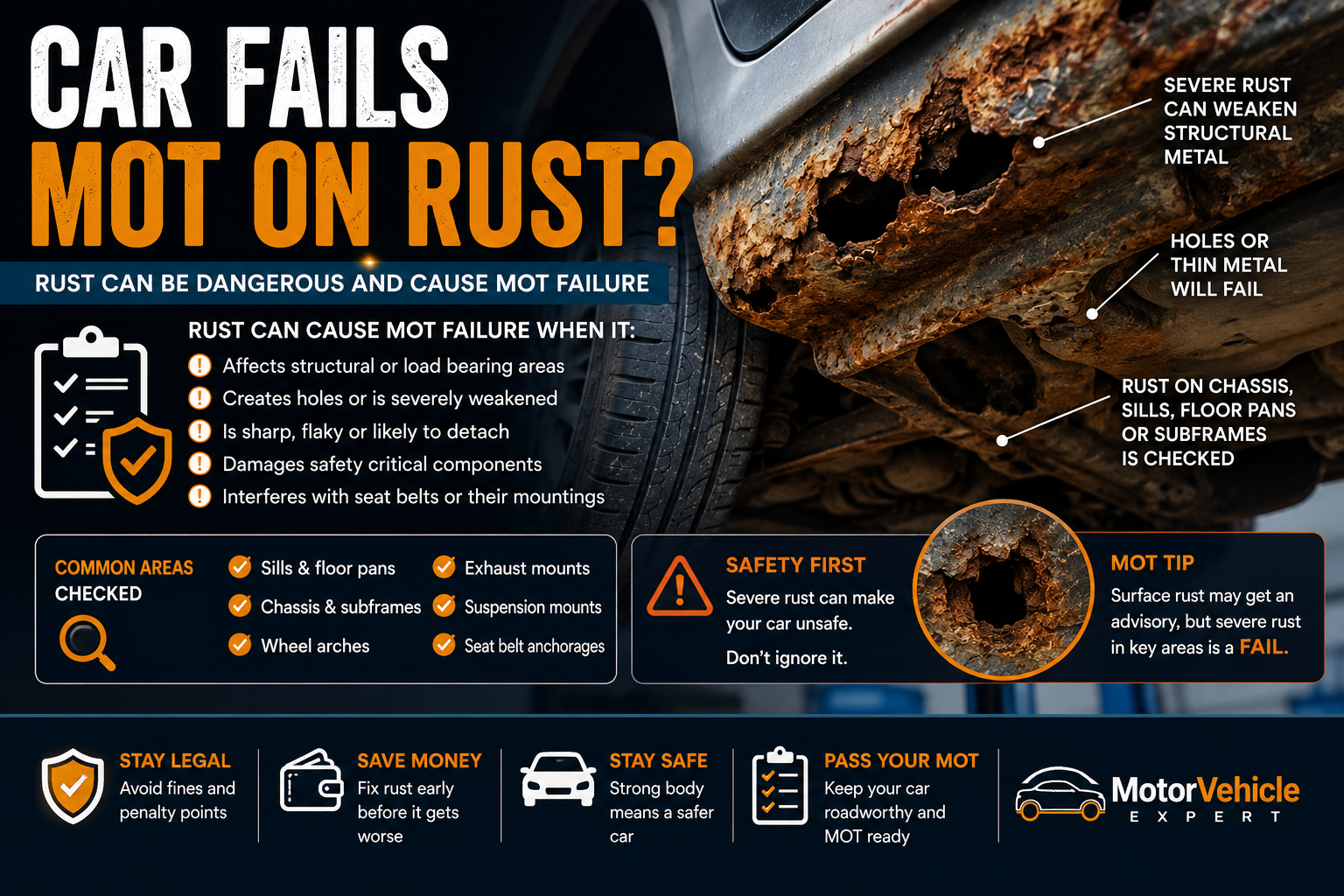
Rust usually fails an MOT when it weakens structural or safety-related areas such as suspension mounts, seatbelt anchorages, sills, floor strength, steering mountings or brake pipes.
Many cars do not fail because of visible paint bubbles alone. The real problem is usually hidden corrosion underneath the vehicle where moisture, salt and dirt collect for years.
A small rusty hole in the wrong structural area can be more serious than a large cosmetic rust patch on an outer body panel.
Surface rust vs structural rust
Surface rust
Usually cosmetic corrosion on the outer layer of metal. Often manageable if treated early.
Structural rust
Corrosion that weakens load-bearing or safety-related metal sections.
Outer body rust
Rust bubbles on arches or doors may look ugly but are not always structural.
Hidden sill corrosion
Inner sill rust can be severe even when outer paint still looks acceptable.
Common areas where rust causes MOT failure
Sills and jacking points
One of the most common structural corrosion areas on older UK cars.
Suspension mounts
Rust around suspension mounting points is safety-critical.
Suspension MOT guide →Brake pipes
Corroded brake pipes can fail because braking safety is affected.
Brake pipe MOT guide →Seatbelt mountings
Seatbelt anchorages must remain structurally strong.
Seatbelt MOT guide →Subframes
Badly corroded subframes may need replacement instead of repair.
Floorpan holes
Floor corrosion becomes serious near mounting points or structural sections.
Rust repairs that can hide bigger problems
One thing many MOT rust guides ignore is how often cosmetic rust repairs hide serious underlying corrosion. Some used cars are patched just enough to pass temporarily without properly restoring strength.
Filler over rust
Body filler may hide holes briefly but does not restore strength.
Underseal hiding corrosion
Thick underseal can hide rotten metal underneath.
Fresh paint underneath
Fresh black paint underneath can sometimes disguise recent welding or corrosion.
Patches welded over weak metal
Poor welding over rotten metal may fail again quickly.
Cheap MOT preparation
Some cars receive temporary cosmetic repairs just before MOT season.
No rust protection after welding
Fresh repairs can rust again quickly if cavity protection is skipped.
Why some cars rust faster than others
Rust is not only about age. Some cars corrode faster because moisture and salt become trapped underneath or inside body cavities for years.
- !Winter road salt exposure.
- !Blocked drainage channels trapping water.
- !Wet carpets from leaks inside the cabin.
- !Cheap previous repairs holding moisture.
- !Underseal trapping moisture against rusty metal.
- !Vehicles stored outside for years.
Is it worth fixing a rusty car?
The answer depends on more than just the repair quote. Hidden corrosion, future MOT advisories and long-term reliability matter just as much as the visible welding job.
More likely worth repairing
Good mechanical condition, limited rust area, strong service history and realistic repair costs.
May not be worth repairing
Widespread structural rust, repeated advisories, failing previous repairs or repair costs close to vehicle value.
Modern used car prices matter
Some owners repair older cars because replacement vehicles have become expensive.
Hidden rust multiplier
Many welding quotes rise once the garage cuts open the affected area.
Useful related guide: Is It Worth Repairing An Old Car UK?
Rust checks when buying a used car
Rust can turn a cheap used car into an expensive ownership mistake very quickly. Always inspect underneath the car, not just the paintwork.
- ✓Check MOT history for repeated corrosion advisories.
- ✓Look underneath sill edges and jacking points.
- ✓Check for fresh underseal or suspiciously fresh paint underneath.
- ✓Look for uneven welding or thick filler patches.
- ✓Inspect brake pipes and suspension areas carefully.
- ✓Be cautious if the underside looks “too freshly cleaned”.
Before buying, use: Used Car Inspection Checklist , How To Check MOT History and Buying Car With Failed MOT History .
Best mechanic-style advice
Rust problems are often discovered too late because many drivers only look at visible bodywork. Serious corrosion usually starts underneath where moisture and salt remain trapped for years.
If the MOT failure involves structural corrosion, ask the garage exactly:
- 1How much metal needs cutting out?
- 2Whether nearby rust is likely.
- 3Whether previous repairs are failing.
- 4Whether cavity protection will be applied afterwards.
A car can still drive normally while the underside becomes structurally unsafe. Rust is one MOT problem that often gets expensive very quietly.
Frequently asked questions
Can surface rust fail an MOT?
Usually not unless it affects structure or creates dangerous edges.
Can rusty sills fail MOT?
Yes, especially near seatbelt or structural areas.
Can underseal hide rust?
Yes. Fresh underseal can sometimes hide corrosion underneath.
Can brake pipe corrosion fail?
Yes. Corroded brake pipes can become unsafe and fail MOT.
Is welding always worth it?
Not always. Hidden corrosion can make repairs uneconomical.
Can I drive after failing on rust?
Not if the defect is dangerous or the vehicle is unsafe.