
Quick answer
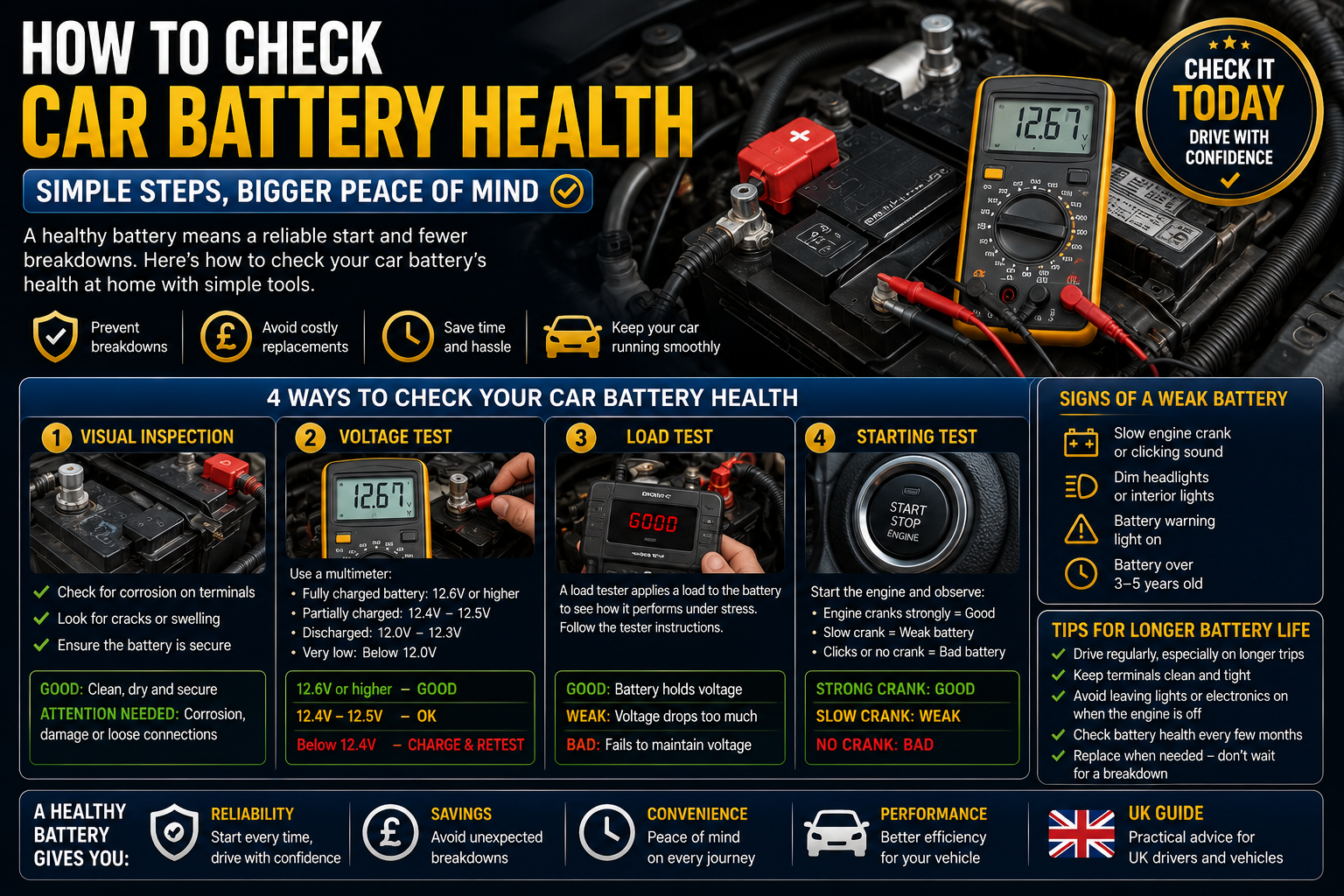
The easiest ways to check car battery health are noticing how the engine starts, checking battery age, inspecting terminals, measuring resting voltage and testing whether the battery repeatedly goes flat.
If the battery warning light appears while driving, the alternator or charging system may be the real cause rather than the battery itself.
A battery can also look fine when the lights and radio work, but still fail when the starter motor demands high current. That is why a proper battery load test is more useful than judging by dashboard lights alone.
Resting voltage tells you charge level. A load test tells you whether the battery can actually work under starting demand.
Why battery health is often misunderstood
A lot of drivers think a battery is healthy because the dashboard lights, radio or interior lights still work. The problem is those items use a small amount of current compared with the starter motor.
In real diagnosis, I would not call a battery good just because the car lights up. I would look at the starting behaviour, battery age, terminal condition, resting voltage, cranking voltage, alternator output and whether the battery holds charge after sitting.
The most common mistake is replacing the battery without checking why it went flat. If the alternator is not charging, or the car has a drain while parked, a new battery can go flat again.
What a weak battery feels like in real life
Slow start in the morning
The engine turns over slowly, especially after sitting overnight or in cold weather.
Clicking but no start
Rapid clicking often points to low voltage, poor terminals or a weak battery under load.
Clicking no-start guide →Needs regular jump starts
Repeated jump starts suggest a weak battery, charging fault or parasitic drain.
Flat after parking
If the battery goes flat after a few days unused, a drain or weak battery may be involved.
Flat battery guide →Battery light while driving
This usually points towards the charging system rather than simple battery age.
Battery warning light →Car will not start but lights work
Lights use less current than the starter, so the battery can still be too weak to crank.
Battery seems fine guide →Signs of a weak car battery
Slow cranking
The engine turns over slowly before starting.
Clicking sound
You hear clicks when trying to start the car.
Starter clicking guide →Dim lights
Headlights or interior lights appear weaker than normal.
Repeated flat battery
The car struggles after standing overnight or a few days.
Repeated flat battery →Cold weather trouble
Weak batteries often fail first during winter starts.
Electrical glitches
Locks, windows, radio or screens behave strangely when voltage is low.
Battery warning light
May indicate charging system issues rather than simple battery failure.
Charging warning guide →Needs jump starts
Regular jump starts often point to a battery, drain or charging issue.
Old battery age
Older batteries are more likely to fail, especially in cold weather or after short journeys.
Find the closest symptom
Slow crank
Battery weakness, poor terminals, bad earth or starter load issue.
Rapid clicking
Often low voltage, loose terminals, corroded connections or weak battery.
Clicking guide →Flat after driving
Alternator or charging system fault becomes more likely.
Alternator signs →Flat after parking
Possible battery drain, weak battery or accessory staying awake.
Drain guide →Battery light on
Usually charging system related, not always the battery itself.
Battery light guide →Starts with jump, fails later
Battery may not hold charge, or alternator may not be charging it properly.
Simple battery health checks
1. Check battery age
Many batteries weaken with age. Look for a date sticker or code on the battery label.
2. Inspect terminals
Loose, dirty or corroded terminals can cause poor starting and charging problems.
3. Watch starting behaviour
Slow cranking after parking is a common weak battery sign.
4. See if it goes flat again
If it quickly goes flat after charging, battery weakness, drain or charging fault may exist.
5. Check warning lights
Battery lights may suggest charging faults rather than battery failure.
6. Get a proper test
A battery load test is better than guessing from age or resting voltage alone.
Car battery voltage guide
A multimeter can give a basic indication of battery charge level, although it does not replace a proper battery load test.
12.6V or above
Usually a well-charged battery at rest, depending on temperature and battery condition.
Around 12.4V
Partly charged. The car may still start, but the battery is not fully charged.
Around 12.2V
Getting low. Starting problems are more likely, especially in cold weather.
Below 12V
Discharged or weak battery possible. Charge and test properly before judging.
Engine running
Voltage often rises if the alternator is charging correctly.
No voltage rise
Charging system fault possible. Check alternator, belt, wiring and earths.
Alternator signs →Do not replace a battery from one voltage reading alone. Charge it, test it under load, then check the alternator output.
Why a battery load test matters
Resting voltage tells you state of charge, but it does not always prove the battery can deliver enough current to start the engine. A weak battery may show a reasonable voltage until it is placed under load.
Resting voltage
Useful for checking charge level, but not enough on its own.
Cranking voltage
Shows how the battery behaves when the starter motor demands high current.
Conductance test
Many garages and parts shops use battery testers to estimate battery condition.
Charging test
Confirms whether the alternator is replacing charge while the engine runs.
Battery problem or alternator problem?
More likely battery
Slow starts, weak cold starts, old battery age, needs jump starts or fails load test.
More likely alternator
Battery warning light while driving, dim lights when running or battery flat after driving.
Alternator charging signs →Possible drain issue
Battery goes flat while parked, overnight or after a few days unused.
Battery drain guide →If the battery light appears, read our battery warning light guide. If the car will not start even though the battery seems fine, read car won’t start but battery seems fine.
What a jump start tells you
Starts with a jump
Battery weakness, low charge, charging fault or bad connection becomes more likely.
Starts then fails later
The battery may not be holding charge, or the alternator may not be putting charge back in.
Alternator not charging signs →Still only clicks
Starter motor, solenoid, battery cable, earth strap or engine mechanical issue becomes more likely.
Starter clicking guide →Needs repeated jump starts
Do not keep boosting it without diagnosis. Test battery health, charging output and drain.
Battery keeps going flat →Battery drain clues
If the battery tests healthy but keeps going flat while parked, the problem may be a parasitic drain rather than the battery itself.
- ✓Battery goes flat after sitting overnight or a few days.
- ✓Interior light, boot light or glovebox light may be staying on.
- ✓Aftermarket dashcams, trackers, stereos or alarms may draw current.
- ✓Control modules may fail to sleep properly.
- ✓Repeated jump starts can hide the real cause.
For this issue, read car battery keeps going flat.
Stop-start batteries, AGM and EFB
Many modern cars with stop-start systems use AGM or EFB batteries. These batteries are designed for heavier electrical demand than a basic battery.
Correct battery type
Fitting the wrong battery type can cause charging and stop-start problems.
Battery registration
Some vehicles need the new battery registered so the charging system recognises it.
Stop-start disabled
Stop-start may stop working when battery health, charge level or temperature is not suitable.
If the battery light appeared after replacement, see battery light on after new battery.
When should a car battery be replaced?
A battery may need replacing if it repeatedly fails to hold charge, struggles in cold weather, tests weak under load or causes regular starting problems.
- ✓Battery fails a proper load or conductance test.
- ✓Slow cranking keeps returning after charging.
- ✓The car needs jump starts regularly.
- ✓The battery is old and unreliable in cold weather.
- ✓Battery case is swollen, damaged or leaking.
- ✓Charging system has been checked and is working correctly.
Before replacing it, confirm the alternator is charging correctly and there is no unwanted electrical drain.
Good battery maintenance habits
- ✓Drive regularly enough to recharge the battery.
- ✓Avoid leaving lights or accessories running.
- ✓Keep battery terminals clean and secure.
- ✓Test older batteries before winter.
- ✓Investigate repeated flat batteries instead of repeatedly jump-starting.
- ✓Use the correct battery type on stop-start vehicles.
Typical UK battery testing and replacement costs
Costs vary by vehicle, battery type and whether the car needs battery registration.
Battery test
Some garages or parts suppliers may test battery health as a quick check.
Standard battery
Often lower cost than stop-start AGM or EFB batteries.
AGM or EFB battery
Usually more expensive and may need correct registration or coding.
Alternator diagnosis
Needed if the battery goes flat after driving or the warning light appears.
Alternator cost guide →Drain diagnosis
May take longer because the car needs testing while modules go to sleep.
Terminal or earth repair
Often cheaper than a battery but can cause similar starting symptoms.
Best mechanic-style advice
Do not replace the battery just because the car would not start once. Check the pattern first: slow crank, clicking, flat after parking, flat after driving, battery light on, or no crank with lights still working.
The proper check is battery condition, terminal tightness, earth connections, cranking voltage, alternator output and drain testing if the battery goes flat while parked.
A battery health check is not one test. It is battery condition, starter load, charging output and drain behaviour together.
Related battery and charging guides
Frequently asked questions
How do I know if my battery is dying?
Slow cranking, clicking, dim lights, poor cold starts, needing jump starts and repeated flat batteries are common signs.
Can a battery test say good but still fail?
Yes. Intermittent faults, poor connections, voltage drop, parasitic drain or charging issues can still cause problems.
Does the battery warning light mean a new battery?
Not always. A battery warning light often points to charging system faults such as the alternator, belt, wiring, sensor or earth connection.
Can short journeys weaken a battery?
Yes. Frequent short trips may not recharge the battery fully, especially in cold weather or when many electrical systems are used.
Should I replace my battery before winter?
If it is old, weak, slow to crank or has already failed a battery test, replacing before winter can help prevent breakdowns.
Can an alternator damage a battery?
Yes. Poor charging, overcharging or undercharging can shorten battery life over time.
What voltage should a car battery be?
A healthy fully charged 12V battery often shows around 12.6V or slightly above at rest. Lower readings may suggest partial charge or weakness.
Why does my battery keep going flat overnight?
Possible causes include a weak battery, parasitic drain, interior light staying on, aftermarket accessories, alarm faults or control modules not sleeping.
Can a car start with a weak battery?
Yes. A weak battery may start the car sometimes, then fail in cold weather, after short journeys or after being parked.
Should I test the alternator before replacing the battery?
Yes. If the alternator is not charging properly, a new battery may go flat again.