
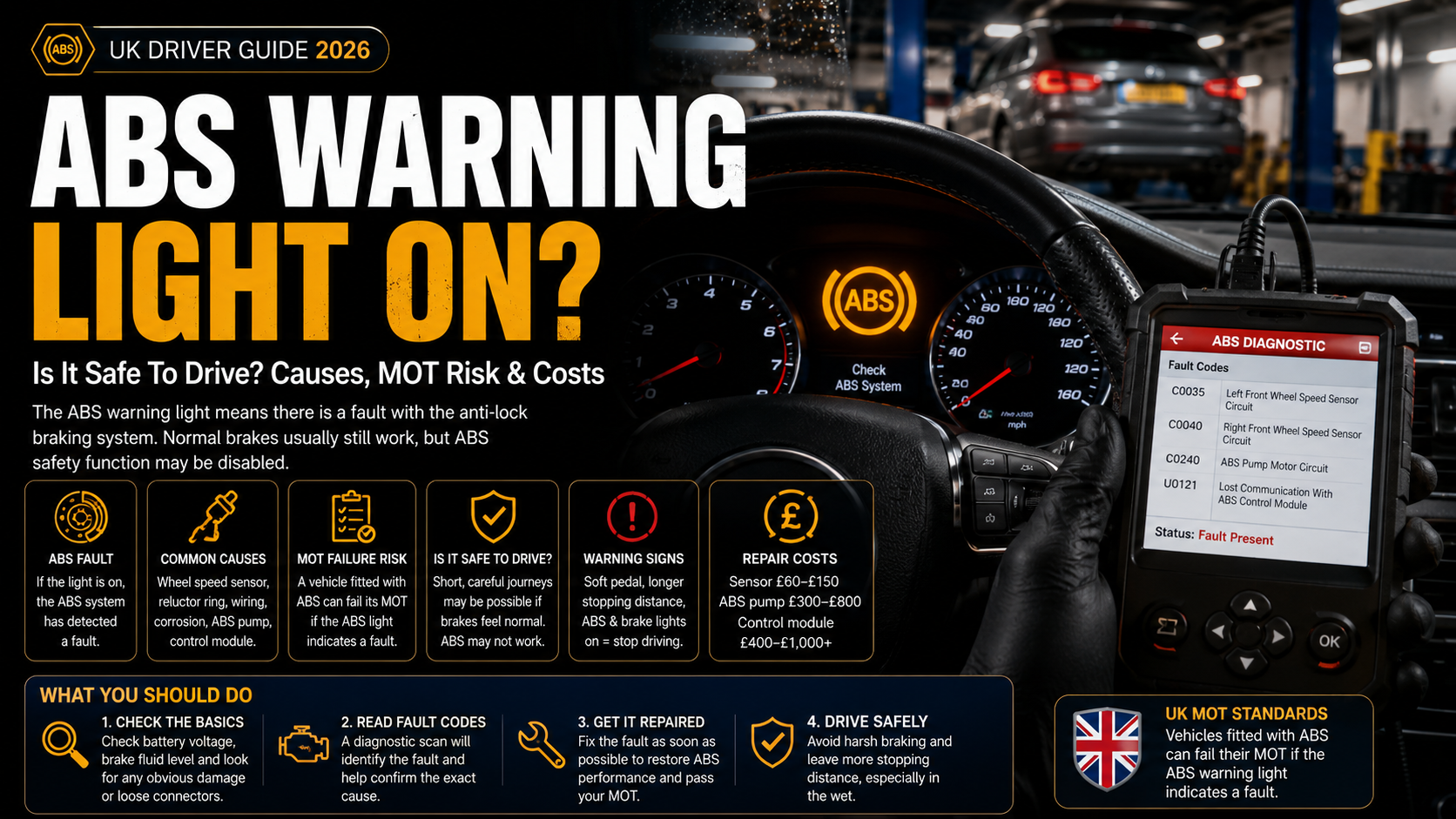
Use the diagnostic app for ABS and brake warning lights
You can use the free Motor Vehicle Expert diagnostic app to check ABS warning lights, brake warnings, traction control lights, safety-system symptoms, safe-to-drive guidance and MOT implications.
Check warning severity
Compare ABS-only warnings with ABS plus red brake light, soft pedal, weak braking or other warning lights.
Find likely causes
Wheel speed sensors, reluctor rings, wiring, battery voltage, ABS pump and module faults explained.
Understand MOT impact
ABS warning lights can affect MOT results, so it is better to investigate before test day.
Choose next checks
Use the app as a starting point before replacing sensors or clearing fault codes.
Quick answer
If only the amber ABS light is on and the brakes feel normal, you may be able to drive carefully for a short journey. However, the ABS system may be disabled, so the wheels may lock more easily during hard braking or on slippery roads.
Do not keep driving if the red brake warning light is also on, the brake pedal feels soft, braking feels weak, the car pulls sharply when braking, brake fluid is low, or several warning lights appear together. That moves the problem from “ABS fault” to “possible braking safety fault”.
ABS light on by itself usually means the anti-lock system has a fault. ABS light plus red brake light or poor pedal feel means stop and treat it as urgent.
What an ABS warning light looks like in real life
Light stays on after startup
The ABS self-check has found a fault, so the system needs diagnosis.
ABS light MOT guide →ABS and traction lights together
The systems often share wheel speed sensor data, so one fault can trigger both lights.
Traction light guide →Light appears after pothole
Wheel speed sensor wiring, reluctor rings or wheel bearing areas may have been disturbed.
Wheel bearing noise →Light appears after battery trouble
Low voltage can trigger ABS, steering, stability and traction warnings.
Battery light after battery →ABS kicks in at low speed
False wheel speed readings can make ABS activate when it should not.
Red brake light also appears
This is more urgent and may point to a braking system fault beyond ABS.
Brake warning light →What does ABS do?
ABS stands for anti-lock braking system. Its job is to help prevent the wheels from locking when you brake hard. If the wheels lock, the tyres can slide and steering control can be reduced. ABS pulses braking pressure quickly so the tyres have a better chance of gripping and the driver has a better chance of steering around danger.
Emergency braking
ABS helps reduce wheel lock during sudden braking.
Wet or slippery roads
The system can help maintain control when grip is reduced.
Stability support
ABS wheel speed data is often shared with traction and stability systems.
ABS does not make poor tyres or worn brakes good. Tyre condition, brake condition, road surface and speed still matter. If the tyres are worn or the brakes are weak, the car can still stop badly even when ABS is working.
Is it safe to drive with the ABS warning light on?
If only the amber ABS light is on and the brakes feel normal, a short careful journey may be possible. Drive gently, leave extra stopping distance and avoid harsh braking until the fault is checked.
- ✓Less urgent: ABS light only, brakes feel normal, no red brake light.
- !Needs diagnosis: ABS light stays on after restarting or returns repeatedly.
- !More urgent: ABS light plus traction control, ESP or stability warning.
- !Stop driving: red brake warning light, weak brakes, soft pedal or unsafe braking feel.
The main risk is that you may only notice the missing ABS function when you need it most. That is why it should be fixed before bad weather, motorway driving, MOT day or a long journey.
When to stop driving immediately
- !The red brake warning light is on as well as the ABS light.
- !The brake pedal feels soft, sinks too far or feels abnormal.
- !The car pulls sharply to one side when braking.
- !Braking feels weak or unpredictable.
- !Brake fluid level is low or there is a visible brake fluid leak.
- !Grinding, scraping or severe vibration happens when braking.
- !Multiple warning lights appear and the car feels unsafe.
If braking does not feel right, treat it as a safety issue, not just a warning-light issue. A car that does not stop properly should not be driven just because it still moves.
Common causes of an ABS warning light
Wheel speed sensor fault
One of the most common causes. ABS needs accurate wheel speed readings from each wheel.
Damaged ABS reluctor ring
Cracked, rusty or damaged rings can give the sensor incorrect readings.
Wiring or connector issue
Broken wires, corrosion or poor connections can trigger intermittent ABS faults.
Low battery voltage
Weak voltage can trigger ABS, traction control or stability warning lights.
Battery health check →Wheel bearing issue
Some wheel bearings include magnetic encoder rings used by the ABS sensor.
Wheel bearing cost →ABS pump or module fault
Pump, hydraulic block or control module faults can be more expensive to repair.
Brake fluid or hydraulic issue
If brake warning lights or poor brake feel appear too, check the braking system urgently.
Brake fluid MOT →After suspension work
ABS sensor wiring can be damaged or left loose after wheel, bearing, brake or suspension work.
Suspension MOT guide →Tyre or wheel mismatch
Incorrect tyre sizes or mismatched rolling radius can confuse some stability systems.
Tyre tread MOT →Symptoms that may appear with an ABS fault
- 1ABS light stays on after startup.
- 2Traction control or stability control warning appears too.
- 3ABS activates unexpectedly at low speed.
- 4Brakes feel normal in daily driving but warning light remains on.
- 5Warning appears after battery, wheel bearing, brake or suspension work.
- 6Intermittent warning after rain, potholes or rough roads.
- 7Speedometer fault appears on some vehicles.
- 8Hill-start assist, traction control or stability assist stops working.
ABS light with traction control or ESC light
ABS, traction control and ESC often use the same wheel speed information. If one wheel sensor gives a bad signal, the car may switch off several systems at once because it cannot trust the data.
ABS light only
Often points to an ABS-specific sensor, ring, wiring or module fault.
ABS plus traction light
Often points to wheel speed data, sensor wiring, wheel bearing encoder or low voltage.
Traction control guide →ABS plus red brake light
More serious. Check brake fluid, pedal feel and braking performance immediately.
Brake warning guide →Will an ABS warning light fail an MOT?
Yes. If a vehicle is fitted with ABS and the warning lamp indicates a system fault, it can fail the MOT. The ABS light should normally come on during the startup self-check and then go out.
If the ABS light stays on, does not come on during the self-check, or shows a fault, the car may fail. For MOT-specific advice, see can ABS light fail MOT?.
What to check next
1. Check brake feel
If the pedal feels soft, braking feels weak or the car pulls under braking, stop using the car.
2. Look for other warning lights
ABS plus red brake, traction control or stability warnings can suggest a more serious fault.
3. Think about recent work
Wheel bearing, brake, suspension or battery work can sometimes disturb sensors or wiring.
4. Check battery condition
Low voltage can cause several warning lights, especially on modern vehicles.
5. Scan for ABS fault codes
A proper diagnostic scan can usually identify which wheel or component is causing the fault.
6. Avoid guessing
Replacing random sensors can waste money if the real issue is wiring, a ring or the ABS module.
How a garage usually diagnoses an ABS light
ABS code scan
Reads stored ABS fault codes and identifies which wheel or circuit is affected.
Live wheel speed data
Checks whether all wheels show believable speed readings while moving.
Sensor and wiring inspection
Looks for broken wires, corrosion, poor connectors or damaged sensor mounting.
Reluctor ring check
Checks for cracked, rusty or missing teeth on tone rings or encoder rings.
Battery and charging test
Confirms the ABS fault is not being triggered by low voltage.
Road test
Confirms whether the warning returns, ABS activates wrongly or braking feels abnormal.
Typical ABS repair costs in the UK
ABS repair cost depends on the exact fault, vehicle design, parts quality and access. A sensor fault is normally cheaper than an ABS pump or module fault, but proper diagnosis is what prevents wasted money.
ABS diagnostic scan
Usually the first step before replacing parts. It helps identify the affected wheel or circuit.
ABS wheel speed sensor
Often one of the more common and cheaper ABS repairs, depending on access.
Wiring repair
Cost depends on fault location, corrosion and testing time.
Reluctor ring or bearing
Some vehicles need a ring, hub or wheel bearing repair to restore signal.
Wheel bearing cost →ABS pump or module
Can be more expensive and may need coding or specialist repair.
Brake system repair
If brake warning symptoms are present, pads, discs, fluid, pipes or calipers may need checking.
Brake pad cost →The cheapest repair is not always the correct repair. Diagnosis matters because ABS lights can be caused by sensors, rings, wiring, voltage, wheel bearings or modules.
Common mistakes drivers make
- !Ignoring the ABS light because the brake pedal feels normal.
- !Replacing a wheel speed sensor without checking the reluctor ring or wiring.
- !Clearing the ABS code without fixing the fault.
- !Driving to MOT day with the warning light still on.
- !Assuming ABS and traction lights are separate problems when they may share the same cause.
- !Ignoring low battery voltage or charging faults that trigger multiple warning lights.
Best mechanic-style advice
Do not ignore an ABS light just because the pedal feels normal. Normal braking and ABS braking are not the same thing. The fault may only matter when you brake hard, hit a wet patch or need steering control in an emergency.
At the same time, do not replace parts blindly. A scan and live data check usually saves money compared with guessing at sensors. The best diagnosis checks the fault code, live wheel speed readings, wiring, rings, battery voltage and recent repair history.
Related brake and warning light guides
Frequently asked questions
Can I drive with the ABS light on?
Often yes for a short careful journey if only the amber ABS light is on and the brakes feel normal. However, ABS assistance may be unavailable and diagnosis should be arranged soon.
Do normal brakes still work with ABS light on?
Usually yes, but emergency braking behaviour may change because the anti-lock function may not operate.
Can low battery cause ABS light?
Yes. Low or unstable voltage can trigger ABS, traction control and stability-related warnings.
Can I reset the ABS light myself?
Clearing codes may turn the light off temporarily, but it will usually return if the fault is still present.
Will ABS light fail MOT?
Yes, it can fail if the warning indicates an ABS system fault.
What is the most common cause?
Wheel speed sensor faults, damaged reluctor rings and wiring issues are common causes.
Why are ABS and traction control lights on together?
They often share wheel speed data. One faulty wheel speed sensor can affect both systems.
Can a wheel bearing cause an ABS light?
Yes. Some vehicles use wheel bearings or encoder rings as part of the ABS signal system.
Is ABS light more serious with a red brake light?
Yes. ABS plus a red brake warning light can indicate a more serious braking problem and should be treated urgently.
Should I replace an ABS sensor without diagnosis?
Not ideally. The fault could be the sensor, wiring, reluctor ring, wheel bearing, voltage supply or ABS module, so diagnosis is better than guessing.