
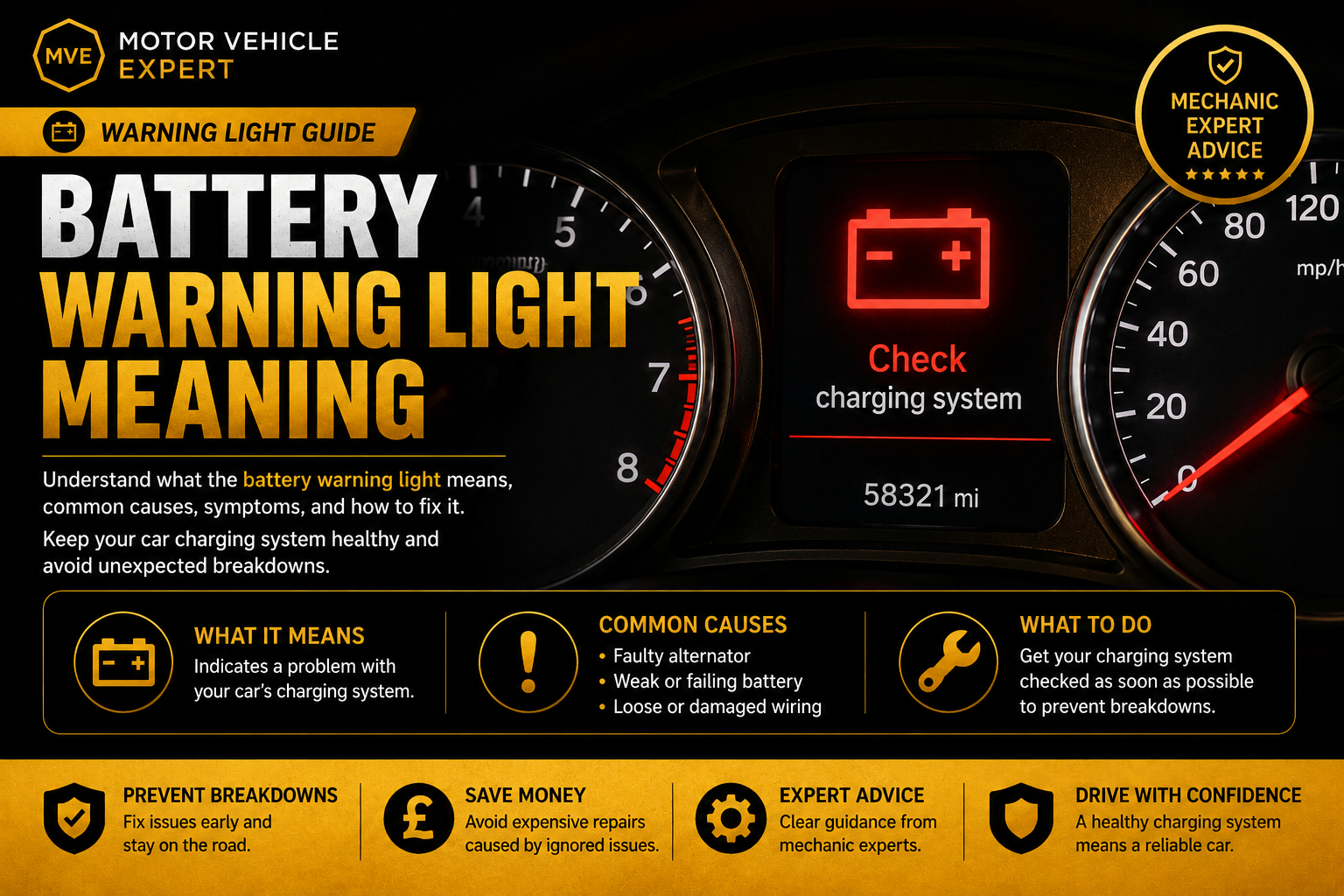
Quick answer
The battery warning light does not always mean the battery is bad. It normally means the battery is not being charged properly while the engine is running.
If the light comes on while driving, reduce unnecessary electrical load where safe, avoid switching the engine off until you are somewhere safe, and arrange inspection quickly. If steering becomes heavy, lights dim, the engine overheats or several warning lights appear, stop safely.
A battery starts the car. The alternator keeps it alive while driving. When the battery light comes on with the engine running, test the charging system before buying another battery.
What the battery warning light really means
The battery starts the car, but once the engine is running the alternator should take over and supply electrical power. It also recharges the battery while you drive.
If the battery light stays on after starting, or comes on while driving, the car may be running from battery reserve only. When that reserve drops, electrical systems can shut down and the engine may stop.
That is why this light should be treated more seriously than a simple reminder light. A charging fault can turn into a breakdown very quickly.
Most battery warning light call-outs are not caused by the battery
One of the biggest mistakes drivers make is assuming the battery warning light means they need a new battery. In many real workshop cases, the battery itself is healthy and the actual fault is a failing alternator, slipping auxiliary belt, poor earth connection or damaged charging cable.
A fresh battery can make the car start again for a short time, but it will not fix a charging system fault. If the alternator is not putting charge back in, the new battery will eventually go flat like the old one.
That is why a proper charging test is better than guessing. Battery condition, alternator output, voltage drop, belt condition and earth connections should be checked together.
What this looks like in real life
Battery light while driving
Often points towards alternator, belt, charging cable, battery sensor or earth connection trouble.
Alternator signs →Car starts, then warning appears
The battery may have enough power to start, but the charging system may not be topping it back up.
Dashboard lights dim
Low charging voltage can make lights, screens and electrical systems behave strangely.
Steering gets heavy
On some cars, a broken auxiliary belt can affect charging and power steering assistance.
Warning after new battery
A new battery will not fix a failed alternator, bad earth, sensor issue or charging fault.
New battery warning →Battery keeps going flat
Repeated flat batteries can be caused by poor charging, battery weakness or a drain while parked.
Flat battery guide →Find the closest symptom
Light on while driving
Most likely charging system related. Check alternator output, belt, wiring and battery connections.
Light stays on after startup
The alternator may not be charging or the car has detected a charging control fault.
Light flickers on and off
Often a loose connection, slipping belt, failing alternator, bad earth or wiring fault.
Light plus clicking start
Can happen when the battery is weak or the starter circuit is not receiving enough power.
Clicking no-start guide →Light plus overheating
A broken belt may stop the alternator and can affect cooling on some engines.
Overheating guide →Car will not start later
If the alternator did not charge the battery, the car may not restart after switching off.
Won’t start guide →Common causes of a battery warning light
Alternator fault
The alternator may not be producing enough charging output while the engine is running.
Alternator not charging →Auxiliary belt problem
A loose, slipping, noisy or broken belt can stop the alternator charging properly.
Battery terminal corrosion
Loose or corroded terminals can interrupt charging and starting power.
Bad earth connection
A weak earth strap can cause warning lights, poor charging and intermittent electrical faults.
Charging cable fault
Damaged wiring or voltage drop can stop correct charge reaching the battery.
Weak battery
An old battery may not accept or hold charge properly, even if the alternator works.
Battery health guide →Battery sensor fault
Modern cars often monitor battery state electronically and can show charging warnings.
Smart charging issue
Some cars vary alternator output through the ECU, sensors and battery monitoring system.
Fluid contamination
Oil or coolant leaks near the belt or alternator can cause slipping, noise or charging faults.
Can you keep driving with the battery light on?
Sometimes the car may continue running for a short distance, but do not treat it as safe to ignore. If the alternator has stopped charging, the car is using stored battery power only.
- !Stop safely if the steering becomes heavy.
- !Stop safely if headlights, dashboard lights or screens become dim.
- !Do not keep driving if multiple warning lights appear.
- !Do not switch the engine off until you are somewhere safe.
- !Arrange recovery if the car begins losing electrical power.
- !Stop if the temperature gauge rises or overheating warnings appear.
Turn off non-essential electrical loads where safe, such as heated seats, rear screen heater and unnecessary accessories. Keep headlights on if visibility requires them.
What to check first
1. Check the belt
If visible and safe, look for a broken, loose, noisy or slipping auxiliary belt.
2. Inspect battery terminals
Look for loose clamps, corrosion, damaged cables or poor connections.
3. Watch electrical symptoms
Dim lights, warning lights, heavy steering and repeated flat batteries are important clues.
4. Test charging voltage
A charging-system test can show whether the alternator is producing correct output.
5. Check battery health
A weak battery can fail to hold charge even if the alternator is working.
6. Check earth and wiring
Bad earth straps, damaged cables and voltage drop can mimic alternator or battery failure.
Battery fault or alternator fault?
More likely battery
Slow cranking, weak cold starts, old battery age or flat battery after parking.
Battery keeps going flat →More likely alternator
Battery light while driving, dim lights with the engine running or battery flat after driving.
Alternator signs →More likely wiring
Intermittent warnings, corroded terminals, loose clamps, damaged earth straps or voltage drop symptoms.
A battery replacement can be a waste of money if the alternator is not charging. Proper testing should check battery health, alternator output, voltage drop and cable condition together.
Battery and charging voltage guide
Voltage readings are not the whole diagnosis, but they give a useful first clue. A garage will normally test voltage with the engine off, engine running and electrical loads switched on.
Engine off
A healthy charged battery is often around 12.4V to 12.8V before starting.
Engine running
Normal charging is often around 13.8V to 14.8V, depending on the vehicle and smart charging system.
Possible charging fault
Below 13V while running may suggest the alternator, belt, wiring, earth or charging control system needs testing.
Very high voltage
Overcharging can suggest regulator trouble and may damage electrical components.
Voltage drops under load
Lights, heater fan and heated screen can reveal weak alternator output or cable resistance.
Smart charging note
Some modern vehicles vary charging voltage, so live data and vehicle-specific testing may be needed.
Do not condemn the alternator from one voltage reading alone. Check belt drive, battery condition, earth straps, main cables and smart charging control before spending money.
Battery light comes on and goes off
An intermittent battery light can be caused by a slipping belt, failing alternator, loose terminal, corroded connection, weak earth strap or damaged wiring.
Do not ignore it just because the light disappears. Intermittent charging faults can become permanent without warning, and the car may fail to restart later.
Worse in wet weather
Can suggest belt slip, water contamination or poor electrical connections.
Worse when turning or braking
Can suggest loose wiring, battery movement or poor terminal connection.
Battery light on after fitting a new battery
If the battery warning light appears after a new battery has been fitted, do not assume the new battery is faulty straight away. The real issue may still be the alternator, auxiliary belt, wiring, battery sensor, earth strap or battery registration.
Modern stop-start vehicles can also be sensitive to battery type. Some vehicles need an AGM or EFB battery, and some need battery registration after replacement.
For this specific issue, read battery light on after new battery.
Stop-start cars, AGM batteries and smart charging
Many modern vehicles use AGM or EFB batteries, battery monitoring sensors and smart charging systems. These systems can react badly to the wrong battery type, weak battery health, incorrect fitting or poor registration.
Wrong battery type
A standard battery may not be suitable where the vehicle requires AGM or EFB technology.
Battery registration
Some vehicles need the new battery registered so the charging system recognises it correctly.
Battery sensor issue
A sensor near the battery terminal can affect charging behaviour and warning messages.
Stop-start disabled
Stop-start may stop working when the battery is weak, undercharged or not recognised properly.
Will a battery warning light fail an MOT?
A battery warning light does not automatically mean your car will fail an MOT, but it should never be ignored before test day. The warning usually indicates a charging system fault involving the alternator, battery, belt, wiring, earth connection or charging control system.
If the charging fault causes dim lights, unstable electrics, warning lights, poor steering assistance, starting problems or affects safety-related systems, the car should be checked before presenting it for MOT.
A tester is not there to diagnose the charging system in detail. The safest approach is to fix the warning before the test rather than risk failure, breakdown or retest hassle.
Typical UK repair costs
Costs depend on the car, parts quality, access and whether diagnosis is needed. Always test before replacing parts.
Battery replacement
Often around £80 to £250 depending on battery type, vehicle and fitting requirements.
Alternator replacement
Often around £250 to £700+ depending on access, alternator type and parts cost.
Alternator cost guide →Belt repair
Can be lower cost if it is a simple auxiliary belt issue, but pulley or tensioner faults add cost.
Wiring repair
Cost depends on where the wiring fault or bad earth is located.
Battery sensor
Some modern cars need sensor testing, replacement or battery registration.
Diagnostic test
Charging tests, voltage-drop checks and battery health checks can prevent wrong repairs.
Common mistakes drivers make
- !Replacing the battery without checking alternator output.
- !Ignoring a flickering battery light because it goes away.
- !Switching the engine off before reaching a safe place.
- !Overlooking a slipping auxiliary belt or bad earth strap.
- !Fitting the wrong battery type to a stop-start vehicle.
- !Assuming a jump start fixes the cause of the warning light.
Best mechanic-style advice
When the battery warning light comes on, think “charging system” first, not just “battery”. The battery may be fine, but if the alternator is not charging, the car will eventually run out of electrical power.
The proper check is simple in principle: test the battery condition, check charging voltage with the engine running, inspect the belt, check terminals and measure voltage drop through the main cables and earths.
A battery warning light is a charging-system warning. Test before replacing parts.
Related warning light guides
Brake warning light
Brake warning lights can point to low brake fluid, handbrake faults or braking system problems.
Brake warning guide →Coolant warning light
Coolant warnings can mean low coolant, overheating, leaks or cooling system faults.
Coolant warning guide →Oil warning light
Oil pressure warnings can become serious quickly and should not be ignored.
Oil warning guide →ABS warning light
ABS warnings can affect emergency braking support and MOT results.
ABS warning guide →Related battery and starting guides
Frequently asked questions
Does the battery light always mean the battery is bad?
No. It often points to a charging system problem rather than the battery itself.
Can a car still run with the battery warning light on?
Yes, but only for a limited time if charging has stopped. Once the battery reserve drops, the car may lose electrical power and stop.
Can a loose belt cause the battery light?
Yes. If the alternator belt slips, breaks or loses tension, the alternator may not charge the battery correctly.
Should I replace the battery first?
Not without testing. The alternator, belt, wiring, terminals, earths and charging system should be checked first.
Is the battery warning light urgent?
Yes. A charging fault can quickly leave you stranded, especially if the light appears while driving.
Can the light come on after a jump start?
Yes. If the charging system is faulty or the battery is very weak, the warning may appear again after a jump start.
Why does the battery light flicker?
A flickering battery light can point to a slipping belt, failing alternator, loose connection, corroded terminal or bad earth.
Will a battery warning light fail MOT?
Not automatically, but it should be checked before the test because charging faults can affect electrical and safety-related systems.
Can a new battery fix the battery warning light?
Only if the battery itself is the problem. If the alternator, wiring, belt, sensor or charging system is faulty, the light can return.
What should a garage test?
A garage should test battery health, alternator output, charging voltage, auxiliary belt condition, terminals, earth straps, main charging cables and battery sensor operation where fitted.