
Quick answer
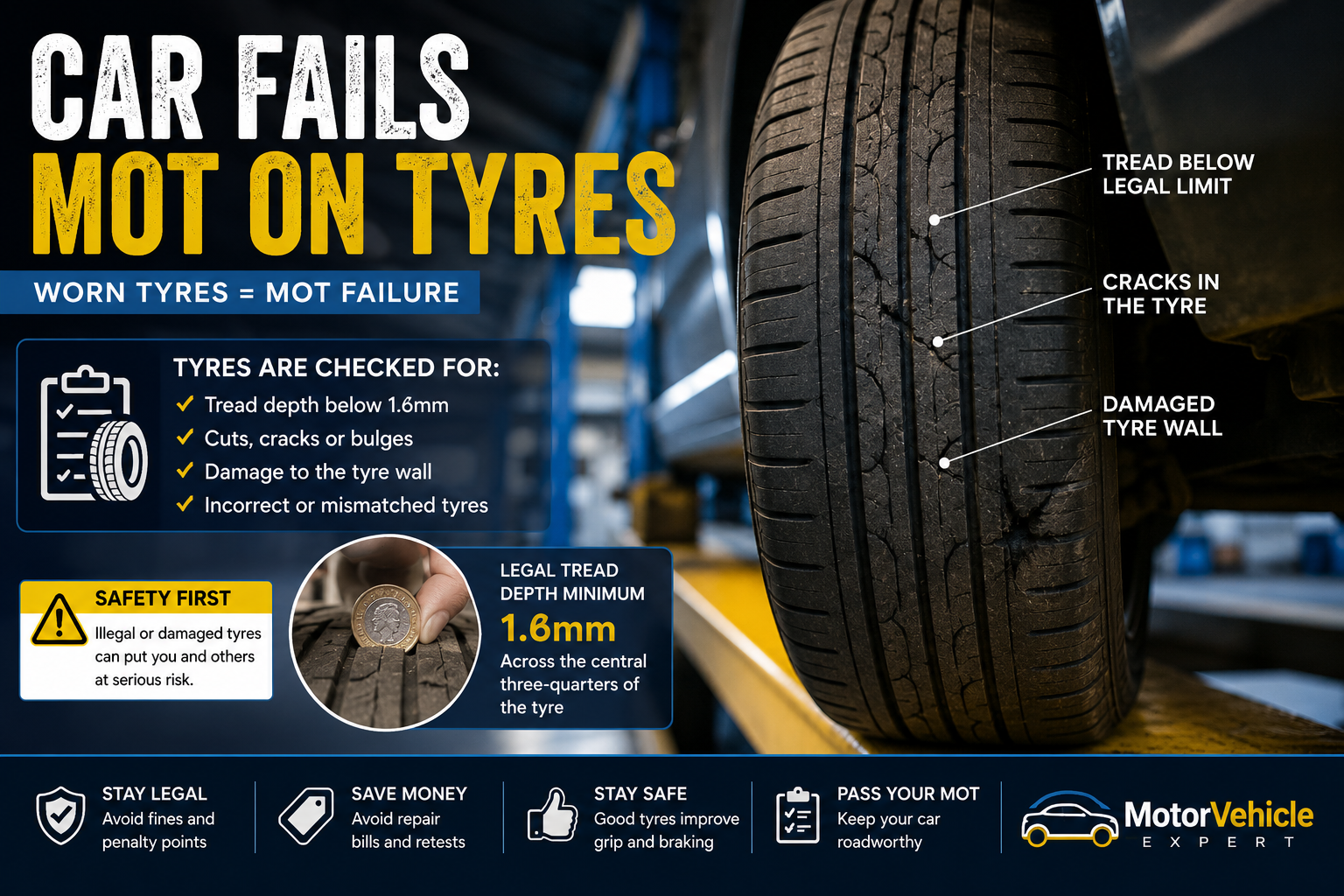
A car can fail its MOT if any fitted tyre is below the legal tread limit, has exposed cords, a bulge, serious sidewall damage, unsafe cracking, incorrect fitment, tyre fouling or severe uneven wear.
Replacing the failed tyre is often the fastest route to a pass, but uneven wear should also be investigated because wheel alignment, suspension, steering or tyre pressure problems may have caused the tyre to fail.
Do not only look at the outside edge of the tyre. Many MOT tyre failures are found on the inner edge where drivers rarely check.
What tyre MOT failures often look like in real life
Many tyre MOT failures are found on the inside edge of the tyre, not the visible outside edge. A driver may think the tyre looks fine from standing beside the car, but the inner shoulder can be bald, cracked or showing cords.
Garages also often see cars fail because one tyre was replaced cheaply after a puncture, while the opposite tyre on the same axle was left worn, old or badly cracked. The MOT checks the condition of each tyre fitted to the vehicle.
If a tyre has exposed cords, a bulge or severe sidewall damage, treat it as unsafe. Do not wait for the MOT retest before replacing it.
Common reasons a car fails MOT on tyres
Low tread
Tread below the legal minimum can fail immediately.
Low tread MOT guide →Sidewall bulge
A bulge usually means internal tyre structure has been damaged.
Tyre bulge MOT guide →Bald tyre
A bald tyre can fail and is unsafe in wet conditions.
Bald tyres MOT guide →Exposed cords
Visible cords or canvas mean the tyre is unsafe and needs replacement.
Tread failure guide →Uneven wear
Inner or outer edge wear can fail if the tread is below limit or cords are exposed.
Wheel alignment MOT guide →Tyre pressure warning
A TPMS warning can affect the MOT where the system is fitted and faulty.
Tyre pressure light MOT guide →Tyre rubbing
A tyre must not foul bodywork, suspension, brake pipes or other components.
Suspension MOT guide →Severe cracking
Old or perished tyres can become unsafe even if tread depth looks acceptable.
Wrong fitment
Incorrect size, load rating, speed rating or unsuitable tyre type can cause issues.
Quick tyre check before MOT
These checks can help you spot obvious tyre problems before the test. Check each tyre, including the inner edge, not just the tyre face you can see easily.
Likely fail
Exposed cords, serious bulge, tread below 1.6mm, deep sidewall cut, tyre fouling or dangerous cracking.
Needs checking
Uneven wear, old cracked tyres, TPMS warning, mismatched tyres or repeated tyre advisories.
Monitor soon
Tread close to the limit, minor cracking, slight feathering or pressure loss that needs regular topping up.
Tyre tread depth rules
For most cars in the UK, the legal minimum tread depth is 1.6mm across the central three-quarters of the tyre around the full circumference.
Below 1.6mm
The tyre can fail the MOT and should be replaced.
Close to the limit
It may pass if still legal and safe, but replacement is often sensible soon.
Inner edge wear
Inner edge wear can be missed during casual checks, but testers will inspect it.
Wear indicators
Tread wear bars are useful clues, but a proper tread gauge is better.
For a focused guide, read can low tyre tread fail MOT? and can bald tyres fail MOT UK?.
Tyre damage that can cause MOT failure
- !Bulges or lumps: often indicate internal structural damage.
- !Exposed cords: tyre should not be used.
- !Deep cuts: especially sidewall cuts or damage exposing reinforcement.
- !Severe cracking: age-related cracking can become unsafe.
- !Puncture damage: may fail if repair is unsafe or tyre condition is poor.
- !Tyre fouling: tyres must not rub bodywork, suspension or brake parts.
If a tyre has a bulge, exposed cords, severe sidewall damage or a deep cut, replacing it is usually the safest option.
Why uneven tyre wear matters
Uneven tyre wear is not just a tyre problem. It can be a clue that something else is wrong with the vehicle. Replacing the tyre may get the car through the MOT, but the new tyre can wear quickly if the root cause is ignored.
Inner edge worn
Often linked to alignment, suspension wear, camber issues or steering geometry.
Alignment MOT guide →Both edges worn
Can suggest underinflation or regular driving with low tyre pressures.
Tyre pressure guide →Centre worn
Can suggest overinflation or incorrect pressure for the vehicle load.
Feathered wear
May point towards tracking, toe angle or worn steering components.
Track rod end MOT guide →Patchy wear
Can involve shock absorbers, wheel balance or suspension control issues.
Shock absorber MOT guide →One tyre much worse
Check alignment, pothole impact, suspension damage or previous tyre mismatch.
Car pulling to one side →Can tyre pressure warning light affect MOT?
A tyre pressure monitoring warning can be relevant at MOT because it may show a tyre pressure monitoring system fault. Even when the tyre itself is legal, pressure problems can affect wear, grip and braking.
Before resetting the warning, check all tyre pressures properly and inspect for slow punctures, valve leaks, damaged tyres and recent pressure changes.
Light after pressure change
The system may need recalibration after all tyres are set correctly.
Light keeps returning
Check for a slow puncture, leaking valve, sensor issue or incorrect pressure.
Useful pages: can tyre pressure light fail MOT? and tyre pressure warning light reset UK.
Likely UK tyre replacement costs
Tyre cost depends on size, brand, speed rating, load rating, run-flat design and fitting extras. Do not choose a tyre that does not match the vehicle’s required specification.
Budget tyres
Usually the lowest-cost option, depending on size and availability.
Mid-range tyres
Often a balance between cost, wear, wet grip and road noise.
Premium tyres
Higher cost, especially on larger wheels or performance cars.
Large wheels
Low-profile tyres, SUV sizes and performance tyres usually cost more.
Wheel alignment
Worth considering if the failed tyre has uneven inner or outer edge wear.
Valve and balancing
Usually included or added during tyre fitting.
For wider budgeting, read car repair costs guide UK.
Can you still drive after failing MOT on tyres?
If the tyre defect is dangerous, such as exposed cords, a serious bulge or unsafe damage, do not drive the vehicle until the tyre is replaced.
For non-dangerous failures, only drive if the vehicle is legal and roadworthy, such as to a repair appointment where permitted. If in doubt, arrange mobile tyre fitting or recovery.
For wider rules, read MOT retest rules UK and how long is an MOT valid?.
What happens next after a tyre MOT failure?
- 1Read the MOT failure sheet and identify exactly which tyre failed.
- 2Replace any tyre below the legal limit or with unsafe damage.
- 3Check the opposite tyre on the same axle for similar wear.
- 4Investigate alignment, steering or suspension if wear is uneven.
- 5Check pressures after fitting new tyres.
- 6Arrange the MOT retest once the tyre issue is fixed.
For retest timing and rules, read MOT retest rules UK.
How to avoid tyre MOT failure
1. Check tread monthly
Use a gauge and check inner, centre and outer tread areas.
2. Inspect sidewalls
Look for bulges, cuts, cracking and impact damage.
3. Maintain pressure
Incorrect pressure can increase wear and affect handling.
4. Watch for uneven wear
Inner edge wear often points to alignment or suspension issues.
5. Replace borderline tyres early
Tyres close to the limit may fail soon after the MOT even if they pass.
6. Check after potholes
Hard impacts can cause sidewall bulges or alignment changes.
For broader MOT preparation, read how to prepare for MOT test UK.
Tyre checks when buying a used car
Tyres can reveal how a car has been maintained. A seller may fit one cheap tyre for an MOT, but uneven wear, mismatched brands or old cracked tyres can still show hidden suspension, alignment or budget maintenance issues.
- ✓Check all four tyres, not just the front pair.
- ✓Look at the inner edges with a torch where possible.
- ✓Check for mismatched sizes, brands or tyre types.
- ✓Look for cracking, bulges, repairs and sidewall damage.
- ✓Check MOT history for tyre advisories or repeat failures.
- ✓Budget for replacement if tyres are close to the legal limit.
Before buying, use the used car inspection checklist, used car test drive checklist and how to check MOT history before buying.
Best mechanic-style advice
If a tyre failed because of normal wear, replacement may be enough. If it failed because of inner edge wear, exposed cords, repeated tyre advisories or one tyre wearing much faster than the others, check alignment, suspension and steering before fitting expensive new tyres.
Tyres are one of the easiest MOT items to check before test day. A five-minute inspection can prevent a simple tyre issue becoming a failed MOT and retest.
Replace unsafe tyres, but do not ignore the reason they wore out. Uneven wear is often a symptom, not the root cause.
Related tyre and MOT guides
Frequently asked questions
Can one tyre fail the whole MOT?
Yes. One unsafe, illegal or badly damaged tyre can cause the whole vehicle to fail.
What tread depth fails MOT?
Below 1.6mm across the central three-quarters around the full circumference can fail for most cars.
Can a tyre bulge fail MOT?
Yes. A bulge normally indicates structural damage and should be replaced promptly.
Can uneven tyre wear fail?
Yes, if tread is below limit, cords are exposed or the tyre is unsafe.
Should I replace tyres in pairs?
Often sensible on the same axle, especially if both tyres are worn, aged or mismatched.
Do I need alignment after new tyres?
Recommended if the old tyres wore unevenly, the steering wheel is off-centre, or the car pulls to one side.
Can old cracked tyres fail MOT?
Yes, if cracking is severe enough to make the tyre unsafe or expose structure.
Best next step after tyre MOT failure?
Replace unsafe tyres, check the opposite tyre, investigate uneven wear and arrange the MOT retest.