
Quick answer
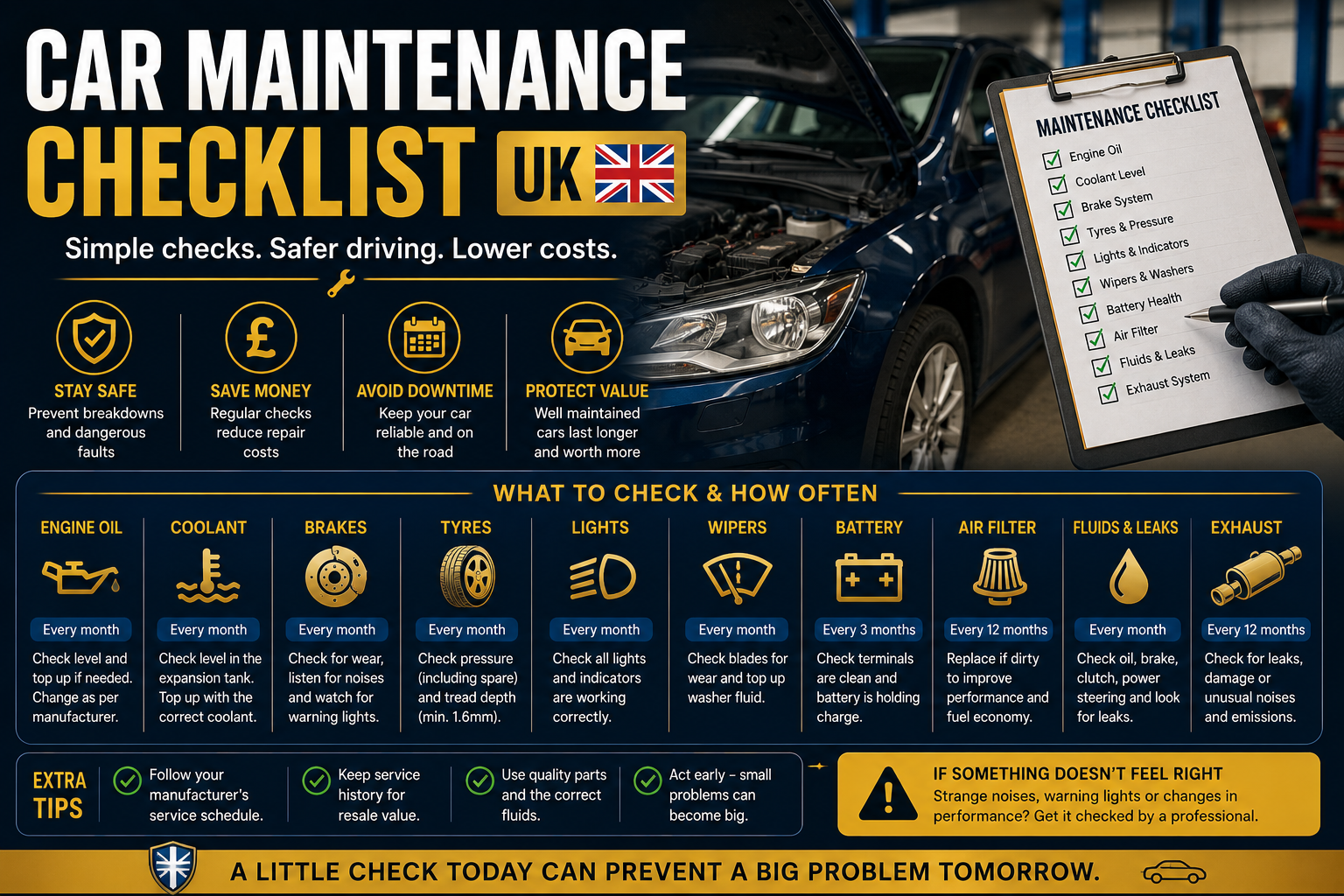
The main car maintenance checks are tyre pressure, tread depth, sidewall condition, oil level, coolant level, washer fluid, lights, wipers, brake feel, battery condition, warning lights and visible leaks under the car.
Do simple checks monthly, before long journeys, before bad weather and before an MOT. If something changes — a new noise, smell, warning light, leak, vibration or starting problem — treat it as a clue, not something to ignore.
Maintenance is cheaper when it is early. The same fault usually costs more once it becomes a breakdown, MOT failure or warning light.
What happens in real life when maintenance is ignored
Most expensive repair stories start small. A tyre wears on the inner edge. Coolant drops slowly. Brakes begin to squeal. The battery cranks slightly slower in the morning. A warning light appears and disappears.
These early signs are the car giving you a chance to deal with the problem before it turns into a roadside breakdown, failed MOT or bigger repair bill.
Low tyre tread becomes an MOT fail
Drivers often check the outside edge but miss bald inner edges.
Low tyre tread MOT guide →Coolant drops slowly
A small leak can become overheating, pressure loss or head gasket worry.
Coolant loss guide →Battery gets weak in winter
A battery that starts fine in summer can struggle when temperatures drop.
Battery health guide →Brake noise gets worse
A small squeal can become grinding discs and a bigger repair bill.
Brakes grinding guide →Warning light gets ignored
Oil, coolant, battery and brake warnings need quick attention.
Warning lights guide →Service history goes missing
Poor records can lower buyer confidence and make diagnosis harder later.
No service history guide →Main car maintenance checklist
Tyres
Check pressure, tread depth, inner edges, cracks, bulges and uneven wear.
Tyre tread MOT guide →Brakes
Listen for grinding, squealing, vibration, pulling or a soft brake pedal.
Brake warning signs →Battery
Slow cranking, dim lights and repeated flat battery can point to battery or charging faults.
Battery health guide →Engine oil
Low oil can quickly damage an engine. Check level and warning lights seriously.
Oil warning guide →Coolant
Watch the level, smell and temperature gauge. Coolant loss should be investigated.
Coolant warning guide →Lights
Check headlights, brake lights, indicators, fog lights and number plate lights.
Brake light MOT guide →Wipers and washers
Smeary wipers, low washer fluid and blocked jets can become MOT and visibility problems.
Washer MOT guide →Servicing
Oil, filters, plugs, belts and fluids need routine attention, not only MOT attention.
Servicing guide →Dashboard warnings
Do not ignore warning lights, especially oil, battery, brake, coolant or engine warnings.
Warning lights hub →Simple monthly checks
- 1Check tyre pressure when tyres are cold.
- 2Check tread depth across the tyre, including inner edges.
- 3Look for tyre bulges, cracks, cuts and uneven wear.
- 4Check oil level on level ground using the correct method for your car.
- 5Check coolant level only when the engine is cold.
- 6Top up screen wash and check washer jets work.
- 7Check lights, indicators, brake lights and number plate lights.
- 8Look under the car for fresh leaks after parking.
- 9Listen for new noises when starting, braking, turning or accelerating.
If you spot uneven tyre wear, read car pulling to one side causes and can wheel alignment fail MOT?
Fluid checks: oil, coolant, brake fluid and screen wash
Engine oil
Low oil, wrong oil or overdue oil changes can cause serious engine wear. Check the level and investigate oil warning lights quickly.
Oil warning guide →Coolant
Coolant should not keep disappearing. Low coolant can cause overheating, heater problems and expensive engine damage.
Overheating causes →Brake fluid
Brake fluid level and condition matter. A low level can suggest wear, leaks or hydraulic problems.
Brake fluid MOT guide →Screen wash
Empty washer fluid sounds small, but it can affect visibility and MOT condition.
Washer MOT guide →Tyres and brakes: checks drivers often leave too late
Tyres and brakes affect safety every time you drive. They are also common MOT failure areas, so do not wait until the test date to check them.
- ✓Check tyre tread depth, pressure, cracks, bulges and uneven wear.
- ✓Check whether the steering pulls or the car shakes at speed.
- ✓Listen for brake grinding, squealing or scraping.
- ✓Feel for vibration, pulling or a soft brake pedal.
- ✓Do not ignore ABS, brake or traction warning lights.
Useful guides: can brake pads fail MOT?, ABS warning light on and car shakes when braking.
Battery, charging and starting checks
Battery problems often show up as slow cranking, clicking, dim lights, warning lights or repeated flat batteries. Sometimes the battery is not the real problem — the alternator, starter motor, earth cable or parasitic drain may be involved.
Slow cranking
Can point to weak battery, poor terminals or starter issues.
Won’t start guide →Battery light
Often points to charging system trouble, not just the battery.
Battery light meaning →Repeated flat battery
Can be weak battery, alternator issue or electrical drain.
Battery keeps going flat →Seasonal checks worth doing
Before winter
Check battery health, tyres, wipers, lights, heater, demisters and washer fluid strength.
Before summer
Check coolant level, cooling fan behaviour, air conditioning and overheating symptoms.
AC not cold guide →Before long trips
Check tyres, oil, coolant, lights, screen wash, warning lights and breakdown equipment.
Before selling or buying
Good maintenance records help show the car has not been neglected.
Used car inspection checklist →Pre-MOT maintenance checks
- 1Check all exterior lights, including brake lights and number plate lights.
- 2Check tyres for tread depth, bulges, sidewall damage and uneven wear.
- 3Check wipers clear the screen properly and washers spray correctly.
- 4Check horn, mirrors, seatbelts and visible warning lights.
- 5Look for obvious fluid leaks under the car.
- 6Check brakes feel normal and no ABS or brake warning lights stay on.
- 7Check windscreen chips in the driver’s view.
- 8Read MOT history if you are preparing a used car for sale or purchase.
Useful MOT guides: common MOT failure reasons UK, how to prepare for MOT test UK and how to check MOT history before buying.
Warning signs not to ignore
- !Oil warning light, coolant warning light or brake warning light.
- !Grinding brakes, brake vibration or soft brake pedal.
- !Coolant loss, overheating or heater blowing cold while engine is hot.
- !Repeated flat battery, battery light or slow cranking.
- !Uneven tyre wear, pulling to one side or steering wheel shaking.
- !New smoke, burning smells, petrol smell, coolant smell or exhaust fumes inside.
- !Engine misfire, rough idle, hesitation or loss of power.
- !Fresh oil, coolant, fuel or brake fluid leaks under the car.
For symptoms, start with diagnostics hub, car smells guide, car noises explained and car warning lights meaning UK.
Keep records and receipts
Keep service invoices, MOT records, repair receipts, tyre receipts and battery paperwork. It helps you track what has been done, spot repeated faults and avoid paying for the same diagnosis twice.
Good records also help when selling the car. Buyers are more confident when service history, MOT history and repair invoices match the condition of the vehicle.
Best mechanic-style advice
Do not treat maintenance as something you only do before MOT day. The MOT checks minimum roadworthiness; it is not a full service and it does not guarantee the car is healthy.
A few minutes checking tyres, fluids, lights, wipers and warning lights can save you from breakdowns, failed tests and bigger repair bills.
The best-maintained cars usually give warnings before they fail. Listen early, check early and fix small faults before they become expensive.
Related maintenance guides
Frequently asked questions
What maintenance checks should I do regularly?
Check tyres, oil, coolant, washer fluid, lights, wipers, brakes, battery condition, warning lights and visible leaks.
How often should I check tyre pressure?
A sensible routine is monthly and before long journeys, using the recommended pressures for your vehicle.
How often should I check oil and coolant?
Check them monthly, before long journeys and whenever warning lights, smells, leaks or overheating symptoms appear.
Is an MOT the same as a service?
No. An MOT is a roadworthiness test. A service replaces and checks maintenance items such as oil, filters, fluids and wear parts.
What should I check before a long journey?
Check tyres, oil, coolant, washer fluid, lights, warning lights and look for leaks before setting off.
What warning lights should I not ignore?
Oil, coolant, brake, battery, engine management and airbag warning lights should be taken seriously.
Why should I keep maintenance records?
Records help prove servicing and repairs, support resale value and make future diagnosis easier.
Can poor maintenance cause MOT failure?
Yes. Tyres, brakes, lights, wipers, washers, suspension, rust, leaks and warning lights are common MOT-related problem areas.