
Quick answer
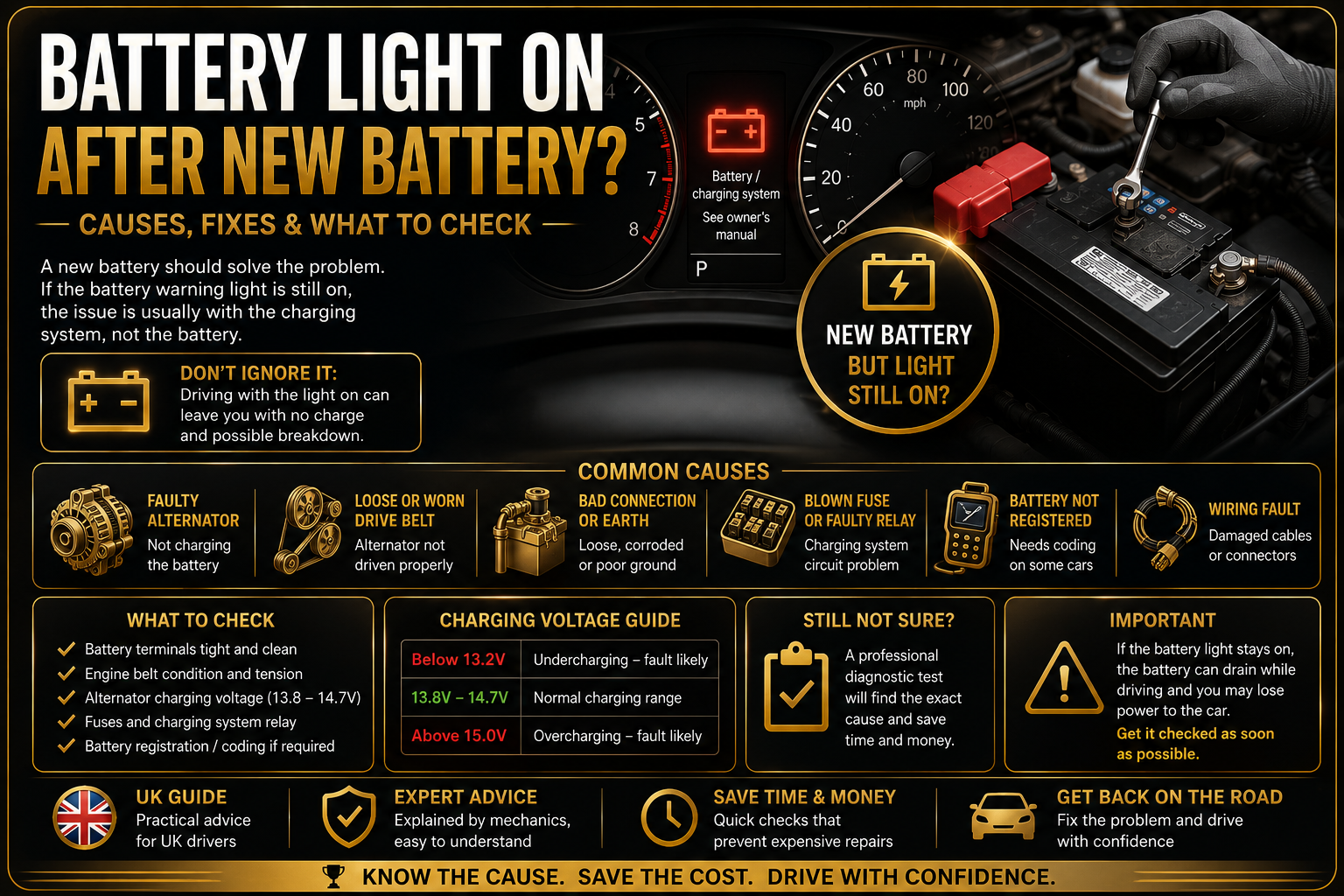
A battery light after fitting a new battery usually means the charging system is still not working correctly. The most common causes are alternator failure, loose battery terminals, poor earth connection, auxiliary belt slip, damaged wiring, wrong battery type, battery monitoring sensor problems or missed battery registration.
Do not keep replacing batteries by guesswork. A charging-voltage test with the engine running is normally the quickest way to see whether the alternator and charging circuit are doing their job.
A battery stores power. The alternator produces power. If the warning light stays on with a new battery, start testing the charging system.
Why a new battery can hide the real fault
A fresh battery can make the car feel fixed for a short time because it has enough stored charge to start the engine and power the vehicle. But once the engine is running, the alternator should be supplying the car and topping the battery back up.
If the alternator is weak, the belt is slipping, the earth is poor or the main charging cable has resistance, the new battery gets drained just like the old one. That is why many drivers fit a battery, feel relieved, then see the battery light again or end up with another flat battery days later.
In the workshop, the important question is not “is the battery new?” It is “is the car charging properly with the engine running?”
Is it safe to drive with the battery light on?
It is risky. The car may keep running for a short time, but if the alternator is not charging, it is running on stored battery power. Once voltage drops too low, electrical systems can fail and the engine may stop.
- !Stop safely if headlights dim, the dashboard flickers or electronics start failing.
- !Stop if steering assistance becomes heavy or several warning lights appear together.
- !Avoid long journeys until the charging system has been tested.
- !Do not keep switching the engine off and restarting unnecessarily.
- !Arrange diagnosis quickly if the warning stays on after battery replacement.
If the alternator is not charging, every mile can drain the new battery. You may stop for fuel or shopping and then find the car will not restart.
Common causes after fitting a new battery
If the warning light stays on, check the simple installation issues first, then test the charging system properly.
Alternator fault
The alternator may not be producing enough charge, even though the battery is new.
Alternator signs →Loose battery terminals
A clamp that is not fully seated or tight can cause charging and starting issues.
Poor earth connection
A weak or corroded earth strap can create low-voltage faults and strange electrical behaviour.
Slipping auxiliary belt
If the belt slips, the alternator may not spin fast enough to charge properly.
Battery sensor issue
Modern cars often monitor battery condition through a sensor on or near the terminal.
Wrong battery type
Stop-start cars may need AGM or EFB batteries instead of a standard battery.
Battery not registered
Some vehicles need the new battery coded or registered to the car after fitting.
Damaged wiring or fuse
Charging cables, main fuses, fusible links and connectors can fail or corrode.
Faulty new battery
Less common, but possible if the battery is defective, discharged or incorrect for the vehicle.
What to check first
These checks help avoid replacing parts blindly. Start with the simple things that may have been disturbed during battery fitting.
1. Recheck battery terminals
Make sure both clamps are tight, clean and fully seated on the battery posts.
2. Inspect the earth strap
Look for corrosion, looseness or damaged earth cables between battery, body and engine.
3. Check the auxiliary belt
A loose, cracked, noisy, wet or missing belt can stop the alternator charging.
4. Check battery sensor plug
If a sensor was disturbed during battery fitting, the car may show charging warnings.
5. Test charging voltage
A voltage test can show whether the alternator is charging while the engine runs.
6. Confirm battery type
Make sure the correct capacity and type were fitted, especially on stop-start vehicles.
Charging voltage clues
A garage or competent technician will usually test battery voltage with the engine off and then again with the engine running. This helps separate a battery issue from an alternator, belt or wiring issue.
Battery voltage low with engine off
The battery may be discharged, weak, incorrectly charged or affected by a drain.
Voltage does not rise with engine running
The alternator, belt, wiring, fuse or charging control system may be faulty.
Voltage is unstable
Can point to alternator regulator problems, poor connections or wiring faults.
Voltage seems fine but light stays on
Battery sensor, smart charging, coding or control module diagnosis may be needed.
Useful related guides: alternator not charging battery signs and how to check car battery health.
Does a new battery need registering?
Some modern cars need the new battery registered or coded after replacement. This helps the charging system understand the battery type, age and capacity.
Battery registration is more common on vehicles with smart charging, stop-start systems, AGM batteries, EFB batteries or battery monitoring sensors. It is not needed on every car, but it should be checked when a warning appears after replacement.
AGM battery
Often used on stop-start vehicles and must usually be replaced with the correct type.
EFB battery
Common on some stop-start cars and different from a basic lead-acid battery.
Battery monitor sensor
If unplugged or disturbed, it can affect charging decisions and warning messages.
How a garage usually diagnoses this
A good diagnosis checks the battery and the whole charging circuit before blaming one part.
Battery test
Confirms battery state of charge, health and whether the new battery is suitable.
Charging output test
Checks alternator output with the engine running and electrical loads switched on.
Voltage drop test
Checks for resistance in positive cables, earth straps and main charging wiring.
Belt and pulley inspection
Confirms the auxiliary belt is present, tight, aligned and not slipping.
Diagnostic scan
Reads charging system, battery sensor and body control module fault codes.
Use diagnostic app →Battery registration check
Confirms whether the car needs battery coding after replacement.
Possible UK repair costs
The final cost depends on whether the fault is a simple connection issue, coding step, belt fault, wiring problem or alternator failure.
Charging system test
Usually a sensible first step before replacing more parts.
Terminal or earth repair
Often lower cost if access is simple and corrosion is minor.
Auxiliary belt replacement
Cost depends on belt access, tensioner condition and pulley layout.
Battery registration
Usually lower cost than major parts replacement if coding is the missing step.
Alternator replacement
Often one of the more expensive charging system repairs.
Alternator cost guide →Wiring or fuse repair
Cost varies depending on fault location and access.
Best mechanic-style advice
Do not treat the battery light as a battery-only problem. The warning is really a charging system warning. A new battery can start the car nicely, but if the alternator is not charging, the same fault will return.
Check the simple things first: terminals, earths, belt, sensor plug and battery type. Then test charging voltage. That is much cheaper than replacing parts blindly.
If the battery light stays on after a new battery, prove the alternator output and charging circuit before spending more money.
Related battery and charging guides
Frequently asked questions
Why is the battery light still on after a new battery?
Because the warning often points to the charging system, not just the battery. Alternator faults, poor connections, belt slip, wiring faults or battery sensor issues can all keep the light on.
Can a bad alternator cause this?
Yes. A faulty alternator is one of the most common reasons the battery light stays on after battery replacement.
Can loose terminals cause the battery light?
Yes. A loose or dirty terminal can interrupt the charging circuit and trigger warning lights.
Can I keep driving?
Only with caution. If the alternator is not charging, the car may eventually lose electrical power and stop.
Could the new battery be faulty?
It is possible, but alternator, belt, wiring, earth and installation issues should also be checked before blaming the battery.
Does the battery need coding?
Some modern cars need battery registration or coding after replacement, especially stop-start vehicles with AGM or EFB batteries.
Why did the old battery go flat?
The old battery may have been weak, but it may also have been drained by a charging fault, alternator issue or parasitic drain.
What should be checked first?
Battery terminals, earth straps, auxiliary belt, alternator output, battery sensor connection and charging voltage should be checked first.