
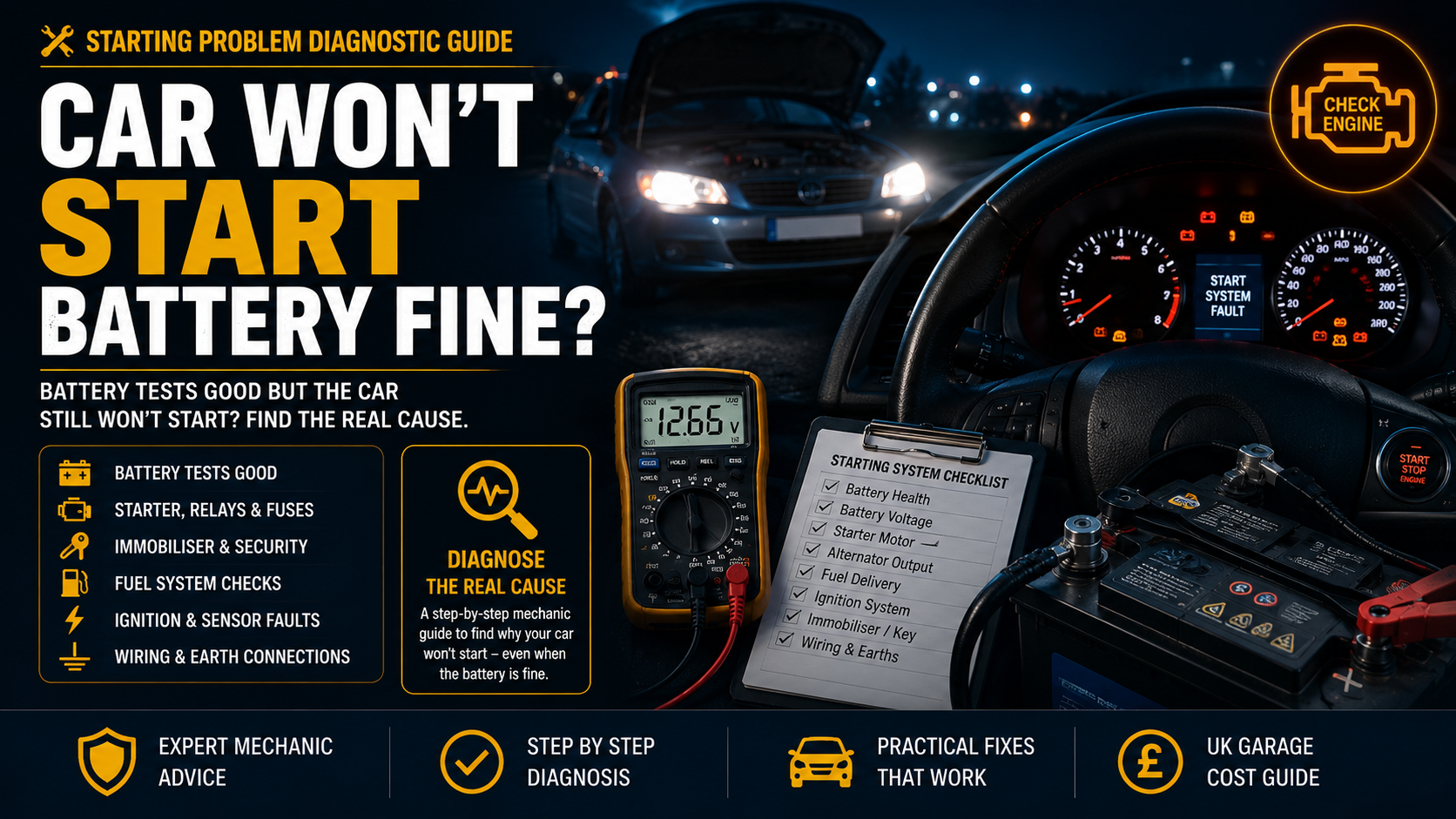
Quick answer
A car can seem to have a good battery because the lights, radio and dashboard work, but starting the engine needs much more current. A weak battery, loose terminal, bad earth strap or starter motor fault can still stop the car starting.
The most important first step is to decide whether the engine does not crank at all, or whether it cranks normally but will not fire. Those two situations usually point to different faults.
No crank vs cranks but won’t start
No crank
If you turn the key or press the start button and the engine does not turn over, the problem is usually in the starting circuit. Common causes include a weak battery under load, loose terminals, bad earth strap, starter motor fault, starter relay, ignition switch, clutch switch, park/neutral switch or immobiliser issue.
Starter clicking guide →Cranks but does not start
If the engine turns over normally but does not fire, the starter is probably doing its job. Common causes include fuel delivery problems, ignition faults, crankshaft sensor faults, immobiliser issues, engine management faults or timing-related problems.
Cranks but won’t start guide →Find the closest symptom
Lights work but no crank
Think starter motor, relay, ignition switch, bad earth, loose terminals or immobiliser.
Rapid clicking
Often weak battery under load, corroded terminals, poor earth or bad cable connection.
Clicking no-start →Single click
May point towards starter solenoid, starter motor, relay or high-resistance cable fault.
Starter motor cost →Cranks normally
Starter likely works. Look at fuel, spark, crank sensor, immobiliser or engine management faults.
Cranks but won’t start →Starts sometimes
Intermittent faults can involve starter, ignition switch, relay, key, immobiliser, wiring or sensors.
Battery keeps going flat
Charging system, battery health or parasitic drain may be involved.
Battery drain guide →What the starting sound can mean
Rapid clicking
Often points to weak battery voltage, bad terminals or a poor earth connection.
Single click
May suggest a starter solenoid, starter motor or high-resistance cable issue.
No sound at all
Can involve the ignition switch, starter relay, immobiliser, clutch switch, park switch or wiring.
Slow cranking
Can still be battery-related even if the lights and radio work normally.
Cranks normally
Usually points away from the starter and towards fuel, spark, sensor or immobiliser faults.
Grinding noise
May involve starter motor gear engagement, flywheel teeth or starter mounting problems.
Common causes when the battery seems fine
Weak battery under load
Lights may work, but the starter motor may still not get enough current.
Battery health guide →Loose battery terminals
Poor connections can stop enough power reaching the starter motor.
Bad earth strap
Poor grounding can cause clicking, no crank or strange electrical faults.
Starter motor fault
A worn starter can click, stick or fail to turn the engine.
Starter cost guide →Starter relay or ignition switch
The start signal may not reach the starter correctly.
Immobiliser or key issue
The car may block starting if the key is not recognised.
Key fob guide →Fuel pump fault
The engine may crank but not receive enough fuel.
Crankshaft sensor fault
The ECU may not know when to inject fuel or trigger spark.
Blown fuse or wiring fault
Electrical supply faults can stop starter, fuel or ignition systems working.
What to check first
1. Watch the dashboard
If lights dim heavily or go out when starting, suspect low voltage or poor connections.
2. Listen carefully
A single click, rapid clicking, silence or normal cranking each points in a different direction.
3. Check gear position
Make sure the car is in Park or Neutral, or the clutch is fully pressed on manual cars.
4. Inspect terminals
Look for loose clamps, corrosion, damaged cables or poor earth connections.
5. Try the spare key
If immobiliser or key recognition is suspected, a spare key may help.
6. Avoid repeated attempts
Constant attempts can flatten the battery and make diagnosis harder.
Could it still be the battery?
Yes. A battery can have enough power for lights and dashboard electronics but still fail when the starter motor demands high current. This is why battery health should be tested under load, not judged by lights alone.
- 1Slow cranking can suggest weak battery output.
- 2Rapid clicking often points to low voltage or poor connections.
- 3Corroded terminals can mimic battery or starter failure.
- 4A bad alternator can leave a good battery undercharged.
- 5A battery that keeps going flat needs charging-system checks.
For more detail, read how to check car battery health, car battery keeps going flat and alternator not charging battery signs.
Manual and automatic starting checks
Manual car
Make sure the clutch pedal is fully pressed. A faulty clutch switch can stop the starter signal reaching the system, even when the battery is fine.
Automatic car
Make sure the selector is fully in Park or Neutral. A park or neutral switch fault can stop the vehicle cranking.
Start button car
Try holding the key close to the start button or steering column if the key battery is weak, depending on the vehicle design.
After recent work
If the fault started after a battery, starter, fuse, fuel filter or service job, recheck that work first.
Immobiliser or key fault clues
Immobiliser faults can stop the car starting even when the battery, starter and engine are otherwise fine. Some cars will not crank, while others may crank but refuse to fire.
- ✓Key warning light stays on or flashes.
- ✓The car starts with the spare key but not the main key.
- ✓Remote locking or keyless entry has recently become unreliable.
- ✓The engine starts briefly then cuts out.
- ✓Dashboard messages mention key, immobiliser or anti-theft system.
If the key fob is also playing up, see car key fob not working.
If it cranks normally: fuel, spark and sensor checks
If the engine turns over at normal speed but will not start, the problem is less likely to be the starter motor. The engine usually needs fuel, spark, compression and correct timing to run.
Fuel delivery
Fuel pump, relay, fuse, fuel pressure, blocked filter or injector faults can stop starting.
Ignition fault
Petrol cars may fail to start because of coils, plugs, wiring or engine control faults.
Sensor fault
Crankshaft or camshaft sensor faults can stop the ECU knowing engine position.
For a deeper guide, read car cranks but won’t start.
When it needs urgent attention
- !The engine will not crank and the car is blocking a road or unsafe location.
- !There is smoke, burning smell or signs of electrical overheating.
- !The starter keeps grinding after you release the key or button.
- !The car cuts out and will not restart after driving.
- !The dashboard shows immobiliser, battery, oil pressure or engine warning messages.
- !You suspect fuel leakage or strong fuel smell.
When to stop guessing
If the car repeatedly fails to start, do not keep replacing parts at random. A proper diagnostic process should check battery condition under load, starter current draw, charging output, fault codes, immobiliser status, fuel pressure and ignition signals.
A car that seems like the battery is fine can still have a weak battery, bad connection or charging fault. Testing saves money compared with replacing parts based on symptoms alone.
Can you fix it yourself?
Simple checks such as gear position, spare key, battery terminals and visible corrosion are good starting points. Starter motor, immobiliser, fuel system and sensor faults usually need proper diagnosis.
Avoid repeated cranking because it can flatten the battery, overheat starter components and make the original fault harder to identify.
Possible UK repair costs
Costs vary depending on the vehicle, fault location, diagnostic time and parts quality. These are broad UK guide prices only.
Battery or terminals
Often around £80 to £250 for a battery, or less if the issue is a clamp, terminal or earth repair.
Battery guide →Starter motor
Often around £180 to £500+ depending on parts, access and labour time.
Starter cost guide →Alternator fault
Often around £250 to £700+ if the alternator has left the battery undercharged.
Alternator cost guide →Relay or fuse
Can be relatively low cost, but diagnosis is needed to find why the circuit failed.
Immobiliser or key
Cost varies depending on whether the issue is key battery, coding, receiver or module fault.
Key fob guide →Fuel or sensor fault
Fuel pump, crank sensor, cam sensor or wiring faults can vary widely in cost.
Best mechanic-style advice
Do not judge the battery only by the lights working. The starter motor needs a large amount of current, and a weak battery or poor connection can fail only when you try to start the engine.
Always split the fault into two paths first: no crank or cranks but will not start. That one step prevents a lot of wrong part replacement.
Related starting and battery guides
Frequently asked questions
Can a battery be bad even if the lights work?
Yes. Lights need far less power than the starter motor, so a weak battery can still seem fine until you try to start the car.
Could it still be the starter motor?
Yes. A bad starter motor is common when the engine does not crank properly, especially if you hear a single click or intermittent starting.
Why does my car crank but not start?
Common causes include no fuel pressure, no spark, immobiliser issues, crankshaft sensor faults or engine management problems.
Can an immobiliser stop the car starting?
Yes. If the key is not recognised, many vehicles will prevent the engine from starting.
Should I keep trying to start it?
No. Repeated attempts can flatten the battery and make the original fault harder to diagnose.
Can poor battery terminals stop starting?
Yes. Loose or corroded terminals can prevent enough current reaching the starter motor.
Why does my car start sometimes but not others?
Intermittent no-start faults can involve the starter motor, ignition switch, relays, earth strap, immobiliser, key, wiring or heat-sensitive sensors.
Can a bad alternator stop my car starting?
Yes. A bad alternator may not charge the battery properly, leaving it too weak to start the next time.