
Quick answer
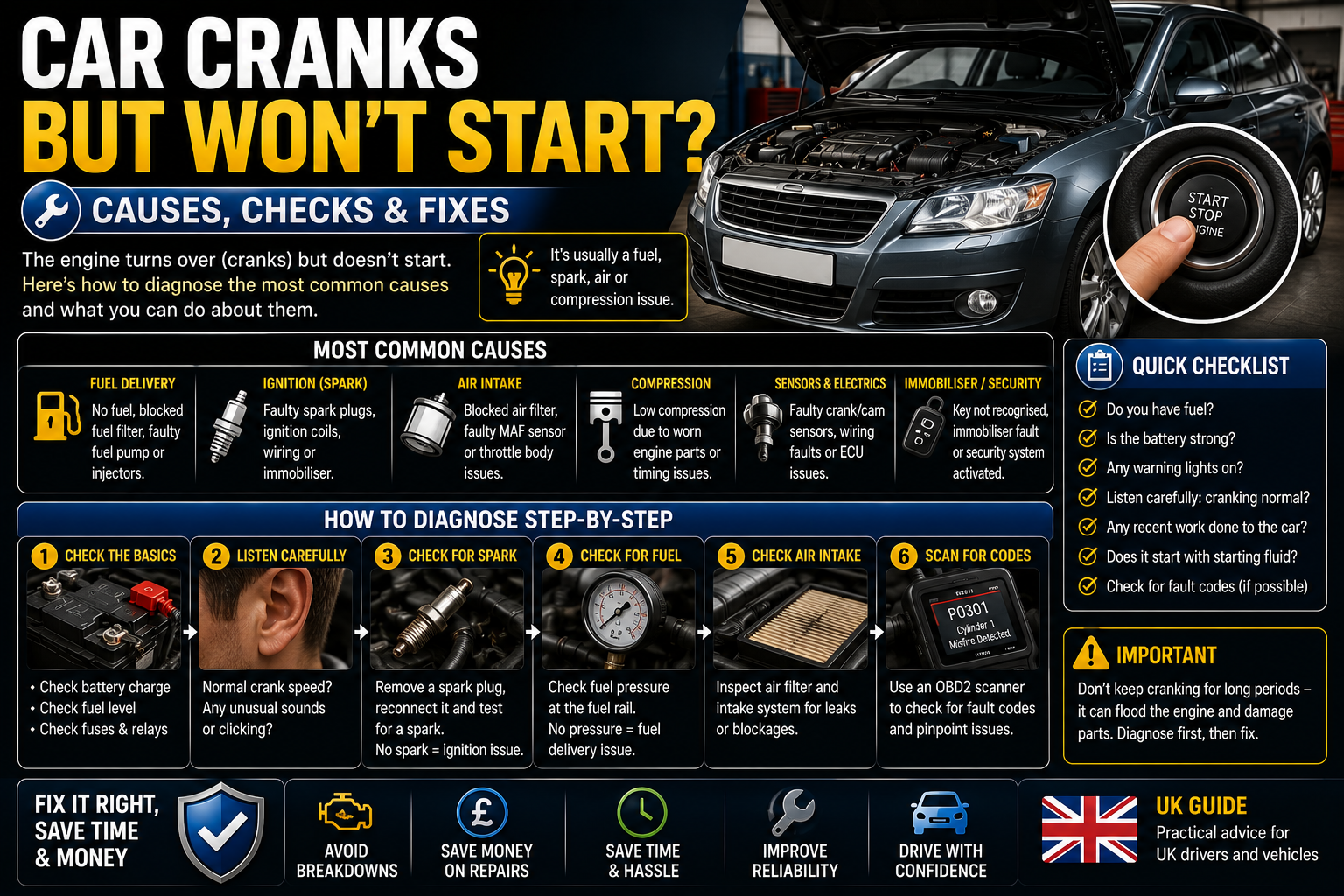
If a car cranks but will not start, the engine is turning over but not firing. Common causes include no fuel, no spark, immobiliser problems, crankshaft sensor faults, camshaft sensor faults, weak battery voltage under load or engine management issues.
This is different from a car that clicks but does not crank. If your car only clicks, read our starter motor clicking guide. If the car will not start but the battery seems fine, see car won’t start but battery seems fine.
A crank no-start needs four main things checked: fuel, spark, compression and correct timing or ECU control.
Why crank no-start faults need proper diagnosis
A crank no-start fault can look the same from the driver’s seat, but the cause can be completely different. One car may need a fuel pump, another may have a crank sensor fault, another may have an immobiliser issue, and another may only have weak voltage during cranking.
That is why guessing gets expensive quickly. Replacing a battery, starter motor, fuel pump or sensor without testing can waste money and still leave the car unable to start.
A good diagnosis starts by confirming the engine is really cranking properly, then checking fuel delivery, spark, sensor signal, immobiliser status, fault codes and voltage under load.
Cranking vs clicking: why it matters
Cranks but will not start
The starter turns the engine, but the engine does not fire. This usually points towards fuel, ignition, immobiliser, sensor, ECU control, compression or timing faults.
Clicks but does not crank
The engine does not turn over. This usually points towards the battery, terminals, earth strap, starter motor, starter relay or starting circuit.
Starter clicking guide →What the starting sound can tell you
Strong normal cranking
The starter is turning the engine properly, so fuel, spark, immobiliser and sensor checks become more important.
Slow cranking
The battery may be weak under load, even if the lights and dashboard still work.
Battery health guide →Fast uneven cranking
Can sometimes point to low compression or timing problems, especially if the sound is unusual.
Starts then cuts out
May suggest immobiliser, fuel pressure, sensor or engine management issues.
Splutters but will not run
Often suggests fuel delivery, ignition misfire, flooding or poor sensor readings.
Misfire symptoms →Only clicks
That is not a true crank-no-start fault. Check battery, terminals, earth strap and starter motor first.
Clicking starter guide →Common causes when a car cranks but won’t start
No fuel reaching engine
Fuel pump, relay, fuse, filter or pressure faults can stop the engine firing.
No ignition spark
Coils, spark plugs, wiring or ignition control faults can prevent combustion.
Immobiliser issue
The key may be recognised enough to crank but still prevent starting on some vehicles.
Key fob guide →Crankshaft sensor fault
The ECU may not know engine position, so fuel and spark timing may fail.
Camshaft sensor fault
Can cause long cranking, poor starting or complete no-start conditions.
Weak battery voltage
The engine may crank, but voltage may drop too low for electronics to work properly.
Battery keeps going flat →Flooded petrol engine
Too much fuel can stop a petrol engine starting cleanly.
Timing issue
A slipped belt or chain fault can cause serious no-start problems and unusual cranking sounds.
Engine management fault
Stored fault codes can help identify sensor, fuel or ignition problems.
Engine light guide →What to check first
- 1Confirm the engine is cranking strongly, not just clicking.
- 2Check whether the immobiliser or key warning light stays on.
- 3Listen for a fuel pump prime when the ignition turns on.
- 4Check whether the engine almost starts then cuts out.
- 5Look for engine management, battery or security warning lights.
- 6Think about whether the fault happens hot, cold or after standing.
- 7Avoid repeated cranking because it can flatten the battery.
- 8Check if the fault started after servicing, fuel filter replacement or battery work.
Can the battery still be the problem?
Yes. A weak battery can sometimes crank the engine but still drop voltage too low for the ECU, fuel pump, injectors or ignition system to work correctly. This is especially possible in cold weather, after short journeys or if the battery is old.
If the engine cranks slowly, the dashboard dims heavily, or the car has recently needed jump starts, test the battery properly. You may also find these guides useful: how to check car battery health, car battery keeps going flat and battery warning light meaning.
Fuel system checks when the engine cranks
If the engine cranks normally but does not fire, fuel delivery is one of the first areas to consider. The engine needs the right fuel pressure at the right time, not just fuel in the tank.
Fuel pump prime
Some cars make a brief pump sound when the ignition is switched on.
Fuel pump relay or fuse
A failed relay or fuse can stop the pump running even if the pump itself is good.
Low fuel pressure
The engine may crank, splutter or start briefly then die if pressure is too low.
Blocked fuel filter
Restricted fuel flow can cause hard starting, hesitation or no-start faults.
Air in diesel fuel system
After fuel filter work, air in the system can stop a diesel starting properly.
Fuel filter guide →Wrong or contaminated fuel
If the issue started after refuelling, fuel quality or wrong fuel needs considering.
Ignition and spark checks
On petrol engines, the engine needs a strong spark at the right time. If the car cranks but does not start, ignition coils, spark plugs, wiring and ECU control may need checking.
Ignition coil fault
A coil fault can cause misfire, rough running or no-start problems.
Misfire guide →Spark plug issue
Worn, fouled or flooded plugs can stop clean starting.
Crank sensor signal
If the ECU cannot see engine speed, spark may not be triggered correctly.
Crankshaft and camshaft sensor faults
Crankshaft and camshaft sensors tell the ECU where the engine is in its rotation. If those signals are missing or unreliable, the ECU may not control fuel injection and spark timing correctly.
Crankshaft sensor
Can cause sudden cutting out, hot no-start, no RPM signal while cranking or complete no-start.
Camshaft sensor
Can cause long cranking, poor starting, rough running or stored engine fault codes.
Heat-related failure
Some sensors fail when hot and work again after cooling down.
Fault-code clue
A scan can help identify missing or implausible crank or cam signals.
Use diagnostic app →Does it happen hot, cold or after standing?
Won’t start cold
Battery weakness, glow plugs on diesel cars, fuel pressure or temperature sensor faults may be involved.
Cold running guide →Won’t start hot
Crank sensor, fuel pressure, heat-related electrical faults or immobiliser issues are common possibilities.
After standing
Battery drain, fuel pressure loss, stale fuel or immobiliser/key issues may become more noticeable.
Flat battery guide →Petrol and diesel no-start causes
Petrol car cranks but won’t start
Petrol cars commonly need fuel, spark, compression and correct timing. Coils, plugs, crank sensors, fuel pumps, injector pulse or flooding can all cause crank-no-start faults.
Diesel car cranks but won’t start
Diesel faults may involve fuel pressure, glow plugs, crank sensors, air in the fuel system, blocked filters, injector issues or DPF-related problems.
If a diesel warning appeared before the no-start problem, read the DPF warning light guide. If the fault started after a filter change, see car jerks after fuel filter change, as air or priming issues can also affect starting.
If it started after recent work
A crank-no-start fault after recent repairs can point directly to something disturbed during the work. Always think about what changed just before the fault appeared.
After battery replacement
Check battery terminals, voltage, fuses, immobiliser behaviour and whether any systems need relearning.
Battery light after new battery →After fuel filter work
Diesels may need correct priming. Air in the fuel system can cause hard starting or no start.
Fuel filter guide →After service work
Check disconnected sensors, air intake pipes, ignition coils, plugs, fuses and fuel system connections.
Servicing guide →When to stop guessing
If the car repeatedly cranks but will not start, fault-code reading and proper checks are usually needed. A good diagnostic process may check battery voltage under load, fuel pressure, spark, injector pulse, immobiliser status and crank or cam sensor signals.
Guessing can quickly become expensive because many no-start faults feel similar from the driver’s seat. Replacing the fuel pump, battery, starter or sensors without testing can waste money.
Scan for codes
Look for immobiliser, crank sensor, cam sensor, fuel pressure, misfire or ECU-related faults.
Check live data
RPM signal while cranking, fuel pressure and sensor readings can be very helpful.
Test before replacing
A fault code points to an area. It does not always prove the part itself is bad.
Possible UK repair costs
Costs depend on the vehicle, access, diagnosis time and the actual fault. These are broad guide categories only.
Diagnostic test
Useful first step before replacing battery, pump, sensors or ignition parts.
Battery or voltage issue
May involve battery testing, terminal repair, earth repair or charging checks.
Battery health guide →Fuel pump or relay
Costs vary depending on pump location, relay/fuse diagnosis and fuel system access.
Ignition repair
Coils, plugs or wiring repairs vary depending on engine layout.
Misfire guide →Sensor replacement
Crank or cam sensor cost depends on access and whether the signal has been tested.
Diesel fuel pressure fault
Diesel diagnosis can become more expensive if injectors, pump pressure or air leaks are involved.
What not to do
- !Do not keep cranking until the battery is flat.
- !Do not assume the starter is faulty if the engine is turning normally.
- !Do not replace the fuel pump without checking power, relay, fuse and pressure.
- !Do not ignore immobiliser or key warning lights.
- !Do not tow-start modern vehicles unless the handbook says it is safe.
- !Do not ignore unusual fast cranking after a timing belt or chain concern.
Best mechanic-style advice
A crank no-start is not the same as a starter motor clicking fault. If the engine is turning properly, start thinking about fuel, spark, sensor signal, immobiliser approval, compression and timing.
Do not guess from the sound alone. Confirm battery voltage under load, scan for fault codes, check whether there is fuel pressure, check for spark where appropriate and look at crank or cam sensor data.
If it cranks strongly but will not fire, the starter is usually not your first suspect. Find out what the engine is missing.
Related starting and diagnostics guides
Frequently asked questions
Why does my car crank but not start?
The engine may be missing fuel, spark, correct sensor signals, compression or immobiliser approval.
Can the battery still be the problem?
Yes. The engine may crank but voltage can still drop too low for reliable starting.
Can a fuel pump cause crank no start?
Yes. If fuel pressure is missing or too low, the engine may crank without firing.
Can an immobiliser allow cranking?
On some cars, yes. The engine may crank but fuel or spark may be disabled.
Should I keep cranking it?
No. Repeated attempts can flatten the battery and overheat starter components.
Is this a starter motor problem?
Usually not if the engine cranks strongly. Starter faults are more likely when it clicks or does not turn over.
Can a crank sensor stop the car starting?
Yes. If the ECU cannot read engine position, fuel and spark timing may not be controlled correctly.
Why does it start then cut out?
This can happen with immobiliser faults, fuel pressure problems, sensor faults or engine management issues.
Why does it crank faster than normal?
Unusually fast cranking can suggest compression or timing problems and should be checked carefully.
Can a diesel crank but not start because of air in fuel?
Yes. Air in the fuel system, especially after fuel filter work, can cause hard starting or no start.