
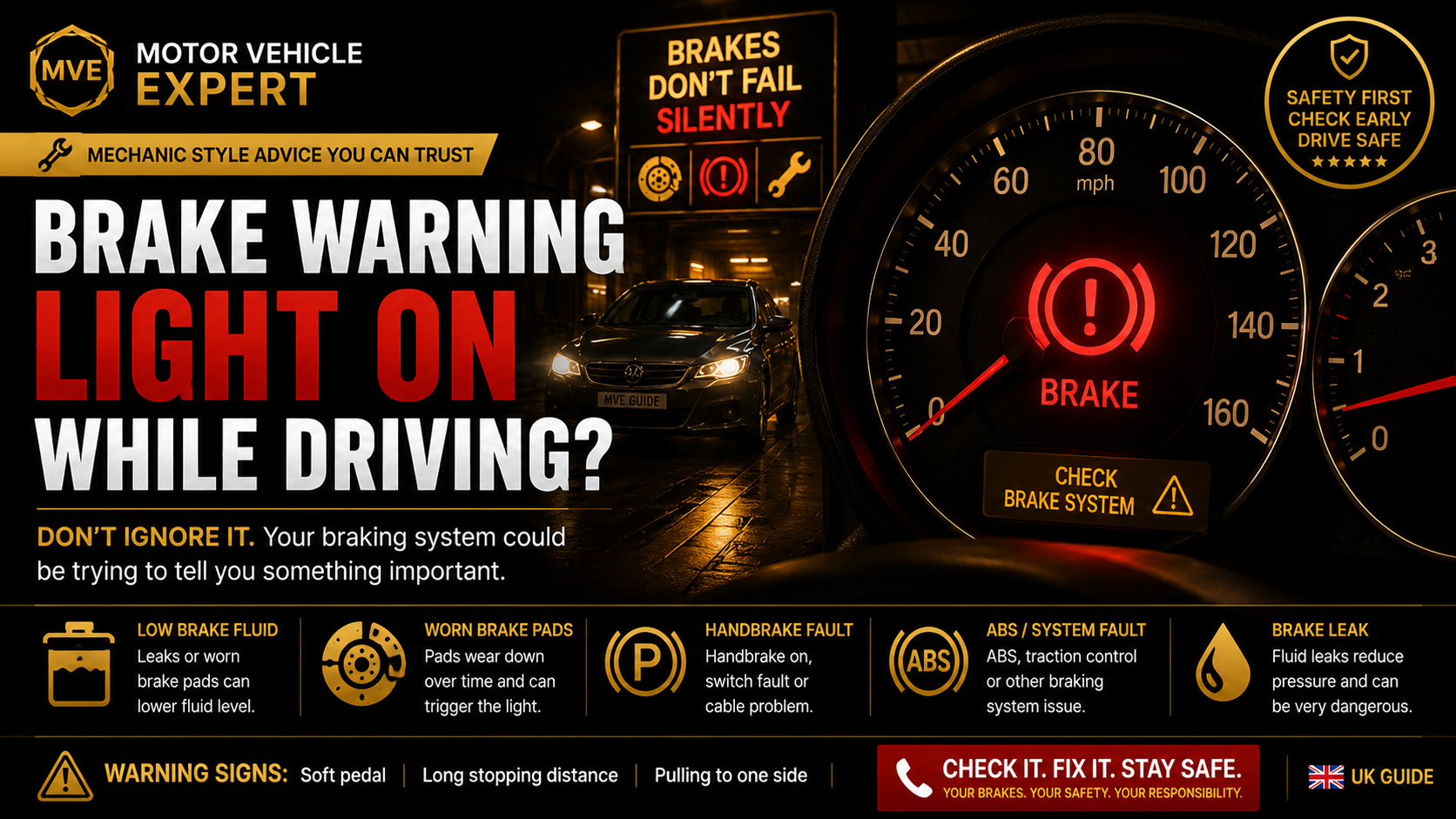
Not sure how serious the brake warning is?
Use the Motor Vehicle Expert diagnostic app to check dashboard warning lights, symptoms, safe-to-drive guidance, possible causes and MOT implications. Brake warnings should always be treated with care because they can affect stopping distance and vehicle safety.
Check warning severity
Compare brake warning lights, ABS warnings, handbrake faults, low fluid symptoms and braking changes.
Safe-to-drive guidance
Understand when to stop immediately and when cautious movement to a safe place may be possible.
MOT risk
Brake warning lights, brake defects, ABS faults and handbrake problems can affect MOT results.
Next checks
Get plain-English checks before guessing parts or ignoring the warning.
Quick answer
If the brake warning light comes on while driving, do not ignore it. First, check whether the handbrake or electronic parking brake is fully released. If it is released and the light stays on, treat it as a braking system warning until proven otherwise.
If the brake pedal feels soft, sinks lower than normal, braking feels weak, the car pulls to one side, you hear grinding, or you see fluid near a wheel, stop driving as soon as it is safe. Do not try to “get home” with brakes that feel wrong.
A brake light with normal pedal feel may need careful diagnosis. A brake light with poor pedal feel, leaks, grinding or weak braking needs immediate attention.
What does the brake warning light mean?
The brake warning light can mean different things depending on the car. On older cars it may be mainly linked to the handbrake and fluid level. On newer cars it may also be linked to brake pad wear, electronic parking brake faults, brake assist systems, ABS, stability control or brake pressure monitoring.
That is why you should not guess from the light alone. The most important thing is how the brake pedal feels and whether the car still stops normally.
Red brake warning
Usually more urgent, especially if linked to brake fluid, hydraulic pressure, handbrake faults or braking performance.
Amber brake warning
Often points to a fault that needs checking soon, such as pad wear, electronic brake faults or sensor issues.
Brake plus ABS light
Can mean normal braking may remain, but ABS, traction or stability support may be affected.
ABS warning guide →What this looks like in real life
Light comes on after pulling away
The handbrake may not be fully released, the switch may be sticking, or the brake fluid level may be low.
Light comes on when braking
Fluid may be moving inside the reservoir because the level is low, or there may be a sensor or hydraulic issue.
Light with soft pedal
This is more serious. It can suggest air, fluid loss, hydraulic pressure trouble or brake system failure.
Light with grinding noise
Brake pads may be badly worn, or metal may be contacting the disc. Do not keep driving normally.
Grinding brake guide →Light after brake work
Could be low fluid, a disconnected sensor, pad wear sensor issue, ABS sensor issue or electronic parking brake problem.
Light plus ABS/traction lights
Can point towards wheel speed sensors, ABS faults, stability control issues or wiring problems.
ABS safe drive guide →Find the closest symptom
Brake light but car feels normal
Could be handbrake switch, low fluid starting point, pad wear sensor or electrical fault. Still needs checking.
Check in app →Brake light and soft pedal
Treat as urgent. A soft or sinking pedal can mean hydraulic pressure trouble or fluid loss.
Brake light and grinding
Often linked to badly worn pads, damaged discs or brake hardware issues.
Grinding guide →Brake light and car pulls
Can suggest uneven braking, seized caliper, brake imbalance, tyre issue or suspension fault.
Pulling guide →Brake light after topping up fluid
If the level drops again, suspect a leak or worn brakes. Do not keep topping up without diagnosis.
Brake light near MOT time
Brake warnings should be checked before the test because brake faults can fail an MOT.
MOT failure guide →Common reasons the brake warning light comes on
Low brake fluid
Can happen from worn pads or a leak. A leak is urgent because brake pressure can be affected.
Parking brake issue
The handbrake may not be fully released, or the switch may be sticking or faulty.
Handbrake MOT guide →Worn brake pads
Some cars have pad wear sensors. Worn pads can also make the fluid level sit lower.
Brake pad cost guide →Brake fluid leak
Leaks from pipes, hoses, calipers or wheel cylinders can reduce braking performance quickly.
Brake fluid MOT guide →ABS fault
ABS problems can bring on brake-related warnings, especially if wheel speed sensors or wiring are faulty.
ABS warning guide →Electronic parking brake fault
Modern cars can show brake warnings for electronic handbrake motors, switches or control faults.
Brake pressure problem
A pressure fault can affect how the pedal feels and how strongly the car brakes.
Sensor or wiring issue
Damaged wiring, corroded plugs or failed sensors can trigger warnings even when brakes feel normal.
Master cylinder problem
A failing master cylinder can cause a sinking pedal, poor pressure and serious braking issues.
When you should stop driving immediately
- !The brake pedal feels soft, spongy or sinks towards the floor.
- !Stopping distance increases or braking feels weak.
- !The car pulls sharply to one side when braking.
- !You hear grinding noises when braking or driving.
- !You feel severe vibration through the brake pedal or steering wheel.
- !You can see brake fluid leaking near a wheel or under the car.
- !The brake warning light appears with ABS, battery, oil or engine warnings.
- !The warning appears after recent brake work and the pedal feels different.
If any of these happen, stop somewhere safe and do not continue driving. Brake faults can change from “it still stops” to “it does not stop properly” without giving you much time.
What to check first
1. Check the parking brake
Make sure the handbrake or electronic parking brake is fully released. Do not assume this is the only cause.
2. Notice the brake pedal
Pedal feel matters more than the warning light alone. Soft, sinking or weak brakes are urgent.
3. Check brake fluid level
Only check if it is safe. Low fluid should be investigated, not just topped up and forgotten.
4. Look for leaks
Check for wet patches near wheels, around calipers, brake hoses, pipes or under the car.
5. Check for other warning lights
ABS, traction control, ESC or battery warnings can help point towards the affected system.
6. Arrange brake inspection
A garage should check pads, discs, fluid, hoses, pipes, calipers, sensors and brake performance.
Brake fluid low: what it may mean
Brake fluid is not like washer fluid. It should not keep disappearing. If the brake fluid level is low, there is a reason. Sometimes it drops as brake pads wear down, but it can also drop because of a leak.
From a mechanic’s point of view, a leak is the dangerous one. If fluid is escaping, pressure can be lost, the pedal can go soft and braking can become weak. Topping up may make the light go out for a while, but it does not fix the cause.
- !Do not ignore repeated low brake fluid.
- !Do not keep topping up without checking for leaks.
- !Do not drive if the pedal feels soft or sinks.
- !Use the correct brake fluid type if topping up is professionally advised.
Brake warning light with ABS light
If the brake warning light appears with the ABS light, the car may still have normal braking, but anti-lock braking support may not work correctly. In an emergency stop, the wheels may be more likely to lock, especially on wet or loose surfaces.
Common causes include wheel speed sensor faults, ABS wiring damage, low voltage, ABS pump faults, brake fluid level issues or control module faults. This should be checked properly, especially before an MOT.
Read more here: ABS warning light on: is it safe to drive?
Can a brake warning light affect MOT?
Yes. Brake system defects, warning lights, low brake fluid, poor braking efficiency, brake imbalance, handbrake faults and ABS faults can affect the MOT result.
If a brake warning light is on before the test, it is better to diagnose it first rather than hoping it will pass. Brakes are safety-critical, and MOT testers will take brake warnings seriously.
Brake pads
Worn pads can fail if they are below safe limits or causing poor braking.
Brake pads MOT guide →Brake fluid
Leaks or unsafe fluid-related faults can affect the MOT.
Brake fluid MOT guide →Handbrake
A weak or faulty parking brake can fail the MOT.
Handbrake MOT guide →Common mistakes drivers make
- !Assuming the light is only the handbrake switch.
- !Topping up brake fluid without checking why it was low.
- !Driving normally with a soft or sinking pedal.
- !Ignoring grinding brakes because the car still stops.
- !Leaving brake warning lights until MOT day.
- !Replacing sensors before checking pads, fluid, leaks and wiring.
Best mechanic-style advice
When a brake warning light comes on, do not start by guessing parts. Start with safety. How does the pedal feel? Does the car stop straight? Is the fluid level low? Is there a leak? Are there grinding noises? Are ABS or traction lights on as well?
If the brakes feel different, treat it as urgent. If the brakes feel normal, still get it checked promptly because a warning light means the car has seen something it does not like.
Related warning light guides
Battery warning light
Charging faults can cause electrical warnings and may affect brake or ABS systems on some cars.
Battery warning guide →Coolant warning light
Low coolant or overheating warnings should be treated seriously to avoid engine damage.
Coolant warning guide →Oil warning light
Oil pressure warnings can damage the engine quickly and should not be ignored.
Oil warning guide →ABS warning light
ABS warnings affect anti-lock braking support and can also affect MOT results.
ABS warning guide →Related brake, warning light and MOT guides
Frequently asked questions
Can I keep driving with the brake warning light on?
Only for a short careful journey to a safe place if braking feels completely normal. If the pedal feels soft, braking is weak, fluid is leaking or the car pulls when braking, stop driving.
Can worn brake pads trigger the brake warning light?
Yes. Some cars have brake pad wear sensors. Also, as pads wear, the fluid level can sit lower because the caliper pistons move further out.
What if the brake pedal feels soft?
Stop driving and arrange help immediately. A soft, spongy or sinking pedal can indicate air, fluid loss or hydraulic brake failure.
Could it just be the handbrake switch?
Sometimes, yes. But do not assume that until the parking brake is released, the brake fluid level is checked and the pedal feel is confirmed as normal.
Will a brake warning light fail MOT?
It can. Brake warning lights, ABS faults, low brake fluid, poor braking performance and handbrake faults can all affect the MOT result.
Why does the brake warning light come on when braking?
It can happen when brake fluid is low and moves inside the reservoir during braking. It can also be caused by sensor or wiring faults.
Is it safe to top up brake fluid?
Only use the correct fluid and only as a temporary measure if needed. Low brake fluid must be investigated because it may be caused by worn brakes or a leak.
What is the best next step?
Check whether the parking brake is fully released, notice how the brake pedal feels, look for leaks, check for other warning lights and arrange a proper brake inspection.