Quick answer
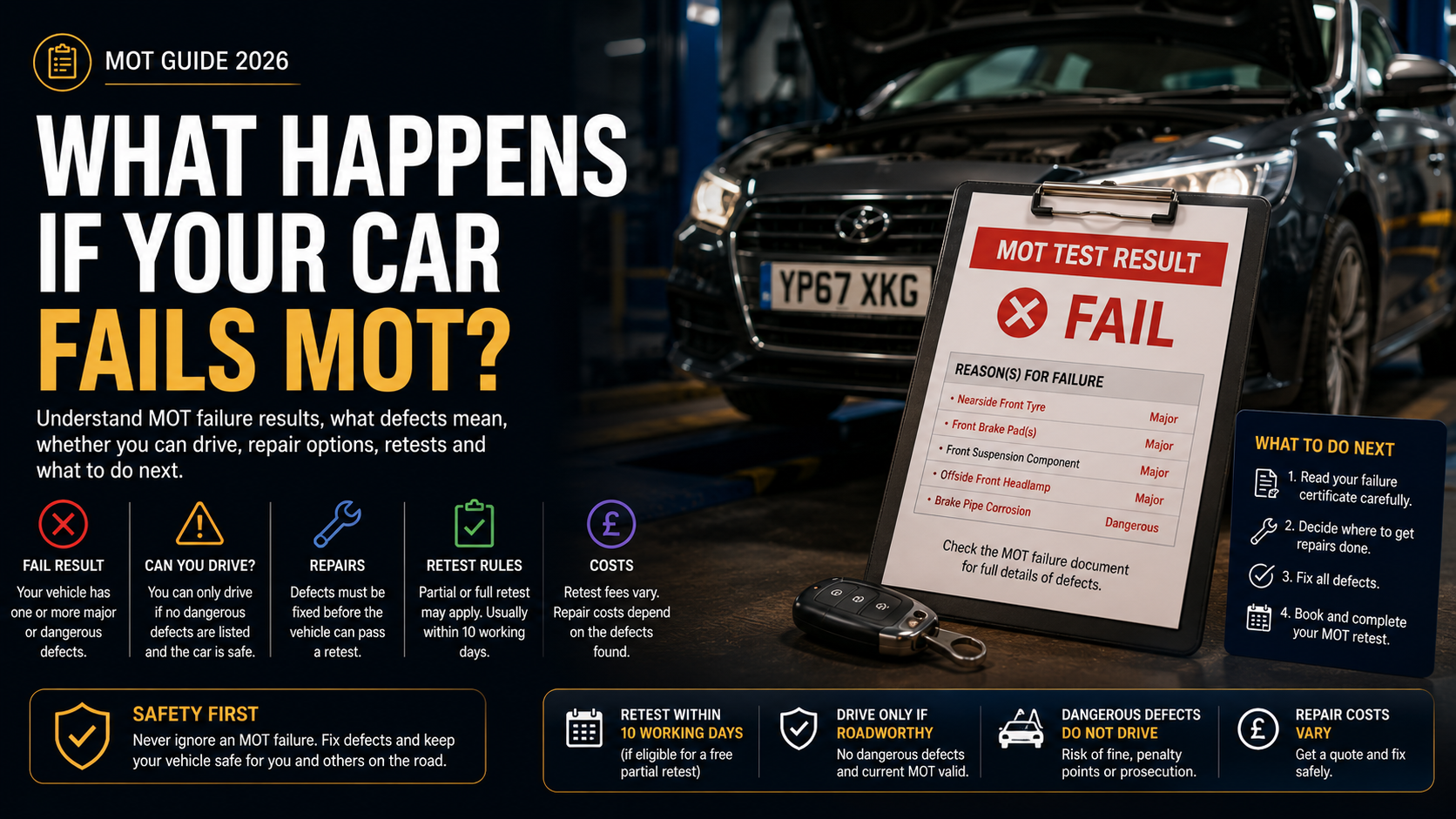
If your car fails its MOT, it has not met the required minimum standard at the time of the test. Major and dangerous defects cause failure and must be repaired before the car can pass.
You can only take the vehicle away after a failed MOT if the current MOT is still valid and no dangerous defects were listed. Even then, the car must still be roadworthy. Official GOV.UK guidance says you need repairs before driving if those conditions are not met.
What an MOT failure feels like in real life
Many drivers panic when they see an MOT failure certificate, but not all failures are equally serious. Some are inexpensive fixes, while others reveal safety issues that should not be ignored.
The key is understanding whether the defect is minor, major or dangerous and deciding whether the vehicle is safe to move before arranging repairs.
What document do you get after a failed MOT?
When a car fails its MOT, the test centre issues a failure result showing the defects found. This is often known as a refusal of MOT test certificate. It tells you what failed and whether the issue is classed as dangerous, major, minor or advisory.
Failure items
These are defects that caused the car to fail and must be repaired before a pass.
Defect category
The sheet should show whether the problem is dangerous, major, minor or advisory.
Retest clues
The listed defects tell the tester what needs checking again after repair.
Minor, major and dangerous MOT defects explained
The defect category matters because it affects how serious the failure is and whether the vehicle can be driven. DVSA introduced major and dangerous defect categories to make serious failures clearer for drivers.
Minor defect
A minor issue is not usually a test failure by itself, but it should still be repaired.
Major defect
A major defect causes MOT failure and must be repaired before the vehicle can pass.
Dangerous defect
A dangerous defect means the vehicle presents an immediate road safety risk and should not be driven until repaired.
Can you drive your car after it fails MOT?
It depends on the failure result. You can take the vehicle away only if your current MOT is still valid and the failed MOT did not list any dangerous defects. The car must still meet minimum roadworthiness standards at all times.
You may be able to drive away
Only if the old MOT is still valid, there are no dangerous defects and the car is roadworthy.
You should not drive away
If the MOT has expired, the car has dangerous defects or the vehicle is not roadworthy.
Driving to repairs
If the vehicle is unsafe or dangerous, arrange repair at the test centre or recovery to another garage.
Old MOT still valid
A valid old certificate does not make an unsafe car legal to drive.
What if your car fails MOT with a dangerous defect?
If the MOT failure includes a dangerous defect, do not drive the car until it has been repaired. GOV.UK says you can be fined up to £2,500, be banned from driving and get 3 penalty points for driving a vehicle that failed because of a dangerous problem.
- !Do not drive the vehicle home if a dangerous defect is listed.
- !Ask the garage whether the vehicle can be repaired there.
- !If using another garage, arrange recovery rather than driving.
- !Do not rely on the old MOT certificate if the vehicle is now dangerous.
- !Keep repair invoices after the fault is fixed.
What are your repair options after MOT failure?
After a failed MOT, you usually have three practical choices: repair the car at the MOT test centre, take it to another garage if it is legal and safe to move, or arrange recovery if the defects are dangerous or the car is not roadworthy.
Repair at test centre
Often convenient because the garage already knows the failure items.
Use another garage
May be useful for specialist repairs, quotes or work the MOT centre cannot do.
Arrange recovery
Best option if the vehicle has dangerous defects or is unsafe to drive.
What happens at the MOT retest?
After the failed defects are repaired, the vehicle needs a retest or partial retest. GOV.UK says that if you leave the vehicle at the test centre for repair and it is retested within 10 working days, only a partial retest is needed and there is no fee in that situation.
- 1Repair the failed defects properly.
- 2Keep invoices or repair notes.
- 3Book or return for the retest within the correct period.
- 4Make sure related advisories have not become worse.
- 5Do not use the car normally until it is legal, roadworthy and passed where required.
For more detail, read MOT retest rules UK.
How much does it cost after a failed MOT?
The cost depends on what failed. A bulb, wiper or washer fault may be cheap. Brakes, tyres, suspension, emissions faults or rust repairs can cost much more, especially if parts are seized, diagnosis is needed or welding is required.
Low-cost failures
Bulbs, wipers, washer fluid, number plate lamps and simple adjustments.
Medium-cost failures
Tyres, brake pads, discs, handbrake work, suspension links and bushes.
Higher-cost failures
Rust welding, DPF faults, catalytic converters, complex suspension or electrical faults.
Useful repair guides: car repair costs guide UK, car fails MOT on brakes and car fails MOT on emissions.
Can a failed MOT affect insurance and tax?
A failed MOT can affect insurance and road use because insurers usually expect the vehicle to be legal, roadworthy and properly maintained. If the car has dangerous defects, an accident or claim could become more complicated.
Insurance
Your insurer may look at MOT status, roadworthiness and whether the car was being used legally.
MOT and insurance guide →Vehicle tax
If the car legally needs an MOT, you normally need a valid MOT before taxing it.
Tax without MOT guide →What should you do next after an MOT failure?
- 1Read the MOT failure sheet carefully.
- 2Check whether any defects are marked dangerous.
- 3Do not drive if the vehicle is dangerous or not roadworthy.
- 4Ask for a clear repair quote and diagnosis.
- 5Repair the failed defects properly.
- 6Book the MOT retest within the correct retest window.
- 7Keep invoices for future buyers and your own records.
- 8Deal with advisories before they become next year’s failure.
What if a used car has failed MOT history?
A failed MOT in a used car’s history is not always a reason to walk away. What matters is why it failed, whether the repairs were done properly and whether the same problems appear again year after year.
Repeated failures
Repeated brake, tyre, suspension or rust failures can suggest poor maintenance.
Recent pass after failure
Check what was repaired and whether invoices are available.
Advisory pattern
Advisories that repeat for years often become future failures.
Before buying, read buying a car with failed MOT history, how to check MOT history before buying and used car inspection checklist.
Best mechanic-style advice
Do not panic when a car fails MOT, but do not ignore it either. The failure sheet is your roadmap. It tells you what failed, how serious it is and what needs fixing before the car can pass.
The biggest mistake is treating a failed MOT as just paperwork. If the defect affects braking, steering, tyres, suspension, emissions, structure or warning lights, fix the root cause properly rather than doing the cheapest temporary repair.
Related MOT failure guides
Frequently asked questions
What happens if your car fails MOT?
You receive a failed MOT result showing the defects. Major and dangerous defects must be repaired before the car can pass.
Can I drive home after a failed MOT?
Only if your existing MOT is still valid, no dangerous defects were listed and the car is roadworthy. If the car is dangerous or not roadworthy, do not drive it.
What is a dangerous MOT defect?
A dangerous defect is a serious safety risk. The car should not be driven until the defect is repaired.
What is a major MOT defect?
A major defect causes MOT failure and needs repair before the vehicle can pass the retest.
Do minor defects fail MOT?
Minor defects do not usually fail the MOT by themselves, but they should still be repaired before they get worse.
Do I need a full MOT after failing?
Not always. Depending on how and where repairs are done, a partial retest may be possible.
Can I take my failed MOT car to another garage?
Only if it is legal and safe to drive. If dangerous defects are listed, arrange recovery instead.
Can a failed MOT affect insurance?
Yes. If the car is not roadworthy or is being used illegally, insurance claims can become more difficult.