
Why does a car hesitate when accelerating?
A car hesitates when the engine or drivetrain cannot respond smoothly to increased accelerator demand. The most common engine causes are worn spark plugs, weak ignition coils, low fuel pressure, restricted injectors, intake leaks, incorrect airflow readings, throttle-control faults and turbo boost leaks.
The exact cause depends on whether the engine pauses briefly, jerks repeatedly, loses power continuously, produces smoke, enters limp mode or displays an engine management warning light.
Often becomes most noticeable under heavy acceleration.
May be accompanied by smoke, limp mode or poor low-rpm response.
Test the vehicle under the load, temperature and engine speed that expose the hesitation.
A flashing engine light, violent jerking or sudden power loss justifies immediate caution.
A flashing engine management light commonly indicates severe active misfire. Unburned fuel may overheat the catalytic converter and turn a contained ignition or fuelling fault into a much more expensive exhaust-system repair.
Hesitation is a symptom, not a diagnosis
Drivers often use the word “hesitation” to describe several different behaviours. One vehicle may pause briefly after the accelerator is pressed, another may jerk repeatedly under load, while another may simply feel weak throughout the engine-speed range.
These complaints require different diagnostic paths. A brief throttle delay may involve airflow or electronic throttle control. Sharp jerking may indicate combustion misfire. Continuous weakness may involve restricted fuel delivery, exhaust backpressure or poor mechanical condition.
Pause before the engine responds
The accelerator is pressed but engine torque rises later than expected.
Likely areasThrottle body, airflow sensor, intake leak, EGR operation or turbo control.
Engine breaks up under load
Power arrives and disappears repeatedly as the vehicle accelerates.
Likely areasIgnition misfire, injector delivery, fuel pressure or electrical interruption.
Engine remains flat
The vehicle accelerates slowly without a clear cut or repeated jerk.
Likely areasFuel restriction, boost loss, exhaust blockage, transmission or mechanical engine condition.
A useful description includes whether the engine is cold or hot, the approximate rpm, selected gear, throttle demand, road gradient and whether restarting temporarily clears the problem.
Signs of acceleration hesitation
Hesitation may be subtle during light driving but become obvious when the engine is asked to produce more torque. The associated symptoms help determine whether the problem is most likely related to combustion, fuel delivery, airflow, turbo control, emissions or the drivetrain.
Pause after pressing the accelerator
The engine takes longer than expected to respond to pedal input, particularly when pulling away or accelerating from low speed.
Jerking under acceleration
The engine repeatedly cuts and recovers as cylinder combustion becomes unstable under load.
Flat or weak acceleration
Engine speed rises slowly and the vehicle struggles to gain speed on hills or during overtaking.
Delayed power followed by a surge
Little power is produced initially before torque arrives suddenly as boost control recovers.
Warning light or limp mode
The control system restricts torque after detecting misfire, fuel-pressure, throttle, airflow or turbo deviation.
Smoke during acceleration
Black, blue or white smoke may provide evidence of airflow loss, excess fuel, oil entry or incomplete combustion.
Worse when cold or hot
Temperature-sensitive ignition, sensor, pump or fuelling faults may appear only during a specific stage of engine operation.
Worse uphill or in a high gear
Greater cylinder pressure, fuel demand and turbo demand expose marginal parts that appear normal during light driving.
Clears after restarting
Restarting may reset temporary torque limitation without repairing the underlying pressure, throttle, sensor or boost fault.
| Driver description | What may be happening | Systems to prioritise | Initial risk |
|---|---|---|---|
| Brief pause after throttle input | Torque request is not followed immediately | Throttle, airflow, intake leak or EGR | Medium |
| Repeated jerking under load | Combustion or fuel delivery is being interrupted | Spark plugs, coils, injectors and fuel pressure | High |
| Weak acceleration at higher rpm | Flow demand exceeds system capability | Fuel delivery, boost and exhaust restriction | Medium to high |
| Hissing and black smoke | Compressed intake air may be escaping | Boost hoses, intercooler and EGR | High |
| Flashing engine warning light | Severe active misfire may be present | Ignition, injector and mechanical cylinder checks | Urgent |
| Engine speed rises but road speed does not | Engine torque may not be reaching the wheels | Clutch or transmission rather than engine hesitation | High |
During engine hesitation, the engine usually fails to gain speed cleanly. During clutch or transmission slip, engine rpm may rise rapidly while vehicle speed increases more slowly than expected.
Hesitation vs power loss, misfire, judder and transmission slip
Correctly naming the dominant symptom prevents the diagnostic process starting in the wrong system. Hesitation, continuous power loss, engine misfire, drivetrain judder and clutch slip can overlap, but they do not produce exactly the same behaviour.
How hesitation differs from continuous power loss
The diagram below compares the timing, sensation and likely diagnostic direction of acceleration hesitation and sustained engine power loss.

Temporary interruption or delay
The engine pauses, stumbles or jerks when torque demand changes. The vehicle may then recover and accelerate normally.
- ✓ Appears when the accelerator is pressed
- ✓ May occur only at one engine speed
- ✓ Can disappear once boost or fuel pressure recovers
- ✓ Often worse under heavy load
- ✓ May be intermittent
Sustained lack of engine output
The engine remains weak across a wider operating range rather than pausing briefly and recovering.
- ✓ Acceleration remains poor
- ✓ Maximum road speed may be reduced
- ✓ Fault may be present at most throttle positions
- ✓ Often associated with limp mode or restriction
- ✓ Does not recover immediately
Combustion becomes uneven
The engine shakes, exhaust note becomes uneven and power delivery may break up sharply.
Main directionIgnition, injector, intake sealing or compression.
Vehicle shakes under load
Vibration may come from clutch engagement, engine mountings, driveshafts or transmission components.
Main directionClutch, mountings, driveshafts and transmission.
Engine speed rises without matching acceleration
The engine produces power, but the drivetrain does not transfer that torque effectively to the wheels.
Main directionClutch friction, automatic transmission or driveline control.
| Symptom | Engine-speed behaviour | Vehicle behaviour | Likely diagnostic direction |
|---|---|---|---|
| Hesitation | Brief pause, stumble or uneven rise | Delayed acceleration followed by recovery | Ignition, fuel, airflow, throttle or turbo |
| Continuous power loss | Slow increase across a broad range | Vehicle remains weak | Fuel restriction, boost loss, exhaust or mechanical condition |
| Misfire | Uneven or repeatedly interrupted | Jerking and possible vibration | Ignition, injector, intake leak or compression |
| Drivetrain judder | May remain relatively stable | Body or driveline vibration under load | Mountings, clutch, driveshaft or transmission |
| Clutch or transmission slip | Rises faster than road speed | Poor acceleration despite increasing rpm | Clutch or transmission |
If engine speed flares upward while road speed does not increase proportionally, investigate clutch or transmission slip. If engine speed itself pauses, drops or becomes uneven, the fault is more likely to involve engine torque production.
What causes a car to hesitate when accelerating?
Acceleration hesitation develops when the engine cannot produce the torque requested by the driver at the moment load increases. The problem may begin with weak ignition, insufficient fuel pressure, incorrect airflow measurement, restricted intake flow, unstable turbo boost, excessive exhaust-gas recirculation or a mechanical engine fault.
Several faults can create almost identical driving symptoms. A weak ignition coil, restricted injector, leaking boost hose and inaccurate airflow sensor may all make a vehicle feel flat or jerky under load. The correct starting point is therefore the symptom pattern and test data, not the name of a component found in a fault-code description.
Common systems behind acceleration hesitation
The diagram below groups the principal causes by system so that the complaint can be matched to the areas most capable of producing it.
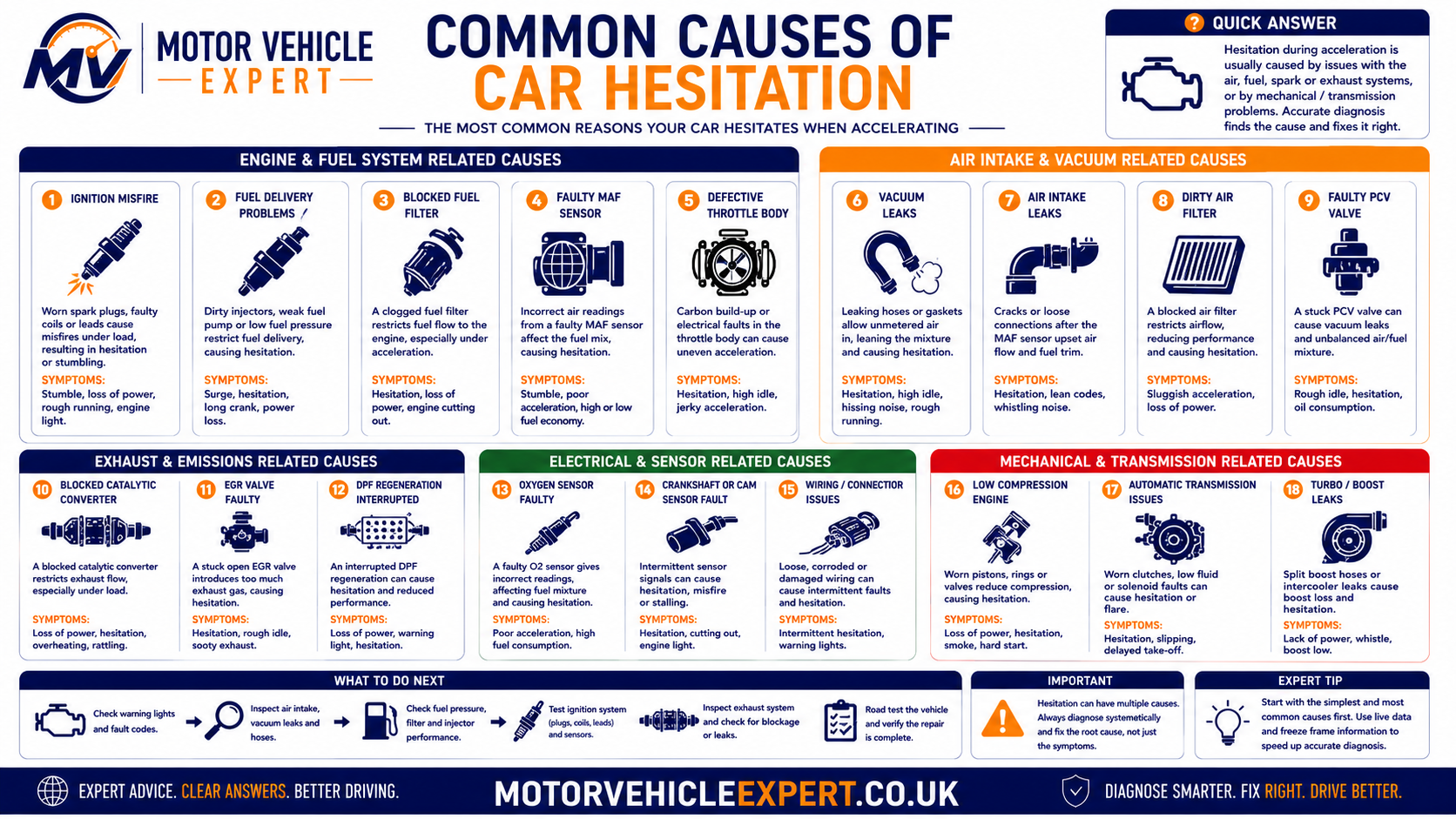
Ignition and fuel faults often become more noticeable as engine load increases. Airflow, throttle and boost faults more commonly disturb the relationship between accelerator demand and actual engine response. EGR, exhaust restriction and mechanical condition can create broader weakness that may initially be described as hesitation.
Ignition breakdown
Worn spark plugs, weak ignition coils, damaged leads or poor coil connections can fail when cylinder pressure rises during acceleration.
Typical patternJerking, misfire, uneven exhaust note and hesitation under heavier throttle.
Insufficient fuel delivery
Weak pumps, restricted filters, low rail pressure or injector faults can prevent the engine receiving the required fuel volume under load.
Typical patternFlat acceleration, surging, difficult starting or reduced power at higher engine speed.
MAF or MAP sensor error
Incorrect airflow or intake-pressure data may cause the engine control unit to calculate the wrong fuelling, throttle or boost response.
Typical patternDelayed throttle response, flat spots, poor fuel economy or limp mode.
Air or vacuum leak
Split hoses, loose clamps, leaking manifolds and failed breather components can allow unmeasured air to enter the engine.
Typical patternLean running, unstable idle, hesitation from low speed and positive fuel trims.
Dirty or faulty throttle body
Carbon deposits, throttle-motor faults or position disagreement can prevent the throttle plate following accelerator demand correctly.
Typical patternInitial pause, unstable idle, poor low-speed response or restricted power.
Boost leak or control fault
Split charge pipes, leaking intercoolers, sticking actuators or incorrect boost control can delay or interrupt turbo pressure.
Typical patternHissing, smoke, late power delivery, sudden surging or limp mode.
EGR valve fault
An EGR valve that remains open when acceleration is requested can dilute the intake charge and reduce available oxygen.
Typical patternHesitation at low engine speed, smoke, rough running and weak response.
Blocked catalytic converter or DPF
Excessive exhaust backpressure prevents the engine clearing gases efficiently and reduces its ability to produce power.
Typical patternProgressive weakness, poor high-speed performance, heat and possible warning lights.
Compression or timing fault
Low compression, incorrect valve timing or worn engine components may reduce torque even when the electronic controls appear normal.
Typical patternPersistent weakness, difficult starting, uneven running and poor cylinder contribution.
| Symptom pattern | Most likely systems | Useful confirmation | Do not assume |
|---|---|---|---|
| Jerks only under heavy load | Ignition, injectors or fuel pressure | Misfire counters, plug inspection and pressure data | That a stored cylinder code proves the coil is faulty |
| Pauses immediately after throttle input | Throttle, airflow or intake leak | Commanded versus actual throttle and airflow response | That throttle cleaning will fix every delayed response |
| Power arrives suddenly after a delay | Turbo boost or charge-air system | Requested versus actual boost and pressure testing | That normal turbo lag explains severe hesitation |
| Weak at higher engine speed | Fuel restriction, boost loss or exhaust blockage | Fuel pressure, boost data and exhaust backpressure | That the air filter is the only possible restriction |
| Worse when hot | Coil breakdown, pump weakness or heat-sensitive sensor | Testing during the hot-fault condition | That a cold workshop test has ruled the system out |
| No fault codes stored | Intermittent, mechanical or plausibility fault | Live data capture and controlled reproduction | That no code means no fault exists |
A vehicle that hesitates only when warm, uphill or above a particular engine speed should be tested under those conditions. Static checks may show normal values because the component is not being subjected to the load, heat or flow demand that exposes the fault.
The technician should reproduce the complaint safely, monitor the systems most likely to be involved and identify which value first moves away from its expected range. This is more reliable than replacing several commonly associated parts and waiting to see whether the symptom disappears.
How ignition faults cause hesitation under acceleration
Petrol engines require a strong, correctly timed spark to ignite the compressed air and fuel mixture. As throttle opening and engine load increase, cylinder pressure rises and the voltage required to bridge the spark-plug gap also increases. An ignition component that appears satisfactory at idle may therefore fail only during acceleration.
This load-sensitive behaviour is why worn spark plugs and weakening ignition coils commonly produce hesitation, jerking or misfire when climbing a hill, accelerating in a high gear or applying full throttle.
Worn spark plugs
Electrode wear increases the gap and raises the voltage needed to create a reliable spark.
Common signsHesitation under load, difficult starting, rough idle and reduced fuel economy.
Weak ignition coil
Internal insulation or winding failure may allow the coil to break down when high secondary voltage is demanded.
Common signsJerking, cylinder-specific misfire data and a flashing engine management light.
Damaged leads or connections
Cracked insulation, corrosion, poor terminals or moisture can allow ignition voltage to escape before reaching the spark plug.
Common signsWorse running in damp weather, visible tracking marks and intermittent misfire.
Lean combustion misfire
A cylinder may be recorded as misfiring because insufficient fuel or excess air makes the mixture too weak to burn consistently.
Common signsPositive fuel trims, hesitation and several cylinders affected rather than one isolated coil.
Injector-related misfire
Restricted, leaking or electrically faulty injectors can cause one cylinder to contribute less torque during acceleration.
Common signsRepeated misfire on one cylinder despite known-good ignition components.
Low cylinder compression
Valve leakage, piston wear or timing problems can imitate an ignition misfire because the cylinder cannot produce normal torque.
Common signsPersistent cylinder imbalance that does not move when coils or plugs are exchanged.
A code such as P0301 indicates that combustion irregularity has been detected on cylinder one. It does not prove that cylinder one's ignition coil is defective. The cause may instead be the spark plug, injector, wiring, intake leakage, compression or another condition affecting combustion.
Confirm the affected cylinder
Read stored and pending codes, inspect freeze-frame information and monitor cylinder misfire counters during the conditions that reproduce the complaint.
Inspect the spark plug
Check electrode wear, gap, deposits, oil contamination, overheating and whether the installed plug is correct for the engine.
Test the ignition component
Where suitable, move the coil to another cylinder and observe whether the misfire follows it. Use output testing where component swapping is inappropriate.
Check fuel and compression
If the ignition system is proven serviceable, confirm injector operation, intake sealing and mechanical cylinder condition before replacing further parts.
| Ignition-related pattern | Likely direction | Recommended test | Repair priority |
|---|---|---|---|
| Misfire begins only under heavy throttle | Weak coil or excessive spark-plug gap | Load test ignition output and inspect plugs | High |
| Misfire worsens when engine is hot | Heat-sensitive coil or electrical connection | Repeat testing at full operating temperature | High |
| Fault moves when coil is exchanged | Coil failure strongly indicated | Confirm wiring and replace the proven component | High |
| Fault remains on the same cylinder | Plug, injector, wiring or compression | Continue cylinder-specific testing | High |
| Several cylinders misfire together | Fuel, airflow, timing or shared supply fault | Check common inputs and fuel delivery | High |
Unburned fuel can enter the catalytic converter and raise its temperature rapidly. What begins as a relatively contained ignition repair can become a much more expensive emissions-system repair if the vehicle continues to be driven hard.
How fuel-system faults cause hesitation and flat acceleration
The fuel system must maintain the correct pressure and flow as engine demand increases. A vehicle may idle normally because fuel demand is low, yet hesitate during acceleration when the pump, filter, injector or pressure-control system can no longer supply the required quantity.
Petrol port-injection, petrol direct-injection and common-rail diesel systems operate differently, but the diagnostic principle remains the same: compare requested fuel delivery with the pressure and combustion response actually achieved.
Weak fuel pump
A worn pump may provide enough fuel at idle but fail to maintain volume and pressure when acceleration demand rises.
Typical patternHesitation at high load, long cranking, surging or power loss at higher engine speed.
Blocked fuel filter
A restricted filter reduces available flow and may force the pump to work harder to maintain system pressure.
Typical patternProgressive weakness, poor motorway acceleration and pressure drop under load.
Restricted injector
Deposits or internal damage can reduce fuel delivery to one or more cylinders, particularly during high-demand operation.
Typical patternCylinder imbalance, hesitation, rough running and lean combustion.
Rail-pressure fault
Pumps, regulators, metering valves, pressure sensors or excessive injector return flow can prevent target rail pressure being met.
Typical patternLimp mode, difficult starting, hesitation and fuel-pressure fault codes.
Contaminated or incorrect fuel
Water, stale fuel or incorrect fuel type can disturb combustion and damage high-pressure components.
Typical patternFault begins shortly after refuelling, with rough running, smoke or poor starting.
Injector wiring fault
Loose terminals, damaged wiring or control-module output faults can interrupt injector operation intermittently.
Typical patternSudden jerking, cylinder cut-out and an intermittent electrical fault code.
A normal pressure reading at idle does not prove that the system can meet acceleration demand. The useful test is whether low-pressure supply and high-pressure rail values remain within specification while the fault is occurring.
| Fuel-system clue | Possible cause | Useful workshop check | Diagnostic caution |
|---|---|---|---|
| Pressure falls as throttle opens | Pump weakness, restriction or control fault | Pressure and flow test under load | Do not judge the pump from idle pressure alone |
| One cylinder shows poor contribution | Injector, ignition or compression fault | Injector balance and cylinder comparison | Do not replace the injector before proving delivery |
| Rail pressure fails to reach target | High-pressure pump, regulator or leak-off | Requested versus actual pressure and return-flow test | Follow manufacturer safety procedures |
| Fault begins after refuelling | Contamination, misfuel or poor fuel quality | Fuel sample and system inspection | Continuing to run may spread contamination |
| Positive fuel trims increase under load | Fuel shortage or unmetered air | Compare pressure, airflow and intake sealing | Lean data does not identify the source by itself |
Petrol direct-injection and common-rail diesel systems can operate at extremely high pressure. Pipes and injectors must not be loosened casually while the system is running or remains pressurised. Proper test equipment and manufacturer procedures are essential.
Airflow, intake leaks and throttle faults
Modern engine management relies on accurate information about air entering the engine and the position of the throttle system. When those inputs disagree with actual airflow, the control unit may deliver the wrong fuel quantity, restrict torque or struggle to respond smoothly to accelerator demand.
These faults often produce delayed response, flat spots or surging rather than a sharp cylinder-specific misfire. Live-data plausibility and intake-system testing are therefore particularly important.
MAF sensor fault
Contamination, ageing or electrical faults can cause the reported airflow to differ from the volume actually entering the engine.
Typical patternFlat acceleration, poor fuel economy, unstable fuelling and possible limp mode.
MAP sensor fault
Incorrect manifold-pressure data can disturb fuelling, EGR and turbo-control calculations.
Typical patternHesitation, boost deviation, smoke and restricted power.
Vacuum or intake leak
Air entering after the airflow meter may not be included in the engine control unit's fuel calculation.
Typical patternLean codes, positive fuel trims, unstable idle and hesitation from low speed.
Blocked air filter
Severe contamination can limit airflow as engine demand rises, although it is less often the sole cause than commonly assumed.
Typical patternReduced high-load performance and increased intake restriction.
Carbon-contaminated throttle body
Deposits around the throttle plate can disturb low-angle airflow and make precise throttle control more difficult.
Typical patternPoor initial response, unstable idle and low-speed hesitation.
Throttle actuator or position fault
A disagreement between requested and measured throttle position may cause torque limitation or fail-safe operation.
Typical patternWarning lights, reduced power and inconsistent accelerator response.
A sensor may produce a value that appears numerically possible yet still be incorrect for the engine speed, load, throttle position and atmospheric conditions present. Good diagnosis compares related inputs rather than judging one number in isolation.
Check baseline values
Compare intake pressure with atmospheric pressure before starting and assess airflow at idle against expected engine size and speed.
Apply throttle and watch response
Confirm that accelerator position, throttle command, measured throttle angle and airflow rise smoothly without delay or dropout.
Check fuel correction
Excessive positive correction may indicate unmetered air or fuel shortage. Excessive negative correction may indicate overfuelling or inaccurate airflow reporting.
Pressure-test the intake
Inspect hoses and joints visually, then use smoke or pressure testing where leakage remains possible but cannot be seen.
| Airflow or throttle clue | Likely direction | Confirmation | Repair approach |
|---|---|---|---|
| Airflow value rises too slowly | MAF error, restriction or engine breathing fault | Compare calculated load and known-good values | Test before replacing the sensor |
| Fuel trims are highly positive at idle | Vacuum or intake leak | Smoke test and inspect breather system | Repair the leak and reassess trims |
| Commanded throttle and actual throttle disagree | Throttle body, wiring or adaptation fault | Inspect position tracks and actuator response | Follow relearn procedure where required |
| MAP reading is implausible before starting | Sensor, reference voltage or pressure-path fault | Compare with atmospheric pressure | Check circuit before sensor replacement |
| Fault disappears when a sensor is disconnected | Substitute strategy masks the symptom | Confirm original signal against specification | Do not treat disconnection as proof |
Turbo hesitation, boost leaks and delayed power delivery
Turbocharged engines naturally require a short period to build boost, but normal turbo lag should not create severe flat spots, repeated surging, smoke, hissing or sudden loss of power. When boost arrives much later than expected or repeatedly rises and falls, the complete charge-air and boost-control system should be inspected.
Diagnosis must compare the pressure requested by the engine control unit with the pressure actually produced. A low-boost code does not automatically prove turbocharger failure, and an overboost code does not automatically prove that the pressure sensor is defective.
Split boost hose
A cracked or loose charge-air hose allows compressed air to escape before reaching the engine.
Typical patternHissing, oily residue around a joint, smoke and weak acceleration.
Leaking intercooler
Impact damage, corrosion or split end tanks may create a leak that becomes significant only as boost pressure rises.
Typical patternProgressive boost loss, oil staining and poor high-load performance.
Wastegate or actuator fault
Mechanical sticking, vacuum loss or an electronic actuator fault can prevent the turbo controlling pressure correctly.
Typical patternDelayed boost, overboost, underboost or intermittent limp mode.
Sticking variable vanes
Soot contamination may restrict vane movement and reduce the turbocharger's ability to control boost across the speed range.
Typical patternWeak low-speed response, sudden surge or overboost at higher load.
Incorrect boost-pressure reading
A contaminated or faulty pressure sensor may report boost inaccurately and disturb control decisions.
Typical patternImplausible pressure data, warning lights and inconsistent torque.
Worn or damaged turbo
Bearing wear, compressor damage or internal leakage can reduce airflow and may introduce oil into the intake or exhaust.
Typical patternWhining, smoke, oil consumption and sustained boost loss.
Boost hoses, intercoolers, vacuum supplies, control solenoids, actuators, pressure sensors, exhaust restrictions and EGR faults can all cause incorrect boost. Replacing a turbo without identifying the true cause may leave the hesitation unchanged.
Requested boost is high but actual boost is low
Suspect charge-air leakage, actuator control, exhaust-energy loss, intake restriction or reduced turbo output. Pressure-test the system before assuming internal turbo damage.
Actual boost exceeds the requested value
Suspect sticking vanes, wastegate control, actuator faults or an incorrect pressure signal. Continued overboost may trigger limp mode to protect the engine.
Boost rises and falls repeatedly
Investigate unstable control, intermittent leakage, actuator movement, EGR interaction and sensor plausibility.
Boost is normal but acceleration remains weak
The problem may lie in fuel delivery, exhaust restriction, transmission behaviour or mechanical engine condition rather than the turbo system.
| Turbo-related symptom | Likely first checks | Useful data | Priority |
|---|---|---|---|
| Hissing under acceleration | Boost hoses, clips and intercooler | Pressure or smoke test | Inspect promptly |
| Late power followed by a surge | Actuator, vane movement and control solenoid | Requested versus actual boost | High |
| Black smoke with weak acceleration | Air shortage, boost leak or EGR fault | Airflow, boost and EGR position | High |
| Limp mode during hard acceleration | Underboost or overboost control fault | Freeze-frame and road-test logging | High |
| Whining noise and oil consumption | Possible internal turbo wear | Shaft, intake and oil-system inspection | Urgent |
A healthy turbocharged engine may deliver less boost at very low engine speed, but the transition should remain smooth. A pronounced flat spot, violent surge, smoke, warning light or sudden limp mode indicates a fault rather than ordinary turbo behaviour.
What the timing of the hesitation can reveal
The point at which hesitation appears is often more useful than the symptom alone. A fault that occurs only when the engine is cold should not be approached in the same way as one that appears after a long motorway journey, during full-throttle acceleration or only when the vehicle is climbing a hill.
Experienced technicians use these patterns to decide which systems should be monitored first. The objective is not to guess the failed component, but to reproduce the fault under controlled conditions and identify which input, command or mechanical response first moves away from its expected value.
Hesitation only when cold
Cold running requires additional fuelling and depends heavily on accurate coolant-temperature, intake-temperature and airflow data.
Likely directionsCoolant-temperature sensor error, intake leak, weak ignition, injector imbalance or incorrect cold-start fuelling.
Hesitation only when hot
Heat can expose electrical resistance, ignition-coil breakdown, pump weakness and sensors that fail after reaching operating temperature.
Likely directionsHeat-sensitive coil, fuel-pump pressure loss, wiring resistance, crankshaft sensor or injector-control fault.
Hesitation below 2,000 rpm
Low-speed acceleration places high load on the engine before airflow and turbo speed have fully increased.
Likely directionsEGR operation, throttle contamination, weak ignition, boost-control response or incorrect gear selection.
Hesitation at higher rpm
Fuel, airflow and exhaust demand rise sharply as engine speed increases, exposing restrictions that are not apparent at idle.
Likely directionsWeak fuel pump, blocked filter, restricted exhaust, boost loss or high-load ignition failure.
Hesitation uphill or overtaking
Climbing and overtaking increase cylinder pressure, fuel demand and turbo demand, making marginal components fail more clearly.
Likely directionsSpark plugs, coils, fuel pressure, injector delivery, boost leakage or exhaust restriction.
Only after pulling away
A fault appearing immediately after moving off may involve throttle response, clutch engagement, low-speed fuelling or engine movement affecting wiring and hoses.
Likely directionsThrottle body, intake leak, engine mounting movement, clutch judder or transient fuel correction.
Worse after rain or washing
Moisture can expose damaged ignition insulation, poor electrical sealing and corrosion within connectors.
Likely directionsIgnition leads, coil boots, plug wells, wiring connectors or water entering the air-intake system.
Appears after extended driving
Heat soak, fuel-temperature rise, component expansion and emissions-system loading may reveal faults after prolonged use.
Likely directionsFuel-pump weakness, heat-sensitive electronics, DPF loading, turbo-control faults or exhaust restriction.
Begins after filling the tank
A sudden change after refuelling raises concern about fuel quality, contamination, incorrect fuel or evaporative-emissions faults.
Likely directionsMisfuel, water contamination, stale fuel, tank-venting fault or purge-valve operation.
| When the hesitation occurs | Systems to prioritise | Best diagnostic approach | Common mistake |
|---|---|---|---|
| Only when cold | Temperature inputs, fuelling and ignition | Begin testing before the engine warms | Allowing the workshop to warm the vehicle first |
| Only when fully hot | Coils, pumps, wiring and heat-sensitive sensors | Repeat the road test at full temperature | Ruling out parts from cold resistance tests alone |
| Only uphill or during overtaking | Ignition, fuel pressure and turbo boost | Record data under sustained load | Testing only while stationary |
| Only after rain | Ignition insulation and electrical connections | Inspect for water entry and voltage leakage | Replacing dry components after the fault has disappeared |
| Only after a long journey | Heat-related and emissions faults | Capture data before switching the engine off | Losing the fault condition before diagnosis |
| Immediately after refuelling | Fuel quality and tank-venting system | Take a fuel sample and review recent events | Continuing to drive with suspected contamination |
“The car hesitates” is less useful than “the engine jerks between 1,800 and 2,500 rpm in fourth gear once fully warm.” A precise description reduces diagnostic time because it tells the technician when and how the complaint should be reproduced.
How hesitation causes differ between petrol and diesel engines
Petrol and diesel engines can produce similar driving symptoms, but the systems most likely to cause them differ. Petrol engines rely on a high-voltage ignition system, while diesel engines depend more heavily on rail pressure, injector condition, turbo control, exhaust-gas recirculation and particulate-filter operation.
The distinction matters because applying petrol-engine assumptions to a diesel fault, or diesel-engine assumptions to a petrol fault, can lead to unnecessary parts replacement and missed mechanical causes.
Common petrol hesitation causes
- ✓Worn or incorrectly gapped spark plugs
- ✓Weak ignition coils under load
- ✓Dirty throttle body or throttle adaptation fault
- ✓Vacuum leak or unmetered intake air
- ✓MAF sensor or fuel-trim error
- ✓Low fuel pressure or direct-injection fault
- ✓Blocked catalytic converter
- ✓Evaporative purge-valve fault
Jerking under load with a flashing engine management light should be treated as a likely severe combustion misfire until testing proves otherwise.
Common diesel hesitation causes
- ✓Low common-rail fuel pressure
- ✓Excessive injector leak-off
- ✓Sticking or contaminated EGR valve
- ✓Split boost hose or intercooler leak
- ✓Variable-vane turbo control fault
- ✓Blocked or heavily loaded DPF
- ✓Airflow-meter plausibility fault
- ✓Intake-manifold contamination
Black smoke, hissing, low boost and limp mode commonly indicate that fuel is being supplied without the expected quantity of clean intake air.
Breaks up sharply under load
A sharp, repeated misfire during acceleration is more likely to involve spark plugs, ignition coils or a cylinder-specific fuelling fault.
Flat response with smoke
Weak acceleration with black smoke commonly points towards an air, boost, EGR or exhaust-flow problem rather than an ignition fault.
Hesitation without warning lights
Mechanical restriction, marginal pressure, intermittent wiring or values that remain inside fault-code thresholds may create a real symptom without storing a code.
| Diagnostic area | Petrol engine focus | Diesel engine focus | Shared checks |
|---|---|---|---|
| Combustion | Spark strength, plugs and coils | Injection quality and compression | Cylinder balance and mechanical condition |
| Fuel delivery | Low-pressure supply and direct injection | Rail pressure, leak-off and injector correction | Pressure under load and fuel quality |
| Air system | Vacuum leaks and throttle control | Boost leakage, EGR and intake contamination | MAF, MAP and intake sealing |
| Exhaust system | Catalytic-converter restriction | DPF loading and exhaust backpressure | Temperature, pressure and flow testing |
| Warning signs | Flashing engine light and fuel smell | Smoke, limp mode and regeneration warnings | Sudden power loss and overheating |
In both petrol and diesel diagnosis, the technician should confirm sensor inputs, control-unit commands and the mechanical response of the system. The components differ, but the need to prove the fault before replacement remains the same.
How a garage should diagnose acceleration hesitation
Proper diagnosis begins by reproducing the complaint, not by selecting a likely part from a list of common causes. The technician should first establish exactly when the hesitation occurs, then use fault-code information, live data and physical testing to identify which system is failing to meet the engine's demand.
A good diagnostic process moves from evidence to confirmation. It does not treat every stored code as a replacement instruction, and it does not assume that a component is healthy simply because no fault code has been recorded.
Acceleration hesitation diagnostic process
The diagram below shows the logical sequence from symptom confirmation through electronic, mechanical and road-test verification.
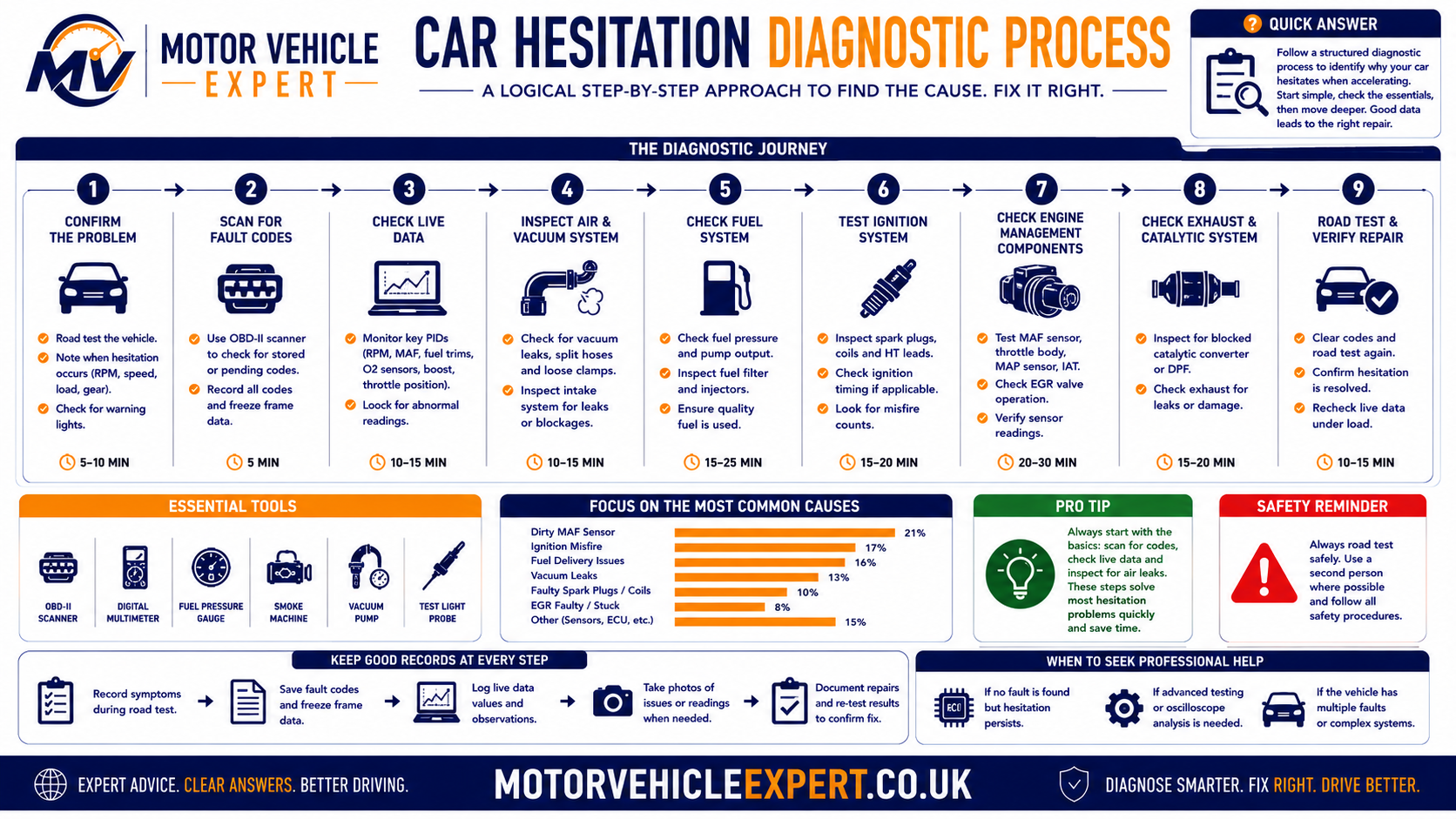
The most reliable diagnosis combines the driver's description with evidence captured during the fault. Stored codes provide direction, live data shows what the control unit sees and commands, while pressure, smoke, ignition and mechanical tests prove whether the connected system can respond correctly.
Confirm the complaint
Ask when the hesitation occurs, reproduce it safely and separate a brief delay from jerking, clutch slip, drivetrain vibration and continuous power loss.
Complete a visual inspection
Inspect intake hoses, boost pipes, wiring, earth connections, fluid levels, obvious leaks, damaged connectors and signs of recent repair work.
Scan all relevant control modules
Record stored, pending and historic codes before clearing anything. Review freeze-frame conditions and note whether other modules report related voltage, communication or torque faults.
Check baseline live data
Compare temperature, airflow, manifold pressure, throttle position, fuel correction, rail pressure and battery voltage with expected values before the road test begins.
Record data during the fault
Monitor the systems most likely to be involved and identify which value changes first when the engine hesitates.
Perform targeted physical tests
Use ignition testing, fuel-pressure measurement, injector comparison, smoke testing, boost-pressure testing, exhaust backpressure or compression testing as the evidence requires.
Prove the failed component or circuit
Confirm power supply, earth, signal integrity, mechanical movement and output capacity before authorising replacement.
Verify the completed repair
Repeat the original operating condition, confirm normal data and check that the hesitation, associated codes and secondary symptoms have been eliminated.
| Diagnostic stage | What should be checked | Evidence produced | Why it matters |
|---|---|---|---|
| Complaint verification | Exact speed, load, temperature and sensation | Repeatable symptom pattern | Prevents testing the wrong system |
| Fault-code review | Stored, pending and freeze-frame information | Direction and original failure conditions | Preserves evidence before codes are cleared |
| Live-data analysis | Inputs, commands and measured outputs | Which system deviates during hesitation | Narrows the physical tests required |
| Physical testing | Pressure, ignition, leakage and mechanical condition | Proof of system capability | Separates a reporting fault from a real mechanical fault |
| Repair verification | Original road-test condition and post-repair data | Confirmed fault elimination | Prevents an unverified vehicle handover |
A complete diagnosis confirms what the engine control unit received, what it commanded and whether the controlled system carried out that command. For example, if requested fuel pressure rises but actual pressure falls, the fault lies in fuel delivery or pressure control, not merely in the accelerator request.
Fault codes, pending codes and freeze-frame data may contain the only record of the temperature, engine speed, load and pressure present when the hesitation occurred. This information should be documented before codes are erased or the battery is disconnected.
What warning lights and diagnostic codes can reveal
An engine management light may accompany acceleration hesitation when the control unit detects misfire, incorrect mixture, implausible airflow, throttle disagreement, fuel-pressure deviation or turbo-boost control outside its expected range.
Codes are useful evidence, but they describe the condition detected by the control unit rather than automatically identifying the failed part. A lean-mixture code can result from low fuel pressure or an intake leak, while an underboost code can be caused by a split hose, actuator fault, exhaust restriction or turbocharger problem.
P0300–P0308
These codes indicate random, multiple or cylinder-specific combustion irregularity.
Possible causesSpark plugs, coils, injectors, intake leakage, wiring or compression.
P0171 / P0174
The control unit has added fuel because the measured mixture appears lean.
Possible causesIntake leak, low fuel pressure, restricted injector or inaccurate airflow measurement.
P0100–P0104
These codes relate to mass-airflow circuit performance or signal integrity.
Possible causesSensor fault, wiring, intake leakage, air restriction or implausible engine airflow.
P0120–P2138
These codes can involve accelerator position, throttle position or disagreement between duplicated safety signals.
Possible causesThrottle body, pedal sensor, wiring, reference voltage or control module.
P0299 / P0234
These indicate that actual boost is lower or higher than the control unit expected.
Possible causesBoost leak, actuator fault, sticking vanes, control solenoid, sensor or turbo condition.
P0087 / P0191
These relate to low fuel-rail pressure or pressure-sensor range and performance.
Possible causesPump weakness, restriction, regulator, injector leak-off, wiring or sensor fault.
A steady engine management light usually indicates a stored emissions or control fault requiring diagnosis. A flashing light commonly indicates severe active misfire and a greater risk of catalytic-converter damage. Reduce load immediately and avoid continued hard acceleration.
Stored code
The control unit has confirmed that the fault met its threshold. The condition may be active now or may have occurred previously.
Pending code
A fault has been detected but may not yet have repeated enough times to illuminate the warning light.
Historic code
The fault occurred in the past and may no longer be active. Context is needed before treating it as the current cause.
No stored code
The fault may be intermittent, mechanical, below the detection threshold or represented by values that appear plausible to the control unit.
Engine speed, load, coolant temperature, vehicle speed, fuel trim and pressure recorded when the code set can reveal whether the fault occurred at idle, during overtaking, when cold or at full operating temperature.
Safe checks a driver can make before booking diagnosis
A driver should not dismantle high-pressure fuel, ignition or turbo systems, but several basic checks can help identify obvious causes and provide the garage with a better description of the fault.
Inspect warning lights
Note whether the engine management light is steady or flashing and whether any additional warning messages appear.
Look for loose hoses
With the engine off and cool, inspect visible intake and boost hoses for loose clips, splits, collapse or oily leakage around joints.
Review recent refuelling
Consider whether the fault began immediately after filling the tank or using an unfamiliar fuel station.
Listen for new noises
Hissing may indicate boost leakage, while popping, uneven exhaust pulses or sharp misfire noises suggest combustion interruption.
Watch for smoke
Black, blue or white smoke provides important evidence about airflow, fuelling, oil entry and combustion quality.
Record the fault pattern
Write down engine temperature, approximate rpm, gear, road speed, throttle demand and whether switching the engine off changes the symptom.
Useful information to give the garage
- ✓Whether the engine was cold or hot
- ✓Whether the fault appeared uphill or on level ground
- ✓The approximate engine speed and gear
- ✓Any warning lights, smoke, smells or noises
- ✓Whether the symptom clears after restarting
- ✓Any recent servicing, repairs or refuelling
Checks to leave to a technician
- ✓High-pressure fuel testing
- ✓Ignition output testing
- ✓Injector electrical or leak-off testing
- ✓Boost-pressure and smoke testing
- ✓Compression and cylinder-leakage testing
- ✓Live-data logging during a controlled road test
If the vehicle loses power suddenly, jerks violently, produces heavy smoke or displays a flashing engine light, further high-load testing should be left to a technician using a safe route and suitable diagnostic equipment.
Can you keep driving when the car hesitates under acceleration?
Whether the vehicle can be driven safely depends on how severe the hesitation is, whether warning lights are present and whether the engine still responds predictably when power is requested.
Mild hesitation without smoke, overheating or warning lights may allow a careful journey to a garage. Sudden loss of power, violent jerking, heavy smoke or a flashing engine management light should be treated much more seriously because the vehicle may become unsafe during overtaking, joining traffic or climbing a hill.
Mild and predictable hesitation
The hesitation is brief, the engine remains smooth, no warning lights are flashing and the vehicle can maintain a safe speed without heavy throttle.
Recommended actionArrange diagnosis soon and avoid unnecessary high-load driving until the cause is confirmed.
Noticeable hesitation or limp mode
Acceleration is unreliable, the engine management light is on or the vehicle enters reduced-power mode during normal driving.
Recommended actionAvoid motorways, overtaking and steep routes. Drive only if the vehicle remains controllable and the journey is essential.
Severe jerking or sudden power loss
The vehicle cannot accelerate predictably, produces heavy smoke, overheats, makes abnormal mechanical noises or displays a flashing engine warning light.
Recommended actionStop in a safe location, switch off the engine where appropriate and arrange professional assistance or recovery.
Warning signs that justify recovery
- ✓ Flashing engine management light
- ✓ Violent or continuous engine misfire
- ✓ Sudden loss of power in traffic
- ✓ Heavy black, blue or white smoke
- ✓ Strong fuel smell or visible fuel leak
- ✓ Overheating or coolant-temperature warning
- ✓ Loud knocking, rattling or turbocharger noise
- ✓ Vehicle unable to maintain a safe road speed
How to minimise risk on the way to a garage
- ✓ Use light throttle and avoid full-load acceleration
- ✓ Leave a larger gap before joining or crossing traffic
- ✓ Avoid overtaking unless absolutely necessary
- ✓ Select a route with fewer hills and high-speed roads
- ✓ Stop if the symptom becomes worse
- ✓ Do not repeatedly test the fault using full throttle
- ✓ Monitor warning lights and engine temperature
- ✓ Keep breakdown assistance details available
A car that hesitates severely may not produce enough power when joining a roundabout, crossing a junction or overtaking. Even when the engine continues to run, unpredictable acceleration can make the vehicle unsafe to use in demanding traffic conditions.
Active misfire can overheat the catalytic converter, low fuel pressure can place additional strain on pumps, and boost faults may allow excessive smoke, oil contamination or turbocharger damage. Early diagnosis is usually less expensive than waiting for the original fault to damage another system.
How much does it cost to repair acceleration hesitation in the UK?
The cost depends on the fault found rather than the hesitation symptom itself. A loose hose or worn spark plug may be inexpensive to correct, while injector, high-pressure fuel, turbocharger or mechanical engine faults can cost considerably more.
The prices below are broad UK planning figures for typical passenger vehicles. Labour rates, engine access, parts quality, vehicle age and regional pricing can all affect the final quotation.
Garage diagnostic assessment
Fault-code scan, visual checks, road testing and basic live-data assessment.
£60–£150Spark-plug replacement
Replacement cost varies with plug type, quantity and engine access.
£80–£250Ignition-coil replacement
Cost may apply to one failed coil or a complete set where several units are aged.
£90–£450MAF or MAP sensor replacement
Includes diagnosis, replacement and basic verification where the sensor is proven faulty.
£120–£400Vacuum or boost-hose repair
A simple split hose may be inexpensive, while moulded charge pipes and intercooler connections can cost more.
£80–£500Throttle-body service or replacement
Cleaning may be suitable for contamination; actuator or position faults may require full replacement and adaptation.
£100–£750Fuel-pump or pressure-control repair
Costs vary greatly between low-pressure tank pumps and high-pressure direct-injection or diesel systems.
£250–£1,500+Injector replacement
Petrol injectors are generally less expensive than common-rail diesel injectors, especially where coding is required.
£180–£650 eachTurbocharger replacement
The total may include the turbocharger, oil feed components, gaskets, labour, cleaning and investigation of the original cause.
£800–£2,500+| Possible repair | Typical UK cost | Usually needed when | Cost-saving diagnostic step |
|---|---|---|---|
| Diagnostic assessment | £60–£150 | The cause has not yet been confirmed | Provide an accurate description of the fault pattern |
| Spark plugs | £80–£250 | Plugs are worn, fouled or outside specification | Inspect condition and verify the correct plug type |
| Ignition coil | £90–£450 | A coil fails output testing or the misfire follows it | Confirm the cylinder fault before replacing several coils |
| Airflow sensor | £120–£400 | Signal testing proves inaccurate or unstable output | Compare live data before fitting a sensor |
| Boost-hose or intercooler repair | £80–£700 | The charge-air system fails a pressure test | Inspect hoses before authorising turbo replacement |
| Fuel-system repair | £250–£1,500+ | Pressure or flow falls outside specification | Test the low-pressure and high-pressure sides separately |
| Injector replacement | £180–£650 each | Delivery, correction or leak-off testing confirms failure | Do not replace all injectors from one fault code |
| Turbocharger replacement | £800–£2,500+ | Internal turbo damage is physically confirmed | Rule out hoses, actuators, sensors and exhaust restriction |
| Compression or timing repair | £700–£4,000+ | Mechanical testing identifies internal engine damage | Confirm mechanical condition before extensive dismantling |
What usually reduces the repair bill
- ✓ Diagnosing the vehicle before replacing parts
- ✓ Providing the garage with a repeatable fault pattern
- ✓ Repairing intake or boost leaks early
- ✓ Keeping spark plugs and filters within service intervals
- ✓ Stopping before a misfire damages the catalytic converter
- ✓ Checking wiring and connections before control units
What commonly increases the repair bill
- ✓ Continuing to drive with severe misfire
- ✓ Replacing sensors from fault-code descriptions alone
- ✓ Ignoring fuel contamination
- ✓ Fitting a turbo without finding the cause of failure
- ✓ Allowing DPF or catalytic-converter restriction to worsen
- ✓ Approving several parts without test evidence
A professional quotation should explain what was tested, what failed and how the recommended repair addresses the measured fault. This is especially important where expensive components such as injectors, high-pressure pumps, throttle bodies or turbochargers are involved.
Vehicle design, engine size, parts availability, labour time and regional garage rates can move the final cost outside these ranges. Accurate pricing requires the registration, engine specification and a confirmed diagnosis.
Can acceleration hesitation cause an MOT failure?
Acceleration hesitation is not tested as a standalone MOT item. However, the fault causing the hesitation may lead to an MOT failure if it affects emissions, warning lights, exhaust smoke, engine condition or the vehicle's ability to complete the test safely.
A mild hesitation with no engine warning light and compliant emissions may not prevent the vehicle passing. A severe active misfire, excessive smoke, emissions-system warning or engine malfunction indicator fault can produce a different result.
Hesitation alone
The MOT does not include a road test designed to measure throttle response or diagnose intermittent acceleration faults.
Engine warning light
The malfunction indicator lamp can affect the MOT result where it indicates a relevant engine or emissions-control fault.
Excessive exhaust emissions
Misfire, incorrect fuelling, EGR faults, catalytic-converter damage and DPF problems may cause emissions to exceed the permitted limit.
Excessive smoke
Heavy or persistent visible smoke may indicate poor combustion, turbo failure, oil burning or an emissions-system fault.
Intermittent hesitation
A fault that appears only uphill, at motorway speed or after an extended journey may not occur during the stationary MOT test.
Vehicle cannot be tested normally
Severe engine malfunction may prevent the tester completing required checks safely or operating the engine as required.
| Condition | Likely MOT relevance | Why | Recommended action |
|---|---|---|---|
| Mild hesitation with no warning lights | May still pass | Hesitation is not directly assessed | Diagnose because the fault may worsen |
| Steady engine management light | Potential failure | May indicate an emissions-control malfunction | Scan and repair before the MOT |
| Flashing engine management light | Serious fault | Often indicates active severe misfire | Avoid driving and arrange diagnosis |
| Excessive smoke | Potential failure | Smoke may exceed test limits or indicate malfunction | Repair the cause before testing |
| Damaged catalytic converter or DPF | Potential failure | Emissions control may be ineffective or visibly defective | Complete proper emissions-system repair |
| Fault occurs only on the road | May not be detected | The MOT is not a full diagnostic road test | Do not rely on an MOT pass as diagnosis |
The MOT checks minimum legal standards at the time of the test. It does not confirm fuel pressure, ignition strength, turbo response, injector balance or intermittent live-data faults under normal road load.
Misfire can raise hydrocarbon emissions and overheat the catalytic converter. Repeatedly revving a badly misfiring engine during testing may worsen damage that was initially limited to the ignition or fuel system.
Should you buy a used car that hesitates when accelerating?
A used car that hesitates should not be treated as having a minor service issue until the fault has been diagnosed. The cause could be a relatively inexpensive spark plug, hose or sensor problem, but the same symptom may also be caused by injectors, fuel pressure, turbo control, exhaust restriction or internal engine wear.
The safest approach is to make the purchase conditional on an independent inspection and written diagnostic evidence. A seller's statement that the vehicle “only needs a sensor” is not proof unless testing identifies the sensor and confirms that the connected system is capable of operating correctly.
Minor proven fault
The cause has been diagnosed, the repair is documented and the vehicle performs normally during an extended test drive.
Buying approachConfirm the repair invoice, warranty and post-repair road test.
Intermittent hesitation
The vehicle hesitates only when hot, uphill or under sustained load, and no conclusive diagnosis is available.
Buying approachArrange independent live-data testing before agreeing a price.
Severe or concealed fault
The car jerks, smokes, enters limp mode, displays warning lights or has recently had codes cleared without supporting repair records.
Buying approachWalk away unless the seller completes and documents a proper repair.
Checks before the engine is started
- ✓ Ask the seller not to warm the engine before arrival
- ✓ Confirm the engine is genuinely cold
- ✓ Check oil and coolant condition
- ✓ Inspect intake and boost hoses
- ✓ Look for recent disconnected-battery evidence
- ✓ Check for fuel, oil or coolant leakage
- ✓ Listen for unusual pump or actuator noises
Acceleration checks during the test drive
- ✓ Test light throttle from low speed
- ✓ Accelerate progressively through several gears
- ✓ Check performance when fully warm
- ✓ Use an uphill section where safe
- ✓ Watch for smoke during acceleration
- ✓ Check whether limp mode appears
- ✓ Listen for hissing, misfire or turbo noise
Look for maintenance evidence
Check spark-plug, fuel-filter, air-filter and engine-oil records, together with any injector, turbo, EGR or emissions-system work.
Ask for previous fault reports
Repeated replacement of coils, sensors or injectors without a confirmed repair may indicate unresolved diagnosis.
Check codes and readiness status
Recently cleared codes or incomplete emissions monitors can suggest that the battery was disconnected or faults were erased before the sale.
Inspect the charge-air system
Look for split hoses, oily joints, intercooler damage, smoke and delayed or inconsistent boost delivery.
Check EGR and DPF evidence
Frequent regeneration, warning lights, short-trip use and repeated DPF cleaning may point towards an unresolved underlying fault.
Be cautious of vague explanations
Statements such as “it just needs a service” or “the sensor is only cheap” should be supported by a written diagnosis and quotation.
| Used-car finding | Buying risk | What it may indicate | Recommended decision |
|---|---|---|---|
| Clean road test with documented completed repair | Lower | The fault may have been properly resolved | Verify independently before purchase |
| Hesitation only after full warm-up | Medium to high | Heat-sensitive electrical, fuel or turbo fault | Require hot-condition diagnosis |
| Warning light recently cleared | High | The seller may have erased active evidence | Delay purchase and rescan after driving |
| Black smoke and low boost | High | Boost leak, EGR fault, turbo or airflow problem | Obtain a written repair estimate |
| Severe misfire under acceleration | High | Ignition, injection or mechanical cylinder fault | Do not buy without completed repair |
| Seller refuses independent inspection | Very high | Repair risk cannot be established | Walk away |
Negotiating the cost of one ignition coil is not enough when the same hesitation could be caused by an injector, turbocharger, fuel pump, blocked exhaust or low compression. Base the purchase decision on confirmed evidence, not the lowest possible repair.
Where the seller agrees to repair the fault, request the garage report and invoice, then repeat the cold start and full warm road test before completing the purchase.
Continue diagnosing acceleration and engine-performance faults
Acceleration hesitation can overlap with general power loss, engine management faults, turbo-control problems and vehicle judder. The guides below explain those related symptoms and diagnostic systems in more detail.
Use the judder guide where the vehicle shakes or vibrates, the fault code guides where diagnostic codes are present, and the turbo guides where boost, smoke or limp mode is the main concern.
Car hesitation when accelerating: common questions
Why does my car hesitate when I press the accelerator?
Hesitation occurs when the engine cannot increase torque smoothly after the accelerator is pressed. Common causes include weak ignition, low fuel pressure, inaccurate airflow data, intake leakage, throttle faults, turbo boost problems, EGR faults and exhaust restriction.
The symptom alone cannot identify the failed part. The operating condition, fault codes, live data and physical tests must be considered together.
Why does my car hesitate only when accelerating hard?
Hard acceleration increases cylinder pressure, fuel demand, airflow and turbo demand. Marginal spark plugs, weak ignition coils, restricted fuel delivery, split boost hoses and exhaust restrictions may therefore appear only under heavy load.
Pressure, boost and misfire data should be recorded while the fault is occurring rather than relying only on idle checks.
Can bad spark plugs cause acceleration hesitation?
Yes. Worn or incorrectly gapped spark plugs require more ignition voltage, especially when cylinder pressure rises under load. They may appear acceptable at idle but misfire during overtaking, hill climbing or high-gear acceleration.
Plug condition, gap and specification should be checked before replacing ignition coils without evidence.
Can a fuel filter make a car hesitate?
A severely restricted fuel filter can reduce fuel flow as engine demand increases. The vehicle may idle normally but become flat, surge or hesitate at higher engine speed and load.
Fuel pressure and flow should be tested during the fault because a normal idle reading does not prove that the system can meet acceleration demand.
Can a dirty throttle body cause a flat spot?
Carbon around the throttle plate can disturb low-angle airflow and contribute to delayed low-speed response or unstable idle. Electronic actuator, position-sensor and adaptation faults can produce similar symptoms.
Cleaning should be performed only when contamination is relevant, and some vehicles require a throttle relearn after the work.
Why does my diesel hesitate at low rpm?
Common diesel causes include EGR valves remaining open, intake contamination, delayed turbo response, variable-vane control faults, low rail pressure and injector imbalance.
The technician should compare airflow, requested and actual boost, EGR position and rail pressure during low-speed acceleration.
Is turbo lag the same as hesitation?
No. Normal turbo lag is a brief and predictable delay while the turbocharger builds pressure. Fault-related hesitation is usually more pronounced or inconsistent and may be accompanied by smoke, hissing, surging, warning lights or limp mode.
Requested and actual boost should be compared before deciding whether the behaviour is normal.
Can a car hesitate without storing fault codes?
Yes. The fault may be intermittent, mechanical, below the control unit's detection threshold or represented by values that remain electrically plausible even though they are inaccurate.
Intake leaks, marginal fuel pressure, exhaust restriction, mechanical compression faults and heat-sensitive components can all exist without a clear stored code.
Why does the hesitation disappear after restarting?
Restarting may reset temporary torque restriction or limp mode, but it does not repair the cause. Boost deviation, throttle disagreement, fuel-pressure faults and certain sensor errors may return as soon as the original operating condition is repeated.
Codes and freeze-frame information should be recorded before they are cleared.
Is it safe to drive with a flashing engine light?
A flashing engine management light commonly indicates active severe misfire. Continued driving can overheat and damage the catalytic converter and may cause unpredictable acceleration.
Reduce load immediately, stop safely and arrange diagnosis or recovery where the misfire is severe.
Can hesitation cause an MOT failure?
Hesitation is not a standalone MOT test item, but the underlying fault may cause failure through an engine warning light, excessive emissions, heavy smoke or defective emissions-control equipment.
An MOT pass does not prove that an intermittent road-load fault has been resolved.
Should I buy a used car that hesitates?
Only after the cause has been professionally diagnosed and the repair has been completed and verified. The symptom may come from a low-cost service item, but it can also indicate injectors, high-pressure fuel equipment, turbo failure, exhaust restriction or mechanical engine damage.
Make the purchase conditional on an independent inspection, written diagnosis and successful cold and fully warm test drives.