
Quick answer
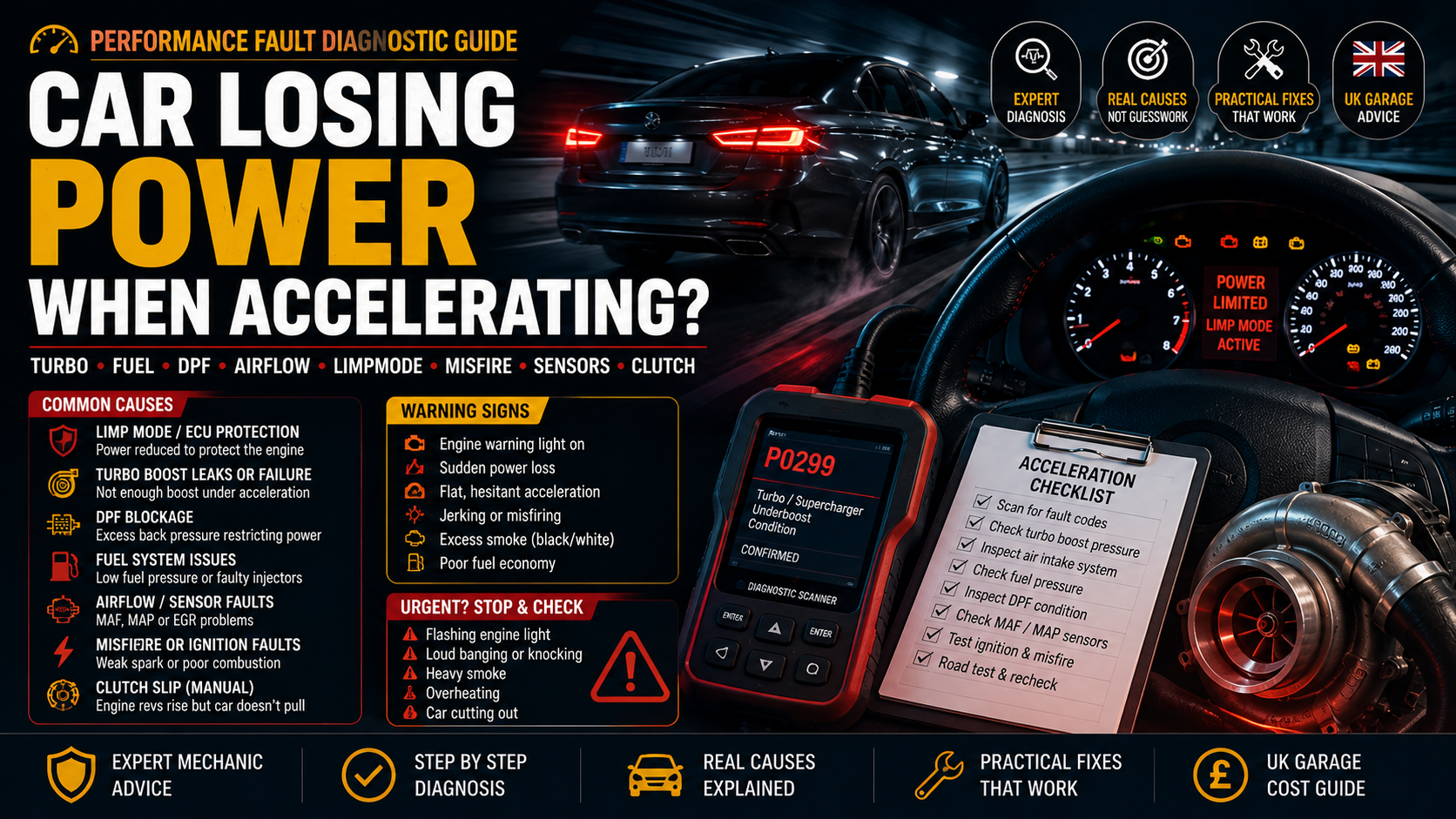
A car losing power when accelerating is usually caused by restricted fuel or air, turbo and boost problems, engine sensor faults, DPF or emissions issues, misfires, limp mode, blocked filters, EGR faults or clutch slip.
The clue is how it happens. A car that revs but does not pick up speed may have clutch slip. A diesel that feels choked may have DPF or EGR trouble. A turbo car that suddenly feels flat may have boost control or boost leak problems. If warning lights appear, smoke comes out, the car shakes or power loss is severe, arrange diagnosis quickly.
Match your symptom
Drivers describe power loss in different ways. Pick the closest match and follow the likely fault area.
Car feels flat
Often airflow, MAF/MAP sensor, EGR, DPF, fuel delivery or turbo-related.
Slow acceleration guide →No power uphill
Load exposes weak fuel supply, boost faults, clutch slip or DPF restriction.
Uphill power loss guide →Jerks or hesitates
Can suggest misfire, fuel pressure, throttle, sensor or ignition problems.
Hesitation guide →Revs rise but speed does not
That often points towards clutch slip rather than engine power loss.
Clutch wear signs →Engine warning light on
The car may be limiting power because a fault has been detected.
Engine light guide →Diesel feels blocked
DPF, EGR, turbo, fuel filter or airflow faults are common suspects.
DPF warning guide →Power drops suddenly
Often limp mode, turbo boost control, sensor fault or engine protection strategy.
Can you drive with EML? →Power loss with smoke
Smoke colour helps separate oil, fuel, coolant, turbo and DPF faults.
Smoke colour guide →Power loss after service
Check airbox, fuel filter, loose plugs, boost hoses and anything recently disturbed.
Sluggish after service →Common reasons a car loses power
Engine management fault
The car may reduce power to protect the engine, turbo, gearbox or emissions system.
Engine light guide →Fuel delivery issue
Weak fuel pump, blocked fuel filter or injector problems can cause poor acceleration.
Airflow sensor fault
MAF or MAP sensor issues can upset fuelling, boost and throttle response.
Turbo boost leak
Split hoses or boost leaks can make turbo cars feel very flat, especially under load.
DPF restriction
Diesel cars may lose power when the DPF or emissions system has a fault.
DPF guide →Engine misfire
Misfires can cause shaking, hesitation, flashing engine light and weak acceleration.
Misfire guide →Clutch slip
If revs rise but speed does not, the clutch may be slipping.
Clutch signs →EGR valve fault
A sticking EGR valve can cause flat performance, smoke, rough running or limp mode.
Blocked air filter
Restricted airflow can reduce performance, especially under load.
Servicing guide →Is the car in limp mode?
Limp mode is a reduced-power state used by many vehicles when the engine management system detects a fault. The car may feel slow, refuse to rev normally, limit speed or only accelerate gently until the issue is fixed.
- ✓Power suddenly drops even though the engine still runs.
- ✓Engine management light, DPF light, glow plug light or EPC light appears.
- ✓The car will not accelerate normally or feels stuck in low power.
- ✓Switching off may temporarily reset it, but the fault often returns.
- ✓Hard acceleration, hills or motorway driving can trigger it again.
If limp mode keeps returning, do not just clear the light. The stored fault codes and live data need checking.
Diesel car losing power
Diesel power loss is often linked to airflow, boost, fuel pressure or emissions systems. Short trips can make DPF problems more likely because the car may not complete regeneration properly.
DPF restriction
Can make the car feel choked, especially with warning lights or limp mode.
DPF guide →EGR valve fault
Can cause rough running, smoke, hesitation and poor low-speed response.
Fuel filter restriction
A blocked or poorly fitted fuel filter can cause hesitation and weak acceleration.
After fuel filter guide →Injector fault
A weak or leaking injector can cause smoke, knocking, rough running and power loss.
Turbo control fault
Diesel turbo faults can cause underboost, overboost, limp mode and poor uphill power.
Glow plug warning flashing
On some diesels, a flashing glow plug light can indicate engine management or emissions faults.
Turbo not kicking in or car feels flat
If a turbocharged car suddenly feels like it has no boost, the issue may be a split boost hose, intercooler leak, turbo actuator fault, boost pressure sensor fault, vacuum control issue or engine management protection.
- ✓Hissing under acceleration can suggest a boost leak.
- ✓Whistling may be normal on some cars, but a new loud whistle needs checking.
- ✓Black smoke on a diesel can suggest air, boost or fuelling imbalance.
- ✓Power loss after hard acceleration may point to overboost, underboost or limp mode.
- ✓Oil around boost pipes can suggest leaks or worn components.
A proper boost pressure check is usually better than guessing at sensors.
Power loss or clutch slip?
Not all “loss of power” is engine-related. If the engine revs climb but the car does not accelerate in proportion, the clutch may be slipping. This is common under load, uphill or in higher gears.
More likely engine power loss
The engine feels flat, struggles to rev, warning lights appear, smoke appears or the car goes into limp mode.
More likely clutch slip
Revs rise quickly, speed does not match, there may be a burning clutch smell, and it is worse uphill or in higher gears.
Useful guides: clutch wear signs and clutch replacement cost UK.
When does the power loss happen?
Only uphill
Fuel delivery, turbo boost, DPF restriction or clutch slip may be more noticeable under load.
Uphill power loss →Only when hot
Heat-related sensors, ignition faults, fuel pressure issues or turbo control faults can appear later.
At motorway speed
DPF, turbo, airflow, fuel restriction or limp-mode faults may show up at sustained load.
With smoke
Smoke colour matters. Black, blue and white smoke point to different problems.
Smoke colour guide →After a service or repair
Check anything recently disturbed, such as airbox, fuel filter, boost pipes, sensors or battery connections.
After service guide →Only when cold
Cold-running sensor, fuel, ignition or glow plug-related issues may be more likely.
Sluggish when cold →Signs the problem may be urgent
- !Flashing engine management light.
- !Heavy shaking, misfire or rough running.
- !Smoke from the exhaust, especially heavy smoke under acceleration.
- !Overheating, coolant loss or burning smells.
- !Very poor acceleration creating safety concerns at junctions or roundabouts.
- !The car cuts out or will not restart.
- !Oil warning, coolant warning or battery warning appears at the same time.
If the car feels unsafe, stop somewhere safe and arrange recovery or inspection. Do not keep forcing hard acceleration through a fault.
What to check next
1. Check warning lights
Fault codes often point to the right system first, but they still need proper interpretation.
2. Notice the pattern
Uphill, hot, cold, motorway or full-throttle symptoms matter.
3. Listen for turbo noises
Hissing, new whistling or whooshing can suggest boost leaks or air leaks.
4. Watch for smoke
Smoke colour and timing can help identify fuel, oil, coolant, turbo or DPF issues.
5. Check service history
Old filters, overdue servicing, wrong oil or neglected maintenance can contribute.
6. Avoid guessing parts
Live data, boost readings, fuel pressure checks and smoke tests often save money.
How garages diagnose power loss
A scan is a starting point, not the whole job. A good diagnosis checks whether the engine is actually short of air, fuel, boost, spark, compression or whether the gearbox/clutch is the real issue.
Fault code scan
Checks for engine management, boost, DPF, EGR, misfire, sensor and fuel system codes.
Live data checks
Airflow, boost pressure, fuel pressure, throttle position and DPF data can show what is happening.
Boost leak test
Helps find split hoses, intercooler leaks, loose clamps and pressure loss.
Fuel delivery checks
A blocked filter, weak pump or injector problem can show up under acceleration.
Smoke and emissions checks
Smoke colour, DPF data and exhaust restriction help narrow diesel and emissions faults.
Clutch road test
Confirms whether rising revs without matching road speed is clutch slip.
Common mistakes drivers make
- !Assuming every power loss is the turbo.
- !Clearing fault codes without fixing the cause.
- !Ignoring DPF warnings and continuing only short journeys.
- !Replacing sensors without checking wiring, hoses, leaks or live data.
- !Confusing clutch slip with engine power loss.
- !Driving hard while the car is in limp mode.
Possible repair costs
Service items
Air filter, fuel filter, spark plugs or basic servicing may be lower cost if overdue maintenance is the cause.
Servicing guide →Sensor or air leak
MAF, MAP, boost leaks, vacuum leaks and wiring faults need diagnosis before parts are replaced.
Misfire repair
Spark plugs or coils can be moderate cost, but injector or compression faults can cost more.
Misfire guide →DPF or EGR fault
Costs vary widely depending on whether cleaning, sensors, EGR repair or replacement is needed.
DPF guide →Turbo fault
A hose leak may be much cheaper than a turbo replacement, so diagnosis is important.
Clutch slip
Clutch replacement can be expensive because gearbox removal is usually required.
Clutch cost guide →Best mechanic-style advice
Do not diagnose power loss from one guess. A flat diesel, a slipping clutch, a boost leak and a misfire can all feel like “no power”, but they are different faults with different repair costs.
Start with the pattern: does it happen uphill, when hot, at motorway speed, after a service, with smoke, or with warning lights? Then check the evidence with fault codes, live data, boost pressure, fuel pressure and a road test. That is how you avoid throwing money at the wrong part.
Related diagnostics guides
Frequently asked questions
Why does my car lose power when accelerating?
Common causes include fuel restriction, turbo faults, sensor problems, misfires, DPF issues, EGR faults, blocked filters, limp mode or clutch slip.
Can a blocked DPF cause power loss?
Yes. Diesel vehicles can lose power when the DPF or emissions system is restricted or has a fault.
Can clutch slip feel like power loss?
Yes. If engine revs rise but road speed does not, the clutch may be slipping rather than the engine being weak.
Can bad spark plugs cause poor acceleration?
Yes. Ignition faults can cause misfires, hesitation, shaking and weak acceleration.
Is limp mode serious?
It means the car has detected a fault and reduced power. It should be diagnosed soon, especially if it keeps returning.
Should I keep driving?
Avoid hard driving. Stop if the car feels unsafe, overheats, smokes, shakes badly, cuts out or shows a flashing warning light.
Why does my car lose power uphill?
Hills put the engine under load, so weak fuel supply, turbo boost faults, clutch slip, DPF restriction or misfires become more obvious.
Why does my turbo car suddenly feel slow?
Possible causes include boost leaks, actuator faults, boost pressure sensor problems, vacuum control issues or limp mode.
Can a dirty air filter cause power loss?
Yes. A blocked air filter restricts airflow, which can make the engine feel flat, especially under acceleration.
Can a fuel filter cause poor acceleration?
Yes. A restricted fuel filter can limit fuel supply, especially under load, uphill or at higher speeds.