MOT Inspection Hub

Does MOT Check? Complete UK MOT Inspection Checklist Explained

Many UK drivers ask whether an MOT checks wheel alignment, tracking, wheel balancing, clutch wear, service history, engine oil, air conditioning, gearbox condition or general vehicle reliability.

An MOT is a roadworthiness and safety inspection. It checks many important legal and safety items, but it is not the same as a full mechanical inspection, diagnostic scan or service.

This complete guide explains what an MOT checks, what it does not check, common myths, failure risks, advisory risks and how to prepare your vehicle before the test.

βœ“ UK MOT checklist βœ“ What is not checked βœ“ Failure risks βœ“ Driver questions answered
Quick answer

What does an MOT check?

An MOT checks whether your vehicle meets minimum UK road safety and environmental standards at the time of the test. The tester inspects key safety areas such as brakes, tyres, steering, suspension, lights, seatbelts, mirrors, registration plates, windscreen condition, wipers, washers, vehicle structure, exhaust condition and emissions.

The MOT is not designed to confirm that the car is mechanically perfect. A car can pass an MOT while still needing servicing, clutch work, gearbox repairs, wheel alignment, air conditioning repairs or future maintenance.

A good way to understand the MOT is this: it checks legal roadworthiness, not full vehicle health.

Best answer

What does an MOT not check?

An MOT does not normally check wheel alignment measurements, wheel balancing, clutch wear, service history, engine oil quality, gearbox condition, air conditioning performance, fuel economy, future reliability or whether the car has been properly serviced.

However, some of these things can still matter indirectly. For example, bad alignment is not measured, but illegal tyre wear caused by bad alignment can fail. Engine oil quality is not checked, but a serious oil leak can fail. Clutch wear is not measured, but a fault affecting safe control may be noticed.

MOT checklist

What Does An MOT Check?

The MOT test covers many safety and environmental areas. These are the main categories a UK MOT tester will inspect.

Brakes

Brake system

The MOT checks braking performance, brake balance, parking brake operation, brake pipes, hoses, fluid leaks, discs, pads and visible brake condition.

Brake MOT failures β†’
Tyres

Tyres and wheels

Tyre tread depth, visible damage, bulges, cuts, exposed cords, tyre suitability, wheel security and serious wheel defects can be checked.

Tyre MOT failures β†’
Lights

Exterior lights

Headlights, brake lights, indicators, rear lights, fog lights, number plate lights and beam aim can all affect MOT results.

Light MOT failures β†’
Suspension

Suspension condition

Springs, shock absorbers, arms, bushes, ball joints, anti-roll bar links and suspension mounting points are inspected for wear or damage.

Suspension MOT failures β†’
Steering

Steering system

The MOT checks steering operation, excessive play, track rod ends, steering rack condition, steering column security and related defects.

Steering rack MOT guide β†’
Emissions

Exhaust and emissions

The exhaust system, excessive noise, visible smoke, emissions output and leaks can affect the MOT result.

Emissions MOT guide β†’
Safety

Seatbelts and restraint systems

Seatbelt condition, operation, mountings and some warning lights can be relevant to MOT safety checks.

Seatbelt MOT guide β†’
Visibility

Windscreen, wipers and washers

The MOT checks wiper operation, washer fluid delivery and windscreen damage in important viewing areas.

Windscreen chip MOT guide β†’
Structure

Body and structure

Dangerous corrosion, sharp edges, insecure panels and structural weakness around important areas can fail.

Rust MOT guide β†’
Not checked

What Does An MOT Not Check?

These are some of the most misunderstood areas. They may matter for ownership, safety or repair costs, but they are not directly checked in the way many drivers expect.

Item Directly checked? Important explanation
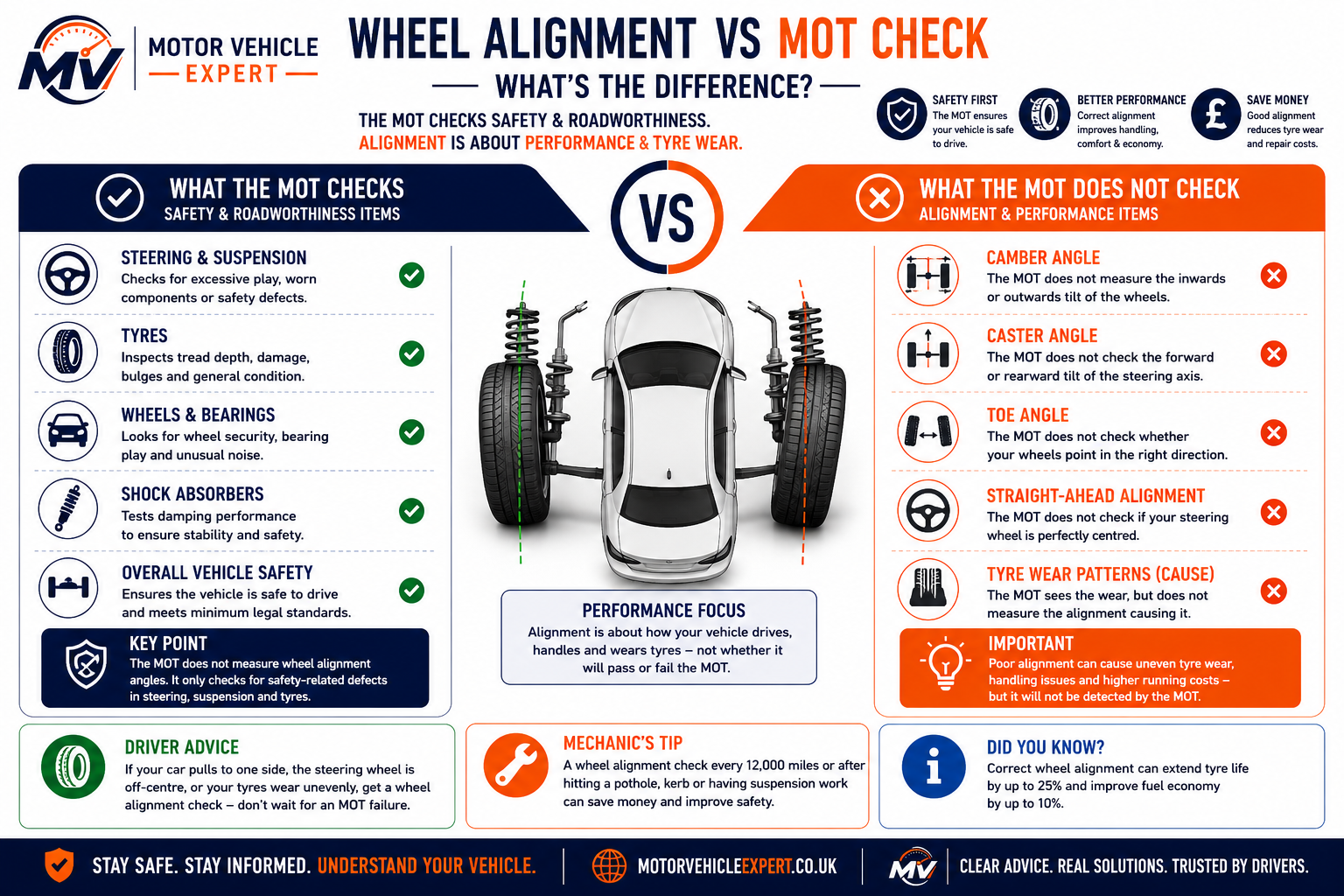
Wheel alignment No The MOT does not measure alignment angles, but tyre wear or steering defects caused by poor alignment can fail.
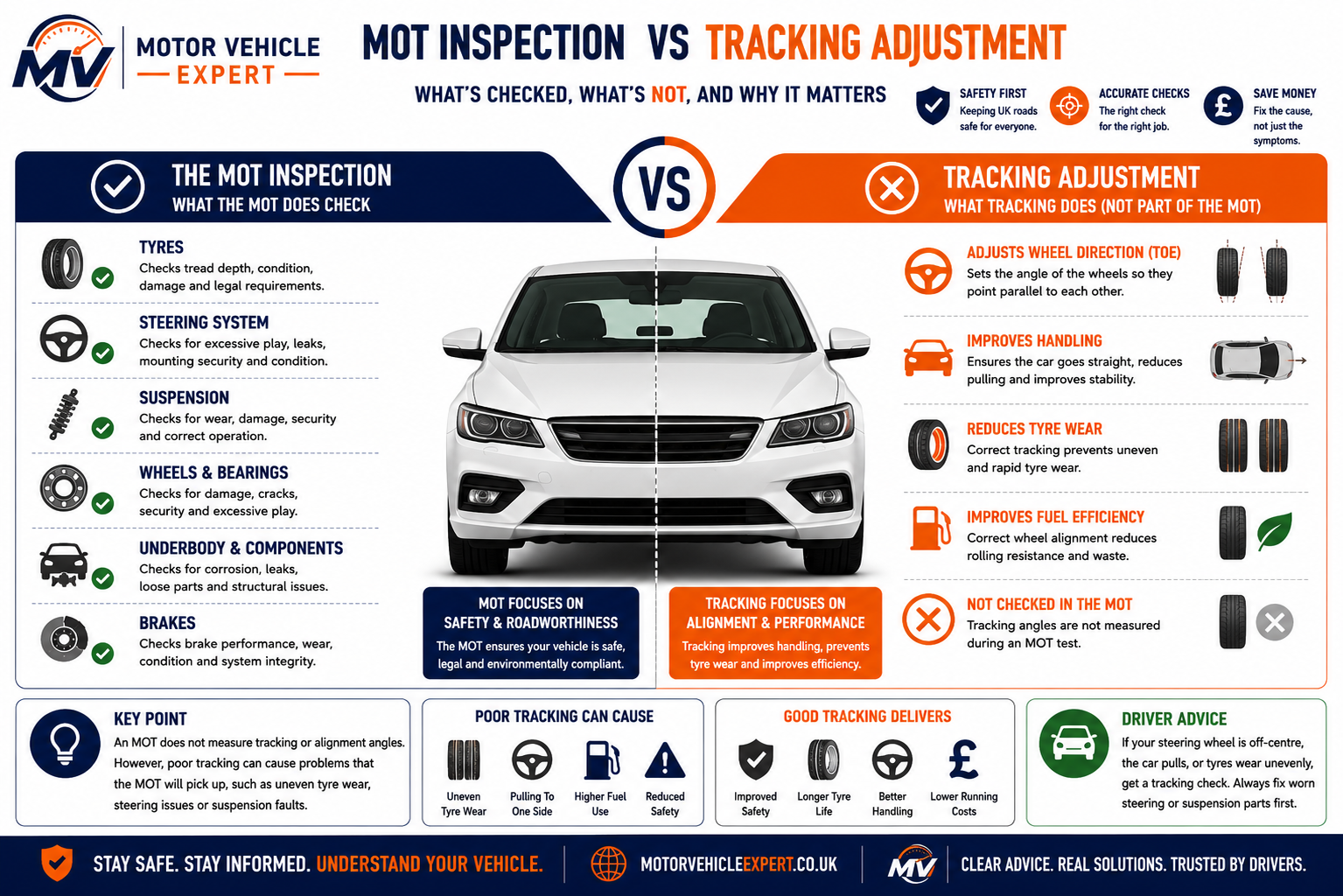
Tracking No Tracking is not measured with alignment equipment during the MOT.
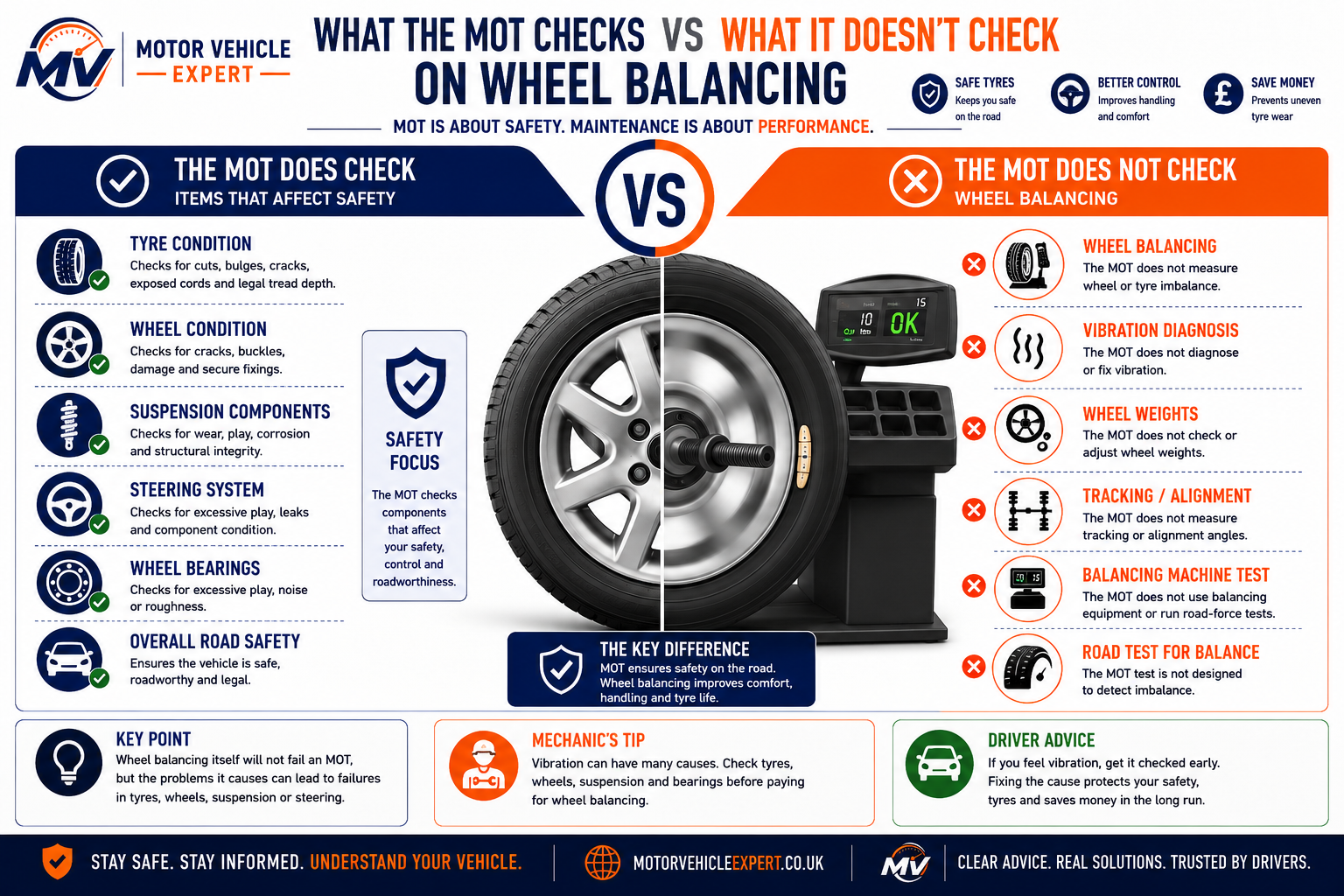
Wheel balancing No The MOT does not use balancing equipment. Vibration may still point to tyre, wheel or suspension problems.
Service history No The tester does not check service stamps, invoices or maintenance records.
Clutch wear No Normal clutch wear is not measured, but serious control issues may be noticed.
Gearbox condition No Internal gearbox wear or future gearbox reliability is not assessed.
Air conditioning Usually no Cold air performance is not normally part of the MOT test.
Engine oil quality No Oil age and service quality are not checked, but serious oil leaks can matter.
Fuel economy No Poor MPG is not tested directly.
Future reliability No A pass does not mean the car will not break down later.
Important distinction

Directly checked vs indirectly affected

Some items are not directly checked, but the damage they cause can still matter. This is where many drivers get confused.

For example, MOT testers do not measure wheel alignment. But if poor alignment has worn the inside edge of a tyre below the legal limit, the tyre can fail. The fail item is the tyre, not the alignment measurement.

The same logic applies to engine oil. Oil quality is not tested, but a significant oil leak can fail or receive an advisory.

Simple rule

Ask this question before MOT

Instead of only asking β€œdoes MOT check this?”, ask:

Could this problem affect braking, steering, tyres, lights, visibility, emissions, vehicle structure, safety systems or roadworthiness?

If the answer is yes, it could still matter during the MOT even if the exact item is not tested directly.

Question hub

Most Common β€œDoes MOT Check...” Questions

This hub links to detailed guides for the most common MOT inspection questions UK drivers search for.

Live guide

Does MOT Check Wheel Alignment?

Learn whether wheel alignment is checked, how bad alignment affects tyre wear and when alignment-related problems can lead to MOT failure.

Read guide β†’
Next page

Does MOT Check Tracking?

Understand whether tracking is measured during an MOT and how poor tracking can create tyre, steering and suspension problems.

Open guide β†’
Next page

Does MOT Check Wheel Balancing?

Find out whether wheel balancing is tested and when vibration may point to tyres, wheels or suspension faults.

Open guide β†’
Next page

Does MOT Check Clutch?

Learn whether clutch wear, clutch slip or biting point problems are included in the MOT inspection.

Open guide β†’
Next page

Does MOT Check Service History?

Find out whether an MOT tester checks service records, stamped books, invoices or maintenance history.

Open guide β†’
Next page

Does MOT Check Air Conditioning?

Understand whether air conditioning performance is tested and when demisting or visibility problems may matter.

Open guide β†’
Next page

Does MOT Check Engine Oil?

Learn whether oil level, oil quality, oil leaks and oil warning lights affect the MOT result.

Open guide β†’
Next page

Does MOT Check Gearbox?

Find out whether gearbox wear, transmission noise or gear selection problems are inspected.

Open guide β†’
Risk table

What Can Actually Fail An MOT?

This table shows the difference between items people ask about and the defects that usually matter during an MOT.

Driver concern Direct MOT check? Can it still lead to failure? Common fail item
Bad tracking No Yes Illegal tyre wear, steering defects
Wheel balancing vibration No Sometimes Tyre damage, wheel damage, suspension faults
Clutch slipping No Sometimes Unsafe vehicle control
No service history No No Not an MOT item
Air conditioning not cold Usually no Rarely Visibility/demisting issue if relevant
Old engine oil No Sometimes Oil leak, warning light, emissions issue
Gearbox noise No Sometimes Unsafe operation, mounting or control problem
Warning lights Yes for some systems Yes ABS, airbag, engine/emissions, brake warnings
Before test day

10 Checks To Do Before An MOT

These simple checks can prevent common MOT failures and save retest time.

Check 1

Check every exterior light

Check headlights, indicators, brake lights, reverse lights, fog lights and number plate lamps.

Lights MOT guide β†’
Check 3

Top up screenwash

Empty washer fluid can cause an MOT failure because visibility is affected.

Washer MOT guide β†’
Check 4

Check wiper blades

Split or ineffective wipers can fail if they do not clear the screen properly.

Wiper MOT guide β†’
Check 5

Check warning lights

ABS, airbag, brake and engine/emissions warning lights can affect MOT results.

Warning lights hub β†’
Check 6

Check horn and mirrors

The horn must work, and mirrors must be present, secure and usable.

Mirror MOT guide β†’
Check 8

Listen for suspension knocks

Knocking, clunking or uneven tyre wear can point to suspension or steering defects.

Suspension MOT guide β†’
Check 9

Check brake feel

Grinding, pulling, soft pedal feel or brake warning lights should be inspected before MOT.

Brake MOT guide β†’
Check 10

Check for leaks and smoke

Oil leaks, coolant leaks, exhaust smoke and emissions problems can affect results.

Common MOT failures β†’
MOT myths

Common Myths About What An MOT Checks

Passing an MOT is important, but it does not mean everything on the car is perfect.

Myth: A passed MOT means the car is mechanically perfect

False. A car can pass while still needing servicing, tyres soon, brake work soon, clutch repair, gearbox diagnosis or other maintenance.

Myth: The MOT checks service history

False. Service records are important when buying a used car, but they are not checked during the MOT.

Myth: Tracking is tested

False. Tracking is not measured. However, tyre wear caused by poor tracking can fail.

Myth: Air conditioning must work to pass MOT

Usually false. Air conditioning performance is not normally tested, although demisting and visibility issues can matter.

Frequently asked questions

Does MOT Check FAQs

Clear answers to common UK driver questions about what is and is not checked during an MOT.

What does an MOT check?

An MOT checks safety and environmental items including brakes, tyres, steering, suspension, lights, seatbelts, mirrors, windscreen, wipers, washers, registration plates, emissions, exhaust condition and vehicle structure.

Does MOT check wheel alignment?

No. It does not measure alignment, but alignment-related tyre wear or steering defects can still cause MOT problems.

Does MOT check tracking?

No. Tracking is not measured directly during an MOT.

Does MOT check wheel balancing?

No. Wheel balancing is not checked using balancing equipment during the test.

Does MOT check clutch?

Normal clutch wear is not directly checked. A clutch issue may only matter if it affects safe control.

Does MOT check service history?

No. Service history, stamped books and maintenance invoices are not part of the MOT.

Does MOT check air conditioning?

Usually no. Air conditioning performance is not normally tested.

Does MOT check engine oil?

Oil quality is not checked, but serious oil leaks can lead to advisories or failures.

Does MOT check gearbox?

Internal gearbox condition is not assessed during an MOT.

Does a passed MOT mean the car is reliable?

No. A passed MOT means the car met minimum legal standards on the day. It does not guarantee future reliability.

About this guide

Practical MOT inspection advice for UK drivers

Motor Vehicle Expert publishes practical UK-focused car advice covering MOT failures, advisories, diagnostics, repair costs, warning lights and used car checks.

This guide is designed to help drivers understand what an MOT actually checks, what it does not check and which problems should be inspected before test day.