
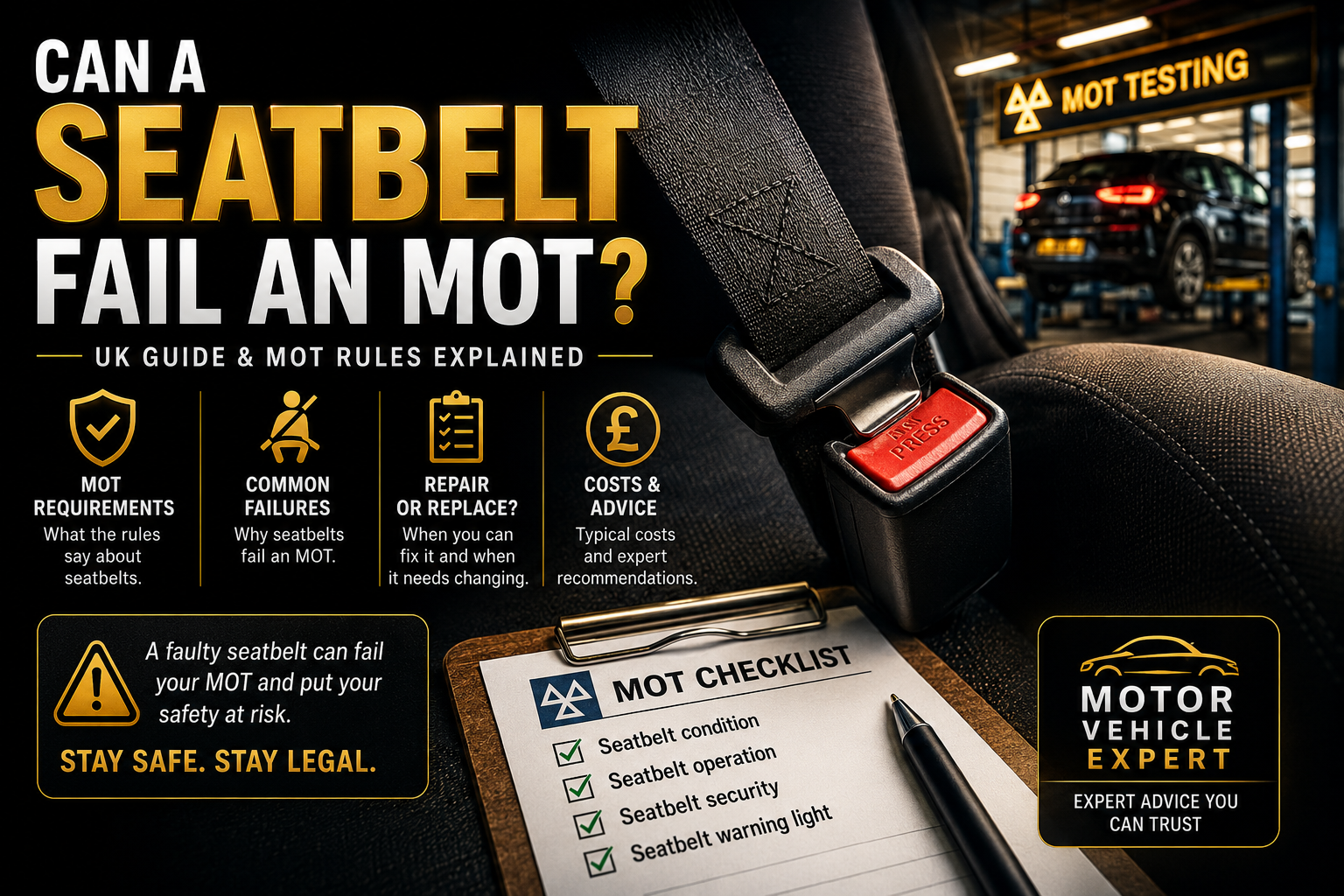
Seatbelt MOT guide

Can A Seatbelt Fail MOT?

Yes, a seatbelt can fail an MOT in the UK if it is damaged, frayed, insecure, does not latch correctly, retract properly or shows signs of serious wear affecting passenger safety.

Can a seatbelt fail MOT UK guide
Quick answer

Will a seatbelt fail an MOT?

A seatbelt can fail an MOT if it is not safe or does not work properly. Common reasons include frayed webbing, cuts, damaged buckles, poor retraction, insecure anchor points, missing belts or obvious restraint system faults.

If a belt does not click in securely, does not release cleanly, is twisted, badly worn, slow to retract, stuck fully in, or has damaged webbing, it should be checked before the test.

Tester view

What an MOT tester is looking for

The tester wants to see that the seatbelt can restrain the occupant properly. That means the belt must pull out, lock where required, latch securely, release properly, retract, and be mounted to a sound structure.

MOT tester checks

What testers check on seatbelts

These are the practical checks that decide whether a belt is safe, advisory or a failure.

Webbing

Is the belt material safe?

The webbing should not be badly frayed, cut, burnt, weakened, knotted or damaged in a way that affects strength.

Buckle

Does it latch and release?

The buckle should click securely and release when the button is pressed. A sticky or unreliable buckle is a safety concern.

Mounting

Are the anchor points secure?

Seatbelt mountings must be secure and supported by sound structure, not loose, badly corroded or damaged.

Retraction

The belt should retract properly and not remain loose across the occupant.

Missing belt

A required seatbelt must be present and usable.

Warning faults

SRS, pretensioner, airbag or restraint system warning faults can matter on modern vehicles.

Failure points

Common reasons a seatbelt can fail an MOT

These are the seatbelt faults worth fixing before test day.

Damage

Frayed or cut webbing

Loose fibres, torn edges, cuts, burns or weakened sections of belt material can fail if they affect strength.

Buckle

Buckle will not latch

The belt must fasten securely. If it pops out, will not click, or only latches sometimes, it is a fail risk.

Release

Buckle will not release

The release button must work properly. A belt that traps the occupant is also unsafe.

Poor retraction

The belt should retract correctly and not stay loose, twisted or jammed in the pillar.

Insecure mounting

Anchor points must not be loose, badly corroded, cracked or poorly repaired.

Missing required belt

A required seatbelt must be fitted, accessible and usable.

Condition checks

What seatbelt condition problems look like

Some seatbelt faults are easy to miss until you pull the belt fully out.

Fraying

Look for loose fibres, worn edges or weak sections of belt material.

Cuts or burns

Any damage that weakens the webbing should be taken seriously.

Slow retraction

The belt may need cleaning, or the mechanism may be worn, dirty or jammed.

Sticky buckle

A buckle that does not click or release properly is a safety concern.

Twisted belt

A twisted belt may not sit correctly across the body or retract properly.

Loose mountings

Seatbelt anchor points must be secure and structurally sound.

Warning lights

Can a seatbelt or airbag warning light fail an MOT?

A seatbelt warning light issue can point to a buckle, sensor, wiring or occupancy detection fault. An airbag or SRS warning light is also important because seatbelt pretensioners are part of the restraint system on many vehicles.

If the airbag or SRS warning light stays on, do not ignore it. The system may not protect occupants correctly in a crash.

Pretensioners

Seatbelt pretensioner faults

Pretensioners help tighten the belt during a collision. If the pretensioner circuit has a fault, the SRS light may stay on or a diagnostic scan may show a restraint fault.

Do not bypass or ignore restraint system faults. They should be diagnosed and repaired properly.

Pre-MOT checks

Pre-MOT seatbelt checks

These checks are simple and can prevent an avoidable failure.

1

Pull each belt fully out

Inspect the full length of webbing for cuts, burns, heavy fraying, knots, twisting or weak sections.

2

Check every buckle

Each belt should click securely into its buckle and should not pop out when pulled firmly.

3

Check the release button

The buckle should release cleanly when pressed and not stick or jam.

4

Check retraction

Let the belt retract. It should not stay loose, drag badly, jam in the pillar or retract only halfway.

5

Check rear belts too

Rear belts are often forgotten because they are used less often. Check them before the MOT.

6

Check warning lights

Look for airbag, SRS, restraint or seatbelt warning lights that stay on after start-up.

Rear belts

Can rear seatbelts fail MOT?

Yes. Rear seatbelts are checked where fitted and required. A rear belt that is damaged, stuck, missing, insecure or will not latch correctly can cause MOT problems.

Rear belts often sit unused for long periods, so they can jam, twist, get trapped under seats or become slow to retract.

Repair advice

Can you repair a seatbelt yourself?

Avoid unsafe repairs. Do not stitch, glue, knot, tape or modify seatbelt webbing. Seatbelts are safety-critical and should be repaired or replaced properly using correct parts.

If the belt has been damaged in a crash, or the pretensioner has fired, get professional advice before reusing it.

Used car checks

Seatbelt checks when buying a used car

Seatbelt condition can reveal neglect, heavy use, crash damage or poor repairs.

1

Check every belt

Pull out every front and rear belt, including centre rear belts where fitted.

2

Look for crash clues

Frayed belts, replaced buckles, missing trim or SRS warnings can suggest previous damage.

3

Check warning lights

Airbag and SRS lights should come on at ignition and then go out normally.

4

Review MOT history

Look for previous seatbelt, airbag, corrosion or safety advisories.

Helpful next reads: used car inspection checklist, questions to ask when buying a used car and how to check MOT history before buying.

Repair costs

Typical seatbelt repair costs

Costs depend on the vehicle, part availability, wiring sensors and whether pretensioners are involved.

Cleaning or freeing a belt

Can be low cost if the belt is dirty or slow to retract but not damaged.

Buckle replacement

Cost varies depending on access, wiring sensors and whether the buckle is part of the restraint system.

Seatbelt reel replacement

May be needed if the belt is stuck, damaged, jammed or not retracting properly.

Pretensioner fault

Can be more expensive and should be diagnosed properly with the correct equipment.

SRS wiring repair

Wiring under seats, buckle sensors or connectors may need careful diagnosis.

Crash-related repairs

If the car has been in an accident, restraint parts may need proper replacement, not patching.

Real-world faults

Seatbelt problems drivers often miss

These are the sort of faults that often get found on MOT day.

Belt trapped behind trim

The belt may not retract because it is trapped, twisted or rubbing behind plastic trim.

Rear belt stuck under seat

Rear belts can get trapped under folded seats or child seat bases.

Sticky buckle from dirt

Coins, crumbs, drinks and dirt can stop buckles clicking or releasing cleanly.

Fraying hidden near the pillar

Damage can hide where the belt feeds into the pillar, so pull the belt fully out.

Loose anchor trim hiding rust

Seatbelt mountings need sound metal around them. Rust nearby should be checked properly.

SRS light after moving seats

Wiring under the seat can be disturbed, causing airbag or pretensioner warnings.

FAQs

Seatbelt MOT questions

Common questions about frayed belts, stuck belts, buckles, rear belts and warning lights.

Can a frayed seatbelt fail MOT?

Yes. If the fraying weakens the belt or makes it unsafe, it can fail.

Can a stuck seatbelt fail MOT?

Yes. A belt that will not pull out, retract, latch or release properly can fail.

Can a rear seatbelt fail MOT?

Yes. Rear seatbelts are checked where fitted and required.

Can a seatbelt warning light fail MOT?

It depends on the fault, but restraint system warning issues should always be checked.

Can an airbag light affect seatbelt checks?

Yes. Airbag, SRS and pretensioner faults are part of the restraint system and should be repaired properly.

Can I repair a seatbelt myself?

Avoid unsafe repairs. Seatbelt systems are safety-critical and should be repaired properly.

Can seatbelt anchor rust fail MOT?

Yes. Rust near seatbelt anchorage points can fail if it weakens the structure.

Should I replace a damaged seatbelt before MOT?

Yes. If a belt is damaged, insecure or not working correctly, repair or replace it before the test.

Motor Vehicle Expert publishes practical UK-focused vehicle diagnostics, maintenance, MOT, warning light, used car and repair cost guidance based on common driver questions and real-world garage situations.