
Quick answer
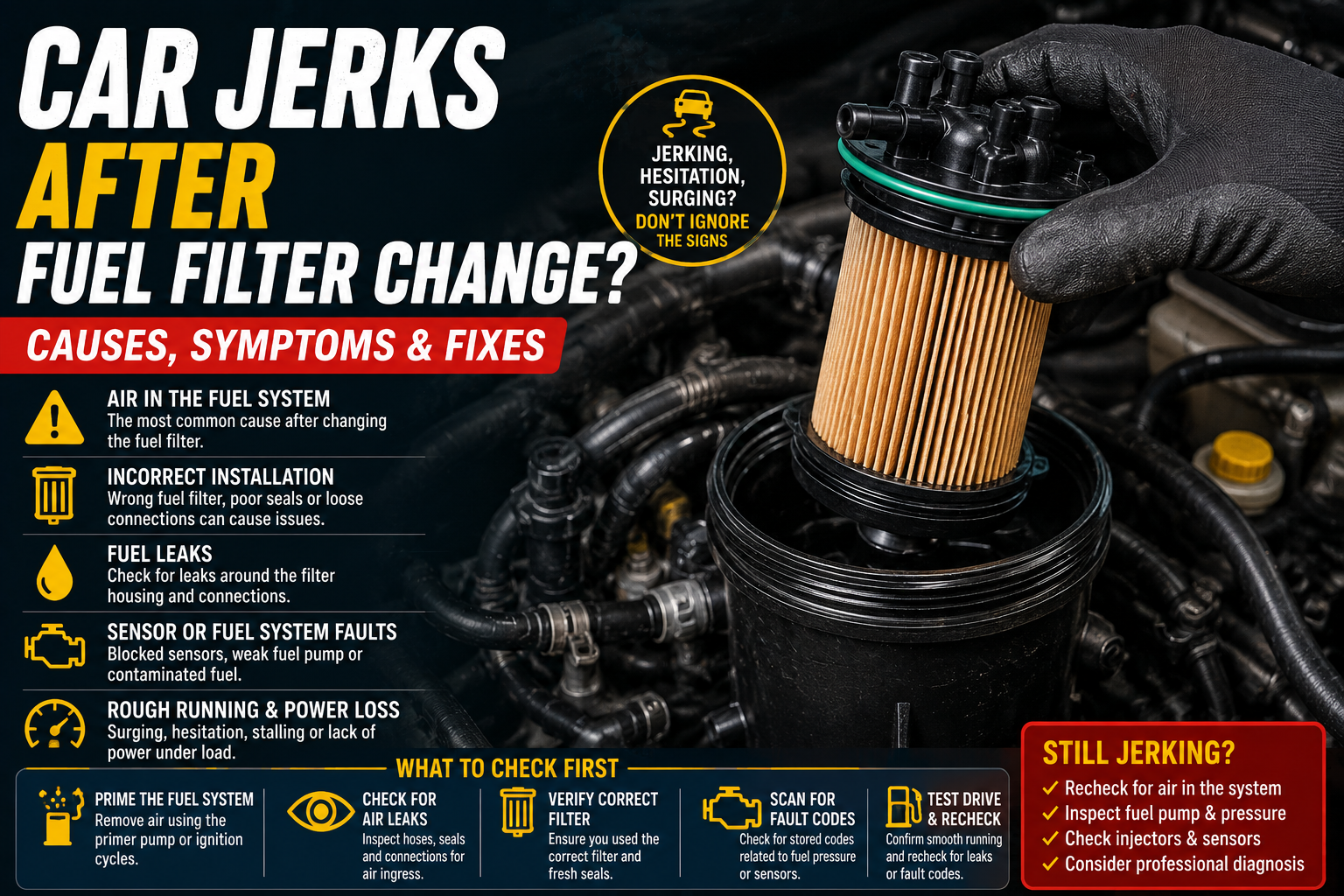
A car should normally run smoothly after a fuel filter replacement. If it jerks straight afterwards, the fuel system may not be sealed, primed or flowing correctly.
Diesel vehicles are especially sensitive to air in the fuel system. Petrol vehicles can also jerk if the filter is wrong, fitted in the wrong direction, restricted, leaking or not allowing correct fuel pressure.
When a fault appears immediately after repair work, check the repair area first before chasing unrelated sensors, injectors or expensive parts.
Did it start immediately after the job?
If the jerking started on the drive home from the garage, after a DIY filter change, or after the first restart, treat it as a post-repair fuel supply fault until proven otherwise.
This does not always mean the person who fitted the filter did something wrong. Some fuel systems are awkward to prime, some filter housings are easy to disturb, and some old seals or clips only leak air after being moved.
If the car already had hesitation before the filter change, the new filter may not be the full story. Fuel pressure, injectors, misfires, sensors or engine management faults may still need checking.
Is jerking after a fuel filter change serious?
Many causes are simple, but fuel system faults should still be treated carefully because poor fuel delivery can cause stalling, hesitation at junctions, limp mode or unsafe acceleration.
Often fixable
Many cases are caused by air, poor priming, loose clips or a seal not seated properly.
Avoid hard driving
Poor fuel delivery can cause hesitation, stalling, limp mode or unsafe pull-away.
Check for leaks
Fuel leaks, damp filter housings or strong fuel smells should be treated as urgent.
Warning light?
Engine, glow plug or emissions lights should be scanned for stored fault codes.
Engine light guide →Stalling risk
Air or low pressure can make the engine cut out unexpectedly, especially at junctions.
Started straight away?
Return to the installer promptly if symptoms began immediately after the repair.
Common causes after a fuel filter change
- 1Air trapped in fuel lines: very common after filter replacement, especially on diesel engines.
- 2System not primed correctly: the engine may start but hesitate, jerk, stall or cut out.
- 3Incorrect fuel filter fitted: wrong flow, size, seal design or specification can restrict fuel delivery.
- 4Filter fitted the wrong way round: some inline filters have a flow direction arrow.
- 5Loose fuel connection: can allow air in or fuel out depending on the system layout.
- 6Damaged seal or O-ring: poor sealing can cause air leaks, fuel leaks or hard starting.
- 7Low fuel pressure: the engine may struggle most when accelerating, climbing hills or under load.
- 8Contamination disturbed: dirt or debris may have moved during the repair and affected flow.
- 9Pre-existing fuel fault: a weak pump or injector issue may become more obvious after the filter is replaced.
Air in the fuel system after filter replacement
Air in the fuel system is one of the most common reasons a car jerks after a fuel filter change. The engine may start and idle, but once you accelerate, climb a hill or demand more fuel, the air pocket can interrupt smooth fuel delivery.
Air leak into the system
A loose pipe, weak clip or damaged seal can let air enter, especially on suction-side fuel systems.
Air not fully bled out
Some systems need correct priming or bleeding after filter replacement before the engine will run smoothly.
A useful clue is whether the car starts badly, stalls shortly after starting, or improves briefly before jerking again under load.
Diesel car jerks after fuel filter change
Diesel engines often need proper priming after a fuel filter replacement. If air remains in the system, the engine may start but run unevenly, hesitate, jerk, cut out or struggle under acceleration.
Some diesel systems self-prime with the ignition cycle, some have a hand primer, and some need a diagnostic tool or correct bleeding procedure. Guessing can make hard starting worse.
Long cranking
Can mean the fuel system has not fully primed or fuel is draining back.
Starts then cuts out
Often points towards air, low pressure, incorrect fitting or fuel starvation.
Jerks uphill
Uphill driving demands more fuel, so weak supply shows up quickly.
Loses power uphill →Warning light appears
Glow plug or engine warning lights can appear with fuel pressure or emissions-related faults.
Filter housing damp
Dampness or diesel smell around the housing should be checked immediately.
Bubbles in clear line
Where fitted, bubbles can point towards air entering the fuel system.
Petrol car jerks after fuel filter change
Petrol cars can jerk after a fuel filter replacement if the filter is fitted the wrong way round, the wrong filter has been supplied, a connector is not fully seated, fuel pressure is low or a line is leaking.
A strong petrol smell, wet fuel line or dripping fuel is not normal. Stop and inspect before driving further.
- 1Check the filter direction if it has a flow arrow.
- 2Check pipe clips and quick-release connectors are fully seated.
- 3Check for petrol smell or visible dampness around the filter.
- 4Check whether jerking only happens under load.
- 5Scan for misfire, fuel trim or fuel pressure-related codes if warning lights appear.
Symptoms to note before diagnosis
The exact symptom helps separate air, pressure, fitting and electrical faults. Write down what happens before returning to the garage or booking diagnosis.
Jerks under acceleration
Often points to fuel flow or fuel pressure problems under load.
Hesitation guide →Hard starting
Can suggest air in the fuel system, poor priming or fuel draining back.
Crank no start guide →Starts then cuts out
May indicate air, low pressure, incorrect filter fitting or weak pump supply.
Rough idle
Can happen if fuel supply is uneven or air is entering through the filter housing.
Rough idle guide →Warning light on
Fault codes may help confirm fuel pressure, injector, misfire or mixture issues.
Engine light guide →Fuel smell
Stop and inspect. Fuel leaks should not be ignored.
What to check first
1. Check for fuel leaks or smell
Look around the filter, hoses, clips and housing. Do not drive with visible fuel leaks.
2. Check all connectors are seated
A pipe can look connected but not be fully locked into place.
3. Confirm the correct filter
Match the part number, fuel type, engine code and filter design.
4. Check filter direction
Inline filters may have a flow arrow. Wrong direction can restrict fuel flow.
5. Inspect seals and O-rings
A twisted, missing or damaged seal can allow air into the system.
6. Prime or bleed correctly
Follow the correct procedure for that vehicle, especially on diesel systems.
7. Scan for fault codes
Codes can show low pressure, misfire, fuel rail pressure or sensor faults.
8. Check fuel pressure if needed
If fitting checks are correct, pressure testing may confirm pump, filter or supply problems.
When to return to the garage
If the jerking started immediately after the fuel filter change, return to the installer and ask them to recheck the filter, seals, pipe connections, priming process and fuel pressure.
This is especially important if the car now starts badly, cuts out, smells of fuel, has warning lights or feels unsafe in traffic.
Ask them to check
Filter part number, direction, seals, housing, clips, fuel line seating, priming and pressure.
Explain the timing
Tell them whether the symptom started immediately, after a restart, once warm, or only under load.
What not to do
- !Do not keep driving hard to “clear it out”.
- !Do not ignore fuel smells or visible leaks.
- !Do not replace injectors, pumps or sensors without testing first.
- !Do not repeatedly crank a diesel if it has air in the system.
- !Do not assume the filter is correct just because it fits physically.
Can you keep driving if it jerks?
Avoid hard driving until the cause is known. Poor fuel delivery can make the car hesitate when pulling out, climbing hills or joining traffic.
Stop driving and arrange help if there is a fuel smell, visible leak, stalling, hard starting, warning light, severe jerking or cutting out.
What a mechanic may check
Filter fitting
Correct part, direction, seals and housing fitment.
Priming
Bleeding or priming according to the vehicle system.
Fuel pressure
Checks supply pressure and pressure drop under load.
Fault codes and live data
Checks pressure, misfire, injector, fuel trim and sensor data.
Best mechanic-style advice
The strongest clue is timing. If the car drove normally before the filter change and jerked immediately after, start with the filter job. Check the simple things first: correct filter, correct direction, seated pipes, seals, clips and priming.
If the filter work checks out, then move to fuel pressure, fault codes, live data, misfire checks and injector or pump diagnosis. That order avoids wasting money on parts that were never the cause.
After a fuel filter change, jerking is usually a fuel supply, air ingress, priming or fitting issue until testing proves otherwise.
Related performance and diagnostics guides
Frequently asked questions
Why does my car jerk after a fuel filter change?
Common causes include air in the fuel system, poor priming, incorrect filter fitting, loose connections, damaged seals or low fuel pressure.
Is air in the fuel system common after filter replacement?
Yes, especially on diesel vehicles. The system may need correct priming or bleeding.
Can the wrong fuel filter cause jerking?
Yes. An incorrect or restricted filter can reduce fuel flow and cause hesitation under load.
Can a fuel leak cause jerking?
Yes. A fuel leak or air leak at a connection can affect fuel delivery and should be repaired urgently.
Should I go back to the garage?
Yes, if the symptom started immediately after the fuel filter change.
Can I keep driving if it jerks?
Avoid hard driving and get it checked. Stop if there are fuel smells, leaks, stalling or warning lights.
Why does it only jerk uphill?
Uphill driving demands more fuel, so low fuel pressure, air in the system or a restricted filter may show up more clearly.
Will fault codes always show?
Not always. Fuel supply and air leak problems can sometimes need pressure testing, visual checks and road testing.