
Quick answer
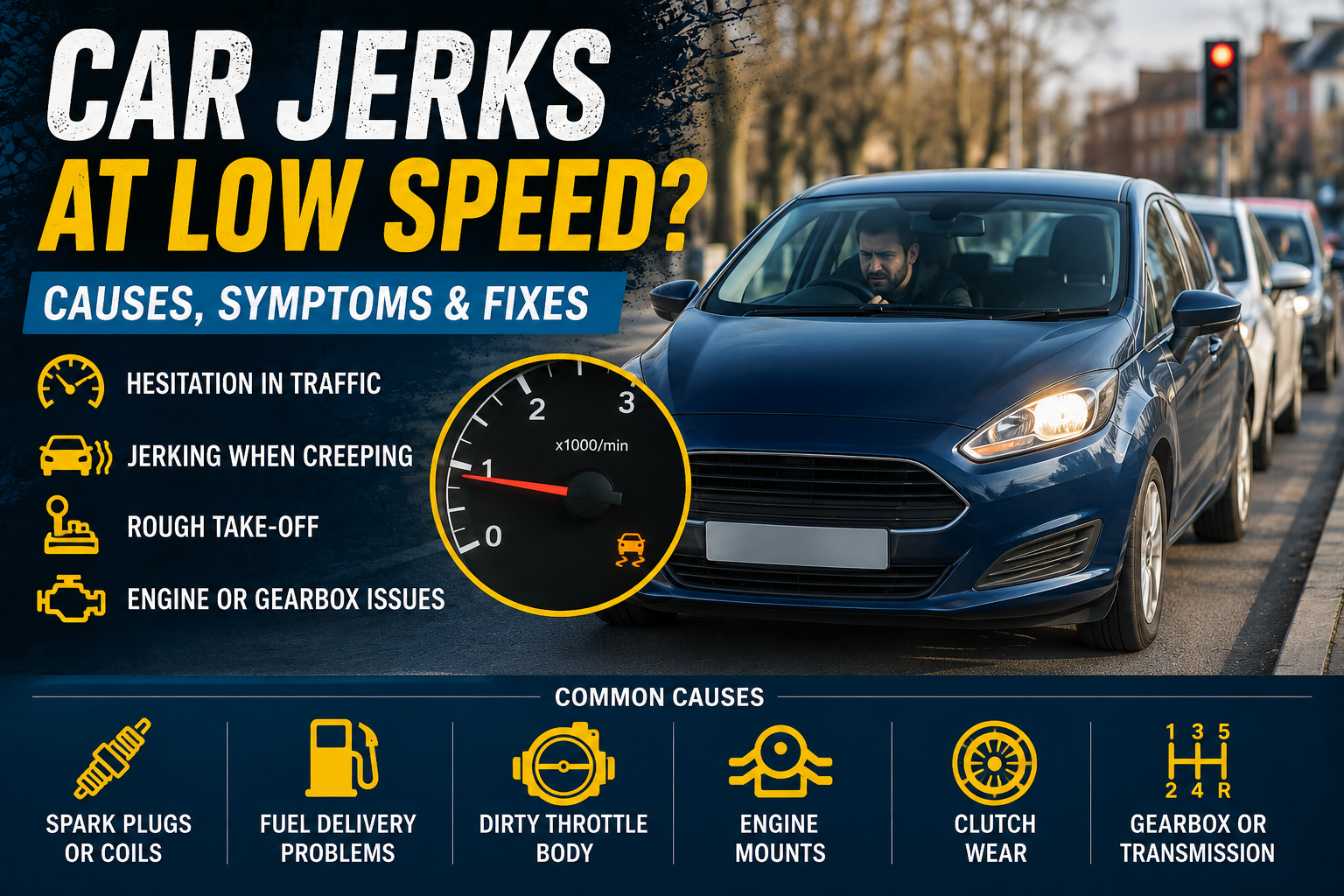
A car that jerks at low speed usually has a drivability fault affecting smooth power delivery. Common causes include clutch take-up problems, minor misfires, dirty throttle body, fuel delivery issues, airflow sensor faults, engine mount wear, gearbox mount movement, EGR behaviour or automatic gearbox engagement.
The most useful clue is the exact situation. Jerking in traffic, when pulling away, when cold, when selecting drive, when changing gear or at steady light throttle can all point to different faults.
Do not diagnose low-speed jerking from the word “jerking” alone. Work out whether it is engine hesitation, clutch grab, throttle snatch, gearbox engagement or drivetrain movement.
Why low-speed jerking is often misdiagnosed
In real garage situations, low-speed jerking is one of the easiest symptoms to misunderstand. Drivers often say the car “kangaroos” or “snatches”, but that feeling can come from several completely different areas.
A manual car may be grabbing at the clutch bite point. An automatic may be engaging harshly at crawling speed. A petrol engine may have a light misfire. A diesel may have EGR or airflow behaviour. A worn mount may make normal power changes feel worse than they really are.
That is why the first step is always the driving pattern, not the parts list.
Quick traffic diagnosis map
Jerks while creeping forward
Think clutch take-up, throttle response, mounts, idle control or low-speed fuelling.
Jerks when lifting clutch
Think clutch wear, contaminated clutch, dual mass flywheel, engine mounts or poor low-rev torque.
Pull-away judder guide →Jerks when selecting Drive
Think gearbox engagement, mounts, idle control, adaptation or engine running quality.
Jerks only when cold
Think cold-start fuelling, ignition weakness, air leaks, sensors or throttle body dirt.
Cold rough idle guide →Jerks with engine light
Think fault codes, misfire data, sensors, emissions, airflow or throttle faults.
Engine light guide →Jerks when changing gear
Think clutch, gearbox, mounts, rev matching or drivetrain movement.
Gear-change jerk guide →Common causes of low-speed jerking
Minor engine misfire
Weak spark, coil issues or poor combustion can feel worse at low revs.
Misfire symptoms guide →Clutch take-up fault
In a manual car, clutch wear, contamination or uneven bite can make the car jerk when crawling or pulling away.
Clutch wear signs →Dirty throttle body
Small throttle openings can become uneven, especially in traffic and car parks.
Fuel delivery issue
Weak pressure, injector issues or restricted fuel flow can cause surging or hesitation.
Hesitation guide →Engine mount wear
Worn mounts can exaggerate normal movement and make the car feel snatchy.
Mount movement clues →Gearbox behaviour
Automatic, manual and dual-clutch cars can jerk at low speed for different reasons.
Gear-change guide →EGR behaviour
A sticking EGR valve can cause rough low-speed running, especially on some diesels.
Overdue servicing
Old plugs, dirty filters and neglected maintenance can make low-speed running rougher.
Servicing guide →Throttle or sensor data
MAF, MAP, throttle and temperature data can affect low-speed fuelling.
Use diagnostic app →Manual car or automatic car?
If it is a manual car
Low-speed jerking often relates to clutch bite, clutch wear, clutch contamination, engine mounts, gearbox mounts or rough low-rev engine running.
- ✓Worse in first gear or reverse.
- ✓Worse when lifting the clutch.
- ✓Worse on hills or in traffic.
- ✓May come with clutch smell or high bite point.
If it is an automatic car
Low-speed jerking may come from gearbox engagement, torque converter behaviour, engine mounts, gearbox mounts, adaptation, low-speed fuelling or engine running faults.
- ✓Jerks selecting Drive or Reverse.
- ✓Harsh between low gears.
- ✓Delay before taking drive.
- ✓Feels better once moving faster.
Why it may jerk more when cold
A cold engine needs richer fuelling, stable ignition and accurate sensor readings. A small fault that feels minor when warm can feel much worse for the first few minutes after starting.
Cold-start fuelling
If fuelling is not right, the car can surge, hesitate or jerk until warm.
Ignition weakness
Damp weather, worn plugs or weak coils can show more when cold.
Misfire guide →Rough idle link
If it also shakes at idle, look closer at misfire, throttle and air leaks.
Cold rough idle →Jerking in traffic or car parks
Stop-start traffic exposes tiny throttle and clutch movements. A car can feel fine on the motorway but become awkward at 5–15mph because the fault only appears when the engine and drivetrain are constantly loading and unloading.
Snatchy throttle
Small pedal input makes the car surge or jerk.
Kangarooing
The car repeatedly lurches forward at low speed.
Near stalling
The engine dips low or almost cuts out.
Drivetrain clunk
Worn mounts make normal power changes feel harsh.
The hidden low-speed clue most drivers miss
Many drivers only notice whether the car jerks, but not what happens immediately before the jerk. That moment is important. Does the engine rev drop first? Does the gearbox engage first? Does the clutch bite first? Does the throttle pedal feel delayed first?
A rev drop before the jerk points more towards engine running, throttle or fuelling. A thump as power is applied points more towards mounts or drivetrain movement. A shudder at the bite point points more towards clutch or flywheel behaviour.
The first half-second before the jerk is often more useful than the jerk itself.
The speed test most websites never mention
One of the quickest ways to narrow down low-speed jerking is to compare vehicle speed with engine speed. This sounds simple, but it often separates engine faults from drivetrain faults.
Jerks at the same road speed
If the car jerks at 5–15mph regardless of engine revs, think more about drivetrain, gearbox, clutch take-up, mounts or automatic engagement.
Jerks at the same engine revs
If the jerking follows engine revs rather than road speed, ignition, fuel delivery, airflow sensors, throttle behaviour or misfire faults become more likely.
This simple distinction can save wasted money because a low-speed lurch does not always come from the engine.
When does the jerking happen?
Only when cold
Cold-running sensor faults, weak ignition, fuelling issues or rough idle problems may improve once warm.
Cold rough idle guide →Only in slow traffic
Throttle response, clutch take-up, engine mounts or low-speed fuelling are common suspects.
When pulling away
Clutch judder, worn mounts, gearbox engagement or weak low-rev torque may be involved.
Pull-away judder guide →At light throttle cruise
Airflow sensor, EGR, fuel delivery or ignition faults often show at steady low-speed throttle.
With engine warning light
Stored codes may point to misfire, sensor, emissions, throttle or fuelling faults.
Engine light guide →With rough idle
Misfire, vacuum leak, throttle body or sensor problems become more likely if the car also shakes at idle.
Vibrates at idle guide →When low-speed jerking needs faster attention
- !Engine management light flashes: this can mean a damaging misfire.
- !The car stalls or nearly stalls: unsafe in traffic and junctions.
- !Jerking becomes violent: could affect control or confidence.
- !Strong fuel smell appears: treat fuel smells seriously.
- !Smoke or burning smell appears: stop and investigate.
- !Gear engagement becomes harsh: automatic or drivetrain fault may be worsening.
- !Symptoms worsen quickly: early diagnosis may prevent bigger repairs.
What to check first
1. Notice the exact situation
Does it happen cold, hot, in traffic, when pulling away, in reverse, during gear changes or at steady throttle?
2. Check warning lights
An engine light, EPC light, gearbox warning or emissions message can guide diagnosis.
3. Review service history
Old spark plugs, dirty filters, overdue servicing or neglected maintenance can contribute.
4. Compare hot and cold
If it improves when warm, sensor, ignition or cold-start fuelling faults become more likely.
5. Check idle quality
A car that also idles badly may have a misfire, air leak, throttle or sensor issue.
6. Get live data checked
Not every fault stores a clear code. Live data can show airflow, fuel trims, misfire counts and sensor behaviour.
Possible repair costs
Repair cost depends on the cause. Some low-speed jerking faults are basic service items, while others need diagnosis before parts are replaced.
Service items
Spark plugs, filters or overdue maintenance may be the cheapest starting point if confirmed.
Throttle or sensor checks
Costs depend on whether the issue is cleaning, sensor data, wiring or air leaks.
Clutch inspection
Manual cars may need clutch, flywheel or mount checks if symptoms happen at bite point.
Clutch replacement cost →Engine mounts
Mount cost varies by car and access, but worn mounts can make low-speed jerking feel worse.
Fuel delivery diagnosis
Fuel pressure, injector or filter issues should be tested before parts are replaced.
Gearbox checks
Automatic low-speed jerking may need fluid, adaptation, mount or transmission checks.
For wider budgeting, read car repair costs guide UK.
Best mechanic-style advice
Do not assume low-speed jerking is just bad driving, especially if it has appeared suddenly or is getting worse. A smooth car should not repeatedly snatch in traffic, hesitate when creeping or thump every time power is applied.
The best diagnosis starts with a road test pattern, then checks idle quality, clutch bite, throttle response, engine movement, warning lights and live data. That avoids replacing spark plugs, sensors, mounts or clutch parts by guesswork.
If the car jerks mainly at low speed, focus on small-control areas: clutch bite, throttle opening, idle stability, engine movement and gearbox engagement.
Related drivability guides
Frequently asked questions
Why does my car jerk in slow traffic?
Common causes include clutch take-up problems, throttle response issues, worn mounts, minor misfires or low-speed fuelling faults.
Can bad spark plugs cause low-speed jerking?
Yes. Weak spark plugs or ignition coils can cause light misfires that feel worse at low revs.
Can an automatic gearbox cause jerking?
Yes. Harsh shifts, delayed engagement, torque converter behaviour or gearbox control issues can feel like low-speed jerking.
Why is the jerking worse when cold?
Cold engines need richer fuelling and stable ignition, so sensors, ignition parts or air leaks can show up more when cold.
Can a dirty throttle body cause jerking?
Yes. A dirty throttle body can make small pedal inputs uneven, especially in traffic or parking situations.
Can worn engine mounts make the car jerk?
Yes. Worn mounts can allow excessive engine movement, making normal throttle changes feel harsh.
Should I keep driving?
Light symptoms may be manageable, but worsening jerking, stalling, warning lights, smoke or fuel smell should be checked quickly.
Will a fault code always appear?
No. Some low-speed faults need live data, road testing and mechanical checks even when no code is stored.