Quick answer
What Is Brake Fade?
Related guide
Brake fade is usually caused by excessive heat within the braking system. Understanding why brakes overheat can help you diagnose the underlying fault, prevent repeated brake fade and avoid expensive damage to brake pads, discs, calipers and brake fluid. For a complete explanation of brake temperatures, overheating symptoms and common causes, read our
Brake Overheating Explained
guide.
Brake fade is the temporary reduction in braking performance caused by excessive heat within the braking system. As temperatures rise, brake pads, brake discs and brake fluid become less effective, increasing stopping distances and making the vehicle harder to slow down safely.
Brake fade usually occurs after repeated heavy braking, long downhill descents, towing heavy loads, spirited driving or track use. Although braking performance often returns once the brakes cool, the loss of stopping power can be dangerous if it happens unexpectedly.
Main Cause
Excessive Heat
Safety Critical
Brake components become hotter than they can safely dissipate.
Most Common Symptom
Longer Stopping Distance
Reduced Performance
The vehicle takes noticeably longer to stop, even with increased pedal pressure.
Can It Be Dangerous?
Yes
Do Not Ignore
Brake fade can significantly reduce braking performance during emergency situations.
Will It Go Away?
Usually Temporary
Cooling Required
Braking performance often improves once temperatures return to normal.
Typical Cause
Repeated Heavy Braking
Heat Build-Up
Mountain roads, towing, traffic and performance driving all increase brake temperatures.
Best Prevention
Maintenance + Driving Technique
Recommended
Good quality components, fresh brake fluid and proper driving habits greatly reduce brake fade.
Safety First
If braking performance suddenly deteriorates, you smell burning brakes, see smoke from a wheel or the brake pedal feels unusually soft, reduce speed safely and allow the braking system to cool before continuing.
Understanding brake fade
Why Do Brakes Lose Stopping Power?
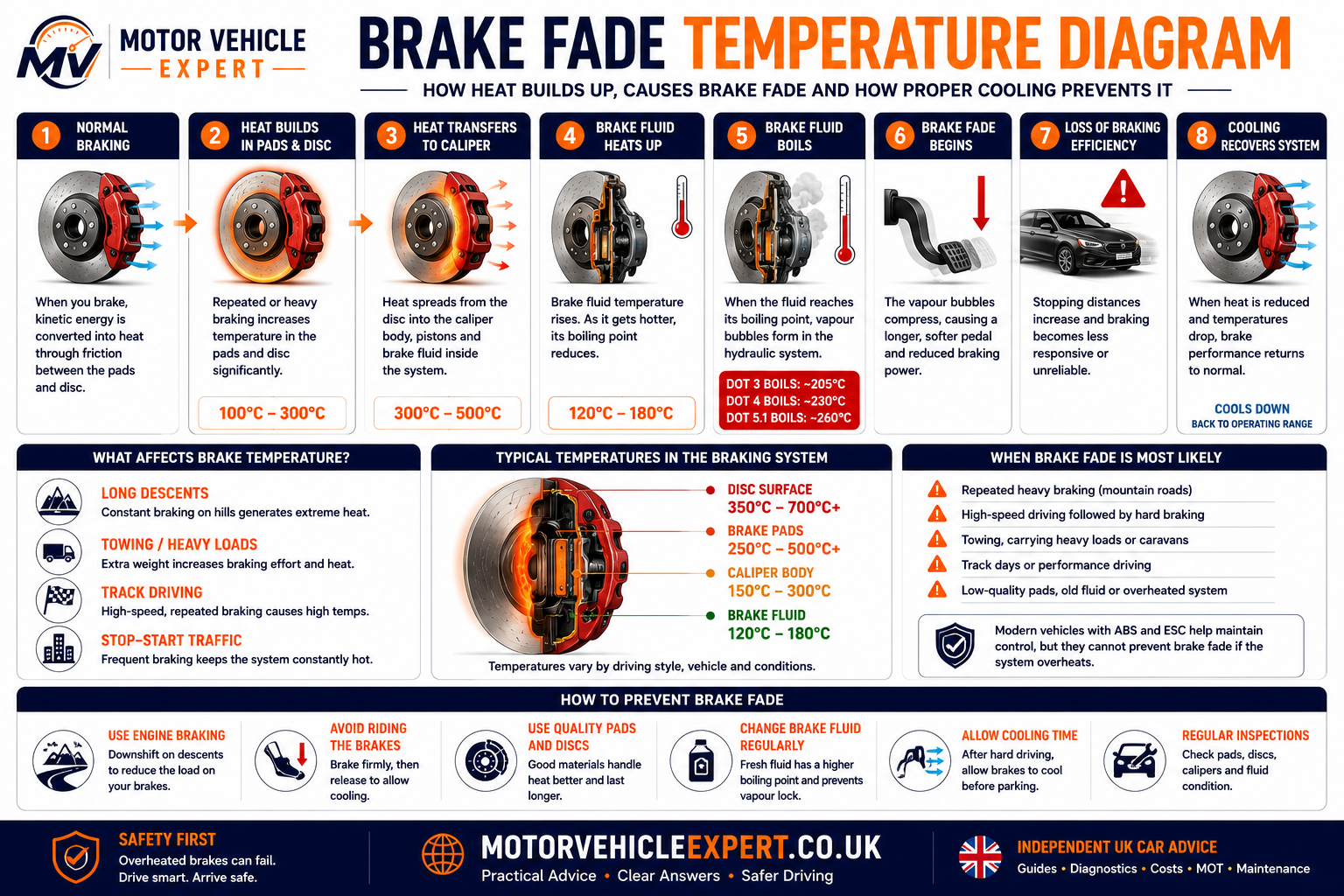
Every time you press the brake pedal, the vehicle's kinetic energy is converted into heat through friction between the brake pads and brake discs. Under normal driving conditions this heat is released into the surrounding air. Brake fade occurs when heat builds faster than the braking system can dissipate it.
As temperatures continue to rise, the friction material on the brake pads becomes less effective, brake discs retain more heat and old brake fluid may begin to boil inside the hydraulic system. These changes reduce braking efficiency and increase stopping distances until the brakes cool.
Workshop Explanation
Brake fade is not normally caused by a single failed component. Instead, it is the result of excessive heat overwhelming the braking system's ability to transfer and dissipate energy safely.
Risk dashboard
When Is Brake Fade Most Likely To Occur?
Some driving conditions generate far more heat than others. Understanding when brake fade is most likely helps drivers adapt their driving style before braking performance begins to deteriorate.
Long Mountain Descents
Very High Risk
Continuous braking generates extreme temperatures and is one of the most common causes of brake fade.
Towing
High Risk
Extra vehicle weight requires the brakes to absorb significantly more energy.
Track Driving
Very High Risk
Repeated heavy braking rapidly overheats pads, discs and brake fluid.
Stop-Start Traffic
Moderate Risk
Frequent braking creates continuous heat with limited cooling.
Fast Road Driving
Moderate Risk
Repeated hard braking raises brake temperatures quickly.
Everyday Driving
Low Risk
A healthy braking system should not normally experience brake fade during regular road use.
Four types
The Four Main Types Of Brake Fade
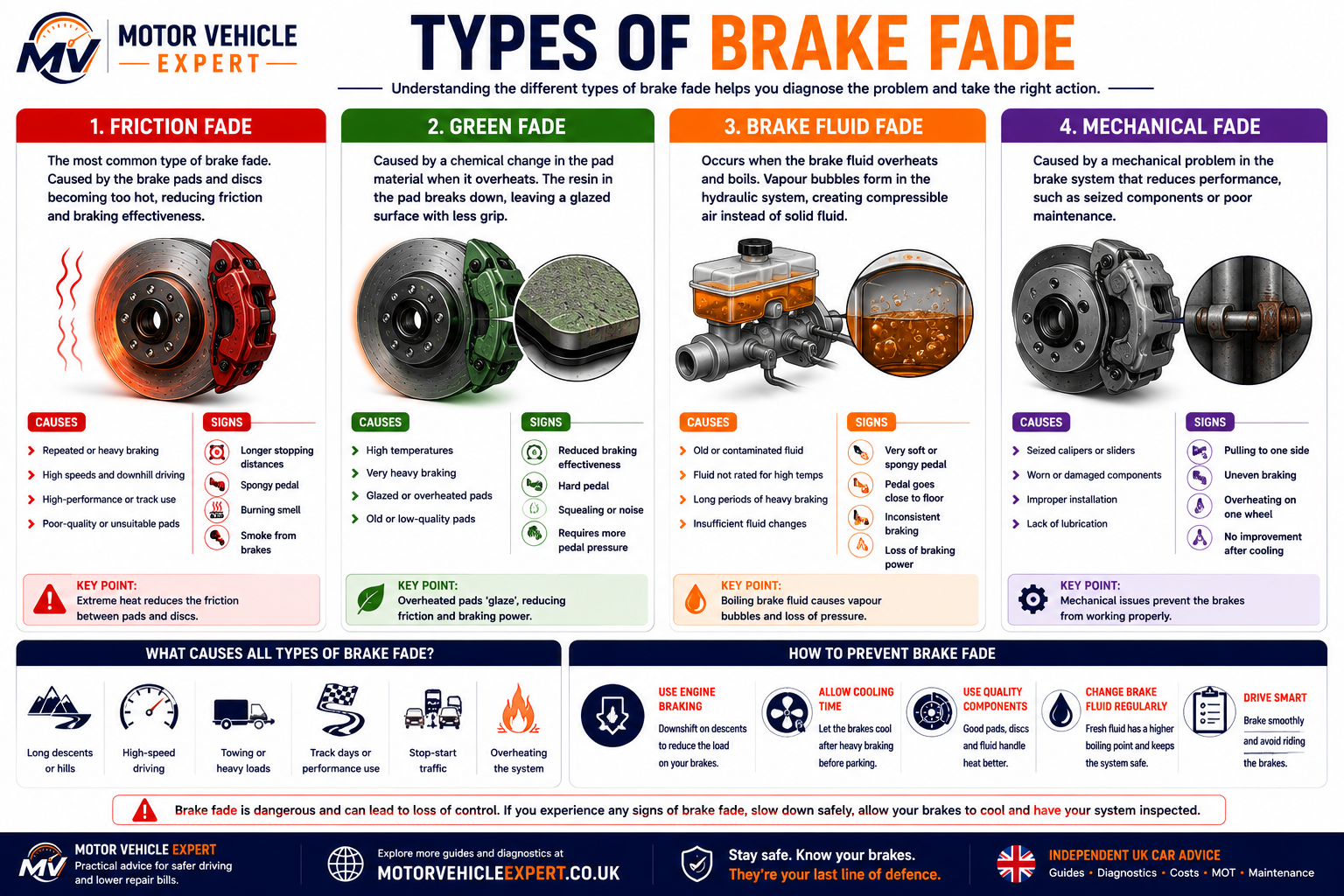
Although drivers often describe every loss of braking performance as "brake fade", mechanics recognise several different forms of brake fade. Each develops for a different reason and requires a different solution.
Friction Fade
Brake pad friction material overheats and produces less stopping force.
Brake Fluid Fade
Brake fluid boils inside the hydraulic system, producing vapour that compresses under pedal pressure.
Green Fade
Occurs when brand-new brake pads are not fully bedded in and gases reduce friction.
Mechanical Fade
Brake components become so hot that mechanical efficiency and braking force begin to decrease.
Brake science
How Heat Causes Brake Fade
Every time you press the brake pedal, your vehicle's kinetic energy must be converted into another form of energy before the car can slow down. The braking system achieves this by converting movement into heat through friction between the brake pads and brake discs. Under normal driving conditions this heat is quickly released into the surrounding air, allowing the brakes to continue operating efficiently.
Brake fade begins when heat is produced faster than the braking system can dissipate it. As temperatures continue to rise, brake pads lose friction, brake discs retain more heat and brake fluid can eventually boil inside the hydraulic system. The result is reduced braking performance and noticeably longer stopping distances.
Want to understand why brakes become dangerously hot? Read our
Brake Overheating Explained
guide for a detailed explanation of brake temperatures, dragging brakes, seized calipers and overheating symptoms.
Brake Pads
Heat Source
Brake pads generate enormous friction every time they clamp onto the brake disc.
Brake Discs
Heat Storage
Brake discs absorb large amounts of heat before transferring it into the surrounding air.
Brake Fluid
Hydraulic Risk
Excessive temperatures can eventually boil contaminated brake fluid, reducing hydraulic braking force.
Calipers
Heat Transfer
Brake calipers transfer braking force but also absorb heat from the brake pads and discs.
Cooling Air
Essential Cooling
Moving air removes heat from the braking system, helping restore normal braking performance.
Repeated Braking
Fade Risk
Repeated heavy braking allows temperatures to build faster than the brakes can cool.
Heat is the real enemy.
Brake fade is almost always a heat-management problem rather than a single failed component. The hotter the braking system becomes, the more likely braking performance will begin to decrease.
Type 1
Friction Fade
Friction fade is the most common type of brake fade experienced by everyday drivers. It occurs when the brake pad friction material becomes so hot that it can no longer generate the same level of grip against the brake disc. Although the driver presses the brake pedal with the same force, less braking energy is produced.
This type of brake fade is commonly seen during long downhill descents, repeated emergency braking, spirited driving or when towing heavy loads. Lower-quality brake pads generally reach friction fade much sooner than premium braking materials.
Common Causes
- ✓Repeated heavy braking
- ✓Overheated brake pads
- ✓Cheap friction material
- ✓Mountain driving
Driver Symptoms
- ✓Longer stopping distance
- ✓Burning smell
- ✓Reduced braking bite
- ✓Brakes improve after cooling
Type 2
Brake Fluid Fade
Brake fluid fade occurs when brake fluid becomes so hot that it begins to boil inside the hydraulic braking system. Unlike brake fluid, vapour bubbles can be compressed. Instead of transmitting hydraulic pressure directly to the brake calipers, part of the pedal movement compresses the vapour, making the brake pedal feel soft or spongy.
Older brake fluid absorbs moisture over time, lowering its boiling point and making brake fluid fade much more likely during heavy braking. This is why regular brake fluid replacement is such an important preventative maintenance task.
Soft Brake Pedal
Classic Symptom
The brake pedal feels soft because vapour bubbles compress inside the hydraulic system.
Old Brake Fluid
Major Cause
Moisture contamination dramatically lowers brake fluid boiling point.
Hydraulic Pressure Loss
Reduced Braking
Less hydraulic pressure reaches the brake calipers during braking.
Type 3
Green Fade
Green fade occurs almost exclusively with brand-new brake pads. During the bedding-in process, binding resins within the friction material release gases as temperatures rise. These gases create a thin layer between the brake pad and brake disc, temporarily reducing friction until the pads are fully bedded in.
Usually Affects
Recently fitted brake pads that have not yet completed the bedding-in process.
Solution
Follow the manufacturer's recommended bedding-in procedure and avoid repeated emergency stops immediately after installation.
Type 4
Mechanical Brake Fade
Mechanical fade occurs when extreme temperatures affect the physical braking components themselves. Brake discs may expand significantly, brake pad backing plates can distort and brake calipers may struggle to maintain consistent clamping force.
Although less common than friction or brake fluid fade on everyday road cars, mechanical fade becomes increasingly important during repeated high-speed braking, motorsport and heavy commercial vehicle use.
Mechanical fade usually indicates extremely high brake temperatures.
Repeated overheating shortens the life of brake pads, brake discs, calipers, seals and brake fluid, often resulting in expensive repairs.
Modern braking
Why Modern Braking Systems Resist Brake Fade Better
Modern vehicles are designed to manage braking heat far more effectively than older systems. Improved brake materials, larger ventilated discs, advanced brake fluids and electronic braking systems all help reduce the likelihood of brake fade during normal road driving.
Ventilated Brake Discs
Internal cooling vanes increase airflow and remove heat more efficiently.
Improved Brake Pads
Modern friction materials maintain braking performance at much higher temperatures.
Higher Quality Brake Fluid
Modern DOT 4 and DOT 5.1 fluids have higher boiling points than older specifications.
Larger Brake Calipers
More even pressure distribution improves braking efficiency and heat control.
ABS & Electronic Stability Systems
Electronic braking systems help maximise braking performance under demanding conditions.
Better Cooling
Modern wheel and brake designs improve airflow, reducing heat build-up during everyday driving.
Recognising the problem
Common Brake Fade Symptoms
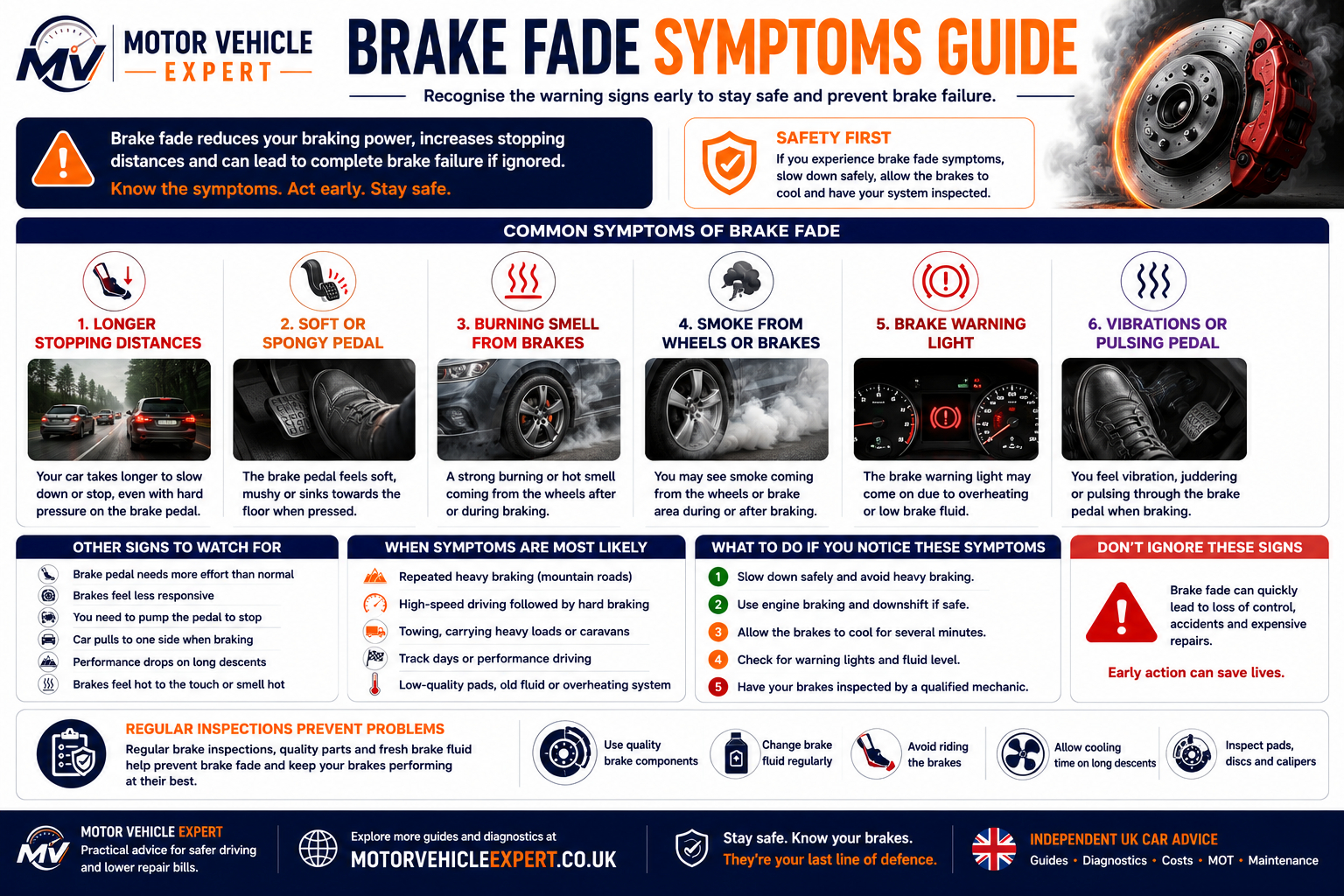
Brake fade rarely happens without warning. In most cases the braking system gives several clear signs that temperatures are becoming excessive before braking performance reduces significantly. Learning to recognise these symptoms early allows the driver to reduce speed safely, allow the brakes to cool and prevent further damage to brake pads, brake discs, brake fluid and hydraulic components.
Although many of these symptoms disappear once the brakes cool down, repeated brake fade should never be ignored because it often indicates excessive operating temperatures, worn braking components or poor maintenance.
Safety Warning
If your vehicle suddenly takes longer to stop, the brake pedal becomes soft, you smell burning brakes or smoke is visible from a wheel, reduce speed immediately, avoid further heavy braking and allow the braking system to cool before continuing your journey.
Brake Fade Symptoms Dashboard
The following symptoms appear most frequently when brake temperatures become excessive. Some indicate minor overheating while others require immediate inspection.
Longer Stopping Distance
High Risk
The vehicle requires noticeably more road distance to stop even though the brake pedal is pressed normally.
Reduced Initial Brake Bite
Moderate Risk
The brakes feel less responsive when first applied and require greater pedal pressure.
Burning Smell
High Risk
A hot burning smell usually comes from overheated brake pads and friction material.
Soft Brake Pedal
Critical
A soft or spongy brake pedal often suggests brake fluid has overheated or vapour has formed inside the hydraulic system.
Smoke From Wheels
Critical
Visible smoke indicates extremely high brake temperatures and immediate cooling is required.
Brake Warning Light
Inspection Needed
Some vehicles illuminate brake or ABS warning lights if hydraulic performance becomes affected.
Poor Braking Confidence
Monitor Closely
Drivers often describe the vehicle as feeling unwilling to stop or lacking normal braking confidence.
Brakes Improve After Cooling
Typical Characteristic
If braking returns to normal after cooling, brake fade rather than permanent mechanical failure is often the cause.
What Drivers Usually Notice First
Most drivers do not immediately recognise brake fade. Instead, they simply notice the vehicle taking slightly longer to stop. This usually develops before burning smells, smoke or brake warning lights appear.
- ✓Braking feels less powerful
- ✓Pedal pressure needs to increase
- ✓Stopping distances become longer
- ✓Repeated braking makes the problem worse
Brake Fade Symptom Severity
Not every symptom carries the same level of danger. The dashboard below helps determine how urgently the braking system should be inspected.
Low
Monitor
Slight reduction in braking feel after prolonged downhill driving that quickly returns to normal.
Medium
Book Inspection
Burning smell, reduced brake bite or repeated overheating should be investigated soon.
High
Stop Driving Soon
Soft brake pedal, greatly increased stopping distance or repeated brake fade requires immediate inspection.
Critical
Do Not Continue
Smoke from the brakes, major hydraulic faults or a sudden loss of braking performance requires the vehicle to be stopped safely and recovered if necessary.
Motor Vehicle Expert Advice
Brake fade itself is often temporary, but the heat that causes it can permanently damage brake pads, brake discs, brake fluid, caliper seals and other hydraulic components. If brake fade occurs more than once, the entire braking system should be inspected rather than simply allowing the brakes to cool and continuing to drive.
Workshop diagnosis
How Mechanics Diagnose Brake Fade
Brake fade is often temporary, so the vehicle may feel normal again by the time it reaches a garage. A proper inspection therefore looks for evidence of overheating, poor hydraulic condition, worn friction material and faults that allow heat to build up repeatedly.
A professional diagnosis should not focus on one part only. Brake pads, brake discs, brake fluid, calipers, hoses, warning lights and the road test all matter because brake fade can be caused by a combination of heat, maintenance condition and driving load.
Inspection principle:
The aim is to answer three questions: did the brakes overheat, why did they overheat, and has any permanent damage been caused?
Workshop Brake Fade Inspection Checklist
1. Road Test
Confirm symptom
A controlled road test checks pedal feel, stopping distance, pulling, vibration, brake noise and whether the symptoms return as temperatures rise.
2. Pedal Feel
Hydraulic clue
A soft, long or sinking pedal can point toward overheated brake fluid, air in the system or hydraulic pressure loss.
3. Brake Pads
Friction check
Pads should be checked for glazing, cracking, uneven wear, low thickness, contamination and heat damage.
4. Brake Discs
Heat evidence
Discs should be inspected for blue heat marks, scoring, cracks, surface damage, thickness variation and excessive wear.
5. Brake Fluid
Boiling risk
Fluid colour, level, moisture content and service history should be checked, especially after soft pedal complaints.
6. Brake Calipers
Drag risk
A sticking caliper can keep a pad touching the disc, creating constant heat and repeated brake fade symptoms.
7. Brake Hoses
Flow issue
Flexible hoses should be inspected for cracking, swelling, internal restriction and fluid leaks.
8. ABS & Warning Lights
System check
Brake, ABS or stability control warning lights should be scanned and diagnosed before the vehicle is returned to use.
Evidence Of Overheating
- ✓Glazed brake pads
- ✓Blue or purple heat marks on discs
- ✓Burning smell from wheel area
- ✓Cracked or crumbling friction material
- ✓Dark or moisture-contaminated brake fluid
Questions A Good Garage Should Answer
- ✓Are the pads and discs still serviceable?
- ✓Has brake fluid boiled or absorbed moisture?
- ✓Is a caliper sticking or dragging?
- ✓Are brake hoses or pipes damaged?
- ✓Is replacement, fluid service or driving technique the main solution?
Do not diagnose brake fade from symptoms alone.
A burning smell or long stopping distance may suggest brake fade, but similar symptoms can also come from seized calipers, worn pads, contaminated discs, hydraulic leaks or old brake fluid. A full inspection is the safest approach.
Root causes
Why Brake Fade Happens
Brake fade is rarely caused by a single fault. In most cases it develops because excessive heat combines with worn braking components, poor maintenance or demanding driving conditions. Understanding the root cause is essential because simply replacing one component may not prevent the problem from returning.
Professional technicians therefore investigate the complete braking system rather than focusing on one part. Brake pads, brake discs, brake fluid, calipers, driving conditions and vehicle load all influence how quickly brake temperatures rise.
Workshop Principle
The braking system should always be treated as one complete system. Replacing only the overheated component without correcting the underlying cause often results in repeated brake fade.
If you suspect excessive brake temperatures rather than worn components alone, see
Brake Overheating Explained
for a complete diagnosis guide.
Brake Fade Cause Dashboard
Worn Brake Pads
High Risk
Thin or glazed brake pads generate more heat, provide less friction and lose braking efficiency much sooner during repeated braking.
Cheap Brake Pads
Common Cause
Lower-quality friction materials generally tolerate less heat than premium pads, increasing the likelihood of brake fade.
Old Brake Fluid
Hydraulic Risk
Brake fluid absorbs moisture over time. Once overheated, it can boil inside the hydraulic system and produce a soft brake pedal.
Worn Brake Discs
Heat Retention
Scored, worn or damaged brake discs dissipate heat less efficiently and can increase brake temperatures.
Seized Brake Caliper
Constant Heat
A sticking caliper keeps the brake pad in contact with the disc, generating continuous heat even when the driver is not braking.
Heavy Vehicle Loads
Higher Energy
Towing caravans, trailers or carrying heavy loads requires the braking system to absorb significantly more energy.
Long Downhill Driving
Classic Cause
Continuous braking on steep descents prevents the brakes from cooling properly, allowing temperatures to rise rapidly.
Track Or Performance Driving
Extreme Heat
Repeated high-speed braking generates temperatures far beyond those experienced during everyday road driving.
Poor Driving Technique
Driver Related
Riding the brakes instead of using engine braking allows unnecessary heat to build continuously.
Mechanic's Summary
Most Common Workshop Findings
- ✓Glazed brake pads
- ✓Dark brake fluid
- ✓Blue heat marks on discs
- ✓Sticky brake caliper
- ✓Brake fluid overdue for replacement
Best Long-Term Solution
- ✓Replace worn friction parts
- ✓Change brake fluid
- ✓Inspect calipers and hoses
- ✓Improve driving technique
- ✓Allow brakes to cool naturally
Driving safety
Can You Drive With Brake Fade?
You should treat brake fade as a serious warning that the braking system has become too hot or is not coping with the driving conditions. If the brakes return to normal after cooling, the vehicle may appear fine again, but repeated brake fade means the system needs inspection.
The safest decision depends on how severe the symptoms are. Mild fade after a long descent is different from smoke, a soft pedal, a warning light or a sudden loss of stopping power.
Mild Fade
Slow down
Reduce speed, avoid further heavy braking, use a lower gear where safe and allow the brakes to cool.
Repeated Fade
Book inspection
If brake fade happens more than once, arrange a full braking system inspection before relying on the vehicle.
Severe Fade
Stop safely
If stopping power suddenly drops, pull over safely and do not continue normal driving until the brakes cool and are checked.
Soft Brake Pedal
Hydraulic risk
A soft pedal may suggest brake fluid fade or air in the hydraulic system and should be inspected urgently.
Smoke Or Burning
Do not ignore
Smoke or a strong burning smell means the braking system is operating at dangerous temperatures.
Warning Light
Diagnose
A brake or ABS warning light should be diagnosed before further regular driving.
Stop driving and arrange inspection if:
The brake pedal sinks, smoke appears, the brake warning light comes on, stopping distances increase dramatically, or the vehicle no longer slows down normally.
MOT advice
Will Brake Fade Fail An MOT?
Brake fade itself may not be present during an MOT test because it often appears only when the brakes are extremely hot. However, the faults that cause brake fade can lead to MOT failure if they affect braking efficiency, balance, component condition or warning lights.
Poor Brake Efficiency
Failure risk
If braking force is below requirement during the roller brake test, the vehicle can fail.
Brake Imbalance
Failure risk
Uneven braking between wheels on the same axle can fail if outside allowed limits.
Brake Fluid Leak
Serious fault
Visible brake fluid leaks are safety-critical and can cause MOT failure.
Worn Pads Or Discs
Inspection item
Excessively worn, damaged or insecure braking components can fail inspection.
Warning Lights
Dashboard issue
ABS, ESC or brake system warning lights may lead to failure depending on the fault.
Seized Caliper
Heat source
A binding brake can cause poor efficiency, imbalance and repeated overheating.
Related MOT guides:
Car Fails MOT On Brakes and
Most Common MOT Advisories Explained.
Repair decision
Repair, Replace Or Let The Brakes Cool?
If brake fade happens once during extreme use, the brakes may recover after cooling. But if fade happens during normal driving, repeats regularly or leaves visible heat damage, the system needs proper inspection and repair.
Let Brakes Cool
Temporary action
Appropriate only if the fade was mild, caused by demanding conditions and braking performance returns normally.
Change Brake Fluid
Hydraulic maintenance
Recommended if brake fluid is old, moisture-contaminated or the pedal became soft during overheating.
Brake Fluid Change Cost UK →
Replace Brake Pads
Friction repair
Needed if pads are glazed, cracked, worn low, contaminated or unsuitable for the vehicle's use.
Brake Pad Replacement Cost UK →
Replace Brake Discs
Heat damage
May be needed if discs are cracked, heavily scored, below minimum thickness or showing severe heat damage.
Brake Disc Replacement Cost UK →
Inspect Calipers
Binding risk
A sticking caliper can create constant heat and must be repaired before new parts are fitted.
Brake Caliper Replacement Cost UK →
Upgrade Components
Heavy use
Towing, mountain driving or track use may require higher-quality pads, discs or brake fluid.
Best repair approach:
Do not fit new pads or discs without checking why the brakes overheated. Old brake fluid, a sticking caliper or poor driving technique can quickly damage new parts.
Prevention
How To Prevent Brake Fade
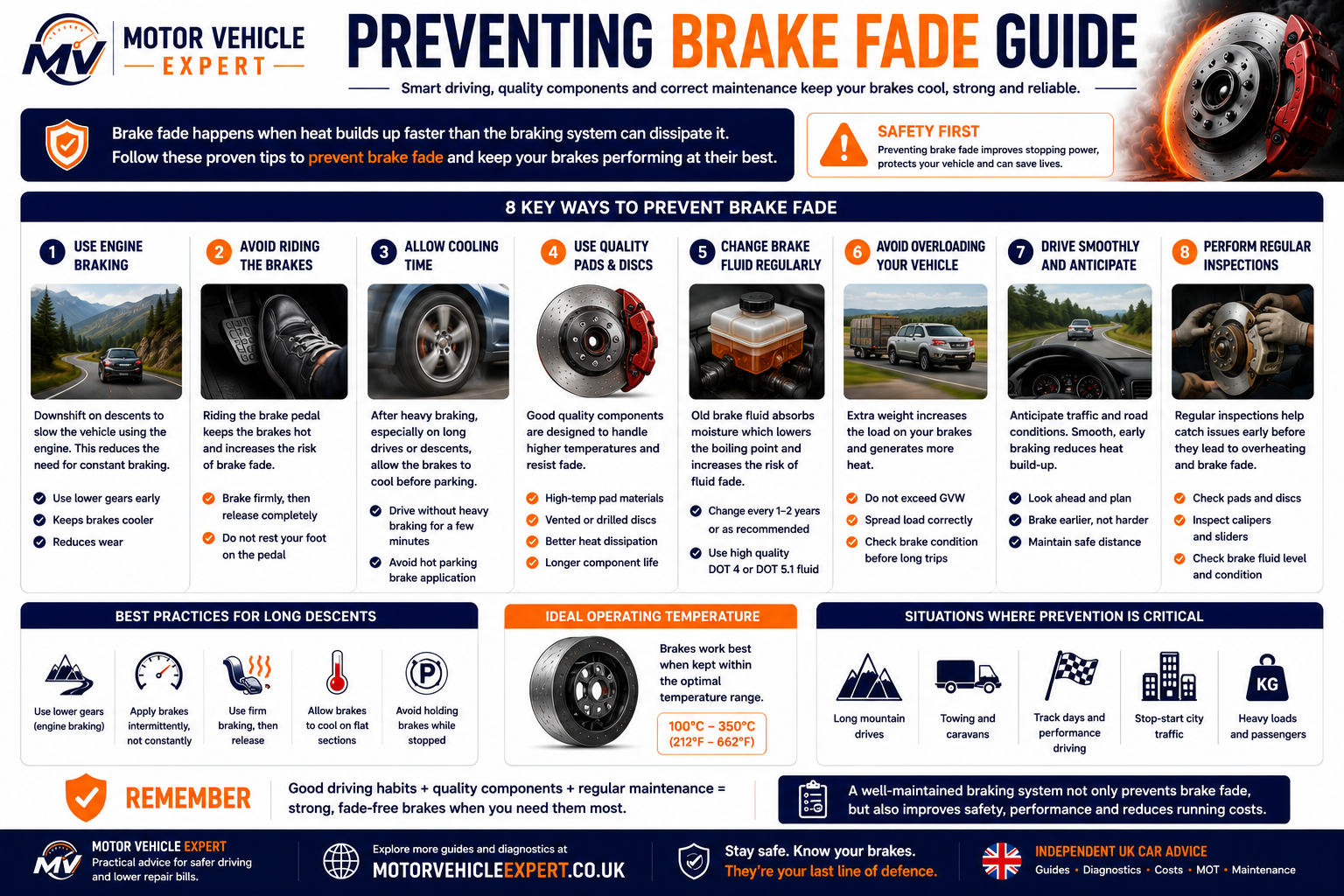
Brake fade prevention is about controlling heat. The right driving technique, good maintenance and quality braking components all help keep brake temperatures within a safe working range.
Prevent overheating first
Brake fade is usually the result of overheating. Understanding why brakes overheat helps prevent repeated brake fade and unnecessary component damage. See our
Brake Overheating Explained
guide.
Use Engine Braking
Best technique
On long descents, selecting a lower gear reduces continuous brake use and limits heat build-up.
Avoid Riding The Brakes
Driver habit
Keeping light pressure on the pedal for long periods creates constant heat.
Use Quality Brake Pads
Component choice
Good friction material maintains braking performance at higher temperatures.
Change Brake Fluid
Fluid protection
Fresh brake fluid reduces the risk of vapour lock during heavy braking.
Inspect Calipers
Prevent drag
Free-moving calipers prevent unwanted pad contact and continuous heat.
Let Brakes Cool
Heat control
After heavy braking, allow the system to cool gradually rather than continuing hard use.
Money-saving advice
How To Avoid Expensive Brake Fade Repairs
The cheapest way to deal with brake fade is to prevent repeated overheating. Once pads are glazed, discs are heat damaged or brake fluid has boiled, repair costs rise quickly.
Service Brake Fluid
Regular brake fluid replacement is cheaper than ABS, caliper or master cylinder repairs.
Replace Pads Early
Worn pads overheat faster and can damage brake discs.
Fix Binding Brakes
A sticking caliper can destroy pads and discs quickly if ignored.
Do Not Buy Cheapest Pads
Low-quality pads may fade earlier and wear discs faster.
Use Correct Driving Technique
Engine braking and controlled braking reduce heat on long descents.
Inspect After Overheating
Checking the system early can prevent a small issue becoming a full brake overhaul.
Best value rule:
Brake fade repairs become expensive when overheating is repeated. Early inspection, fresh fluid and good-quality brake components are usually cheaper than replacing damaged pads, discs, calipers and hydraulic parts later.
Used car buying
Brake Fade Checks When Buying A Used Car
Brake fade is not usually something you can see by looking at a parked vehicle, but previous overheating often leaves clear evidence elsewhere in the braking system. A careful inspection before buying can reveal whether the brakes have been maintained correctly or repeatedly subjected to excessive heat.
During a test drive, pay close attention to brake pedal feel, stopping performance, steering stability and any burning smells after repeated braking. Combined with a visual inspection and service history, these checks provide an excellent indication of the overall condition of the braking system.
Brake Service History
Excellent Sign
Look for invoices showing regular brake fluid changes together with brake pad and brake disc replacement when required.
Brake Pedal Feel
Road Test
The brake pedal should feel firm, progressive and consistent. A long or soft pedal deserves further investigation.
Brake Fluid Condition
Maintenance Indicator
Dark brake fluid or a neglected service history often suggests brake maintenance has been delayed.
Brake Disc Condition
Inspect Carefully
Blue heat marks, cracking, excessive scoring or heavy corrosion may indicate previous overheating.
Brake Pad Wear
Check Even Wear
Uneven brake pad wear can point towards sticking calipers or other braking faults.
Burning Smell
Warning Sign
A noticeable burning smell after a short drive could indicate a dragging brake or overheating component.
Buying Tip
A complete brake service history together with smooth, confident braking is usually a far better indicator of vehicle care than simply fitting brand-new brake pads immediately before sale.
Avoid these mistakes
Common Driver Mistakes That Cause Brake Fade
Many cases of brake fade are caused by driving technique rather than defective parts. Modern braking systems are extremely capable, but continuous heat generation can overwhelm even high-quality components if they are used incorrectly.
Riding The Brakes
Most Common
Keeping constant pressure on the brake pedal during long descents prevents the brakes from cooling naturally.
Ignoring Brake Fluid
Maintenance Error
Old brake fluid has a lower boiling point and greatly increases the risk of hydraulic brake fade.
Cheap Brake Pads
False Economy
Lower-quality pads generally lose braking efficiency sooner under heavy braking.
Overloading The Vehicle
Extra Heat
Heavy loads require the braking system to absorb much more energy during every stop.
Skipping Inspections
Avoidable
Ignoring worn pads, discs or sticking calipers often leads to repeated overheating.
Track Driving On Road Brakes
Extreme Heat
Standard road braking systems may not be designed for repeated high-speed braking.
Remember
Brake fade is usually preventable. Good maintenance, sensible driving technique and quality braking components significantly reduce the likelihood of overheating.
Continue Learning
Explore the Complete Braking System Knowledge Centre
Brake fade is a loss of braking performance caused by excessive heat, reduced friction or hydraulic problems. Continue exploring our complete UK braking guides covering brake components, hydraulic braking, electronic braking systems, MOT inspections, repair costs and practical driver safety advice.
Brake Components
Hydraulic Braking
Electronic Braking & Warning Lights
MOT & Brake Safety
Brake Repair Costs
Driver Inspection & Safety Guides
Complete your braking knowledge
Brake fade is usually the result of excessive heat affecting the friction materials or hydraulic system rather than a single faulty component. Continue through the Motor Vehicle Expert Braking System Knowledge Centre to understand how brake pads, brake discs, calipers, brake fluid, hydraulic pressure, ABS, electronic parking brakes and proper driving techniques work together to maintain safe, consistent braking performance.
Frequently asked questions
Brake Fade Explained FAQs
What is brake fade?
Brake fade is a temporary reduction in braking performance caused by excessive heat. It can make the vehicle take longer to stop and may make the pedal feel less effective.
What causes brake fade?
Brake fade is usually caused by repeated heavy braking, long downhill driving, towing, overheated pads and discs, old brake fluid, seized calipers or poor driving technique.
Is brake fade dangerous?
Yes. Brake fade is dangerous because it reduces stopping power and increases stopping distances, especially during emergency braking.
Can brake fluid cause brake fade?
Yes. Old or moisture-contaminated brake fluid can boil when overheated, creating vapour in the hydraulic system and causing a soft or spongy brake pedal.
Does brake fade go away?
Brake fade often improves once the brakes cool down, but repeated overheating can permanently damage pads, discs, brake fluid, calipers and hydraulic seals.
Can worn brake pads cause brake fade?
Yes. Thin, glazed or poor-quality brake pads can overheat more quickly and lose friction under repeated braking.
Can ABS prevent brake fade?
No. ABS can help prevent wheel lock-up, but it cannot stop brake pads, discs or brake fluid from overheating.
Will brake fade fail an MOT?
Brake fade itself may not appear during an MOT, but the causes of brake fade — such as poor brake efficiency, imbalance, fluid leaks, worn components or warning lights — can result in MOT failure.
How do you prevent brake fade?
Use engine braking on descents, avoid riding the brakes, maintain brake fluid, fit quality pads and discs, inspect calipers and allow brakes to cool after heavy use.
Should I replace brakes after brake fade?
Not always, but the system should be inspected. Replacement may be needed if pads are glazed, discs are heat damaged, brake fluid has boiled or a caliper is sticking.
About this guide
About This Brake Fade Guide
This guide was created to help UK drivers understand brake fade, why brakes lose stopping power when overheated, how to recognise the symptoms and how to prevent dangerous braking performance loss.
The page explains brake heat build-up, friction fade, brake fluid fade, green fade, mechanical fade, warning signs, MOT relevance, used car buying checks and maintenance decisions using a practical workshop-style approach.
UK Focused
Written for UK drivers, MOT concerns, repair decisions and everyday road use.
Workshop Approach
Explains brake fade using practical diagnostic logic used when inspecting braking systems.
Driver First
Designed to help motorists recognise symptoms, stay safe and ask better garage questions.
Editorial standards
How This Brake Fade Guide Was Written
Motor Vehicle Expert braking guides are written to explain vehicle safety systems clearly while remaining practical for everyday drivers. The aim is to combine mechanical principles with real-world inspection advice.
Guide Principles
- ✓Brake system safety first
- ✓Mechanic-style diagnostic structure
- ✓UK MOT relevance
- ✓Clear ownership advice
Topics Covered
- ✓Brake fade causes
- ✓Symptoms and inspection checks
- ✓Brake fluid and hydraulic risks
- ✓Prevention and repair decisions
Editorial note:
This guide is educational and intended to help drivers understand braking behaviour. It does not replace a professional inspection of a safety-critical braking system.
Disclaimer
Important Brake Safety Disclaimer
Brake fade affects stopping performance and should always be treated seriously. This guide is for educational purposes only and should not be used as a substitute for professional brake inspection or repair.
If your vehicle has reduced braking performance, smoke from the wheels, a burning smell, a soft brake pedal, brake warning lights or repeated brake fade symptoms, arrange inspection by a qualified technician before relying on the vehicle.
Safety first:
Brakes are safety-critical. Never continue normal driving with a confirmed hydraulic fault, severe brake fade, fluid leak or sudden loss of braking performance.
Read our full disclaimer →