
What Is A Brake Servo?
A brake servo is the brake assistance unit fitted between the brake pedal and the brake master cylinder. Its job is to multiply the driver's pedal effort using vacuum assistance, making the brake pedal easier to press while still allowing the hydraulic braking system to generate strong braking force.
The brake servo does not replace the hydraulic braking system. Instead, it works before the hydraulic pressure stage. When the driver presses the pedal, the servo boosts the input force sent into the master cylinder. The master cylinder then pushes brake fluid through the brake pipes and brake hoses so the brake calipers can apply the brakes at the wheels.
Main Purpose
Multiplies pedal effort so the driver can generate strong braking force without excessive leg pressure.
Common Symptom
A brake pedal that suddenly becomes very hard often points to reduced vacuum assistance.
Best First Check
Vacuum hoses, check valves and vacuum pumps should be tested before replacing the servo unit.
A brake servo fault usually creates a hard pedal with poor assistance, while a master cylinder fault more often causes a soft, sinking or spongy pedal. Correct diagnosis matters because both faults affect braking in different ways and can be confused during quick inspections.
What Is A Brake Servo?
A brake servo is a large sealed assistance unit usually mounted on the engine bay bulkhead directly behind the brake master cylinder. On most vehicles it uses vacuum pressure to reduce the physical effort required at the brake pedal. When the driver presses the pedal, the servo uses a pressure difference across an internal diaphragm to help move the pushrod connected to the master cylinder.
This assistance is important because the hydraulic braking system needs significant force to create strong stopping power. The disc braking system still relies on brake pads clamping against brake discs, but the driver's pedal force must first be converted into hydraulic pressure. The brake servo makes that process easier and more controlled by assisting the driver's input before pressure is generated.
Petrol engines often provide vacuum from the inlet manifold, while many diesel engines use a separate vacuum pump because they do not naturally produce the same intake vacuum. Some modern hybrid and electric vehicles use electric vacuum pumps or alternative brake assistance systems, but the purpose remains the same: reduce pedal effort while maintaining safe, predictable braking performance.
A healthy brake servo allows smooth, progressive braking. A faulty servo can make the pedal feel unusually hard, increase stopping effort, cause a hissing sound or affect engine idle if there is a vacuum leak. Because these symptoms can overlap with faults in the master cylinder, brake fluid, brake pipes, hoses, calipers or ABS system, the complete braking system should be assessed before major parts are replaced.
Vacuum Chamber
Uses pressure difference to help move the servo diaphragm and pushrod during braking.
Internal Diaphragm
Moves inside the servo housing when atmospheric pressure and vacuum are controlled by the internal valve.
One-Way Valve
Helps retain vacuum in the servo so brake assistance remains available during normal braking.
Pushrod
Transfers assisted pedal force from the servo into the brake master cylinder.
Vacuum Hose
Carries vacuum from the engine or vacuum pump to the servo and should be checked for cracking or poor sealing.
Brake Master Cylinder
A rear master cylinder leak can allow brake fluid to enter the servo and damage the internal diaphragm.
The brake servo makes modern braking feel light, controlled and predictable. If assistance is lost, the brakes may still operate hydraulically, but the pedal can become extremely hard and stopping the vehicle can require much more effort than the driver expects.
Brake Servo Diagram
The brake servo sits directly between the brake pedal and the brake master cylinder. Although the component appears simple from the outside, it contains a large diaphragm, control valve and pushrod assembly that work together using engine vacuum to multiply braking force. The diagram below illustrates the main components and how they interact whenever the brake pedal is pressed.
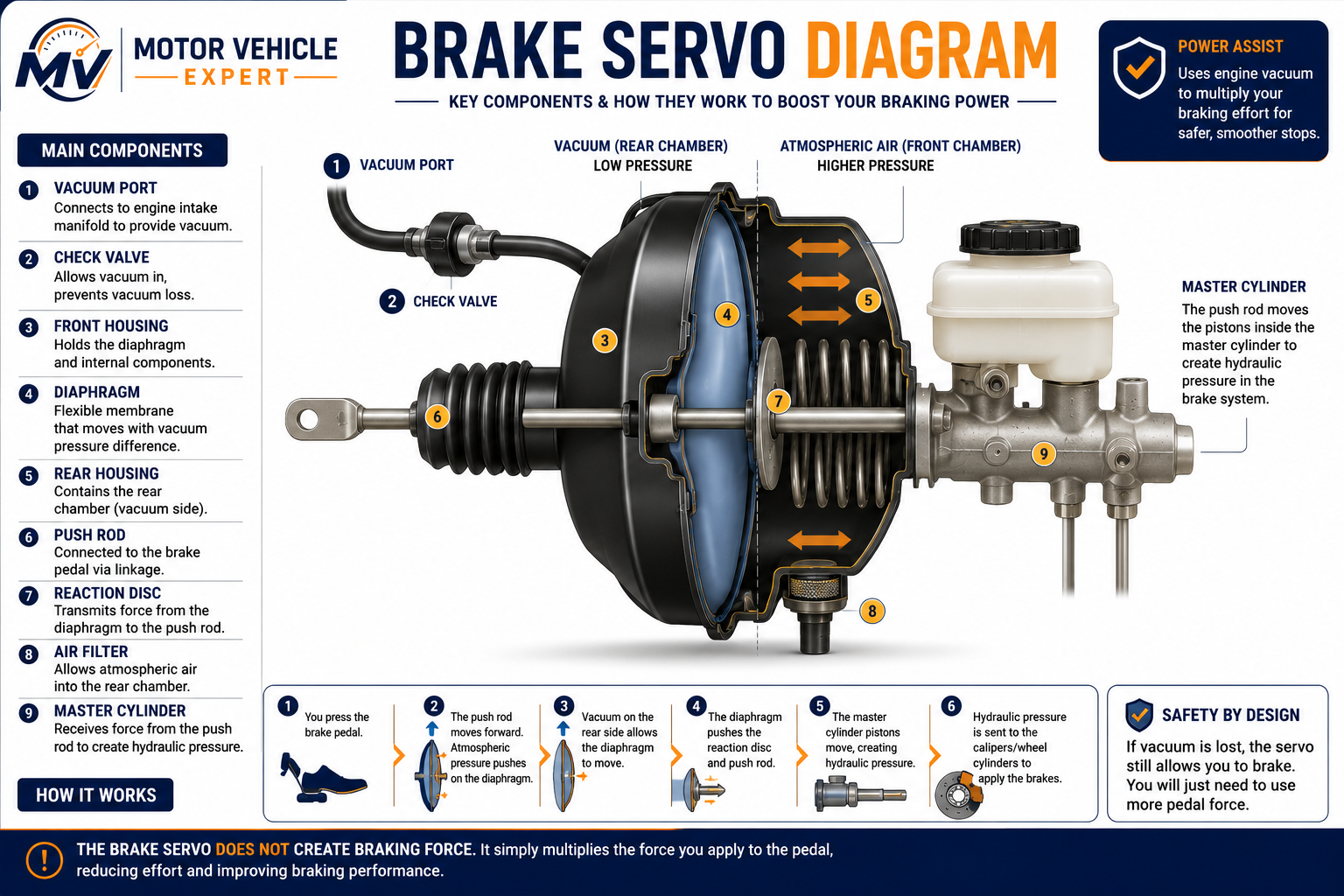
During normal driving the servo stores engine vacuum inside its vacuum chamber. When the driver presses the brake pedal, atmospheric pressure is admitted to one side of the diaphragm while vacuum remains on the opposite side. The resulting pressure difference assists the driver's pedal effort before hydraulic pressure is created inside the brake master cylinder.
Vacuum Chamber
Stores engine or vacuum pump assistance ready for every brake application.
Servo Diaphragm
Converts the pressure difference into additional force acting on the pushrod.
Control Valve
Regulates atmospheric pressure and vacuum inside the servo during braking.
One-Way Check Valve
Prevents vacuum escaping from the servo after the engine has been switched off.
Pushrod Assembly
Transfers the assisted force directly into the brake master cylinder.
Master Cylinder
Converts the assisted mechanical force into hydraulic brake pressure.
Although the brake servo provides brake assistance, it does not generate hydraulic pressure itself. Hydraulic pressure is always created inside the brake master cylinder. The servo simply reduces the amount of pedal effort required by the driver.
How A Brake Servo Works
Modern hydraulic braking systems require considerable force to stop a vehicle safely. Without brake assistance, drivers would need to apply much greater pressure to the brake pedal during every stop. The brake servo solves this problem by using vacuum energy that already exists within the engine or is generated by a dedicated vacuum pump.
At rest, both sides of the servo diaphragm are exposed to vacuum. Because the pressure is equal on both sides, no assistance is produced. As soon as the brake pedal begins moving, an internal reaction valve opens and allows atmospheric pressure to enter one chamber while the opposite chamber remains under vacuum. The resulting pressure difference pushes the diaphragm forwards with considerable force.
The diaphragm is connected directly to a pushrod leading into the brake master cylinder. Instead of relying solely on the driver's leg strength, the servo adds its own force to the driver's input. The master cylinder then converts this combined force into hydraulic pressure, sending brake fluid through the brake pipes and brake hoses towards the brake calipers.
As braking force increases, an internal reaction disc provides progressive pedal feedback. This prevents the brakes from feeling overly sensitive while allowing the driver to judge braking effort accurately. When the brake pedal is released, the reaction valve closes, both chambers return to equal vacuum pressure and the diaphragm returns to its rest position ready for the next braking event.
Step 1
Engine vacuum or the vacuum pump fills both chambers inside the brake servo.
Step 2
The reaction valve opens and allows atmospheric pressure into one chamber.
Step 3
Pressure difference pushes the diaphragm and multiplies pedal effort.
Step 4
Assisted force is transferred into the master cylinder to create hydraulic pressure.
Step 5
Hydraulic pressure operates the brake calipers and pads at each wheel.
Step 6
Releasing the brake pedal equalises vacuum pressure and prepares the servo for the next application.
Without a brake servo, emergency braking would require significantly more physical effort. The servo improves driver comfort during everyday driving while also helping drivers achieve maximum braking force more quickly during emergency situations.
Vacuum Brake Servo Operation
The brake servo is often called a vacuum brake booster because it relies on vacuum pressure to assist braking. Rather than generating braking force itself, the servo uses the difference between atmospheric pressure and engine vacuum to multiply the force applied by the driver's foot. This simple but highly effective design has been used for decades because it delivers smooth, reliable brake assistance without placing additional physical demands on the driver.
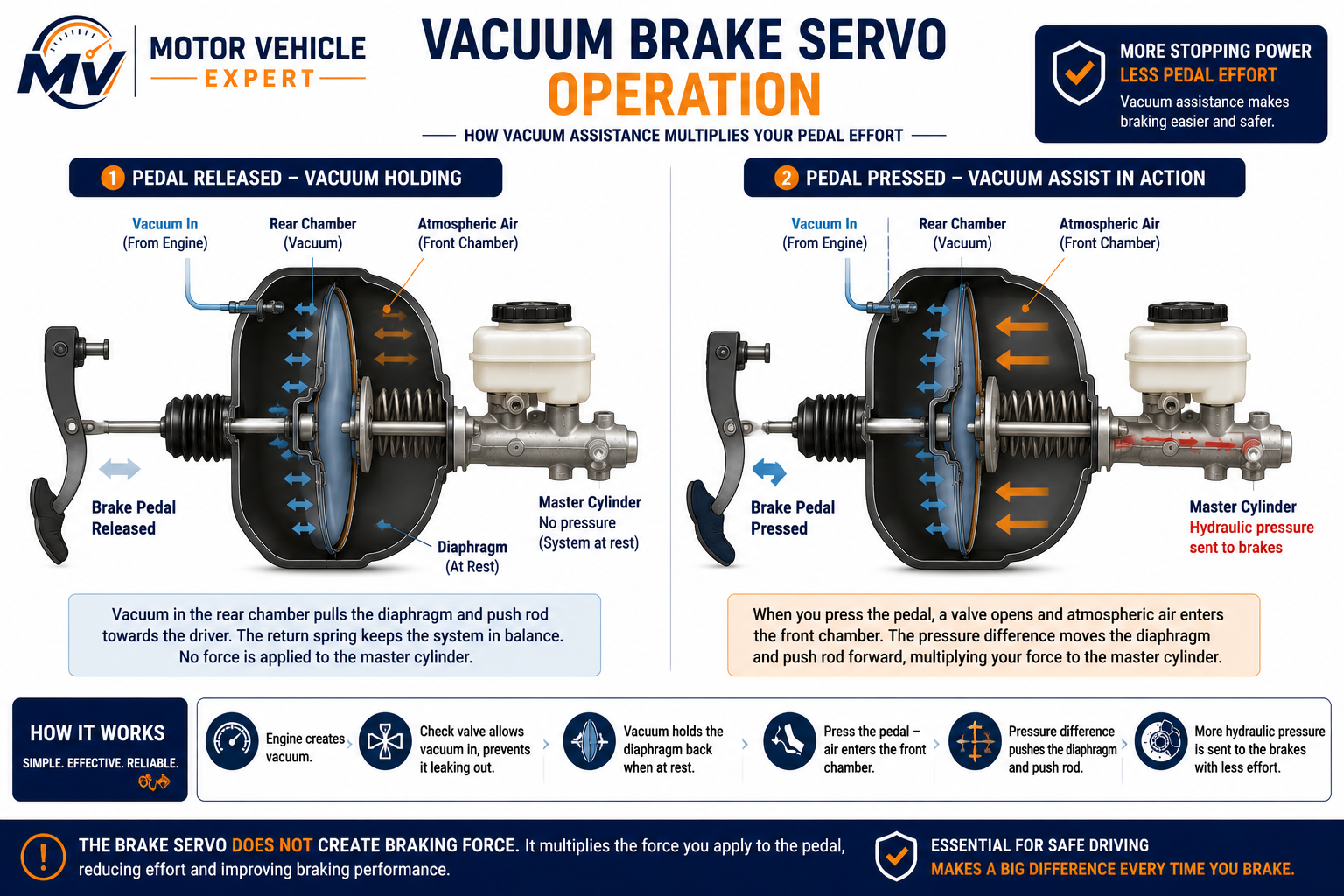
On petrol engines, vacuum is normally produced naturally within the inlet manifold whenever the throttle is partially closed. A vacuum hose connects the inlet manifold to the brake servo through a one-way check valve. This valve allows vacuum to enter the servo while preventing it from escaping when engine vacuum temporarily falls or the engine is switched off.
Diesel engines operate differently because they produce very little intake manifold vacuum. For this reason, most diesel vehicles use a dedicated mechanical or electric vacuum pump driven by the engine. Hybrid and electric vehicles may also use electrically driven vacuum pumps or electronic brake assistance systems because there is little or no engine vacuum available.
During normal driving, both chambers inside the brake servo remain under vacuum. As soon as the driver presses the brake pedal, the internal reaction valve admits atmospheric pressure into one chamber while vacuum remains in the other. The pressure difference immediately moves the diaphragm forward, multiplying pedal effort before the brake master cylinder begins generating hydraulic pressure.
Once the driver releases the brake pedal, the control valve closes and both chambers return to equal vacuum pressure. The diaphragm returns to its rest position and the system is instantly ready for the next brake application. Because the vacuum is stored inside the servo, drivers usually retain one or two assisted brake applications after switching the engine off.
Petrol Engines
Vacuum is supplied naturally from the intake manifold through a vacuum hose and one-way check valve.
Diesel Engines
Most diesel engines require a dedicated vacuum pump because little natural intake vacuum exists.
Hybrid & EV
Modern hybrids and electric vehicles frequently use electric vacuum pumps or electronic brake boosters.
Check Valve
Prevents stored vacuum escaping from the servo after the engine has been switched off.
Reaction Valve
Controls when atmospheric pressure enters the servo to create brake assistance.
Brake Assistance
Assistance increases smoothly with pedal effort, giving the driver natural braking feel and control.
A brake servo itself is often blamed for hard brake pedals, but experienced technicians first inspect the vacuum hose, one-way check valve and vacuum pump. These inexpensive components fail more frequently than the servo and should always be tested before replacing the booster assembly.
Common Brake Servo Problems
Brake servos are extremely reliable and often last the lifetime of the vehicle. However, like every braking component, they are affected by age, heat, vibration, contaminated brake fluid and deteriorating rubber components. Many symptoms blamed on the brake servo actually originate from the surrounding vacuum system, making professional diagnosis essential before replacement.
Hard Brake Pedal
The most common symptom of reduced brake assistance. Vacuum leaks, failed servos or faulty vacuum pumps can all produce an unusually hard brake pedal.
Vacuum Hose Leak
Cracked or split vacuum hoses reduce the amount of assistance available and may also affect engine running.
Failed Check Valve
A faulty one-way valve allows stored vacuum to escape, reducing brake assistance after starting or repeated braking.
Servo Diaphragm Failure
A damaged diaphragm prevents the servo from multiplying pedal force correctly and usually requires servo replacement.
Vacuum Pump Fault
Mechanical or electric vacuum pump failures reduce the vacuum available to the brake servo.
Brake Fluid Contamination
Brake fluid leaking from the rear of the master cylinder can damage the servo diaphragm and internal seals.
Hissing Noise
A hissing sound while pressing the brake pedal often indicates escaping vacuum around the servo or connected pipework.
Engine Idle Changes
Vacuum leaks can allow unmetered air into the engine, causing rough idle or changing engine speed when braking.
Poor Brake Feel
Reduced assistance may develop gradually, making braking feel heavier long before complete servo failure occurs.
A hard brake pedal does not automatically mean the brake servo has failed. Professional workshops first inspect the complete brake assistance system, including the vacuum hose, one-way check valve, vacuum pump, brake master cylinder and hydraulic braking system before recommending servo replacement.
Brake Servo Failure Guide
Brake servo failures usually develop gradually rather than occurring without warning. In many cases, the servo itself is not the component that has failed. Vacuum leaks, damaged hoses, worn check valves or faulty vacuum pumps often produce identical symptoms. Understanding the common warning signs helps prevent unnecessary parts replacement and ensures the real fault is diagnosed correctly.
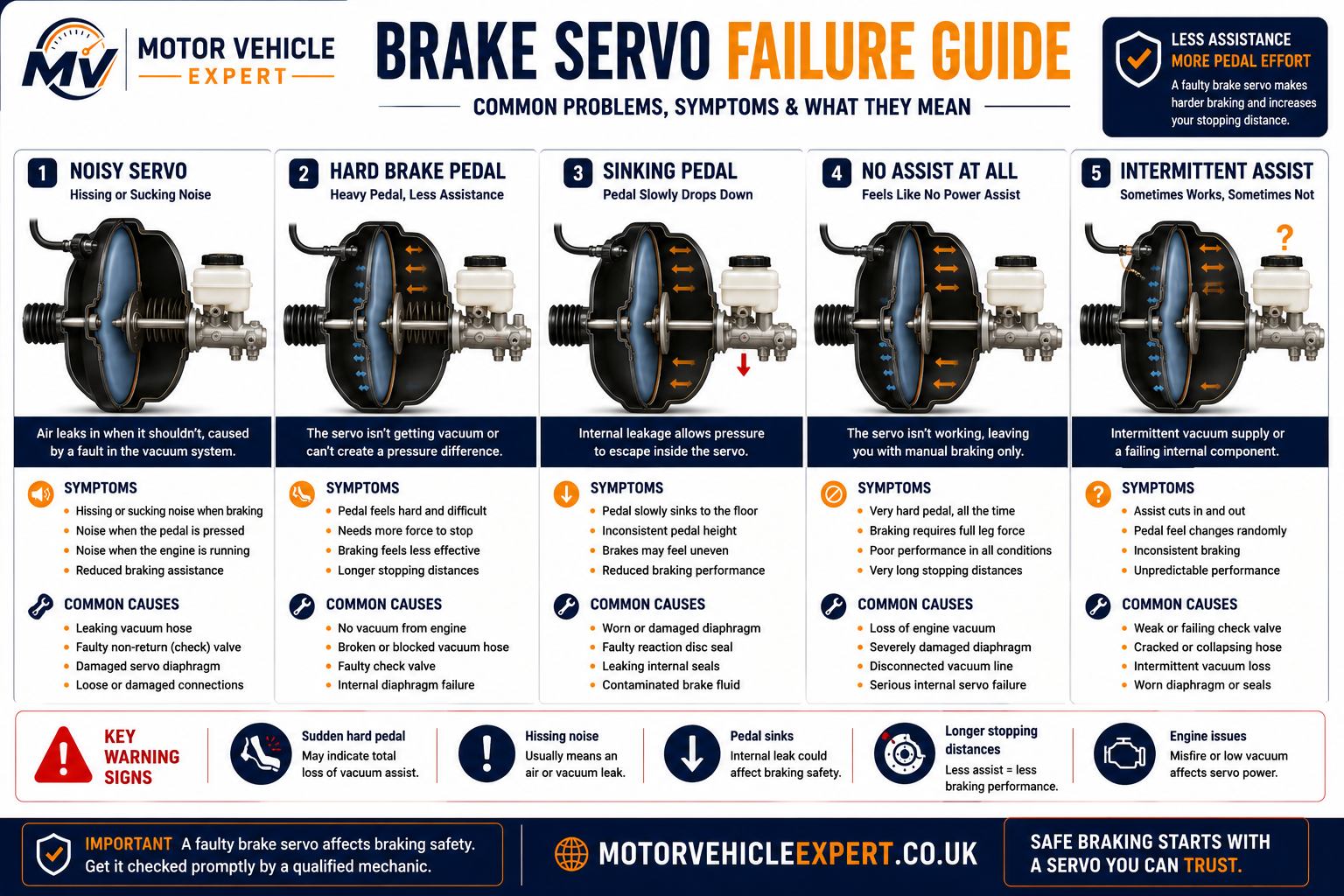
One of the earliest symptoms is a brake pedal that gradually becomes firmer than normal. Drivers often notice they must press much harder than before to achieve the same braking effect. Because the hydraulic braking system continues to operate, the vehicle will usually still stop, but emergency braking requires significantly greater effort.
A hissing sound while pressing the brake pedal is another classic symptom. This often indicates air entering the servo through a damaged diaphragm or leaking internal valve. However, split vacuum hoses and poor hose connections can produce similar noises, making further inspection essential.
Petrol engines may also develop unstable idle speed when the brake pedal is pressed. A leaking servo or vacuum hose allows additional air into the intake system, upsetting the air-fuel mixture and causing rough idle or fluctuating engine speed.
Hard Brake Pedal
Reduced brake assistance requiring much greater pedal effort.
Hissing Noise
Air escaping through a damaged diaphragm or leaking vacuum connection.
Longer Stopping Distance
Braking performance suffers because full pedal force becomes harder to achieve.
Engine Idle Changes
Vacuum leaks can alter idle speed on petrol engines.
Poor Pedal Feel
Brake assistance gradually decreases as vacuum leaks worsen.
Brake Warning Lights
Modern vehicles may also display stability control or brake-related warnings.
Never assume a hard brake pedal automatically means the brake servo requires replacement. Professional diagnosis should always include vacuum hose inspection, check valve testing, vacuum pump output testing and master cylinder inspection before replacing the servo assembly.
Brake Servo Inspection Guide
Professional workshops inspect the entire brake assistance system rather than concentrating solely on the servo. Many apparent servo failures are ultimately traced to inexpensive vacuum leaks or damaged hoses that can be repaired without replacing the brake booster itself.
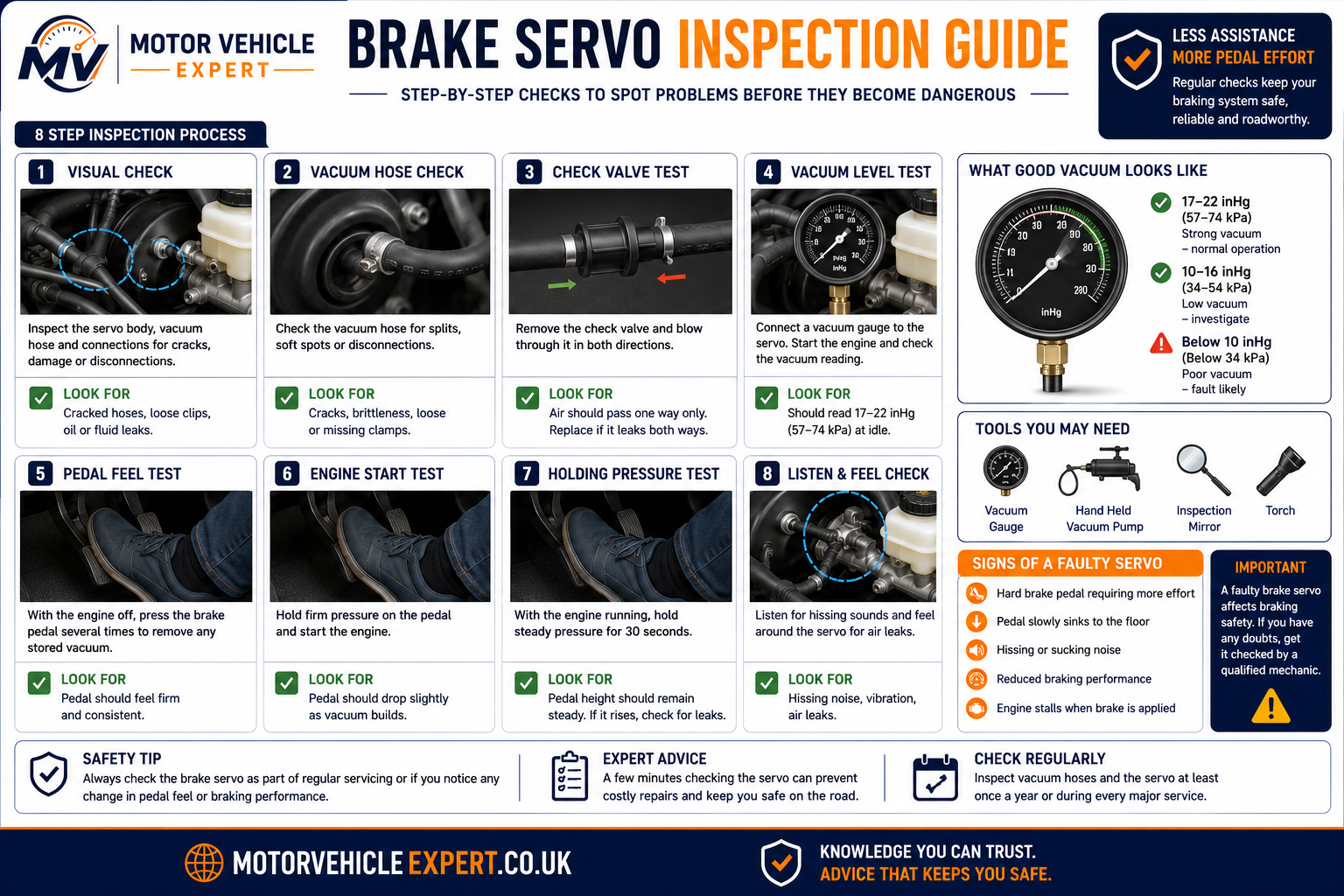
Vacuum Hose
Look for splits, loose connections, oil contamination or collapsed sections.
Check Valve
Confirm vacuum is retained after the engine has been switched off.
Vacuum Pump
Measure vacuum output against manufacturer specifications.
Master Cylinder
Inspect for brake fluid leaking into the servo housing.
Pedal Test
Pump the brake pedal with the engine off, hold pressure and start the engine. The pedal should drop slightly if the servo operates correctly.
Road Test
Confirm smooth, progressive braking without excessive pedal effort or abnormal noises.
Brake servo diagnosis should always follow a logical process: inspect vacuum supply, test the one-way valve, measure vacuum pump output where fitted, inspect the master cylinder for leaks and finally assess the servo itself. This approach prevents unnecessary replacement of expensive components.
Can A Brake Servo Be Repaired Or Must It Be Replaced?
One of the most common assumptions made after a hard brake pedal develops is that the brake servo itself has failed. While complete servo failures do occur, experienced technicians know they are often far less common than problems affecting the vacuum supply system. Split vacuum hoses, leaking one-way check valves, worn vacuum pumps and leaking brake master cylinders can all produce symptoms that closely resemble brake servo failure. Accurate diagnosis is therefore the most important stage of any brake servo repair because replacing the booster without confirming the fault can waste hundreds of pounds while leaving the original problem unresolved.
Modern brake servos are sealed safety components designed to provide reliable brake assistance throughout many years of service. Unlike brake calipers or master cylinders, they are not generally designed to be dismantled and repaired by ordinary workshops. The internal diaphragm, reaction valve and control mechanism operate under carefully controlled pressure differences, and manufacturers normally specify complete replacement if the servo itself becomes defective.
Fortunately, many apparent brake servo faults originate outside the servo housing. The first components inspected should always be the vacuum hose and one-way check valve. Rubber hoses naturally harden with age, engine heat and oil contamination. Small cracks may not be obvious during a visual inspection but can allow sufficient air leakage to reduce brake assistance. Replacing a damaged hose or faulty check valve is considerably cheaper than replacing the complete servo and often restores normal braking immediately.
Diesel vehicles deserve particular attention because they rely on a dedicated vacuum pump rather than inlet manifold vacuum. Mechanical vacuum pumps wear gradually while electrically driven pumps may suffer motor, relay or electrical faults. Low vacuum output can produce an increasingly hard brake pedal despite the brake servo remaining in perfect working order. Measuring vacuum pressure using professional diagnostic equipment forms an essential part of the diagnostic process before any major components are replaced.
Another frequently overlooked cause of brake servo damage is brake fluid contamination. The brake master cylinder is mounted directly onto the front of the servo, separated only by a pushrod seal. If the rear seal inside the master cylinder begins leaking, brake fluid can enter the servo housing where it attacks the rubber diaphragm and internal seals. In these situations replacing only the master cylinder may not be sufficient because the contaminated servo may continue deteriorating internally even after the hydraulic leak has been repaired.
When a brake servo itself has genuinely failed, replacement is normally the safest and most reliable solution. Internal diaphragms cannot usually be serviced individually and reaction valve calibration requires specialist equipment. Attempting to dismantle a servo without the correct procedures can compromise braking performance and create significant safety risks.
Reconditioned brake servos are available for many popular vehicles and can provide an excellent balance between cost and reliability when supplied by reputable brake specialists. These units are typically stripped, cleaned, fitted with new diaphragms and seals where appropriate, pressure tested and inspected before sale. Cheap second-hand servos from vehicle breakers should be approached cautiously because internal corrosion or diaphragm deterioration cannot normally be assessed externally.
Labour costs vary considerably between vehicles. On some cars the servo can be accessed relatively easily once the brake master cylinder has been moved aside. Other vehicles require significant dashboard, pedal box or bulkhead disassembly before the retaining nuts become accessible. Labour therefore often exceeds the cost of the servo itself, particularly on premium European vehicles where engine bay packaging is extremely compact.
Replacement of the brake servo frequently requires removal of the brake master cylinder. Although it may be possible to move the master cylinder without disconnecting hydraulic brake pipes on some vehicles, many repairs require partial hydraulic disassembly. Where hydraulic lines are opened, the braking system must be correctly bled using manufacturer-approved procedures to remove all trapped air before the vehicle is returned to service.
Modern vehicles equipped with ABS, Electronic Stability Control and electronic brake assistance may also require additional diagnostic procedures after repairs have been completed. Professional workshops verify brake pedal travel, servo assistance, hydraulic pressure, stored fault codes and ABS operation before carrying out a controlled road test. Simply replacing the servo without confirming complete braking system performance falls well short of professional repair standards.
From a cost perspective, replacing inexpensive vacuum components before condemning the servo almost always makes financial sense. A cracked vacuum hose or failed check valve may cost only a small fraction of a complete servo replacement while producing almost identical symptoms. Likewise, identifying a weak vacuum pump early can prevent unnecessary replacement of perfectly serviceable brake assistance components.
Vacuum Hose
Usually RepairSplit or collapsed hoses are inexpensive to replace and frequently restore normal brake assistance.
Check Valve
Replace SeparatelyOne-way valves commonly fail with age and should always be tested before replacing the servo.
Vacuum Pump
Repair or ReplaceParticularly important on diesel vehicles where brake assistance depends entirely upon pump output.
Brake Master Cylinder
Inspect CarefullyRear seal leaks can contaminate and permanently damage the brake servo.
Brake Servo
Usually ReplaceInternal diaphragm or reaction valve failures normally require complete servo replacement.
Post-Repair Testing
Always RequiredConfirm vacuum assistance, pedal feel, hydraulic operation and road performance before returning the vehicle to service.
Brake servo replacement should never be based solely on a hard brake pedal. A professional diagnostic routine always checks the complete brake assistance system—including the vacuum hose, one-way check valve, vacuum pump, brake master cylinder and hydraulic braking system—before recommending replacement of the servo. This systematic approach reduces unnecessary repair costs while ensuring the true fault is corrected safely.
Brake Servo And The UK MOT Test
Although the brake servo is hidden behind the brake master cylinder and cannot be inspected internally during an MOT, its operation has a direct effect on braking performance. The DVSA MOT Inspection Manual requires the braking system to operate safely and efficiently, meaning faults affecting brake assistance can contribute to an MOT failure if braking performance is significantly reduced.
During the MOT, the tester checks the complete braking system rather than the servo alone. Brake pedal feel, braking efficiency, hydraulic performance, brake balance, brake pipes, brake hoses, brake fluid leaks, brake discs, brake pads and warning lamps are all assessed together. If the servo fails to provide normal assistance, the increased pedal effort may reduce braking performance or indicate an underlying safety defect that requires repair.
A professional technician will often identify brake servo faults before the MOT by carrying out a simple functional test. With the engine switched off, the brake pedal is pumped several times to remove stored vacuum. The pedal is then held down while the engine starts. If the servo is operating correctly, the pedal should move slightly downwards as vacuum assistance becomes available. Failure of this test suggests further investigation is required.
Modern braking systems are closely integrated. Vehicles fitted with ABS, Electronic Brakeforce Distribution (EBD), Brake Assist and Electronic Stability Control depend upon a healthy hydraulic braking system. Although these systems perform different functions, maintaining the brake servo, master cylinder and hydraulic components ensures every braking safety system operates correctly.
Pass
Brake assistance operates normally, braking efficiency meets MOT requirements and no safety defects are present.
Investigate
Heavy pedal effort or abnormal brake feel should always be investigated before the MOT.
Potential Failure
If brake assistance is significantly reduced or braking performance is unsafe, the vehicle may fail its MOT.
Never ignore a suddenly hard brake pedal simply because the vehicle still stops. Reduced brake assistance can significantly increase stopping effort during emergency braking and should always be professionally diagnosed before continued use.
Typical Brake Servo Replacement Costs UK
Brake servo repairs range from inexpensive vacuum hose replacements to complete brake booster replacement. Labour often represents a significant proportion of the final bill because access behind the brake master cylinder and dashboard bulkhead can be time-consuming on many modern vehicles. These guide prices are broad UK estimates only.
Vacuum Hose
£40–£120Cracked or collapsed vacuum hoses are among the most common and least expensive brake assistance repairs.
One-Way Check Valve
£40–£100Frequently replaced alongside the vacuum hose to restore proper vacuum retention.
Vacuum Pump
£180–£550Mechanical or electric vacuum pumps vary considerably in price depending on engine design.
Brake Servo
£250–£700Complete servo replacement including labour on many common UK vehicles.
Master Cylinder & Servo
£450–£900+Often recommended where brake fluid contamination has damaged both components.
Brake Fluid & Bleeding
£70–£180Hydraulic bleeding may be required whenever brake pipes or the master cylinder have been disconnected.
Diagnostic Inspection
£50–£120Professional diagnosis often identifies inexpensive vacuum faults before major parts are replaced.
Premium Vehicle Repairs
£700–£1,300+Labour costs increase significantly where dashboard or bulkhead components require removal.
Complete Brake Assistance Repair
£900–£1,800+Vacuum pump, servo, master cylinder and hydraulic work combined can become a major repair.
Always authorise a professional inspection before replacing the brake servo. A damaged vacuum hose or faulty one-way valve can produce almost identical symptoms for a fraction of the replacement cost.
Brake Servo Used Car Buying Checks
Brake servo problems are relatively uncommon compared with brake pad or brake disc wear, but they can be expensive to repair if the fault involves the vacuum pump, brake master cylinder or complete servo assembly. When buying a used vehicle, checking brake assistance should form part of every inspection.
Start the engine and assess brake pedal feel immediately. The pedal should feel progressive and require only moderate pressure during normal braking. A pedal that feels unusually firm, requires excessive effort or changes dramatically after repeated applications deserves further investigation.
Brake Pedal Feel
A heavy or unusually hard brake pedal should never be ignored during a test drive.
Vacuum Hoses
Check for cracked rubber hoses, poor repairs or oil contamination around vacuum connections.
Master Cylinder
Inspect for brake fluid leaks around the rear of the master cylinder and servo connection.
Engine Idle
Engine speed should remain stable when the brake pedal is pressed repeatedly.
Service History
Look for evidence of brake fluid replacement, hydraulic servicing and previous brake repairs.
Professional Inspection
A pre-purchase inspection can identify vacuum leaks or developing brake assistance faults before purchase.
Never dismiss a hard brake pedal as "normal for this model." Modern vehicles should provide smooth, progressive brake assistance. If braking feels unusually heavy, have the system professionally inspected before committing to the purchase.
Brake Servo FAQs
What does a brake servo do?
A brake servo, also called a vacuum brake booster, reduces the amount of force needed to press the brake pedal. It uses engine vacuum or a dedicated vacuum pump to multiply the driver's pedal effort before hydraulic pressure is generated by the brake master cylinder.
Is a brake servo the same as a brake booster?
Yes. In the UK the component is commonly called a brake servo, while in North America it is usually referred to as a brake booster or vacuum brake booster. Both names describe the same component.
What are the symptoms of a failing brake servo?
Common symptoms include a hard brake pedal, increased stopping effort, hissing noises when braking, reduced brake assistance, poor pedal feel and, on some petrol vehicles, rough engine idle caused by vacuum leaks.
Can I drive with a faulty brake servo?
Although the hydraulic brakes may still work, braking usually requires much greater pedal effort. Because emergency stopping distances and driver control may be affected, a faulty brake servo should be repaired before further driving whenever possible.
Can a faulty brake servo fail an MOT?
Yes. If reduced brake assistance affects braking performance or creates an unsafe braking condition, the vehicle may fail its MOT inspection.
Can a vacuum hose cause a hard brake pedal?
Yes. Split vacuum hoses, leaking connections and faulty one-way check valves are common causes of reduced brake assistance and are often mistaken for complete brake servo failure.
Can the brake master cylinder damage the brake servo?
Yes. If brake fluid leaks from the rear seal of the master cylinder, it can enter the servo housing and damage the internal diaphragm and seals, often requiring replacement of both components.
Do diesel vehicles use brake servos?
Yes. Most diesel vehicles use brake servos but rely on a dedicated vacuum pump because diesel engines produce very little natural inlet manifold vacuum.
How much does brake servo replacement cost in the UK?
Typical UK replacement costs range from around £250 to £700 for many vehicles, although premium models, vacuum pump faults or master cylinder replacement can increase the overall repair bill considerably.
Can a brake servo be repaired instead of replaced?
Usually not. Modern brake servos are generally replaced as complete assemblies. However, vacuum hoses, check valves and vacuum pumps can often be repaired separately if they are the true cause of the fault.
How can I test a brake servo at home?
With the engine switched off, pump the brake pedal several times until it becomes firm. Hold pressure on the pedal while starting the engine. If the brake servo is operating correctly, the pedal should move slightly downward as vacuum assistance becomes available.
What is the difference between a brake servo fault and a master cylinder fault?
A faulty brake servo usually causes a hard brake pedal requiring greater effort, while a failing brake master cylinder more commonly produces a soft, sinking or spongy pedal caused by hydraulic pressure loss.
Explore the Complete Braking System Knowledge Centre
The brake servo reduces the effort needed to operate the brakes by assisting the brake master cylinder. Continue exploring our complete UK braking guides covering brake components, hydraulic braking, electronic braking systems, MOT inspections, repair costs and practical driver safety advice.
Brake Components
Hydraulic Braking
Electronic Braking & Warning Lights
MOT & Brake Safety
Brake Repair Costs
Driver Inspection & Safety Guides
The brake servo works with the brake master cylinder, brake fluid and the rest of the hydraulic braking system to reduce pedal effort and deliver controlled stopping power. Continue through the Motor Vehicle Expert Braking System Knowledge Centre to understand how every braking component, electronic safety system and MOT requirement fits together.