
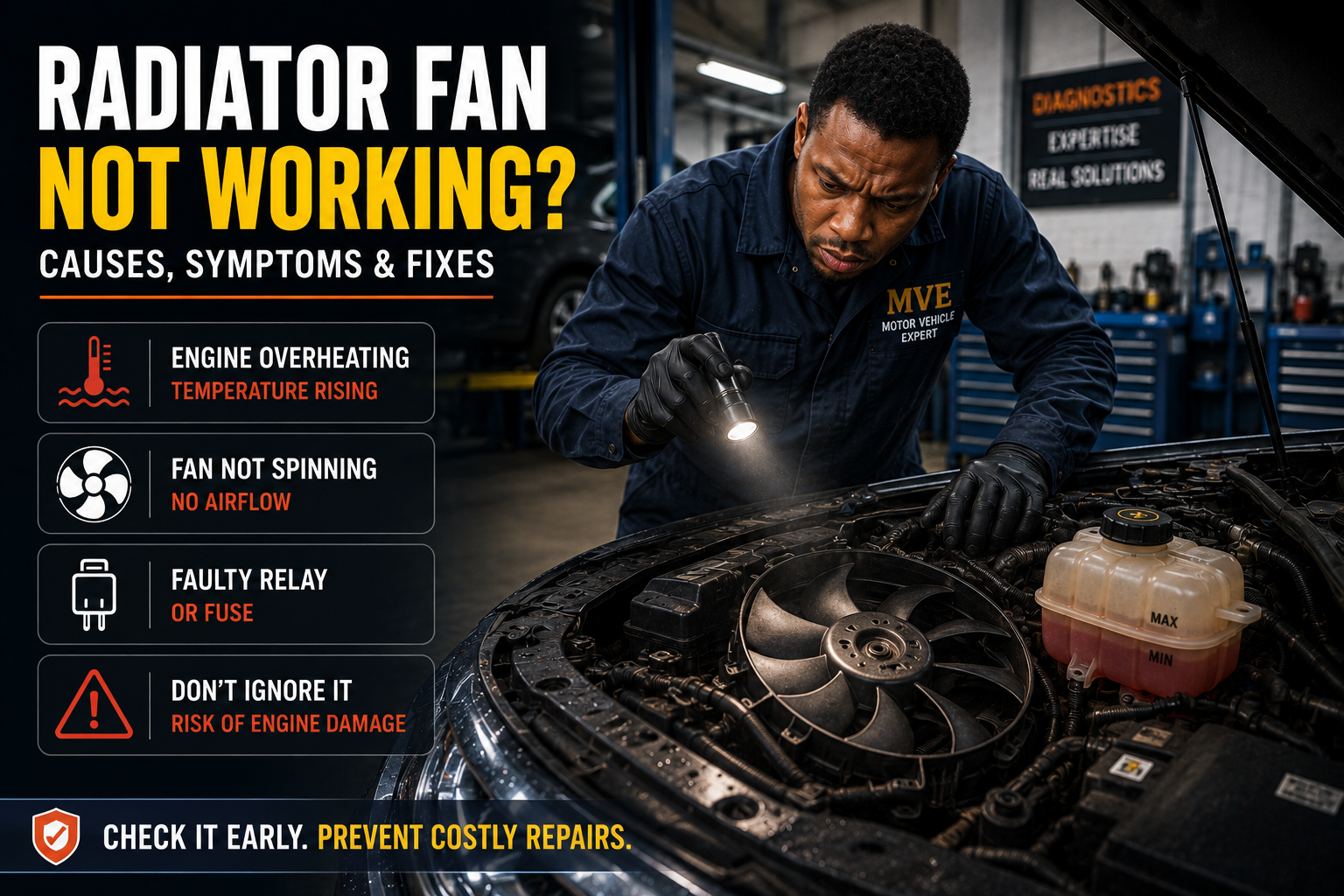
Quick answer
A radiator fan that does not come on can cause overheating when the car is stationary because there is very little airflow through the radiator. Once the car is moving, road speed may cool the radiator enough to hide the fault for a while.
Start with the basics: check coolant level when cold, watch the temperature gauge, listen for the fan, try the air conditioning clue, then check the fan fuse, relay, wiring, fan motor and temperature sensor. Do not keep letting the engine overheat while testing.
If the car overheats mainly in traffic but cools down when moving, think airflow first. The radiator fan is a strong suspect, but still check coolant level, airlocks, thermostat behaviour and radiator condition before buying parts.
For related overheating, coolant leak, thermostat and radiator guides, visit Cooling System Guides UK.
What I normally see with radiator fan faults
In real workshop situations, radiator fan problems usually show themselves in traffic first. Drivers often say the car is fine on the motorway, then suddenly starts overheating in queues, supermarket traffic or while parked with the engine running.
A lot of people immediately replace the fan motor, but that is not always the fault. I regularly see blown fuses, weak relays, damaged wiring, low coolant, airlocks or faulty temperature sensors causing the exact same symptoms.
The overheating pattern matters. If the temperature drops once the car starts moving again, airflow is helping the radiator and the fan system becomes one of the first areas to inspect properly.
A fan fault can look small at first, but repeated overheating in traffic can eventually damage the head gasket or cooling system if ignored.
What this looks like in real life
Temperature rises in queues
The gauge climbs in traffic, at lights or while waiting in a car park.
Car overheats in traffic →Temperature drops when driving
Once moving, road airflow cools the radiator and the fault may seem to disappear.
Overheating at idle →Fan stays silent
The engine gets hot but there is no fan noise from the front of the car.
Aircon gets warm in traffic
Poor fan operation can reduce air conditioning performance while stationary.
Overheats with AC on →Coolant smell after stopping
Overheating or pressure can push coolant vapour out and create a sweet smell.
Coolant smell guide →Warning appears then clears
The warning may appear in traffic and clear when the car cools at road speed.
Coolant warning light →Signs the radiator fan may not be working
Overheats in traffic
The temperature climbs in queues, at lights or while idling.
Cools down when moving
Road airflow helps the radiator once the car is driving again.
Fan never comes on
The engine gets hot but the fan stays silent.
Coolant warning light
Low coolant or overheating may trigger a dashboard warning message.
Aircon weaker at idle
Some cars rely on cooling fan airflow for good A/C performance while stopped.
Fan runs constantly
Constant fan running is also a clue, often linked to sensors, coolant level, A/C demand or control faults.
Common causes of a radiator fan not working
Blown fuse
The fan circuit can draw a lot of current, so a blown fuse can stop the fan completely.
Faulty relay
A relay can fail and stop the fan receiving power when the car commands it on.
Failed fan motor
The motor can seize, wear out, run weakly or stop working when hot.
Temperature sensor fault
If the car does not read the correct temperature, it may not switch the fan on at the right time.
Wiring or connector fault
Corrosion, loose plugs, broken wires or heat damage can interrupt fan operation.
Fan control module
Many modern cars use a control unit or resistor pack to manage fan speed.
Low coolant
Low coolant can make the engine overheat and may confuse temperature behaviour.
Coolant loss guide →Airlock in the system
Air trapped in the cooling system can cause strange temperature readings and poor coolant flow.
Heater cold then hot →ECU command issue
The fan may depend on temperature, A/C pressure, engine load and other sensor data.
The air conditioning clue
On many cars, switching on the air conditioning should make the cooling fan run or cycle while the car is stationary. This is not a perfect test for every vehicle, but it is a useful clue.
Fan works with A/C
The fan motor may be capable of running. The fault may be temperature sensor, coolant level, fan command or control logic.
Fan does not work with A/C
Check fan fuse, relay, wiring, fan motor, control module and whether the A/C system itself is operating correctly.
A/C gets warm in traffic
Poor fan operation can reduce cooling performance while stationary.
Fan runs constantly with A/C
This can be normal on some cars, but it can also point to heat, pressure or sensor concerns.
Why a bad fan causes overheating in traffic
The radiator needs airflow to remove heat. When driving, airflow comes through the front of the car naturally. In traffic, that airflow disappears, so the radiator fan has to pull air through instead.
That is why a car with a bad fan may behave normally on the motorway but get hot in a supermarket queue, school-run traffic or stop-start town driving.
If the car overheats even at normal road speeds, do not blame the fan alone. You may also have low coolant, a blocked radiator, thermostat trouble, water pump weakness or head gasket symptoms. Read engine overheating while driving.
What to check first
1. Do not test it until it overheats badly
Watch the temperature gauge and stop before the engine gets too hot.
2. Check coolant level when cold
Low coolant can create overheating symptoms that look like a fan fault.
3. Listen for the fan
With the engine hot, the fan should usually cut in before the temperature climbs too far.
4. Try the A/C clue
On many cars, switching on A/C should command fan operation or fan cycling.
5. Check fuse and relay
Use the correct fuse rating and location. Do not fit a larger fuse to “see what happens”.
6. Get electrical testing
A garage can check power, earth, fan command, motor operation, relay switching and live temperature data.
What not to do
- !Do not keep idling the car until it overheats badly.
- !Do not put your hands near the fan area. Fans can start suddenly.
- !Do not open the coolant cap while the engine is hot.
- !Do not fit a higher-rated fuse than specified.
- !Do not assume the fan motor is bad without checking power, earth, relay and command signal.
- !Do not ignore low coolant or coolant leaks just because the fan also seems faulty.
When to stop driving
- !The temperature gauge rises into the red.
- !The coolant warning light comes on.
- !Steam appears from the engine bay.
- !Coolant is leaking or the expansion tank is empty.
- !The heater blows cold while the engine is hot.
- !The engine runs rough, knocks or loses power.
A fan fault can turn into engine damage if you keep driving in traffic. If overheating comes back quickly, recovery is safer than trying to nurse it home.
How a garage diagnoses a cooling fan fault
Fan command test
A diagnostic tool may command the fan on to see whether the motor and control circuit respond.
Power and earth checks
The fan may be fine but not receiving proper voltage or ground.
Relay and fuse checks
A blown fuse may be a symptom of a seized motor or short circuit, not just a random failure.
Live temperature data
Sensor readings are checked to see whether the car knows the engine is hot enough for fan operation.
A/C pressure and fan demand
On some vehicles, air conditioning pressure affects fan speed and fan command.
Cooling system check
Low coolant, airlocks, thermostat faults and blocked radiators are checked if overheating continues.
Possible UK repair costs
The price depends on what has failed and how easy it is to access. A simple relay is very different from a fan module or full fan assembly.
Fuse or relay
Often lower cost if testing confirms this is the only problem.
Temperature sensor
Usually moderate, depending on access and whether coolant needs draining.
Fan motor or assembly
Can cost more if the fan, shroud and module are supplied as one unit.
Wiring repair
Cost depends on where the damage is and how long diagnosis takes.
Fan control module
Varies widely by vehicle, especially on modern cars with variable-speed fans.
Cooling system repair
If low coolant, leaks or airlocks are involved, fan repair alone may not solve overheating.
For related budgeting, see coolant leak repair cost UK and car repair costs guide UK.
Best mechanic-style advice
Do not diagnose a radiator fan fault from one symptom alone. Traffic overheating, idle overheating, coolant loss, weak heater performance and A/C behaviour all help narrow the real cause.
If the car cools while driving but overheats while stationary, the fan system becomes a strong suspect — but still check coolant level, thermostat operation and radiator condition before replacing parts.
Modern fan systems are more complex than older cars. Many vehicles now use multiple fan speeds, fan control modules, coolant sensors, ECU commands and air-conditioning pressure inputs. Proper testing is usually cheaper than guessing.
If the engine overheats repeatedly in traffic, stop using the car until the fault is diagnosed properly. Cooling-system damage gets expensive very quickly once overheating becomes frequent.
Related coolant and overheating guides
Frequently asked questions
Why is my radiator fan not working?
Common causes include a blown fuse, faulty relay, failed fan motor, bad temperature sensor, wiring fault, poor connector or fan control module problem.
Can a bad radiator fan cause overheating?
Yes. It commonly causes overheating when idling, sitting in traffic or moving slowly because the radiator has little natural airflow.
Is it safe to drive with the radiator fan not working?
It is risky, especially in traffic or warm weather. Stop if the temperature rises, warning lights appear, coolant leaks or steam is visible.
Should the fan come on with air conditioning?
On many cars, yes, but behaviour varies. Treat it as a useful clue rather than a guaranteed test.
Why does my car overheat in traffic but cool down when driving?
Road speed pushes air through the radiator. In traffic, the fan must provide airflow. If it does not, the engine can get hot while stationary.
Can low coolant stop the fan working?
Low coolant may not directly stop the fan motor, but it can affect temperature behaviour and cause overheating symptoms that look like a fan fault.
Can a radiator fan run all the time?
Yes. Constant fan running can be caused by sensor faults, overheating, low coolant, A/C demand or an emergency cooling strategy.
Should I replace the fan straight away?
Not without testing. A fan that does not run may still be fine if the fault is a relay, fuse, wiring issue, sensor or control module.
Can a bad thermostat look like a fan fault?
Yes. If coolant cannot circulate properly, the car may overheat even if the fan system is working.
Can a fan fault damage the engine?
Yes. If the car repeatedly overheats because the fan is not working, it can damage the head gasket, cylinder head, hoses and other cooling-system parts.