
Not sure how serious the warning light is?
Use the free Motor Vehicle Expert diagnostic app page to check warning lights, symptoms, possible causes, safe-to-drive guidance and MOT implications. It is useful when you need a quick first direction before reading the full guide or booking inspection.
Check safe-to-drive advice
Compare steady warning lights, flashing lights, power loss, smoke, overheating and rough running symptoms.
Look up warning lights
Check engine, battery, oil, coolant, brake, ABS, airbag, tyre pressure and DPF warnings.
Check MOT risk
Understand whether the warning may affect MOT results, especially emissions and safety-related lights.
Find next checks
Get simple plain-English checks before guessing parts or clearing fault codes.
Quick answer
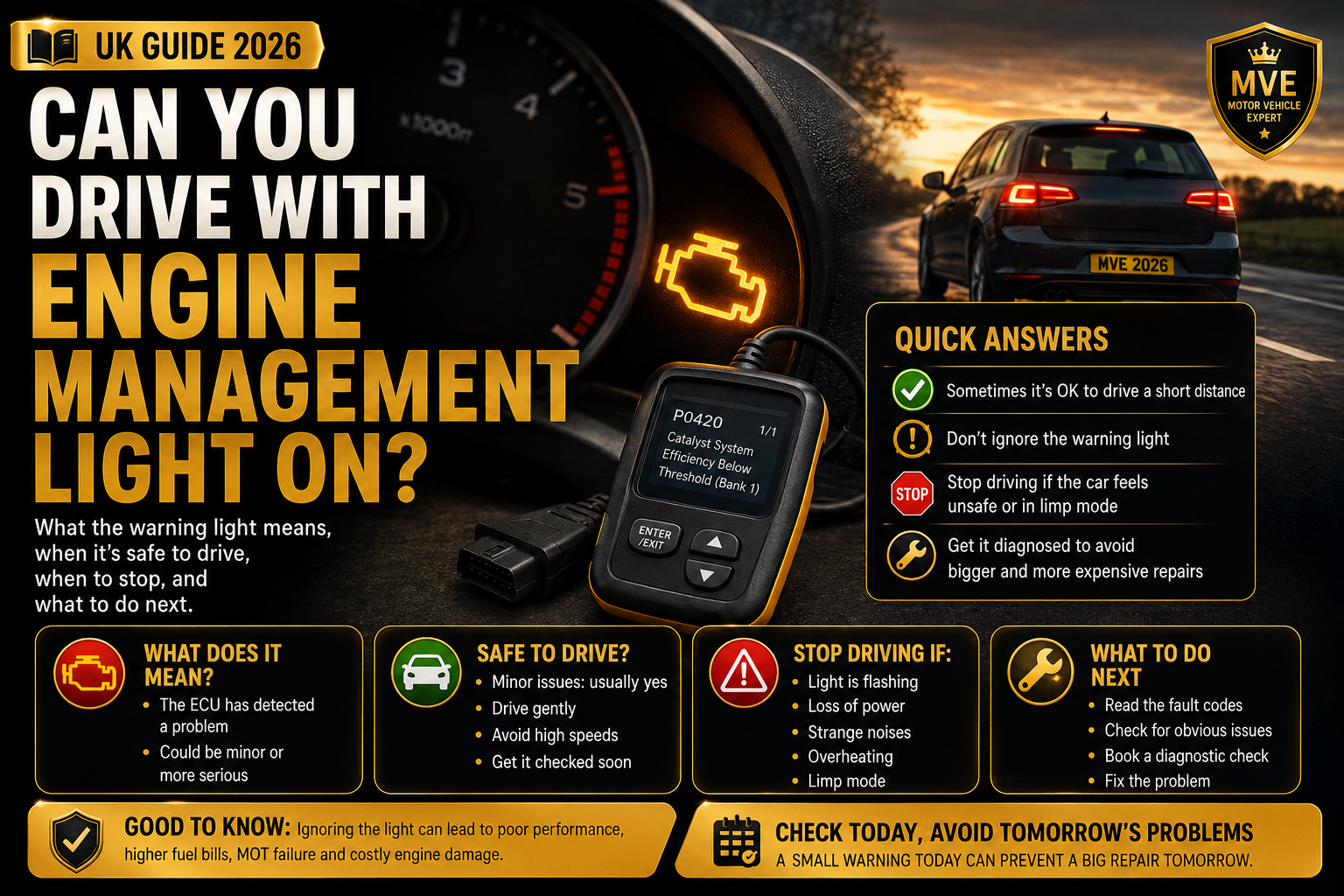
If the engine management light is steady and the car drives normally, a short careful journey home or to a garage may be possible. Avoid hard acceleration, high revs, towing, motorway stress and long journeys until the fault is checked.
If the light is flashing, or the engine is misfiring, shaking, losing power, smoking, overheating or smelling hot, stop driving as soon as it is safe and arrange inspection or recovery.
Steady engine management light
A steady engine management light usually means the engine control system has detected a fault. The car may still drive, but the fault can affect emissions, fuel economy, performance or reliability.
May be less urgent
If the car starts normally, idles smoothly, pulls normally and has no extra warning symptoms.
Still needs diagnosis
A small sensor, air leak or emissions fault can become more expensive if ignored.
Drive gently
Avoid high revs, heavy loads, fast motorway runs and long journeys until the fault is known.
For the full explanation of this dashboard warning, read the engine management light guide.
Flashing engine management light
A flashing engine management light is more serious than a steady one. From a mechanic’s point of view, this often means the engine is misfiring badly enough to risk damaging the catalytic converter or emissions system.
- !Ease off the accelerator immediately.
- !Avoid high revs and heavy acceleration.
- !Stop safely if the engine shakes, judders or runs roughly.
- !Do not continue a long journey with a flashing warning light.
- !Arrange recovery if the car feels unsafe or lacks power.
If the car is shaking or running roughly, see engine misfire symptoms and causes.
When you should not keep driving
- !The engine management light is flashing.
- !The car is misfiring, shaking, juddering or struggling to idle.
- !There is major power loss or limp mode.
- !You notice smoke from the exhaust or engine bay.
- !The temperature gauge rises or the car overheats.
- !There is a strong burning, fuel or exhaust smell.
- !An oil pressure, coolant, brake or battery warning appears as well.
- !The car feels unsafe in traffic.
If another serious warning light appears at the same time, treat the situation more urgently. An engine light plus oil, coolant, brake or battery warning is not something to keep driving with.
Real-life situations and what they usually mean
Light on after filling fuel
On some cars, a loose fuel cap or EVAP fault can trigger the warning.
Light on with no symptoms
Could be emissions, sensor or intermittent fault. Still needs fault-code scanning.
Check in app →Light on with rough idle
Can point towards misfire, air leak, throttle body, injector or sensor issues.
Misfire guide →Light on with poor acceleration
Could be limp mode, turbo, fuel, DPF, airflow or EGR-related.
Power loss guide →Light on with black smoke
Often linked to over-fuelling, air restriction, injector, EGR, turbo or DPF faults.
Smoke colour guide →Light returns after clearing
The fault has not been fixed. Clearing the code only removes the warning temporarily.
Common reasons the engine management light comes on
Oxygen sensor fault
Can affect fuel mixture, emissions and economy.
Ignition misfire
Spark plugs, ignition coils or wiring can cause rough running and flashing lights.
Misfire guide →DPF or emissions issue
Diesel faults may involve the DPF, EGR valve, AdBlue system or emissions sensors.
DPF warning guide →Airflow sensor fault
Can cause hesitation, poor running, poor economy or power loss.
Fuel system issue
Fuel pressure, injector or mixture faults can trigger the warning.
Loose fuel cap
On some vehicles, an EVAP system fault can turn the light on.
Turbo boost fault
Boost leaks, actuator faults or pressure sensor issues can cause limp mode.
Throttle body fault
Can cause poor throttle response, idle problems or hesitation.
EPC warning guide →Catalytic converter issue
Can follow misfires, fuel mixture problems or long-term emissions faults.
If power drops when accelerating, read car losing power when accelerating. If the car hesitates, see car hesitates when accelerating.
What to do next
1. Check whether the light is steady or flashing
A flashing light should be treated as urgent.
2. Notice how the car feels
Power loss, vibration, smoke, overheating or rough running changes the risk level.
3. Check for other warnings
Oil, coolant, battery, EPC, DPF, brake or ABS warnings can point to a more serious fault.
4. Avoid guessing parts
Do not replace sensors randomly without checking fault codes and live data.
5. Read fault codes
A diagnostic scan gives a starting point, but codes still need proper interpretation.
6. Book repair promptly
Ignoring the warning can increase fuel use, emissions and repair costs.
Use the free diagnostic app page to check the warning light, compare symptoms and see general safe-to-drive guidance before deciding your next step.
Can you drive to a garage?
If the light is steady and the car drives normally, a short careful journey to a garage is usually more sensible than continuing to use the car normally. Keep speed moderate and avoid hard acceleration.
If the light is flashing, the car is misfiring, overheating, smoking or lacking power, do not drive it to the garage unless a professional has advised it is safe. Recovery is usually the safer option.
Will the engine management light affect MOT?
Yes, it can. An illuminated engine management light can be an MOT issue, especially if it indicates an emissions-related fault or the vehicle fails the emissions test.
Read the dedicated guide: will engine management light fail MOT?. If the car has already failed on emissions, see car fails MOT on emissions.
Other warning lights to take seriously
Oil warning light
Can indicate low oil pressure. Read oil warning light on and off.
Battery warning light
Can mean the charging system is not working properly. Read battery warning light meaning.
Brake warning light
Can be safety-critical. Read brake warning light on while driving.
DPF warning light
Diesel emissions systems need prompt attention. Read DPF warning light explained.
EPC warning light
Common on some petrol vehicles. Read EPC warning light meaning.
ABS warning light
The basic brakes may work, but ABS may not. Read ABS warning light on.
Common mistakes drivers make
- !Clearing the light without fixing the actual fault.
- !Driving normally because the car “feels fine”.
- !Ignoring a flashing light until the car breaks down.
- !Replacing an oxygen sensor without checking air leaks, wiring or fuel trim.
- !Leaving the warning until MOT day.
- !Buying a used car with the light on and accepting “it only needs resetting”.
Related warning light and diagnostics guides
Frequently asked questions
Can I drive with a steady engine management light?
Possibly for a short careful journey if the car drives normally, but you should arrange diagnosis soon.
Can I drive with a flashing engine light?
No, not if you can avoid it. A flashing light can mean an urgent misfire or damage risk.
What if the car feels normal?
It may be less urgent, but the stored fault still needs checking because emissions, fuel economy or engine reliability may be affected.
Can the light go off by itself?
Sometimes, but the fault may still be stored and can return later.
Will it fail MOT?
It can, especially if the warning is emissions-related or remains on during the test.
Should I clear the code?
Do not just clear it. Find and fix the cause first or the warning may return.
Can a loose fuel cap cause the engine light?
On some cars, yes. A loose or faulty fuel cap can trigger an EVAP system fault.
Can I drive in limp mode?
Only a short distance if the car is safe and no serious symptoms are present. Limp mode means the car is protecting itself from possible damage.