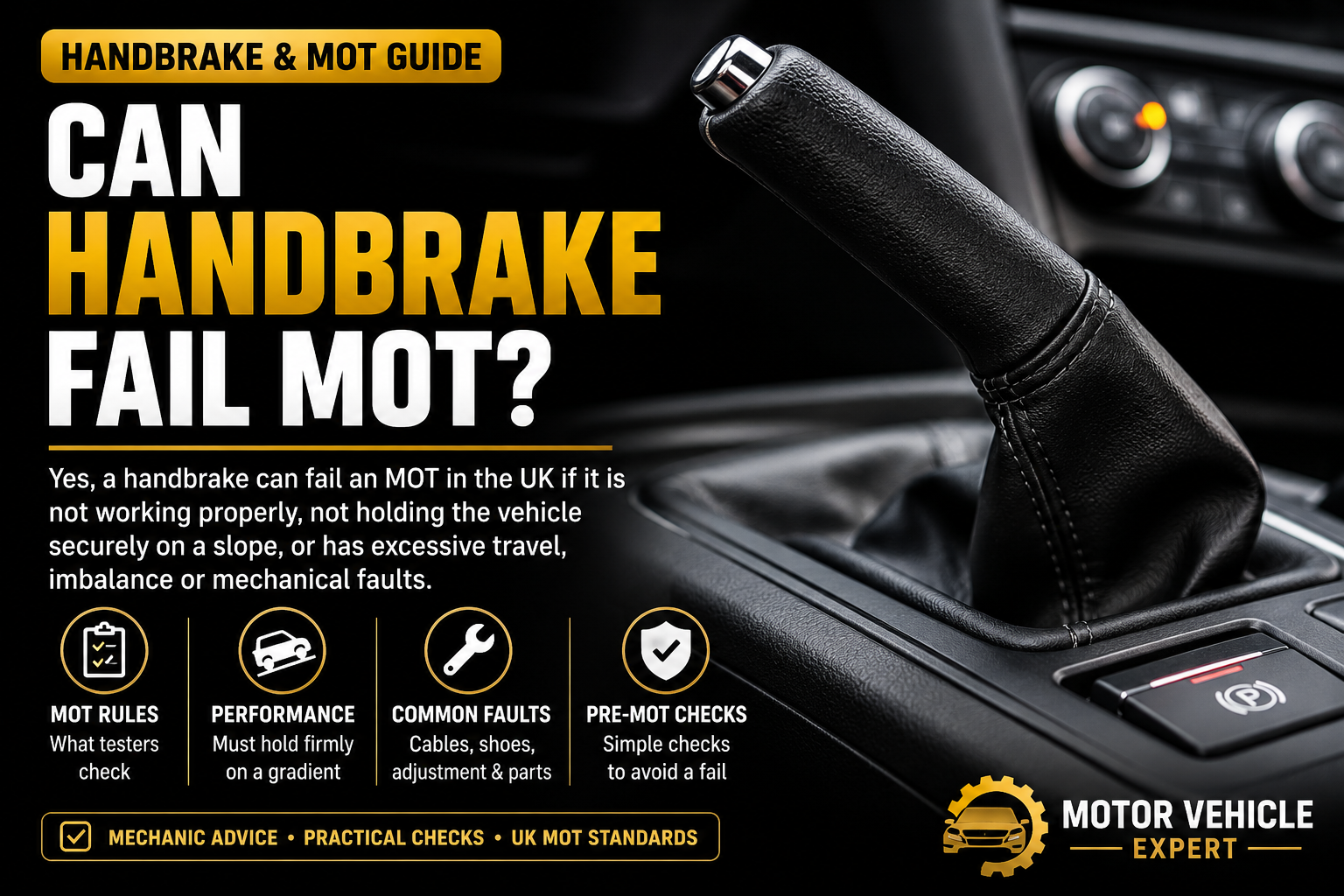
Handbrake MOT guide

Can Handbrake Fail MOT?

Yes, a handbrake can fail an MOT in the UK if it does not hold the vehicle securely, has excessive travel, poor braking performance, imbalance between wheels or damaged cables and components.

Can handbrake fail MOT UK guide
Quick answer

Will a weak handbrake fail an MOT?

A handbrake can fail an MOT if it does not provide enough parking brake force, has excessive travel, does not stay applied, sticks on, has damaged parts or shows an electronic parking brake fault.

If the car rolls when parked on a slope, or the lever comes up much higher than normal, do not wait for the MOT to find out. Get it checked first.

Mechanic view

What the tester is really checking

The tester is checking whether the parking brake works properly and holds the vehicle effectively. It is not enough for the lever or switch to move — the rear brakes must actually apply with enough force.

Failure points

When a handbrake can fail an MOT

These are the common parking brake defects that can turn into an MOT failure.

Holding force

Poor parking brake efficiency

If the handbrake cannot hold the vehicle effectively, it can fail the MOT.

Travel

Excessive lever travel

A lever that pulls very high can suggest stretched cables, poor adjustment or worn rear brake parts.

Balance

One side not working

If one rear brake applies much weaker than the other, the parking brake can fail for imbalance.

Seized cable

A seized or stretched handbrake cable can stop the brake applying or releasing properly.

Sticking rear caliper

Rear calipers with built-in parking brake mechanisms can seize, bind or fail to apply fully.

Electronic parking brake fault

Warning lights, motor faults or switch problems can affect MOT result and safe operation.

Symptoms

Signs your handbrake needs attention

Most handbrake faults give warning signs before the MOT.

Lever

Lever pulls too high

If the lever suddenly needs more clicks than normal, the system may need adjustment or repair.

Slope

Car rolls on a hill

This is one of the clearest signs the parking brake is not holding properly.

Rear brakes

One wheel grips more

Uneven parking brake action can come from cables, calipers, shoes, pads or adjustment problems.

Dragging rear brake

A sticking parking brake can cause heat, smell, grinding or poor fuel economy.

Loose lever feel

A loose lever or poor ratchet feel may point to worn mechanism or cable issues.

Dashboard warning

Electronic parking brake warnings should be diagnosed before the MOT.

Pre-MOT checks

What to check before your MOT

Use these checks to spot obvious handbrake problems before test day.

1

Test it on a safe slope

On a safe incline, apply the handbrake and check whether the vehicle holds firmly.

2

Notice lever travel

If the lever pulls much higher than it used to, adjustment or repair may be needed.

3

Check for sticking

After releasing the handbrake, the car should move freely without dragging from the rear brakes.

4

Listen for rear brake noise

Grinding, scraping or dragging noises can point to rear brake or parking brake faults.

5

Watch warning lights

Electronic parking brake, brake warning or ABS warnings should be checked before the MOT.

6

Do not rely on adjustment only

If parts are seized or worn, simply tightening the cable may not fix the real problem.

Real cause

Common causes of handbrake MOT failure

Typical causes include stretched cables, seized rear brake mechanisms, worn rear pads or shoes, rusty parts, sticking calipers, poor adjustment, damaged ratchets and electronic parking brake motor faults.

Cars that rarely use the parking brake can sometimes develop sticking mechanisms. Regular use helps keep many mechanical handbrake systems moving freely.

Safety

Can you drive with a weak handbrake?

The normal foot brakes may still work, but a weak handbrake is still a safety issue. The car may roll when parked, become difficult during hill starts or fail to hold securely when loaded.

If the handbrake does not hold the car properly, repair it before relying on it.

Cost clues

What might need repairing?

The cost depends on whether the issue is adjustment, cables, rear brakes or an electronic parking brake fault.

Handbrake adjustment

Usually lower cost if the system is healthy and only adjustment is needed.

Cable replacement

Moderate cost depending on access, corrosion and vehicle design.

Rear shoes or pads

Worn rear brake parts can reduce parking brake efficiency.

Rear caliper repair

A sticking caliper can be more expensive if replacement is needed.

Electronic parking brake motor

EPB faults can cost more because diagnosis and parts vary widely.

Brake inspection

A proper inspection helps avoid adjusting a system that actually has seized or worn parts.

FAQs

Handbrake MOT questions

Common questions about weak handbrakes, parking brake efficiency, lever travel and electronic parking brakes.

Can a loose handbrake fail MOT?

Yes, if braking efficiency is poor, the travel is excessive or the parking brake does not hold properly.

Does a high handbrake mean MOT failure?

Not always, but excessive travel can point to poor adjustment, worn parts or weak holding force.

Can an electronic handbrake fail?

Yes. EPB warning lights, motor faults, switch issues or poor holding force can cause MOT problems.

Can I tighten the handbrake myself?

Some older systems can be adjusted, but seized or worn parts must be diagnosed first.

Is the handbrake tested every MOT?

Yes. Parking brake operation and effectiveness are checked during the MOT.

Best pre-test action?

If the handbrake feels weak, pulls high, sticks or does not hold on a slope, get it inspected before the MOT.

Motor Vehicle Expert publishes practical UK-focused vehicle diagnostics, maintenance, MOT, used car and repair cost guidance based on common driver questions and real-world garage situations.