
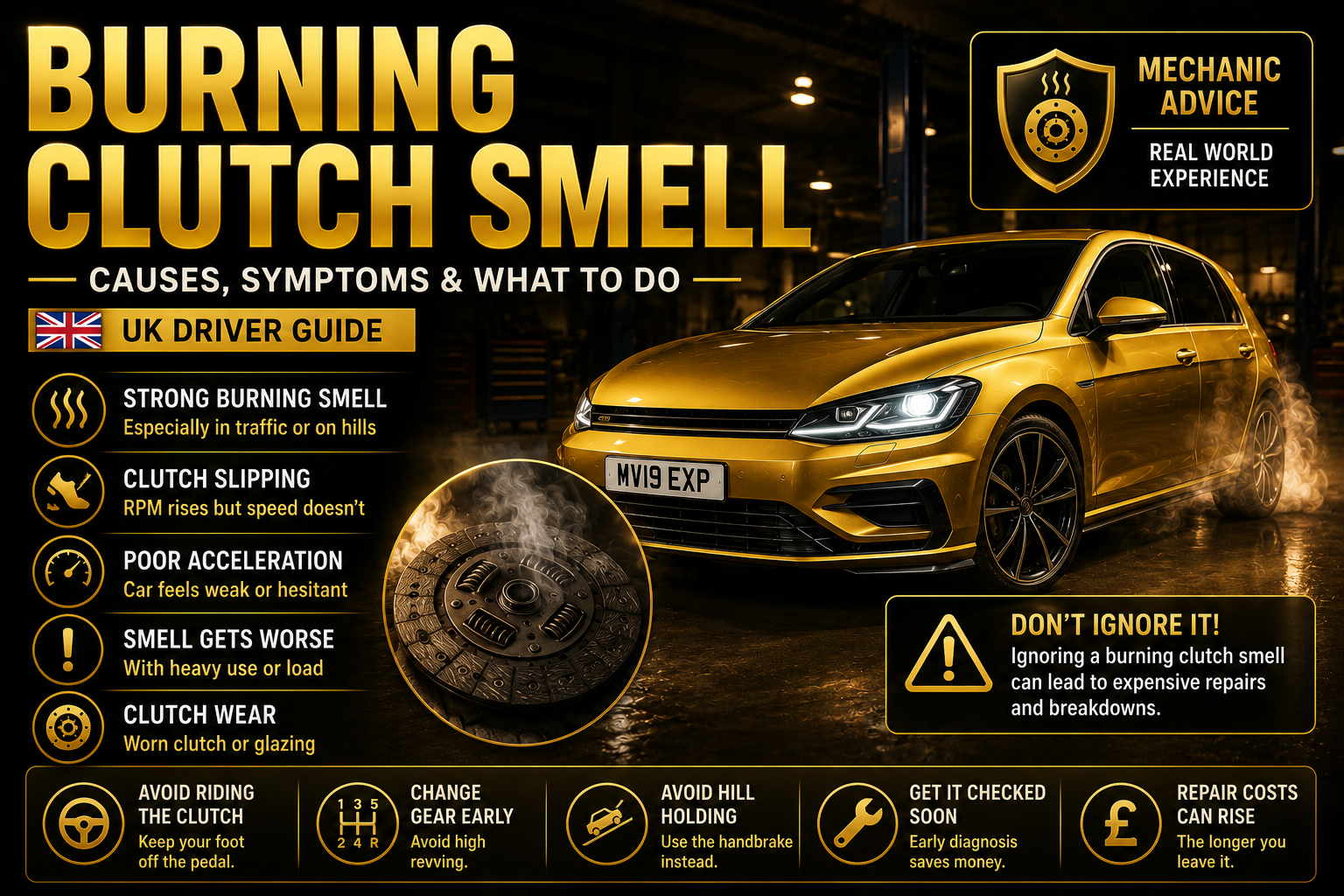
Quick answer
A burning clutch smell usually means the clutch friction material has become hot. This can happen after hill starts, reversing, towing, stop-start traffic or holding the car on the clutch. If the smell happens repeatedly or appears with poor acceleration, high biting point or revs rising without speed, the clutch may be slipping.
One short smell does not always mean the clutch is ruined. Repeated smell is different. If the clutch keeps overheating, the friction material can wear quickly and the car may eventually struggle to move.
A clutch smell after a one-off mistake is different from a clutch smell that keeps returning during normal driving.
What does a burning clutch smell like?
Most drivers describe a burning clutch smell as hot, sharp and similar to overheated friction material. It is often stronger after hill starts, reversing, towing or heavy traffic and is usually different from coolant, oil or burning rubber smells.
If the smell appears together with poor acceleration or revs rising without speed, clutch slip becomes much more likely.
- Burning smell once after a difficult hill start → May be temporary overheating.
- Burning smell after normal driving → Possible clutch wear.
- Burning smell + revs rising → Likely clutch slip.
- Burning smell + smoke → Stop driving and inspect.
- Burning smell during used car test drive → Treat as a buying warning sign.
What burning clutch smell normally feels like in real driving
In real driving, burning clutch smell is often noticed after reversing uphill, parking on a slope, stop-start traffic, towing, or trying to pull away with too much throttle. The smell is usually sharp, hot and friction-like, different from coolant, oil or burning rubber.
A driver may say the smell appeared once after a difficult manoeuvre. That can happen. The bigger concern is when the smell appears during normal acceleration, after every hill, or after a test drive where the clutch should not have been worked hard.
If the smell comes with engine revs rising but the car not accelerating properly, that is no longer just a smell problem. That is a clutch slip warning.
Common causes of burning clutch smell
Riding the clutch
Resting your foot on the clutch pedal or holding the car on the clutch can create heat and smell.
Hill starts
Balancing throttle and clutch on a steep hill can overheat the clutch if it slips for too long.
Slow reversing or parking
Reversing slowly, especially uphill or into tight spaces, often uses more clutch slip than normal driving.
Stop-start traffic
Repeated clutch use in traffic can heat the clutch, especially if the driver holds the bite point.
Towing or heavy load
Extra load makes the clutch work harder and can expose a weak or worn clutch.
Worn clutch slipping
A worn clutch can slip under load and create heat even when the driver is not doing anything unusual.
Clutch slipping symptoms →When a burning clutch smell may not mean the clutch is finished
A brief smell after a difficult hill start, reversing on a slope or awkward parking manoeuvre does not always mean the clutch has failed. Clutches are friction parts, and friction creates heat if the clutch is slipped too much.
More likely one-off use
The smell appears after a clear driver event, then disappears and does not return during normal driving.
More likely a clutch fault
The smell returns often, appears after normal acceleration, or comes with clutch slip symptoms.
Let it cool
If safe, stop using the clutch heavily and let it cool before continuing gently.
Do not keep testing it harshly
Repeatedly forcing the clutch to check if it slips can make the damage worse.
Burning smell with clutch slipping symptoms
Burning smell becomes more serious when it appears with classic clutch slip symptoms. That usually means the clutch is no longer gripping properly and is overheating under load.
- !Engine revs rise but road speed does not match.
- !The car struggles uphill.
- !The clutch biting point is very high.
- !The smell appears after normal acceleration.
- !The car feels weak in higher gears.
- !There is smoke or the car struggles to move.
If those symptoms are present, read Clutch Slipping Symptoms and arrange diagnosis.
Can you drive with a burning clutch smell?
If the smell was brief and the car drives normally, you may be able to continue gently after letting the clutch cool. Avoid hard acceleration, hill starts, towing, holding the car on the clutch and stop-start abuse.
The clutch smell is strong, smoke appears, the car will not accelerate properly, the revs flare, the clutch pedal feels wrong, the car struggles uphill or you are worried the vehicle may not move safely.
If the smell was one-off
Drive gently, avoid slipping the clutch and monitor whether the smell returns.
If the smell keeps returning
Book diagnosis. Repeated overheating can quickly turn into clutch failure.
Burning clutch smell in traffic, hills and parking
These situations create the most clutch heat because the clutch is often partly engaged while the car is moving slowly.
Stop-start traffic
Use neutral and the brake when stopped instead of holding the bite point.
Hill starts
Use the handbrake properly and avoid balancing the car on the clutch.
Reversing uphill
Short, controlled movements are better than long periods of clutch slip.
Towing
Extra weight can overheat a weak clutch and make slip more obvious.
Heavy loads
Passengers, luggage or steep roads increase clutch load.
Test drives
A burning smell after a normal used car test drive is a buying warning.
Burning clutch smell when buying a used car
A burning clutch smell during a used car viewing should be taken seriously. It may mean the seller has been slipping the clutch, the clutch is worn, or the car has been moved around harshly before you arrived.
- !Smell around the car after the test drive.
- !Check whether the clutch bites high.
- !Watch for revs rising without acceleration.
- !Ask when the clutch was last replaced.
- !Ask whether the flywheel was checked or replaced.
- !Do not accept “it always smells like that” as reassurance.
Can burning clutch smell fail an MOT?
The smell itself is not normally a direct MOT failure item. The MOT does not test clutch wear in the same way it tests brakes, tyres, lights or suspension.
However, if the vehicle cannot be moved or tested safely because of a clutch fault, that can create problems. Related issues such as leaks, unsafe driving behaviour or other defects may also matter.
Repair costs if the clutch smell is caused by wear
If burning smell is caused by clutch slip or a worn clutch, repair normally means clutch replacement. The final cost depends on vehicle type, labour time, gearbox access, clutch kit quality and whether the flywheel or hydraulic parts also need attention.
Clutch kit
Friction plate, pressure plate and release bearing may be replaced as a kit.
Flywheel
Dual mass flywheel wear can add significant cost if replacement is needed.
Leaks or hydraulics
Oil contamination, slave cylinder or hydraulic faults may change the repair plan.
Best mechanic-style advice for burning clutch smell
- ✓Do not hold the car on the clutch at junctions or hills.
- ✓Use the handbrake on hill starts instead of balancing the clutch.
- ✓Do not rest your foot on the clutch pedal while driving.
- ✓If the smell appears once, let the clutch cool and drive gently.
- ✓If the smell keeps returning, arrange diagnosis.
- ✓Burning smell with rev flare usually means clutch slip.
- ✓When buying used, treat clutch smell as a negotiation or walk-away warning.
Related clutch and diagnostic guides
Frequently asked questions
What does burning clutch smell mean?
It usually means the clutch friction material has overheated. This can happen from slipping the clutch, hill starts, reversing, traffic or clutch wear.
Can I drive after smelling burning clutch?
If it was brief and the car drives normally, let it cool and drive gently. If the smell keeps returning or the car slips, arrange diagnosis.
Does burning clutch smell mean the clutch is ruined?
Not always. One short smell may not ruin the clutch, but repeated burning smell can quickly damage or reveal a worn clutch.
Why does my clutch smell after reversing?
Reversing slowly often uses more clutch slip, especially uphill or while parking. That can heat the clutch and create smell.
Is burning clutch smell bad when buying a used car?
Yes. If it appears during a normal test drive, treat it as a warning sign and price the car as if clutch repair may be needed.
Can burning clutch smell fail an MOT?
The smell itself is not normally a direct MOT item, but a clutch fault that prevents safe movement or testing can cause problems.
What is the difference between clutch smell and burning rubber?
Clutch smell is usually sharp and friction-like after clutch use. Burning rubber may come from belts, tyres, hoses or hot rubber parts.
How do I stop burning the clutch?
Avoid riding the clutch, use the handbrake on hills, select neutral when stopped and avoid holding the car on the bite point.