
Quick answer
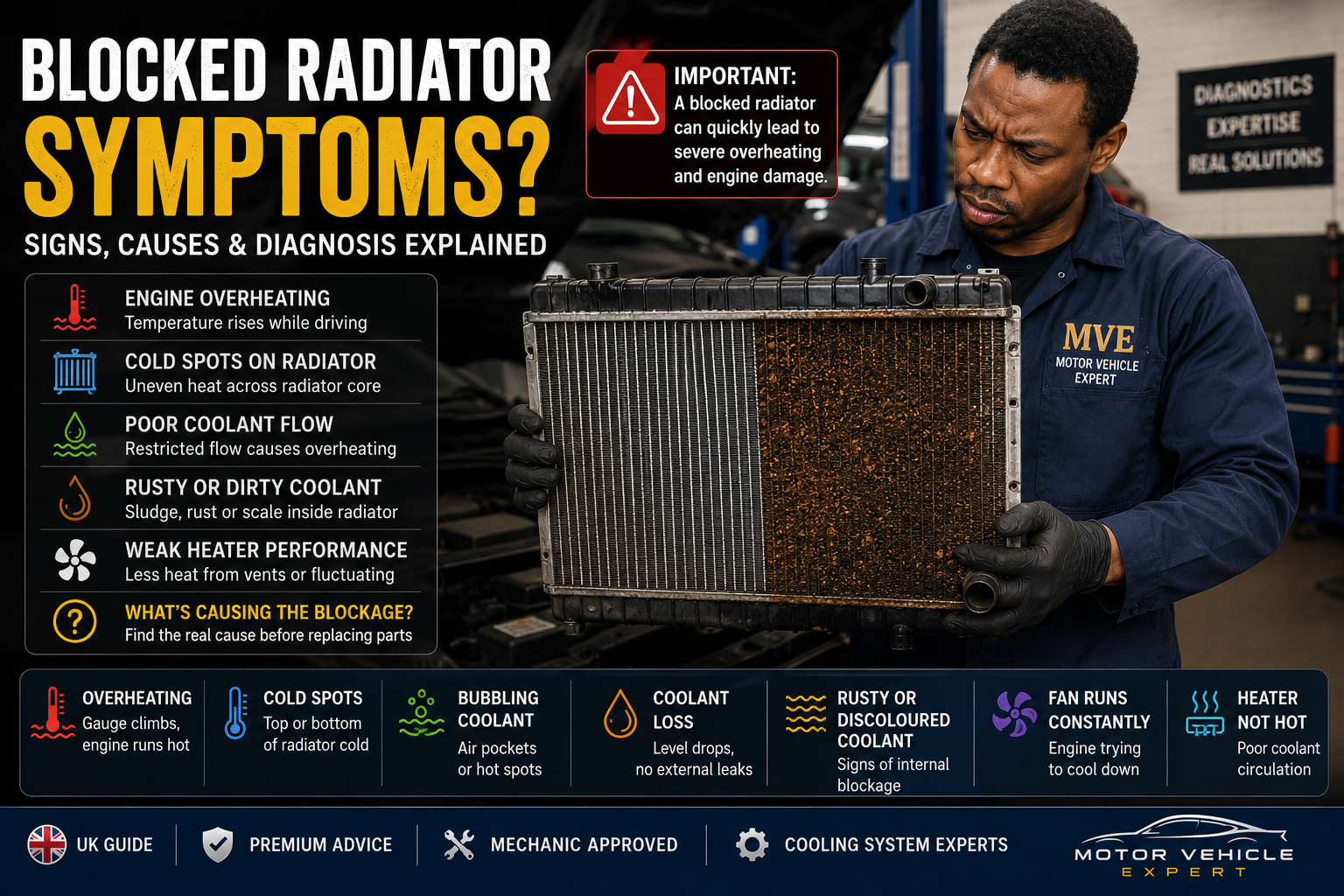
A blocked radiator can cause overheating, poor coolant flow, cold spots across the radiator, coolant bubbling, temperature gauge movement, rusty or dirty coolant and overheating while driving or under load.
Do not assume every overheating car needs a radiator. A thermostat fault, weak water pump, low coolant, airlock, radiator fan fault, pressure cap issue or head gasket problem can look similar.
- !Stop driving if overheating becomes severe or coolant starts boiling.
- ✓Cold spots across the radiator can strongly suggest restricted coolant flow.
- !Rusty or dirty coolant may point towards internal blockage or contamination.
The first time I dealt with a blocked radiator
One of the more confusing cooling-system problems I came across was a car that only seemed to overheat during longer drives and heavier engine load.
At first, the coolant level looked acceptable and the fan appeared to work, so the fault did not immediately seem obvious. The temperature would stay normal for a while, then slowly climb on faster roads or uphill sections.
What eventually made the radiator more suspicious was the pattern: uneven heat across the radiator, dirty coolant and overheating that became worse when the engine had to work harder.
That experience taught me not to diagnose overheating from one symptom alone. A blocked radiator can look like a thermostat fault, water pump weakness, airlock or pressure problem until the full pattern is checked.
If the radiator cannot remove heat properly, the engine can overheat even when coolant is present in the expansion tank.
What a blocked radiator looks like in real life
Gauge rises on motorway
At speed the engine makes steady heat. A restricted radiator may not remove it fast enough.
Overheating while driving →Temperature climbs uphill
Extra load creates more heat and exposes weak radiator cooling.
Radiator has cold patches
Cold areas can suggest coolant is not flowing through part of the radiator core.
Coolant looks rusty or dirty
Old coolant, rust and sludge can restrict small radiator passages.
Fan runs often
The fan may work harder because the radiator is not cooling efficiently.
Radiator fan guide →Coolant bubbles or boils
Poor heat removal can make coolant boil, though pressure faults and head gasket issues can also cause bubbling.
Bubbling coolant guide →Common blocked radiator symptoms
Engine overheating
The radiator cannot cool the hot coolant properly, so engine temperature rises.
Overheating causes →Overheating while driving
A blocked radiator often shows under load, on hills, motorways or long journeys.
Driving overheating guide →Cold radiator spots
Uneven temperature across the radiator can suggest restricted coolant flow inside the core.
Coolant bubbling
Coolant may bubble if heat is not being removed properly or pressure is wrong.
Coolant bubbling guide →Rusty or sludgy coolant
Contaminated coolant can block small radiator channels and reduce cooling efficiency.
Coolant warning guide →Heater changes temperature
Poor coolant flow, low coolant or airlocks can affect both radiator cooling and cabin heat.
Heater cold then hot →Coolant pushed out
Overheating or pressure problems can force coolant out of the expansion tank.
Fan runs but car still overheats
If the fan works but heat is not leaving the radiator, blockage or flow problems are possible.
Fan fault guide →Repeated coolant loss
Overheating can push coolant out, while leaks or pressure issues can also lower the level.
Coolant loss guide →Internal radiator blockage
Internal blockage means coolant cannot flow properly through the radiator core. The small passages inside the radiator can become restricted by rust, old coolant, sludge, scale, oil contamination or stop-leak products.
Cold areas on radiator
If one part of the radiator stays cooler than the rest when the engine is hot, coolant may not be flowing through that section.
Dirty coolant
Brown, rusty or sludgy coolant suggests the cooling system may be contaminated.
Poor heat removal
The coolant may enter the radiator hot but not cool down enough before returning to the engine.
Repeated overheating
If the thermostat, fan and coolant level are fine, a restricted radiator becomes more likely.
External radiator blockage and damaged fins
A radiator also needs airflow. Even if coolant flows inside, the radiator cannot cool properly if air cannot pass through the front fins.
- !Leaves, mud, insects or road debris packed into the radiator or condenser.
- !Bent radiator fins blocking airflow.
- !Front grille damage or blocked airflow path.
- !Air conditioning condenser blocking airflow in front of the radiator.
- !Overheating worse in traffic, hot weather or with air conditioning on.
If overheating is worse with the air conditioning switched on, also read car overheats with air conditioning on.
When the overheating happens gives useful clues
Overheats at speed
Can point to restricted radiator flow, thermostat restriction, poor water pump circulation or pressure loss.
Overheats in traffic
Often points to fan operation, airflow, low coolant or radiator efficiency problems.
Overheats in traffic →Overheats uphill
Extra load creates more heat and exposes a radiator that is partly blocked or not cooling properly.
Overheats after coolant work
Could be trapped air, low coolant, poor bleeding or existing radiator restriction.
Fan runs constantly
The fan may be trying to compensate for a radiator that cannot remove enough heat.
Heater blows cold while hot
This can suggest low coolant, airlocks or poor circulation rather than only a blocked radiator.
Heater not hot guide →Cold spots on the radiator
One of the strongest signs of an internally blocked radiator is uneven heat across the radiator surface.
Some sections may feel very hot while other areas remain much cooler because coolant cannot circulate properly through blocked radiator channels.
This is why mechanics sometimes carefully compare radiator temperature across different areas after the engine has warmed up.
- ✓Hot and cold areas can suggest restricted coolant flow.
- !Dirty coolant often appears together with internal blockage.
- !Never touch a radiator while overheating or pressurised.
An infrared thermometer is often used to compare radiator temperature across different sections without touching hot components directly.
What to check first
1. Let the engine cool
Never open the coolant cap when hot. A hot cooling system can be pressurised and dangerous.
2. Check coolant level and condition
Look for low level, rusty colour, sludge, oil contamination or repeated level drops.
3. Inspect the radiator front
Check for leaves, dirt, insects, damaged fins or anything blocking airflow.
4. Watch the temperature pattern
Note whether overheating happens at idle, in traffic, uphill, on motorways or with air conditioning on.
5. Check fan operation
A good radiator still needs airflow at low speed and in traffic.
6. Book flow and pressure checks
A garage can test for cold spots, pressure loss, thermostat faults and poor coolant circulation.
How a garage diagnoses a blocked radiator
Radiator temperature check
A mechanic may use temperature readings to look for cold spots across the radiator core.
Infrared temperature tools are often used because blocked sections can sometimes be identified without dismantling the cooling system immediately.
Coolant flow check
Checks whether coolant is moving through the radiator properly when the thermostat opens.
Pressure test
Finds leaks and pressure faults that may cause boiling, coolant loss or overheating.
Thermostat check
A stuck thermostat can mimic a blocked radiator by restricting flow to the radiator.
Thermostat symptoms →Water pump check
A weak water pump can reduce circulation and make the radiator look like the problem.
Water pump symptoms →Combustion gas test
Used if bubbling, pressure build-up or repeated coolant loss suggests possible head gasket trouble.
Head gasket symptoms →When to stop driving
- !The temperature gauge reaches the red.
- !The coolant warning light appears.
- !Steam comes from the engine bay.
- !Coolant is boiling or being pushed out of the tank.
- !The heater blows cold while the engine is hot.
- !The engine loses power, knocks, smells hot or runs rough.
Do not keep driving a car that is overheating. A blocked radiator can lead to head gasket damage, cylinder head problems and expensive engine repairs.
Possible UK repair costs
Radiator clean or debris removal
Lower cost if the issue is external dirt, leaves or blocked airflow.
Coolant flush
May help if contamination is mild, but it will not fix a badly restricted radiator.
Radiator replacement
Often needed if the core is internally blocked, leaking or damaged.
Thermostat replacement
Needed if coolant is not being allowed to flow to the radiator properly.
Thermostat guide →Water pump replacement
Needed if poor circulation is caused by a failing pump rather than the radiator.
Water pump guide →Overheating damage checks
Extra checks may be needed if the engine has overheated badly.
For wider repair planning, read coolant leak repair cost UK and car repair costs guide UK.
Common mistakes drivers make
- !Replacing the radiator without checking thermostat operation.
- !Ignoring dirty coolant until the car overheats.
- !Opening the coolant cap while the engine is hot.
- !Only checking the outside of the radiator and not coolant flow.
- !Assuming a fan fault is the only reason the car overheats in traffic.
- !Using stop-leak products repeatedly instead of repairing the fault.
Best mechanic-style advice
Do not condemn the radiator just because the car overheats. First check coolant level, thermostat operation, fan operation, water pump circulation, pressure loss and head gasket clues.
A blocked radiator becomes more likely when coolant is dirty, the radiator has cold spots, the fan works but the temperature still rises, or the car overheats under load even with enough coolant.
Related coolant and overheating guides
Frequently asked questions
What are the symptoms of a blocked radiator?
Common symptoms include overheating, temperature rising under load, cold radiator spots, dirty coolant, coolant bubbling, fan running often and poor coolant flow.
Can a blocked radiator cause overheating while driving?
Yes. If the radiator cannot remove enough heat, the engine can overheat on motorways, hills, long journeys or when towing.
Can a radiator be blocked inside?
Yes. Rust, sludge, old coolant, scale, oil contamination or stop-leak products can restrict the small passages inside the radiator.
Can the outside of the radiator get blocked?
Yes. Dirt, leaves, insects, damaged fins or debris can block airflow through the radiator and reduce cooling performance.
Can a blocked radiator make the heater blow cold?
It can contribute to poor heat if coolant circulation is affected, but low coolant, airlocks, heater matrix restriction and water pump faults are also common causes.
What else can look like a blocked radiator?
A stuck thermostat, weak water pump, low coolant, airlock, faulty fan, pressure cap problem or head gasket fault can all create similar overheating symptoms.
Should I flush or replace a blocked radiator?
A flush may help mild contamination, but a badly blocked, leaking or damaged radiator often needs replacement.
Is it safe to drive with a blocked radiator?
Avoid driving if the car is overheating, boiling coolant, showing warning lights or pushing coolant out.