
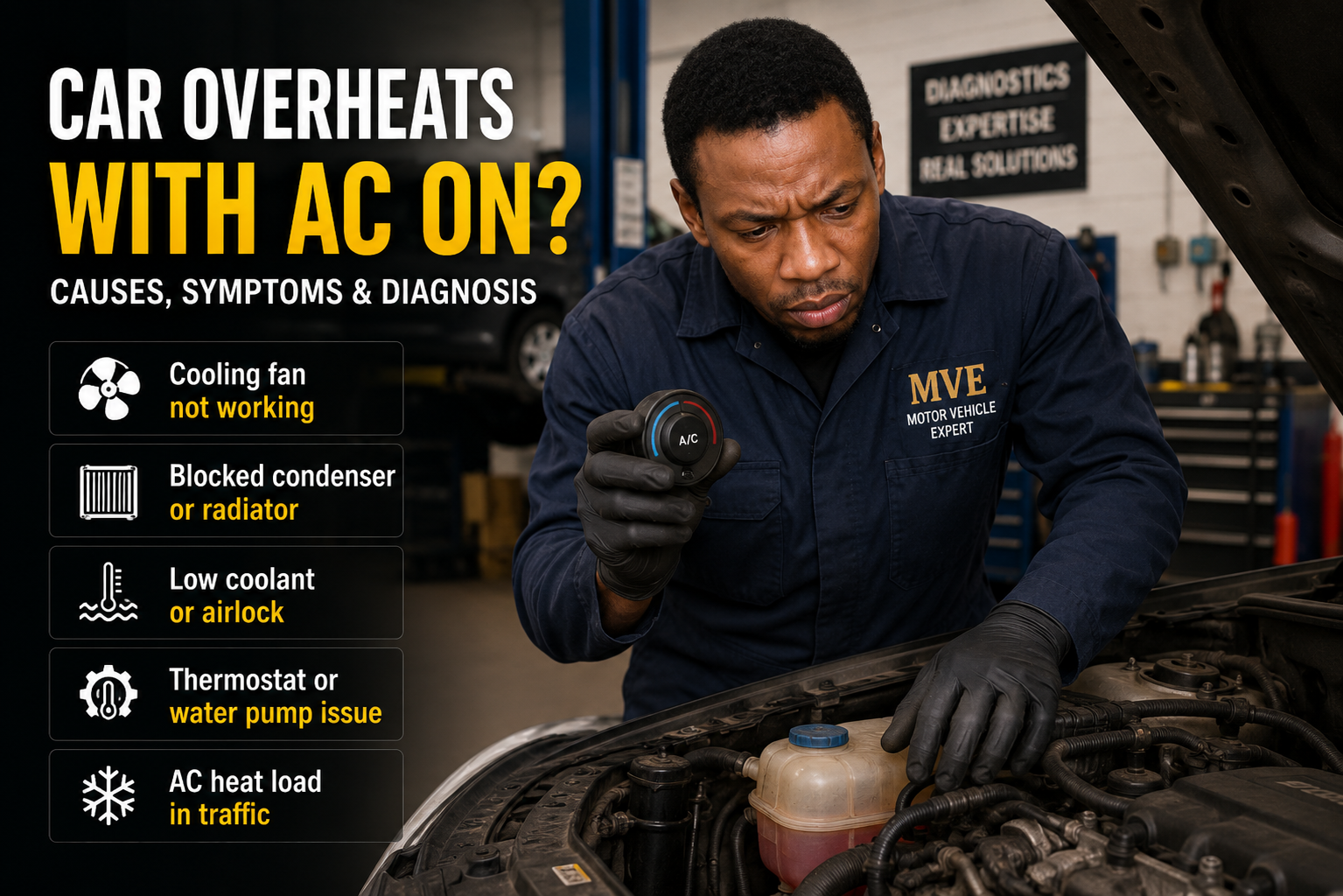
Use the diagnostic app for AC overheating problems
You can use the free Motor Vehicle Expert diagnostic app to compare overheating symptoms, cooling fan faults, coolant warning lights, AC cooling problems, coolant leaks and safe-to-drive advice.
Check the overheating pattern
See whether it overheats only with AC on, only in traffic, at idle, uphill or while driving normally.
Compare fan symptoms
A silent fan, weak fan or fan that only works sometimes can explain AC-related overheating.
Spot coolant clues
Low coolant, coolant smell, bubbling, steam or heater changes can point beyond the AC system.
Choose safer next steps
Know when to switch AC off, when to stop driving and what checks to do once the engine is cold.
Quick answer
Air conditioning increases the heat load at the front of the vehicle. The condenser gets hot, the radiator has to remove more heat, and the cooling fan often needs to run properly to pull air through both units.
If the car only overheats with AC on, especially in traffic or at idle, start by checking cooling fan operation, radiator and condenser airflow, coolant level, thermostat behaviour, water pump circulation and signs of coolant loss.
Turn the AC off if the temperature starts climbing. If the gauge keeps rising, the coolant warning light appears or steam comes from the engine bay, stop safely and let the engine cool.
Do not blame the AC compressor first. Most AC-related overheating starts with fan operation, airflow through the condenser and radiator, low coolant, poor coolant circulation or a cooling system already running close to its limit.
What this looks like in real life
Temperature rises in traffic
The gauge climbs while waiting at lights, in queues or in slow town driving with AC on.
Traffic overheating guide →Cools when AC is off
Turning AC off reduces heat load, so the cooling system may recover temporarily.
Fan sounds weak or silent
The cooling fan may not be running at the correct speed when AC demand is high.
Radiator fan guide →Temperature drops when moving
Road speed creates airflow through the radiator and condenser, hiding the fault for a while.
Idle overheating guide →AC goes warm at idle
Poor fan airflow can affect both engine cooling and air conditioning performance when stationary.
AC not cold guide →Coolant smell appears
Extra heat and pressure may expose a small coolant leak, weak cap or coolant hose issue.
Coolant smell guide →Find the likely cause from the pattern
Overheats only with AC on in traffic
Most likely cooling fan, weak fan speed, fan relay, fan module or blocked condenser airflow.
Fan diagnosis →Overheats with AC on and coolant drops
Look for coolant leaks, weak cap, pressure loss or coolant being pushed out when hot.
Coolant leak cost →Overheats with AC on and heater goes cold
Low coolant, air trapped in the system or poor coolant circulation becomes more likely.
Heater hot then cold →Overheats even with AC off
The AC may only be exposing a deeper cooling problem that is already present.
Overheating causes →AC goes warm and temperature rises
Poor airflow across the condenser and radiator is a strong possibility.
AC not cold guide →Bubbles or coolant pushed out
Pressure, boiling coolant, airlocks or head gasket symptoms may need checking.
Bubbling coolant guide →Common causes of overheating with AC on
Cooling fan fault
One of the most common causes. The fan may not run when AC is requested.
Fan diagnosis →Weak fan speed
Some fans have low and high speeds. A failed high-speed stage can cause AC-related overheating.
Fan relay, fuse or module fault
The fan may be fine but not receiving the correct command, power or earth.
Blocked condenser fins
Dirt, leaves, insects and bent fins can stop air passing through properly.
Radiator airflow restriction
If air cannot pass through the cooling stack, heat builds quickly with AC on.
Blocked radiator guide →Low coolant level
Low coolant reduces heat transfer and makes the engine more sensitive to extra AC load.
Coolant warning guide →Thermostat fault
A restricted thermostat can stop coolant flowing through the radiator properly.
Thermostat guide →Weak water pump
Poor circulation can become obvious when the engine and AC system are both adding heat.
Water pump symptoms →Head gasket pressure issue
Less common, but repeated overheating, bubbling or coolant loss needs deeper checks.
Head gasket symptoms →Why it often happens in traffic
At motorway speed, air naturally passes through the grille, AC condenser and radiator. In traffic, that natural airflow disappears. The cooling fan has to pull air through the condenser and radiator instead.
With AC on, the condenser becomes hot. If the fan is weak, the condenser is blocked or the radiator cannot remove heat properly, the engine temperature can climb while stationary.
Overheats stopped with AC on
This usually points towards airflow, fan control, condenser blockage or low-speed cooling weakness.
Cools when driving again
Road airflow is temporarily doing the work the fan should be doing at low speed.
Overheats in hot weather
Higher outside temperature adds load and exposes weak cooling performance faster.
Overheats with AC but not heater
The AC adds heat at the condenser, while the heater can sometimes help remove engine heat.
Cooling fan problems and AC operation
On many vehicles, switching the air conditioning on should make the cooling fan run or cycle. This helps cool the AC condenser and supports the engine radiator. If the fan does not respond properly, overheating with AC on becomes likely.
- !Fan does not switch on when AC is selected.
- !Fan runs slowly or sounds weak.
- !Fan works sometimes but not every time.
- !High-speed fan setting does not operate.
- !Fan fuse, relay, wiring or control module fault.
- !Temperature sensor or AC pressure sensor fault affecting fan command.
A fan that does not run is not always a bad fan motor. A garage should check power, earth, relay, fuse, fan command, sensor data and module operation before replacing parts.
Radiator and condenser airflow problems
The AC condenser usually sits in front of the radiator. Air must pass through the condenser first, then through the radiator. If the condenser is packed with dirt or the fins are damaged, the radiator receives less effective airflow.
Blocked front fins
Leaves, dirt, insects, mud and road debris can reduce airflow through the cooling stack.
Bent condenser fins
Damaged fins restrict airflow and reduce AC and engine cooling performance.
Blocked radiator core
Internal sludge or external blockage can make the radiator struggle under extra load.
Blocked radiator symptoms →Dirty cooling stack
The gap between condenser and radiator can hold leaves, dust and debris.
Missing undertray or ducting
Some cars rely on air guides and ducting to direct airflow properly.
Fan shroud damage
A damaged shroud can reduce how well the fan pulls air through the radiator.
Coolant and circulation faults made worse by AC load
Sometimes the AC is not the real fault. It simply adds enough load to reveal a cooling problem that was already there.
Low coolant
The system has less coolant to carry heat away, so temperature climbs faster with AC on.
Coolant loss guide →Air trapped in the system
Air pockets can interrupt coolant flow and create unstable temperature readings.
Bubbling coolant guide →Weak water pump
Poor circulation may be more noticeable at idle with AC on because heat load is higher.
Water pump guide →Thermostat restriction
If the thermostat does not open properly, hot coolant cannot reach the radiator efficiently.
Thermostat symptoms →What turning the AC off tells you
If engine temperature improves when the AC is turned off, it tells you the cooling system is struggling with the extra load. It does not prove the AC compressor itself is faulty.
In many real workshop cases, the problem is the radiator fan, blocked condenser, weak airflow, low coolant, poor coolant circulation or a cooling system already running too hot.
Driving with the AC switched off may hide the symptom, but it does not fix the cooling fault. If the car overheats again, get the system checked.
When to stop driving
- !Temperature gauge enters the red.
- !Coolant warning light or overheating message appears.
- !Steam comes from under the bonnet.
- !Coolant is leaking, boiling or being pushed out.
- !The heater suddenly blows cold while the engine is hot.
- !The engine loses power, knocks, smells hot or runs rough.
Turn the AC off immediately if the temperature starts rising. If the temperature continues to climb, stop safely and let the engine cool. Do not open the coolant cap while hot.
What to check first
1. Turn AC off if temperature rises
This reduces heat load and may help prevent serious overheating while you find a safe place to stop.
2. Check cooling fan operation
With AC on, the fan should often run or cycle on many vehicles. Behaviour varies, but it is an important clue.
3. Check coolant level cold
Low coolant can cause overheating and may point to a leak or pressure issue.
4. Inspect radiator and condenser
Look for leaves, dirt, insects, bent fins or blocked airflow through the front cooling stack.
5. Notice when it happens
Only in traffic, only with AC on, only uphill or also while driving all point to different faults.
6. Arrange diagnosis
Persistent overheating needs fan-control checks, pressure testing and cooling-system diagnosis.
How a garage usually diagnoses this
Fan command test
Diagnostic equipment can command the fan on and check low-speed and high-speed operation.
Fuse, relay and wiring checks
The fan circuit is tested for power, earth, relay switching and control module faults.
AC pressure and fan request
The AC system may request fan operation based on pressure and temperature data.
Cooling system pressure test
Checks for leaks, weak caps and pressure loss that can cause boiling or coolant loss.
Radiator temperature check
Cold spots or uneven temperatures can suggest blockage or poor coolant flow.
Coolant circulation checks
Thermostat, water pump, radiator and airlocks are checked if the fan is working correctly.
Possible UK repair costs
Costs depend on the vehicle, access, parts quality and the exact fault. A fuse or relay is usually much cheaper than a fan assembly, radiator, water pump or head gasket repair.
Fuse or relay
Usually lower cost if confirmed as the only fan-control fault.
Cooling fan repair
Cost depends on whether the issue is fan motor, fan assembly, wiring or control module.
Fan repair guide →Radiator or condenser cleaning
Lower cost if the issue is external dirt, leaves or blocked airflow.
Radiator replacement
More expensive if the radiator is blocked internally, leaking or damaged.
Radiator symptoms →Thermostat or water pump
Cost depends heavily on engine access and whether coolant needs draining.
Water pump guide →Coolant leak repair
Can range from a simple hose repair to more involved cooling-system work.
Coolant leak costs →For wider repair budgeting, read car repair costs guide UK.
Common mistakes drivers make
- !Blaming the AC compressor before checking the cooling fan.
- !Driving with AC off for weeks without fixing the underlying cooling fault.
- !Opening the coolant cap while the engine is still hot.
- !Only topping up coolant without checking why the level dropped.
- !Replacing the fan motor without checking fuse, relay, wiring and fan command.
- !Ignoring blocked condenser fins or debris between the condenser and radiator.
Best mechanic-style advice
Do not blame the AC compressor straight away. If the engine overheats with AC on, the usual first checks are fan operation, airflow through the condenser and radiator, coolant level and coolant circulation.
If the fan does not run with AC demand, test the fan circuit before replacing the fan. If the fan works properly but the car still overheats, look deeper at coolant flow, radiator blockage, thermostat operation, water pump weakness and pressure problems.
Related cooling and overheating guides
Frequently asked questions
Why does my car overheat when the AC is on?
The AC system adds extra heat load. If the fan, radiator, condenser airflow or coolant circulation is weak, the engine temperature can rise.
Can a bad cooling fan cause overheating with AC on?
Yes. Cooling fan faults are one of the most common causes, especially if the car overheats in traffic but improves when moving.
Why does it only overheat in traffic?
In traffic there is little natural airflow, so the cooling fan must pull air through the condenser and radiator. If airflow is weak, temperature can rise.
Should I turn the AC off if the engine overheats?
Yes. Turning the AC off reduces heat load. Stop safely if the temperature keeps rising or warning lights appear.
Can low coolant cause overheating with AC on?
Yes. Low coolant reduces the system’s ability to carry heat away from the engine, and AC load can make the weakness show faster.
Can a blocked condenser cause overheating?
Yes. If the condenser fins are blocked or damaged, airflow through the radiator can be reduced.
Can a thermostat cause overheating with AC on?
Yes. A sticking or restricted thermostat can limit coolant flow and make overheating worse under extra load.
Is it safe to keep driving if the car only overheats with AC on?
Do not ignore it. You may be able to drive with AC off if the temperature stays normal, but the cooling fault should be diagnosed before it causes engine damage.
Can a weak water pump cause overheating with AC on?
Yes. If coolant circulation is weak, the extra heat load from the AC can make the temperature rise faster, especially at idle or low speed.
Does AC overheating mean the compressor is faulty?
Not usually. The compressor adds load, but the fault is often fan operation, airflow restriction, low coolant, radiator blockage or poor coolant circulation.