
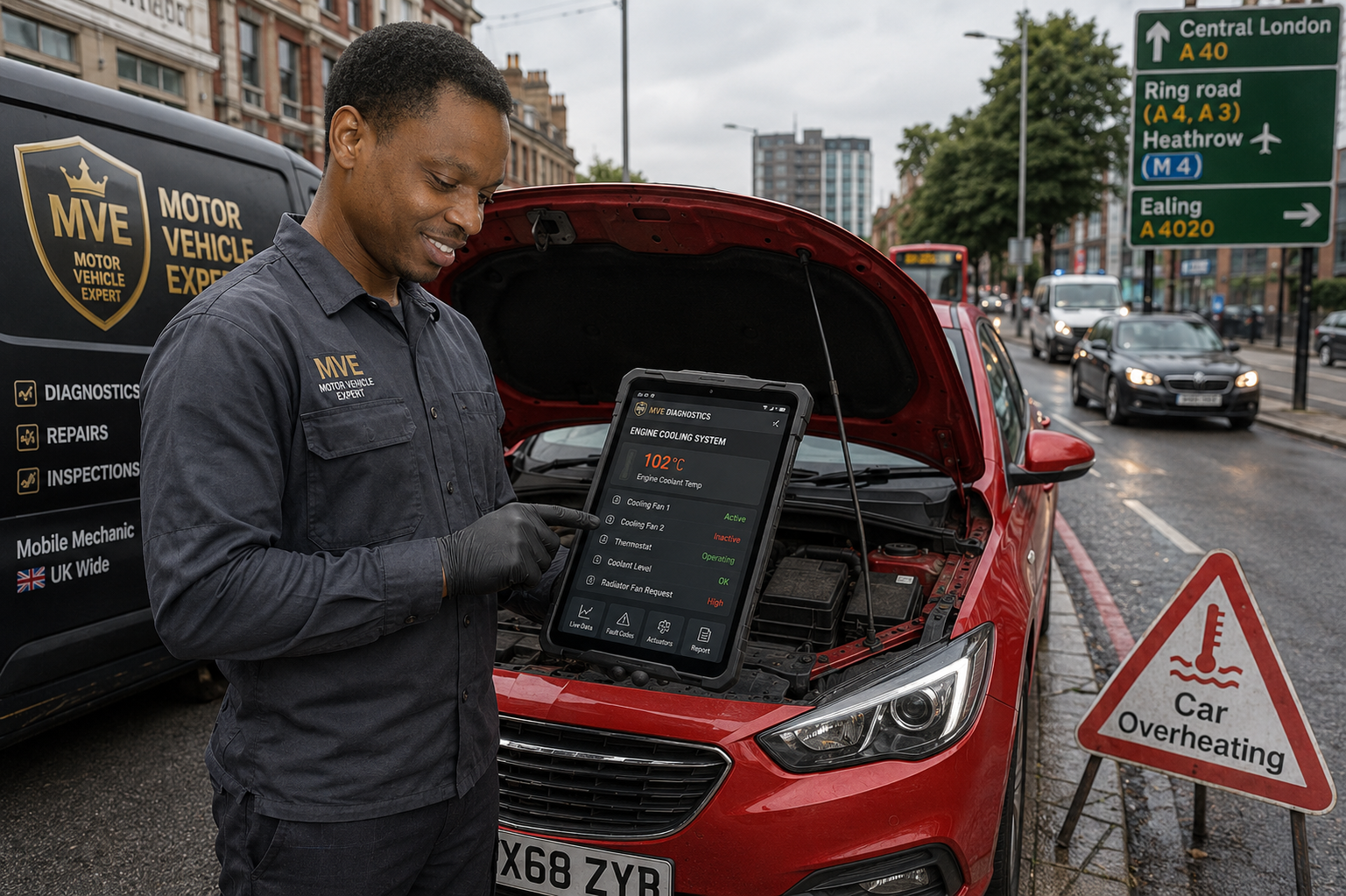
Quick answer
If a car overheats mostly in traffic, queues or while idling, the most likely issue is poor low-speed cooling. At road speed, airflow helps cool the radiator. In traffic, the cooling fan, coolant level, thermostat, radiator condition and water pump become much more important.
The radiator fan is one of the first things to check, especially if the temperature rises while stationary and drops again once driving. But low coolant, trapped air, pressure loss, blocked radiator fins, thermostat faults and weak coolant circulation can cause the same symptom.
- !Stop safely if the temperature gauge reaches the red or steam appears.
- !Do not open the coolant cap hot. The system may be pressurised.
- ✓Check the fan and coolant level cold before guessing parts.
The first time I experienced a car overheating in traffic
One of the biggest reasons I became so interested in vehicle diagnostics was because of an experience with my own first car years ago.
I remember sitting in slow-moving traffic, watching the temperature gauge slowly climb higher and higher while I had absolutely no idea what was happening. At first I thought it was normal because the car still drove fine on the motorway. But every time traffic slowed down or I stopped at lights, the temperature would rise again.
Then came the panic moment — steam, a hot smell and confusion about whether I should keep driving or stop immediately. At that time I did not understand how cooling fans, radiator airflow, thermostats or coolant circulation worked. I simply knew the car was getting dangerously hot and I did not know why.
That experience pushed me to start properly learning about cars, diagnostics and fault-finding instead of guessing. Over time I realised that overheating in traffic is often very different from overheating at motorway speed. Many cases involve cooling fan problems, airflow issues, radiator faults or systems that only fail when the vehicle is stationary.
That is one reason Motor Vehicle Expert focuses so heavily on real-world symptoms and practical explanations — because many drivers are sitting in exactly the same situation I once faced: confused, stressed and unsure whether the car is safe to keep driving.
If a temperature gauge keeps rising in traffic, do not ignore it hoping it will cool down later. Continuing to drive an overheating engine can quickly lead to head gasket damage, warped components or complete engine failure.
Quick diagnostic path
Use the pattern of overheating to narrow the fault before replacing parts.
Temperature rises only in traffic
Check radiator fan operation, fan fuse, fan relay, wiring, low-speed fan control and coolant level.
Temperature drops when driving
Moving airflow is helping the radiator. This often points to poor fan operation or restricted airflow at low speed.
Overheats with air conditioning on
Air conditioning adds heat load. A weak fan, blocked condenser/radiator area or low coolant can show up quickly.
Overheats after coolant work
Suspect trapped air, poor bleeding, incorrect coolant level or a leak that was not fully repaired.
Overheats and heater blows cold
Low coolant or airlocks may be stopping hot coolant from circulating through the heater matrix.
Overheats with bubbling or pressure
Pressure loss, airlocks or head gasket-related pressure problems should be tested properly.
What this problem looks like in real life
Temperature rises at traffic lights
The gauge may slowly climb while stationary but return closer to normal once driving again.
Cooling fan never comes on
Many drivers notice the fan is silent even when the engine becomes very hot.
Radiator fan guide →Heater suddenly blows cold
Low coolant or trapped air can interrupt heater matrix flow during overheating.
Heater guide →AC stops cooling properly
Cooling fan problems can affect both engine cooling and air conditioning performance.
AC overheating guide →Coolant smell after traffic
Hot coolant may leak or evaporate onto engine components once temperatures rise.
Coolant smell guide →Steam appears after stopping
Heat soak after parking can expose weak cooling system faults or low coolant.
What to do guide →Common causes of overheating in traffic
Radiator fan failure
Faulty fan motors, relays, modules, fuses, wiring or sensors can stop airflow through the radiator.
Radiator fan not working →Low coolant level
Low coolant reduces cooling efficiency and may introduce trapped air into the system.
Coolant warning guide →Thermostat problem
A thermostat that sticks closed or opens late can reduce coolant flow through the radiator.
Thermostat guide →Blocked radiator
Poor internal flow or blocked external fins can stop heat leaving the radiator properly.
Radiator blockage guide →Air trapped in cooling system
Airlocks can interrupt coolant circulation and create unstable temperature behaviour.
Airlock symptoms →Weak water pump
Poor coolant circulation can become more noticeable at idle, low speed or under heat load.
Water pump guide →Cooling system pressure loss
A weak cap, cracked tank, leaking hose or radiator leak can reduce boiling protection.
Coolant leak cost →Head gasket pressure problem
Combustion gases can create overheating, bubbling, coolant loss and pressure issues.
Head gasket guide →Hot weather and stop-start driving
Traffic and warm weather can expose a cooling system already working close to its limit.
Overheating causes →Why radiator fan faults are so common
At motorway speed, air naturally passes through the radiator. In traffic, that airflow drops sharply, so the cooling fan becomes essential. If the fan does not switch on, runs too slowly or cuts in too late, the engine temperature can rise while the car is stationary.
Fan faults can also affect air conditioning because many vehicles use the cooling fan to help remove heat from the AC condenser. That is why some cars overheat more quickly with the air conditioning switched on.
Signs the fan may not work properly
- ✓Fan stays silent when hot.
- ✓Temperature rises mostly at idle.
- ✓Air conditioning performance drops.
- ✓Temperature falls once moving.
- ✓Fan only works on one speed or cuts in too late.
Possible fan-related faults
- ✓Blown fuse.
- ✓Faulty relay.
- ✓Failed fan motor.
- ✓Temperature sensor issue.
- ✓Wiring or fan control module fault.
When it overheats gives useful clues
Only overheats in traffic
Often points towards fan operation, low-speed airflow, low coolant, pressure loss or air trapped in the system.
Overheats with air conditioning on
Air conditioning increases heat load and can expose cooling fan weakness.
AC overheating guide →Gauge rises then drops again
Can suggest intermittent fan operation, trapped air, thermostat problems or unstable coolant flow.
Overheats after coolant top-up
Air may still be trapped in the system or the coolant level may drop again because of a leak.
Coolant loss guide →Only happens on hot days
Extra ambient temperature can expose a cooling system already working close to its limit.
Overheats with coolant smell
Can suggest coolant leakage, pressure loss or coolant escaping when the system gets hot.
Coolant smell guide →When to stop driving immediately
- !Temperature gauge reaches the red zone.
- !Steam appears from under the bonnet.
- !Coolant warning light appears.
- !The heater blows cold while the engine is overheating.
- !Coolant level becomes very low.
- !The engine smells hot, loses power or starts running badly.
- !You can hear boiling, bubbling or hissing from the cooling system.
Stop safely, switch off the engine and allow it to cool fully before checking coolant level. Never remove the coolant cap when the engine is hot because the system may be pressurised.
What to check first
1. Let the engine cool properly
Do not open the coolant cap while hot. Wait until the system has cooled and pressure has reduced.
2. Check coolant level cold
Low coolant is one of the most important first checks. If it is low, there may be a leak or pressure issue.
3. Watch cooling fan operation
Allow the engine to warm up and see whether the radiator fan activates before the gauge climbs too high.
4. Look for leaks
Check hoses, radiator edges, expansion tank, water pump area and underneath the vehicle.
5. Watch temperature behaviour
Note whether overheating happens only in traffic, with AC on, after a coolant top-up or while driving normally.
6. Arrange proper diagnosis
Repeated overheating should be pressure tested and diagnosed properly before more engine damage happens.
How garages diagnose traffic overheating
Cooling fan activation test
Checks whether the fan activates at the correct temperature and whether all fan speeds work.
Pressure testing
Helps identify coolant leaks, weak caps, cracked tanks and pressure loss.
Thermostat checks
Confirms coolant flow through the radiator and checks for late opening or restricted flow.
Radiator temperature scanning
Cold spots can indicate internal blockage or poor heat transfer.
Water pump inspection
Checks for weak circulation, leaks, impeller problems or belt-driven pump issues.
Combustion gas testing
Helps rule out head gasket pressure problems when coolant bubbles, pressure or loss are present.
Possible UK repair costs
The cost depends on the exact fault, vehicle design, parts quality and labour access. A fan fuse or relay is usually cheaper than a water pump, radiator or head gasket repair.
Cooling fan fuse or relay
Usually among the cheaper overheating repairs if diagnosis confirms the fault.
Cooling fan motor
Costs vary depending on whether the fan, module or full fan assembly is needed.
Thermostat replacement
Can range from moderate to expensive depending on engine design and access.
Thermostat guide →Radiator replacement
Prices vary by vehicle type, radiator size, coolant type and labour access.
Radiator symptoms →Water pump replacement
Often more expensive if the pump is driven by the cambelt or requires major access.
Water pump symptoms →Head gasket repair
Usually one of the most expensive overheating-related repairs and needs proper confirmation.
Head gasket symptoms →Common mistakes drivers make
- !Ignoring traffic overheating because the temperature drops once moving.
- !Opening the coolant cap while the engine is still hot.
- !Only topping up coolant without finding why it became low.
- !Replacing the thermostat without checking fan operation or coolant level.
- !Assuming the head gasket has failed before doing basic cooling system tests.
- !Continuing to drive after steam, red-zone temperature or coolant warning lights appear.
Use the diagnostic app for overheating problems
You can use the Motor Vehicle Expert diagnostic app to compare overheating symptoms, coolant warning lights, fan problems, heater behaviour, coolant leaks and safe-to-drive guidance.
The app gives general guidance only. If the temperature gauge enters the red, steam appears or the engine runs badly, stop safely and arrange proper inspection.
Best mechanic-style advice
Do not ignore overheating that only happens in traffic. Many drivers continue driving because the temperature falls again once moving, but repeated overheating can still damage the engine, head gasket, coolant hoses, radiator and expansion tank.
In workshop diagnostics, cooling fan operation, coolant level and pressure testing are usually checked early because they commonly reveal the root cause quickly. The best approach is to find out whether the issue is airflow, coolant level, coolant circulation or pressure loss.
Related cooling and overheating guides
Frequently asked questions
Why does my car overheat in traffic but not on the motorway?
This often points towards radiator fan problems, low-speed airflow issues, low coolant, trapped air, thermostat faults or weak coolant circulation.
Can a bad radiator fan cause overheating?
Yes. The radiator fan becomes important when the car is stationary or moving slowly. If it fails, the radiator may not get enough airflow in traffic.
Can low coolant cause overheating in traffic?
Yes. Low coolant reduces cooling efficiency and can introduce air into the system, which can make overheating worse at idle or in traffic.
Why does the temperature go down while driving?
Moving airflow through the radiator helps cool the engine naturally at higher speed. If the temperature drops while driving, fan operation should be checked.
Should I drive if the gauge enters the red?
No. Stop safely, switch off the engine and allow it to cool. Driving in the red zone can cause serious engine damage.
Can air conditioning make overheating worse?
Yes. Air conditioning adds heat load and can expose cooling fan, condenser, radiator or coolant circulation problems.
Can trapped air cause overheating in traffic?
Yes. Airlocks can interrupt coolant circulation, affect heater performance and create unstable temperatures.
Can repeated overheating damage the engine?
Yes. Repeated overheating can damage the head gasket, cylinder head, cooling system seals, hoses and other engine components.
Why does my heater blow cold when the car overheats?
This can happen when coolant is low, air is trapped in the system or coolant circulation is poor. It should be treated seriously.
Should I just top up coolant and keep driving?
Only topping up may not fix the cause. If coolant was low, find out why. There may be a leak, pressure loss, airlock or engine-related problem.