
Quick answer
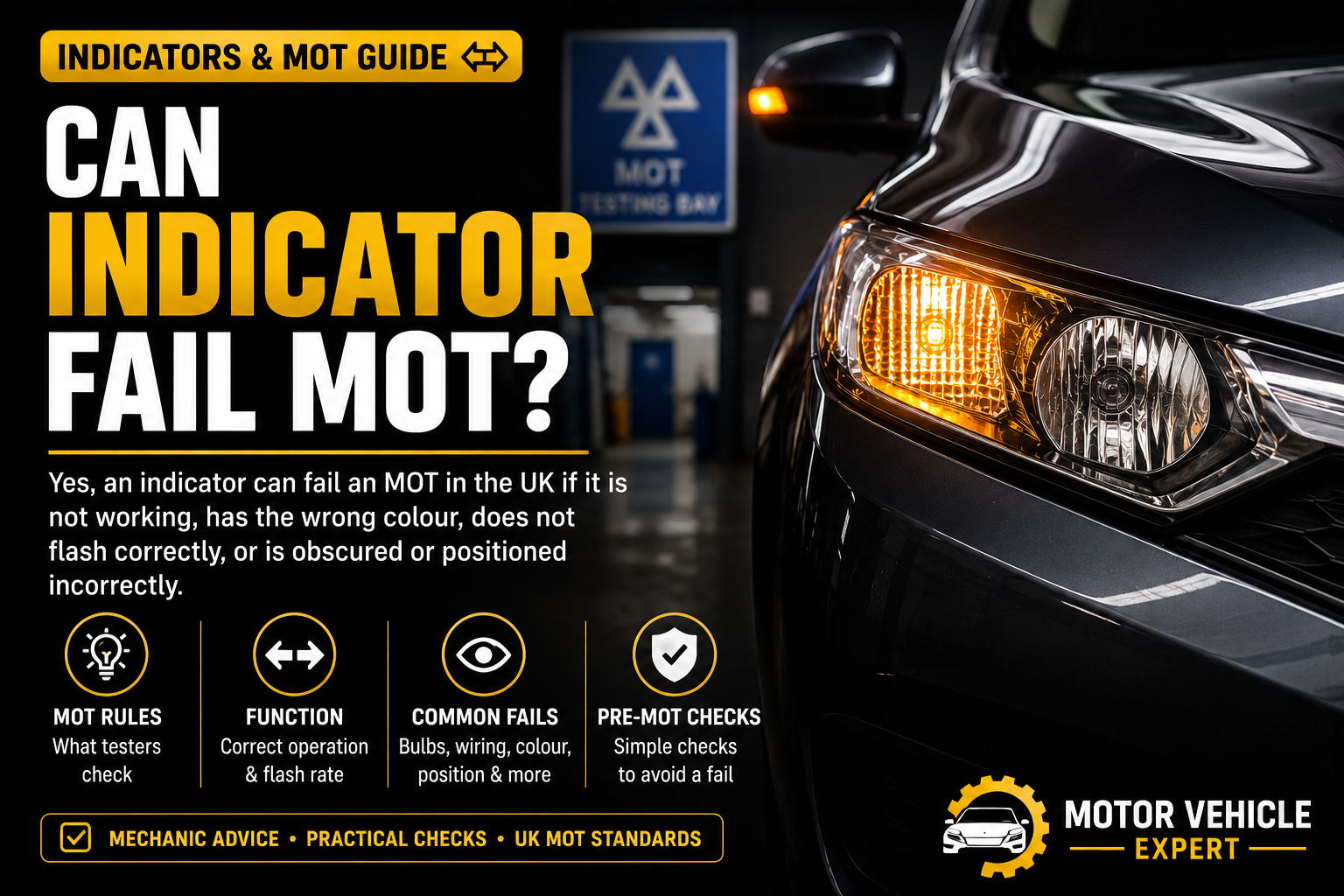
If an indicator does not flash, flashes incorrectly, shows the wrong colour, has a damaged lens or is insecure, it can cause MOT failure.
Hazard warning lights are also important and may be checked depending on vehicle requirements.
When indicators can fail MOT
Bulb not working
One or more indicators fail to illuminate.
Rapid flashing
Often signals a failed bulb or circuit fault.
No flashing
Lamp may stay on or not operate at all.
Wrong colour
Indicators should display the correct signal colour.
Damaged lens
Broken lenses may reduce visibility or expose bulbs.
Loose lamp unit
Indicator units should be secure.
Common causes of indicator faults
Failed bulbs are common, especially on older cars. Other causes include faulty relays, switches, damaged wiring, poor earths or moisture inside lamp units.
Modern vehicles with LED lights may need replacement lamp units or electronic diagnosis.
What to check before the MOT
1. Test left and right
Check front, rear and side repeaters if fitted.
2. Check flash speed
Rapid or uneven flashing often means a fault.
3. Test hazard lights
Confirm all corners flash together.
4. Inspect lenses
Look for cracks, fading or water ingress.
5. Replace failed bulbs
Often quick and inexpensive.
6. Fix dashboard warnings
Some cars warn of failed indicator lamps.
Usually easy to repair
Many indicator faults are simple fixes such as replacing bulbs or cleaning connections.
Do not ignore them, as signalling faults increase accident risk and may attract police attention on the road.
Related MOT lighting guides
Frequently asked questions
Will one indicator out fail MOT?
It can, depending on which lamp and vehicle setup.
What causes fast flashing?
Usually a failed bulb or circuit issue.
Do side repeaters matter?
Yes, where fitted and required they should work properly.
Can cracked lenses fail?
Yes, if severe or affecting visibility.
Should I test hazards too?
Yes, it is a sensible pre-MOT check.
Are LED indicators tested?
Yes, they must function correctly too.