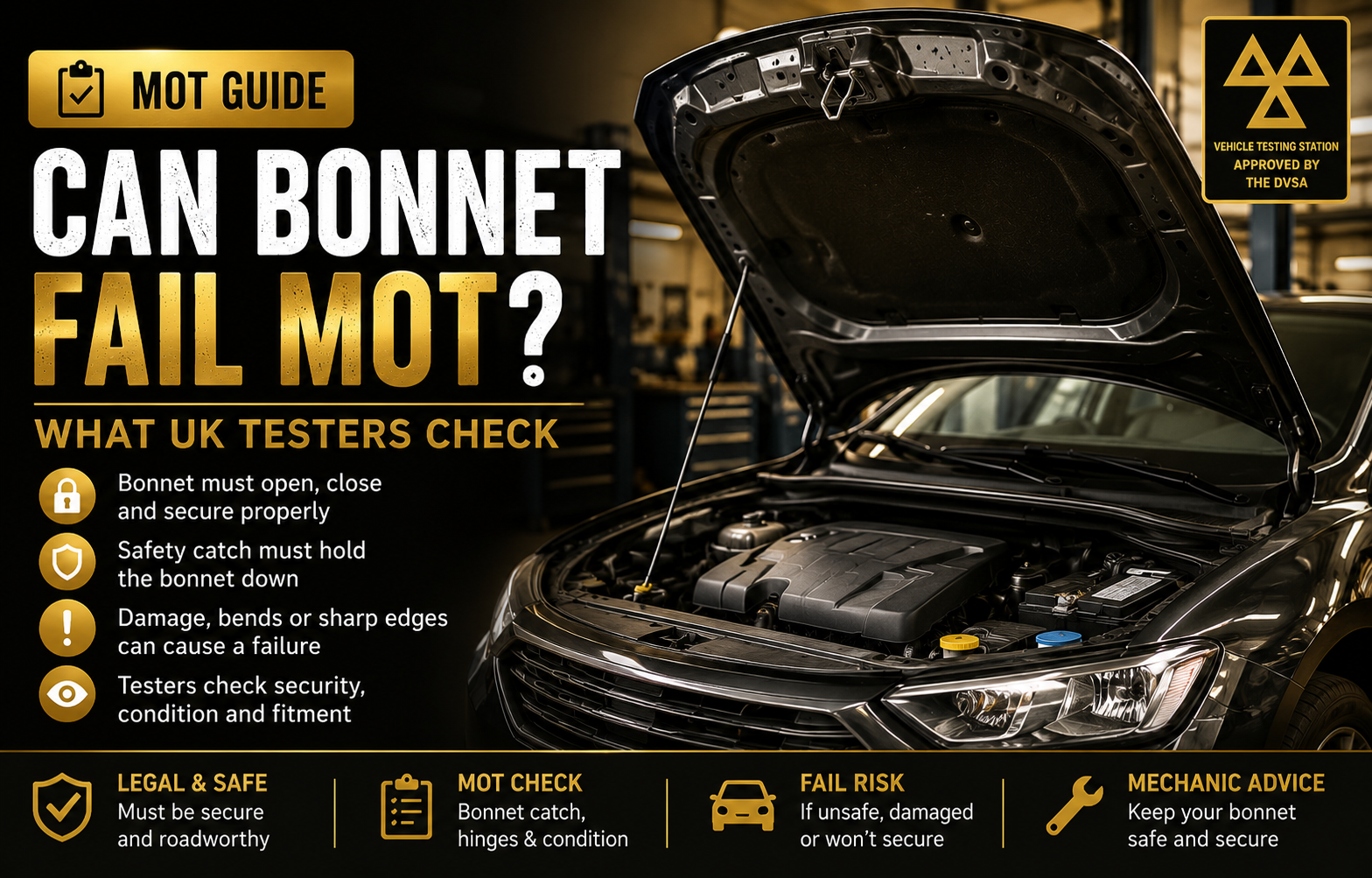
Quick answer
The bonnet must be secure and safe. If it cannot close properly or may open unexpectedly, it can lead to an MOT failure.
Even minor latch problems are worth fixing before test day.
When a bonnet can fail MOT
Faulty latch
If the bonnet does not lock securely.
Secondary catch broken
Extra safety catches are important.
Bonnet lifts while driving
Movement suggests insecure fastening.
Sharp edges
Bent or damaged metal may be dangerous.
Severe corrosion
Rust around hinges or latch mounts can weaken parts.
Poor alignment
If badly fitted, it may not close correctly.
Common bonnet problems before MOT
Typical faults include sticking release cables, worn catches, bent bonnet panels after minor impacts, rust around hinges and missing rubber stops causing vibration.
Many bonnet issues are simple adjustments rather than major repairs.
What to check before your MOT
1. Open and close bonnet
Make sure it releases and shuts properly.
2. Test secure latch
Gently lift after closing to confirm it catches.
3. Check safety catch
Secondary catches should function correctly.
4. Inspect hinges
Look for rust, cracks or looseness.
5. Check edges
Repair dangerous sharp damage if present.
6. Lubricate catches
Sticky catches often improve with cleaning and lubrication.
Often easy to fix first
Bonnet faults are commonly inexpensive to sort before an MOT. Catch adjustment, cable lubrication or replacing worn latch parts may solve the issue quickly.
Leaving it unresolved risks failure and a retest.
Related MOT guides
Frequently asked questions
Can bonnet latch fail MOT?
Yes, insecure latches can fail.
Does rusted bonnet matter?
If safety or security is affected, yes.
Can a dented bonnet fail?
Only if it causes danger or poor closing.
What about broken release cable?
It can create access and safety issues.
Can I adjust bonnet catch?
Often yes, depending on the vehicle.
Best next step?
Check latch security before the test.