
Quick answer
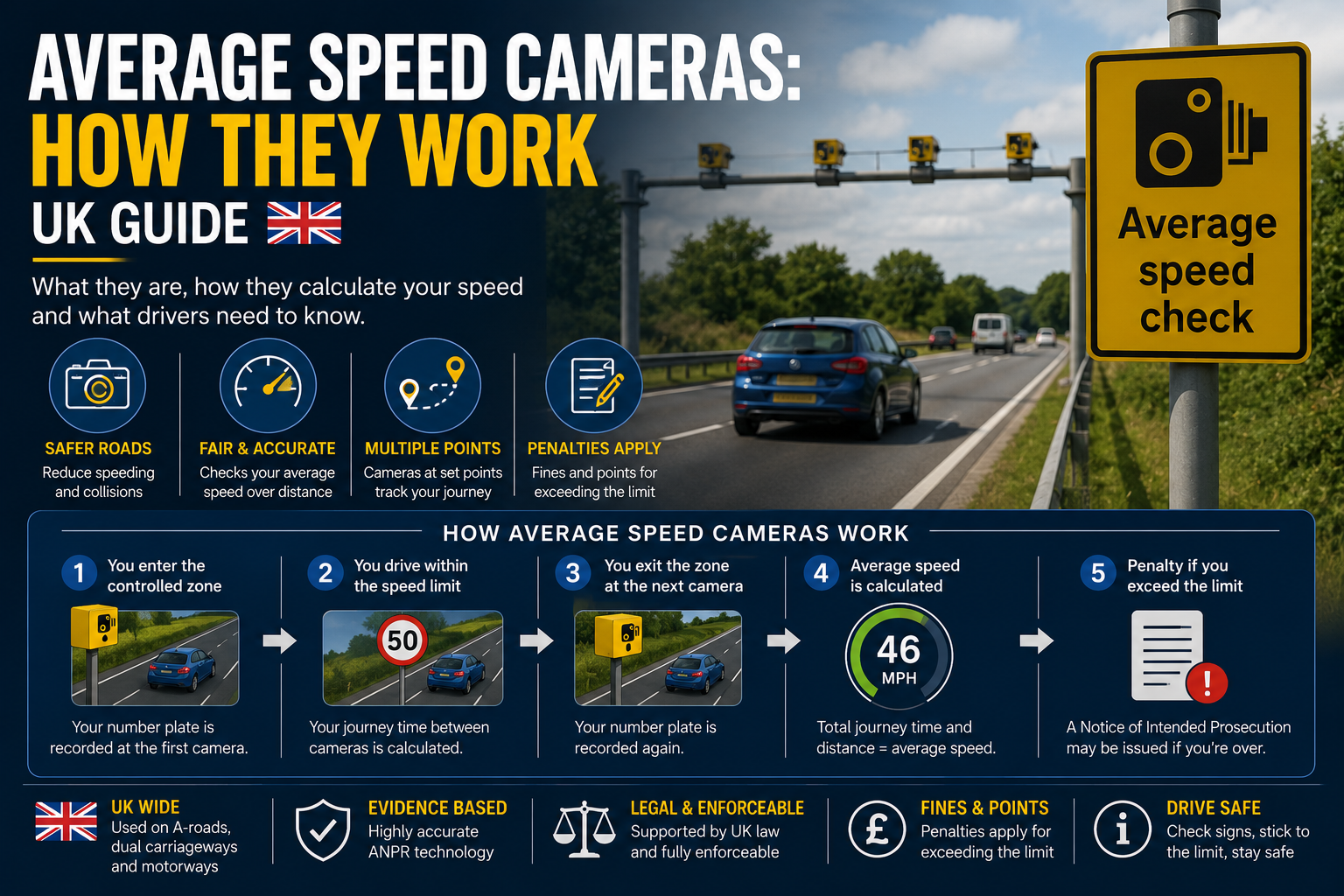
Average speed cameras record a vehicle at two or more points, compare the time taken to travel between those points and calculate the average speed over that measured section.
If your calculated average is above the posted limit, enforcement may follow. That is why drivers should keep within the limit for the whole zone, not just slow down when passing the visible cameras.
A fixed speed camera checks speed at one point. Average speed cameras check your speed across a section of road.
Why average speed cameras catch drivers out
Many drivers misunderstand average speed zones because they treat them like normal fixed cameras. They slow down near the camera, then speed up again between cameras, thinking they have avoided the risk.
That is the wrong habit. The system is interested in how long it takes your vehicle to travel between camera points. If you cover the distance too quickly, your average speed may still be too high.
The best way through an average speed zone is simple: settle into the posted limit early, keep a steady pace, leave space and avoid last-second braking.
How average speed cameras calculate speed
Average speed systems use time and distance. They do not need to catch one sudden burst of speed at a single camera point.
1. First camera records your vehicle
The system captures your number plate and the time you pass the first camera point.
2. Another camera records it again
Your vehicle is identified again further along the monitored route.
3. Average speed is calculated
The system compares your travel time over a known distance and works out your average speed.
Where average speed cameras are commonly used
Average speed cameras are often used where smooth, steady speeds matter more than catching one moment of speeding.
Motorway roadworks
Temporary speed limits in roadworks are one of the most common places drivers see average speed zones.
Smart motorways
Controlled motorway sections may use cameras and variable speed limits to manage traffic flow.
Smart motorway guide →Dual carriageways and A-roads
Longer routes may use average speed systems to reduce repeated speeding.
Tunnels and bridges
Controlled corridors may use cameras to keep speeds steady and reduce risk.
Urban routes
Some town and city routes use average speed checks where speeding is a known safety concern.
Temporary works zones
Speed limits can change during roadworks, so always follow the signs on the road.
Common average speed camera myths
“Changing lanes avoids them”
No. Do not treat lane changing as a way to avoid enforcement. Stay within the posted limit and drive normally.
“They only work in daylight”
No. Many systems are designed to operate during the day and at night.
“They always flash”
No. You may not see a visible flash even if the system records vehicles.
“Slowing at the camera is enough”
No. Your average speed across the measured section is what matters.
“Sat nav speed is enough”
Sat navs can help, but the legal speed limit signs on the road should be followed first.
“Roadworks limits are optional at night”
No. If the temporary limit is displayed, treat it as the active limit unless signs show otherwise.
Fines, points and speed awareness courses
Average speed cameras can enforce speed limits like other camera systems. If your average speed is recorded above the limit, you may receive a notice and could face a fixed penalty, penalty points, a speed awareness course offer or further action depending on the circumstances.
The important point is that the posted speed limit applies across the zone. In roadworks or smart motorway sections, the temporary limit shown on the road is the limit drivers need to follow.
How to drive through average speed camera zones
The safest and simplest approach is steady, legal driving through the full monitored section.
- 1Check the posted speed limit as you enter the zone.
- 2Keep a steady speed instead of braking late.
- 3Leave a safe gap from the vehicle ahead.
- 4Watch for temporary limits in roadworks.
- 5Do not rely only on sat nav alerts.
- 6Remember that vans and larger vehicles may have different limits on some roads.
For speed limit rules by vehicle and road type, read UK speed limits explained and van speed limits UK.
Why average speed cameras are different from fixed cameras
A fixed speed camera usually measures speed at or near one point. An average speed system measures your speed across a longer section, so speeding briefly and then slowing later can still leave your average too high.
They are often used where smoother, steadier speeds are more useful than catching a single moment of speeding.
Fixed camera habit
Some drivers brake when they see the camera and then accelerate away.
Average camera reality
The system looks at travel time between camera points, so the full section matters.
Common driver mistakes in average speed zones
- !Entering the zone too quickly before settling down.
- !Braking only when a camera appears.
- !Following the car in front instead of checking the speed limit.
- !Missing temporary limits in roadworks.
- !Assuming no flash means no recording.
- !Forgetting that some vans have lower limits than cars on some roads.
Helpful UK speed limit and driving guides
Frequently asked questions
Do average speed cameras flash?
Not always. Many systems do not rely on a visible flash.
Can average speed cameras work at night?
Yes. Many systems are designed to operate day and night.
Are average speed cameras only in roadworks?
No. They can also be used on permanent routes, tunnels, bridges and controlled corridors.
Can changing lanes avoid them?
No. Changing lanes should not be treated as a way to avoid enforcement.
Do they measure every vehicle?
They can monitor vehicles travelling through the camera zone and calculate average speed between camera points.
What is the safest approach?
Stay within the posted limit for the whole monitored section and avoid late braking.